Tetra Pak U.S. and Canada today released its FY25 Sustainability Report Supplement, highlighting how the company is advancing more resilient food systems across the region through innovations in food production and technology, expanded recycling infrastructure, operational emissions reductions and community involvement.
The local supplement accompanies Tetra Pak’s 27th Sustainability Report, released globally on June 5, which reported a 34% reduction in greenhouse gas (GHG) emissions across the company’s value chain since 2019 and a 56% reduction across its own operations, while reaching 97% renewable energy consumption globally. The U.S. and Canada supplement provides a closer look at the local initiatives and achievements supporting those broader sustainability ambitions.
“Sustainability isn’t a separate initiative for us, it’s how we do business,” said Seth Teply, president and CEO, Tetra Pak U.S. and Canada. “Whether we’re helping customers operate more efficiently, expanding access to carton recycling or giving back to our local communities, we’re focused on delivering practical solutions that strengthen the security of food systems while reducing impact to the planet.”
Highlights from the FY25 U.S. and Canada Sustainability Report Supplement include:
Food systems
Commercializing the Tetra Pak® A3/Speed filling line for the Tetra Prisma® Aseptic 250 Edge with DreamCap™ 26 following a successful U.S. field test, producing 25,000 packages per hour—the equivalent output of nearly three Tetra Pak® A3/CompactFlex lines with a 50% smaller footprint and lower operating costs.
Supporting food access through employee volunteer efforts, including packing 18,000 pounds of potatoes, 23 pallets of fresh vegetables and more than 13,000 meals for food banks across North America.
Circularity
Supporting the expansion of carton recycling access to nearly 2.5 million additional U.S. households in 2025, bringing nationwide access to 63%.
Supporting ReCB LLC to begin operations in Iowa, where 6,000 tons of used cartons are being processed annually into roof coverboards.
Climate
Reducing operational emissions: Improvements at Tetra Pak’s Vernon Hills, Illinois, distribution center are expected to avoid approximately 50 metric tons of CO₂ emissions annually.
Tetra Pak U.S. and Canada continues to operate on 100% renewable electricity.
Nature
Supporting environmental stewardship through employee cleanup and restoration projects across the U.S. and Canada.
Building sustainability awareness for employees through Sustainability Week, featuring expert discussions on resilient food systems, responsible sourcing and carton recycling.
Social sustainability
Taking an active role in the community by sponsoring and volunteering at local events.
Continued growth in workplace equity and recognition. The company was named to U.S. News & World Report’s Best Companies to Work For list, including its Manufacturing and Agriculture category, placing it among the top 25% of more than 1,000 companies reviewed.
The FY25 Sustainability Report Supplement also highlights Tetra Pak U.S. and Canada’s continued collaboration with customers, municipalities, recyclers, nonprofit organizations and industry partners to help build more resilient, efficient and sustainable food systems across North America.
About Tetra Pak We’re here to make food safe and available. It’s why we provide advanced food production systems. In collaboration with our customers and suppliers, driven by more than 24,000 dedicated employees worldwide, we protect food sustainably every day for hundreds of millions of people in more than 160 countries. Because we’re here to fulfill a purpose: We commit to making food safe and available, everywhere, and we promise to protect what’s good: food, people and the planet.
More information about Tetra Pak is available at tetrapakusa.com.
Media contact Stephanie Ward Communications Manager, Tetra Pak U.S. and Canada 940-380-4635
CLEVELAND, September 1, 2026 /3BL/ – Ohio State Buckeyes Wide Receiver Jeremiah Smith and KeyBank are kicking off football season with two exciting initiatives designed to engage and inspire Ohio families: the debut of “The Financial Playbook with Jeremiah Smith”, a financial literacy coloring book for children, and a statewide fan sweepstakes that gives football fans the chance to win one of 15 autographed Jeremiah Smith jerseys.
The “Financial Playbook with Jeremiah Smith” is a 14-page coloring book designed to help parents and caregivers introduce financial concepts in an engaging, age-appropriate way. Through football-themed pages, the book teaches young children about saving, account management, healthy credit habits and giving back to their communities. The Financial Playbook will be available at all KeyBank branches located in Ohio during business hours, while supplies last.
The coloring book focuses on four key concepts:
Saving for the future and preparing for unexpected expenses.
Understanding accounts and monitoring your finances.
Building healthy credit habits and long-term financial confidence.
Supporting and giving back to your community.
“The Financial Playbook is a fun way for parents and kids to start talking about money together,” said Smith. “My partnership with KeyBank is all about helping Ohio’s youth learn smart financial habits, and this project was a great opportunity to make those lessons engaging and approachable. I hope families enjoy it and learn something along the way.”
The partnership between KeyBank and Smith reflects a shared commitment to investing in Ohio communities and empowering the next generation. As one of college football’s most exciting young athletes, Smith embodies the values of preparation, hard work and excellence that resonate with KeyBank’s mission of helping clients achieve their goals. Through initiatives like the Financial Playbook with Jeremiah Smith and fan experiences such as this sweepstakes, KeyBank and Smith are creating meaningful connections with Ohioans both on and off the field.
In addition to the launch of the coloring book, fans are invited to visit any KeyBank branch located in Ohio during business hours throughout September, take a photo with a life-size Jeremiah Smith cardboard cutout and upload their photo to the official KeyBank Fan Wall for a chance to win. The sweepstakes runs from September 1 through September 30.
KeyBank branches throughout the state will feature special in-branch displays encouraging fans to participate. The promotion is part of KeyBank’s ongoing partnership with Smith and is designed to bring communities together, celebrate the excitement of college football season and create memorable fan experiences across Ohio.
“At KeyBank, we believe financial confidence begins with education,” said Patty Jurca, KeyBank Chief Brand Officer. “‘The Financial Playbook with Jeremiah Smith’ is a creative way to help families start conversations about money, while our fan sweepstakes allows us to connect with communities across Ohio through one of the most exciting athletes in college football today.”
Winners will be selected and contacted by a KeyBank representative following the close of the sweepstakes entry period.
ABOUT KEYCORP
KeyCorp’s roots trace back more than 200 years to Albany, New York. Headquartered in Cleveland, Ohio, Key is one of the nation’s largest bank-based financial services companies, with assets of approximately $191 billion at June 30, 2026.
Key provides deposit, lending, cash management, and investment services to individuals and businesses in 15 states under the name KeyBank National Association through a network of approximately 950 branches and approximately 1,100 ATMs. Key also provides a broad range of sophisticated corporate and investment banking products, such as merger and acquisition advice, public and private debt and equity, syndications and derivatives to middle market companies in selected industries throughout the United States under the KeyBanc Capital Markets trade name. For more information, visit https://www.key.com/. KeyBank Member FDIC.
No purchase or transaction necessary to enter or win. A purchase or transaction will not improve your chance of winning. For official rules, visit any Ohio KeyBank branch or email grace.sullivan@keybank.com. Restrictions apply.
WESTCHESTER, N.Y., September 1, 2026 /3BL/ – SavATreetoday announced a national partnership with the Arbor Day Foundation to accelerate reforestation in regions recovering from hurricanes, wildfires, and other disasters. Through SavATree’s new For Every Tree initiative, every tree removal performed by the company will directly support the planting of a new tree in high‑priority restoration areas across Florida and Michigan.
This commitment is rooted in SavATree’s brand promise to help another tree grow for every tree removed.
“We’ve been saving our customers trees, shrubs, and lawns for over 45 years; preservation is core to our mission at SavATree,” said Ryan Berk, Chief Executive Officer of SavATree. “However, when a tree must come down, we believe it should spark new growth somewhere else. Healthy forests are the foundation of resilient ecosystems, and restoring habitats after major storms is essential to protecting wildlife and strengthening communities. Our For Every Tree initiative ensures when a customer does need a removal, we’re helping another tree grow in the forests that people and wildlife depend on.”
“Trees and forests are the backbone of our ecosystems. As we grapple with a changing climate and the challenges it brings people and the planet, restoring forests and acting as caring leaders of our neighborhood canopies can make a significant difference in our future, which is why we are proud to partner with SavATree,” said Dan Morrow, Vice President of Partnerships at the Arbor Day Foundation. “SavATree’s commitment to responsible stewardship and their For Every Tree initiative reflects the kind of long‑term dedication that’s needed to create meaningful impact in the forests that need it most. Together, we’re helping restore critical habitat and strengthening the natural landscapes communities rely on.”
Rebuilding Forests in Florida and Michigan
The partnership will initially support two major Arbor Day Foundation projects; each identified as a forest area of greatest need by the Arbor Day Foundation:
Florida — Hurricane Michael Reforestation Project
Hurricane Michael devastated more than 2.8 million acres of forestland when it struck the Florida panhandle in 2018. SavATree’s support will help reestablish lost tree canopy to restore watershed and ecological functions, as well as vital habitat for a variety of threatened and endemic wildlife in the region.
Michigan — State Forests Reforestation Project
In partnership with the Michigan Department of Natural Resources, SavATree will help replant 15,000 trees across state forests. The project focuses on restoring native jack pine and red pine stands, critical habitat for species such as deer, turkey, grouse, and the threatened Kirtland’s warbler.
Why This Matters Now
Recent data shows that climate‑driven disturbances are reshaping America’s forests at an unprecedented pace. The U.S. lost more than 3.4 million acres of natural forest in a single recent year, and weather events including hurricanes and wildfires are now rising faster than human‑directed land changes, a dramatic shift documented by NASA and Global Forest Watch.
SavATree’s arborists have seen the impact firsthand. Many worked on post‑storm cleanup after Hurricane Michael, removing dangerous trees and clearing debris.
SavATree is a leading provider of professional tree, shrub, and lawn care services, with a commitment to science‑based stewardship and sustainable landscape management. With ISA Certified Arborists® across the country, SavATree delivers expert care that prioritizes preservation, safety, and environmental responsibility.
About the Arbor Day Foundation
The Arbor Day Foundation is a global nonprofit inspiring people to plant, nurture, and celebrate trees. They foster a growing community of more than 1 million leaders, innovators, planters, and supporters united by their bold belief that a more hopeful future can be shaped through the power of trees. For more than 50 years, they’ve answered critical need with action, planting more than half a billion trees alongside their partners. And this is only the beginning.
The Arbor Day Foundation is a 501(c)(3) nonprofit pursuing a future where all life flourishes through the power of trees. Learn more at arborday.org.
The United States lost more than 270,000 journalism jobs over the past two decades as almost 3,500 newspapers shut down. Even as independent news outlets are forced to close, a well-capitalized network of partisan platforms that some have likened to propaganda machines is growing quietly in the background.
Media critics have long focused attention on Fox as a mainstream news outlet singularly dedicated to coloring the news with a formulaic ratings strategy that promotes and amplifies conservative talking points on issues like climate change and transgender rights. Even casual Fox News viewers can determine pretty quickly the network has a partisan bent, but that’s not always the case.
In one concerning example, investigative journalist Judd Legum recently identified a new network of Republican-affiliated news websites aimed at influencing voters in key swing states under the guise of reliable media outlets.
“One Nation, the Senate GOP’s primary dark money group, is producing propaganda masquerading as journalism,” Legum reported in his Popular Information newsletter earlier this month. So far, he found half a dozen such operations, covering key races in Alaska, Georgia, Iowa, Maine, New Hampshire and Ohio in the runup to the November midterm elections.
These outlets are branded as neutral and credible local news platforms like Maine Policy Updates, which publishes under the tagline “Maine’s News Source,” and Iowa Voice (“Stay Informed. Stay Iowa”), making it almost impossible for readers to tell the sites are entirely owned and operated by One Nation. Legum also identified factual inaccuracies reported in the outlets that match messaging used in One Nation political ads.
The loss of credible news outlets alongside the rising prevalence of fake news is not the only concern. The decline of trustworthy information resources in the United States takes many forms — from social media platforms, where over half of Americans are exposed to misinformation on a daily basis, to the Donald Trump administration’s systematic elimination of evidence-based federal programs and resources.
In the face of these challenges, a group of often unsung heroes are still fulfilling the role of professionally trained, reliable information and community outreach specialists, even as budget cuts threaten their mission. Yes, we’re talking about your local librarians, who perhaps are more important now than ever before.
Beyond shelves of books, public libraries provide learning, workforce development and public health programming to more than 90 million people every year. At the Howard County Library System in Maryland, Little Learners classes feature stories and activities for preschoolers.<em> (Image: </em><a href=”https://flickr.com/photos/hocolibrary/55433242118/in/photolist” target=”_blank” rel=”noopener”><em><u>Howard County Library System</u></em></a><em>/Flickr)</em>
Libraries remain a trusted resource, but staffing and budget shortfalls pose problems
Trump took office last year with a reputation for criticizing public libraries, among other independent social and cultural institutions. But the latest numbers from the Institute of Museum and Library Services (IMLS), an independent federal agency Trump unsuccessfully tried to eliminate, tell a story of an essential community resource.
“This year’s data make clear that public libraries remain one of the most trusted and utilized institutions in American life. With over 800 million visits, millions of programs offered, and a steady rise in both physical and digital circulation, libraries are demonstrating their enduring relevance and reach in communities nationwide,” according to the most recent IMLS report tracking over 9,000 U.S. public library systems. “A total of 93 million people attended 4.6 million programs, addressing critical needs in early learning, digital and financial literacy, workforce development, and public health.”
The use of digital library services is also on the rise. Earlier this year, the Ohio-based e-lending firm OverDrive noted that digital lending broke records last year among the 114 countries where it provides services, with U.S. library systems listed in nine of the top 10 library systems providing e-books, audiobooks and digital magazines.
Yet the gap between library budgets and the rising demand for library services is widening. While library room reservations and e-resources increased alongside in-person visits from 2021 to 2024, staffing and budgets have not kept up, the advocacy organization Every Library warns. In 2024, staffing levels remained 8.2 percent below pre-pandemic levels and a 5 percent budget increase failed to match the pace of inflation.
“Smaller libraries have been hit especially hard. Their staffing levels were down 11.5 percent, more than three times the average,” Every Library emphasized. “They also saw a decrease in e-resource usage, contradicting the trend seen in larger systems.”
Local children enjoy activities at the opening of Spark Lab, a science, technology, engineering, arts and math (STEAM) learning space at Princeton Public Library in New Jersey earlier this year.<em> (Image: </em><a href=”https://flickr.com/photos/princetonpubliclibrary/55091065000/in/photolist” target=”_blank” rel=”noopener”><em><u>Princeton Public Library</u></em></a><em>/Flickr)</em>
Changes to federal broadband program could threaten digital access and restrict access to content at public libraries
Libraries are also beacons of digital literacy for people with limited access to the internet, undercutting educational and employment opportunities among other life goals. Around 66 million U.S. households have “low levels of digital readiness,” and 33 million do not use the internet at home, according to the American Library Association. People of color, rural residents, low-income families and people with disabilities are most impacted by digital opportunity gaps, according to the ALA.
“America’s libraries — 120,000 strong — are essential to addressing these gaps and realizing the vision of universal broadband adoption and ability to use,” the organization argues. Even so, smaller libraries are more likely to cut e-services when budgets fall short.
Despite these concerns, in June the Federal Communications Commission signaled that it will propose new rules impacting its E-Rate program, which provides schools and public libraries with low-cost broadband access.
The FCC followed up on August 14, filing a document in the Federal Register in which it opened several proposed rules for public comment. Although the FCC previously stated that no facilities would be cut from the E-Rate program, advocacy groups continue to raise alarms over the potential for paring down the program, if not eliminating it entirely.
Equally concerning is the FCC’s apparent willingness to impose new content restrictions on E-Rate users that target minorities, particularly transgender individuals. Specifically, the agency’s proposal references CIPA, the Children’s Internet Protection Act of 2000, which is intended to prevent minors from accessing pornography online. However, words like pornography are subject to interpretation, and Trump swept into office under a social agenda targeting “transgender ideology” as pornographic.
Although the text of the FCC filing emphasizes general concerns over “children’s screen time,” the initial reference to CIPA is of a piece with the Trump administration’s persistent efforts to demonize transgender persons, providing powerful momentum for ongoing attempts to prevent LGBTQ materials from circulating in public libraries.
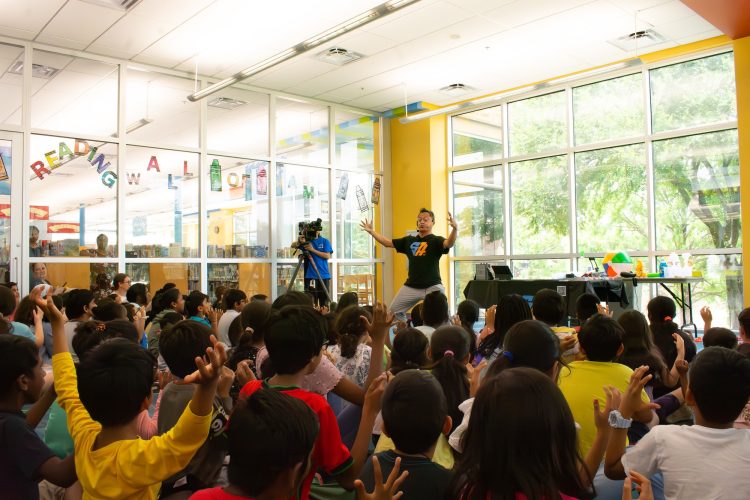
Kids pack the house for a “Science Ninja” event at the Irving Public Library in Texas. <em>(Image: </em><a href=”https://flickr.com/photos/irvinglibrary/54593531246/in/photolist” target=”_blank” rel=”noopener”><em><u>Irving Public Library</u></em></a><em>/Flickr)</em>
Library advocates fight back
This summer, the American Library Association partnered with the Schools, Health & Libraries Broadband Coalition to launch a national campaign calling on the public to lobby their representatives in Congress to preserve E-Rate. “E-Rate is a congressionally-mandated program, and we need Congress to help us defend E-Rate now,” the partners emphasize.
The campaign also includes an online tool to help people submit comments to the FCC before the October 13 deadline.
While the result remains to be seen, raising awareness about the potential impact on library services is a solid first step. For communities already impacted by cuts to food assistance benefits and new Medicaid work requirements, losing free services at a local public library is yet another cut that runs deep.