
TULSA, Okla.–(BUSINESS WIRE)–NGL Energy Partners LP Announces Quarterly Cash Distribution for the Class B, Class C, and Class D Preferred Units
Month: September 2026
LEI: 213800ZBKL9BHSL2K459
17 September 2026
OSB GROUP PLC
(the Company)
Redemption of the remaining £17,072,000 outstanding of the £150,000,000 6.000% Fixed Rate Resetting Perpetual Subordinated Contingent Convertible Securities issued in October 2021 (ISIN: XS2391408072)
(the “Securities“)
OSB GROUP PLC (the “Issuer“) has today given notice to the Securityholders that it has elected to redeem all outstanding Securities, being an aggregate principal amount of £17,072,000, pursuant to Condition 8(b)(i) of the terms and conditions of the Securities (the “Conditions“).
Having obtained the necessary regulatory approvals, notice of redemption has been given to Securityholders, the Trustee and the Agents in accordance with the terms and conditions of the Securities.
All outstanding Securities will be redeemed on 7 October 2026 (the “Redemption Date“) at their principal amount together with accrued but unpaid interest to (but excluding) the Redemption Date.
Following redemption, the Securities will be cancelled pursuant to the Conditions. Accordingly, the listing of the Securities on the London Stock Exchange’s International Securities Market will be cancelled on, or shortly after, 8 October 2026.
Enquiries:
| Jess Petrie | |
| Head of Corporate Governance Email: company.secretariat@osb.co.uk |
|
| Investor relations | |
| Alexander Holcroft Group Director of Investor Relations Email: osbrelations@osb.co.uk |
|
| Brunswick | |
| Robin Wrench / Simone Selzer | t: 020 7404 5959 |
Notes to Editors
About OSB GROUP PLC
OSB began trading as a bank on 1 February 2011 and was admitted to the main market of the London Stock Exchange in June 2014 (OSB.L). OSB joined the FTSE 250 index in June 2015. On 4 October 2019, OSB acquired Charter Court Financial Services Group plc and its subsidiary businesses. On 30 November 2020, OSB GROUP PLC became the listed entity and holding company for the OSB Group. The Group provides specialist lending and retail savings and is authorised by the Prudential Regulation Authority, part of the Bank of England, and regulated by the Financial Conduct Authority and Prudential Regulation Authority. The Group reports under two segments, OneSavings Bank and Charter Court Financial Services.

LONDON–(BUSINESS WIRE)– Funds Date TIDM ISIN Code Shares in Issue Currency Net Asset Value NAV/per Share First Trust IPOX Europe Equity Opportunities UCITS ETF 16.09.2026 IPXE.IM IE00BFD26097 50,002.00 EUR 1,214,127.60 24.282
LONDON–(BUSINESS WIRE)– Funds Date TIDM ISIN Code Shares in Issue Currency Net Asset Value NAV/per Share First Trust Cloud Computing UCITS ETF 16.09.2026 CPQ IE00BFD2H405 6,200,002.00 USD 421,518,474.34 67.987
ロンドン–(BUSINESS WIRE)–(ビジネスワイヤ) — オムディア(Omdia)の最新調査によると、米国のPC(タブレットを除く)の出荷台数は、2026年第1四半期に前年比7.0%減の1,580万台となり、前年比の減少率としては2023年第3四半期以来最大となった。。この落ち込みは、部品供給の制約に加え、PC用メモリおよびストレージ価格の急騰によるコスト圧力、さらに当面の法人向け需要の多くをすでに消化していたWindows 11へのリフレッシュサイクル後の需要の反動減が重なったことを反映している。この前年比比較には、関税関連の在庫確保の前倒しによって出荷台数が押し上げられた好調な2025年第1四半期に加え、予想されるメモリ価格の上昇を前に、2026年第1四半期に小幅なチャンネル在庫の積み増しが行われたことも影響した。 米国のPC出荷台数、部品供給制約の影響 DRAMとNANDの供給がAIサーバー用途に一段と振り向けられる中、部品コストの上昇がエントリーレベルのデバイスでベンダーマージンを圧迫し、低価格PCの提供が困難になった。同四半期の500ドル未満のPC出荷台数は、
LONDON–(BUSINESS WIRE)– Funds Date TIDM ISIN Code Shares in Issue Currency Net Asset Value NAV/per Share First Trust Dow Jones Internet UCITS ETF 16.09.2026 FDNU IE00BG0SSC32 1,275,002.00 USD 50,787,118.03 39.833
LONDON–(BUSINESS WIRE)– Funds Date TIDM ISIN Code Shares in Issue Currency Net Asset Value NAV/per Share First Trust NYSE Arca Biotechnology UCITS ETF 16.09.2026 FBTU.LN IE00BL0L0H60 500,002.00 USD 16,217,178.63 32.434
LONDON–(BUSINESS WIRE)– Funds Date TIDM ISIN Code Shares in Issue Currency Net Asset Value NAV/per Share First Trust Nasdaq Cybersecurity UCITS ETF 16.09.2026 NQCYBREN IE00BF16M727 27,783,554.00 USD 1,732,615,065.00 62.361
RC Drilling Intersects one of Widest and Highest Grade-Thickness Intercepts to Date at the Boin Gold Deposit
VANCOUVER, British Columbia, Sept. 17, 2026 (GLOBE NEWSWIRE) — Newcore Gold Ltd. (“Newcore” or the “Company”) (TSX-V: NCAU, OTCQX: NCAUF) is pleased to announce additional drill results from the 80,000-metre drill program underway at the Company’s Enchi Gold Project (“Enchi” or the “Project”) in Ghana. Reverse Circulation (“RC”) Drilling at the Boin Gold Deposit (“Boin”) encountered a wide zone of higher-grade gold mineralization within the lower oxidized and upper fresh mineralization. Hole KBRC411 intersected 2.59 grams per tonne gold (“g/t Au”) over 69.0 metres (“m”) from 58 m, including 6.41 g/t Au over 24.0 m from 59 m. This intercept is one of the widest and highest grade-thickness zones encountered at Boin to date. Drilling continues to demonstrate the continuity of gold mineralization and potential for reserve and resource growth, as well as higher-grade mineralization, at Enchi. Results from drilling completed in 2026, including drilling targeting higher-grade mineralization at depth, are expected to be incorporated into future project economic studies and may support further mine plan optimization.
Highlights from RC Drilling at the Boin Gold Deposit at Enchi
- Drilling intersected high-grade gold mineralization above the mineral reserve grade.
- Hole KBRC411 intersected 2.59 g/t Au over 69.0 m from 58 m, including 6.41 g/t Au over 24.0 m from 59 m.
- This intercept is one of the widest and highest grade-thickness zones encountered to date at Boin.
- Drilling targeted shallow mineralization within the central portion of the deposit.
- Hole KBRC414 intersected 0.83 g/t Au over 32.0 m from 70 m, including a higher-grade interval of 3.37 g/t Au over 6.0 m from 84 m.
- Drilling supports future mine plan optimization, with drilling continuing to delineate Enchi’s higher-grade potential.
- Drill results not included in Mineral Resource Estimate and Pre-Feasibility Study, with drilling continuing to highlight Enchi’s longer-term prospectivity.
- Drilling reached a maximum vertical depth of 125 metres, with the average vertical depth of all holes drilled to date at Boin only down to 100 metres.
- All deposits at Enchi remain open for expansion along strike and to depth.
Luke Alexander, President and CEO of Newcore stated, “We are excited to continue to delineate Enchi’s higher-grade potential. This drilling includes one of our best intercepts encountered to date on the Project, as well as a wide zone of above reserve grade gold mineralization. This drilling continues to demonstrate the opportunity for future mine plan optimization and the potential to incorporate additional higher-grade mineralization into future studies. With the drill rigs turning at site, we look forward to continuing to unlock the value potential of our Enchi Gold Project in Ghana.”
This release reports results for 7 RC holes totalling 960 m (KBRC395, KBRC396, KBRC404, KBRC411 to KBRC414) targeting the Boin Gold Deposit, with all holes intersecting gold mineralization. A total of 47,100 m in 295 holes has been reported to date as part of the ongoing drill program at Enchi, with 99% of holes intersecting gold mineralization.
Select assay results from the 7 holes of the drill program reported in this release are below:
Table 1 – Enchi Gold Project Drill Highlights
| Hole ID | Zone/Deposit | From (m) | To (m) | Length (m) | Au (g/t) |
| KBRC411 | Boin | 58.0 | 127.0 | 69.0 | 2.59 |
| including | 59.0 | 83.0 | 24.0 | 6.41 | |
| KBRC414 | Boin | 70.0 | 102.0 | 32.0 | 0.83 |
| including | 84.0 | 90.0 | 6.0 | 3.37 | |
| KBRC404 | Boin | 70.0 | 92.0 | 22.0 | 0.68 |
| including | 72.0 | 79.0 | 7.0 | 1.64 |
Notes:
1. See detailed table for complete results;
2. Intervals reported are hole lengths with true width estimated to be 75 – 85%; and
3. Length-weighted averages from uncut assays.
A plan map showing the drill hole locations can be viewed at:
https://newcoregold.com/site/assets/files/6006/2026_09_17-ncau-nr-enchi-plan-map-boin.pdf
Cross sections showing drill results and highlights for holes KBRC411 and KBRC414 can be viewed at:
https://newcoregold.com/site/assets/files/6006/2026_09-ncau-crosssection-boin.pdf
A complete list of the drill results in this release, including hole details, can be viewed at:
https://newcoregold.com/site/assets/files/6006/2026_09_17-ncau-enchi-2024-2026-drill-results.pdf
RC Drilling at the Boin Gold Deposit
KBRC395, KBRC396, KBRC404 and KBRC411 to KBRC414 (7 RC holes totalling 960 m) were completed at Boin, targeting shallow mineralization within the central portion of the deposit. The goal of this drilling was reserve conversion for future mine plan optimization, with a focus on converting higher-grade portions of the deposit. Drilling was designed to improve geological confidence and confirm grade continuity, supporting future reserve and resource updates. This drilling focused on targeting oxidized and shallow fresh mineralization, and reached a maximum vertical depth of 125 metres. The holes reported in this news release were distributed across 5 separate sections spread along a 1.9 km strike length.
The drilling reported in this news release targeted the central portion of the Boin Gold Deposit. Hole KBRC411 intersected a wide, high-grade, gold mineralized zone with 2.59 g/t Au over 69.0 m from 58 m, including 6.41 g/t Au over 24.0 m from 59 m. This is one of the widest and highest grade-thickness intercepts encountered to date at Boin. This hole was drilled in an area of known mineralization with a goal of better defining the higher-grade targets at Enchi, highlighting the potential for future mine plan optimization. Hole KBRC414, collared 100 metres south of KBRC411, also encountered a wide zone of mineralization with 0.83 g/t Au over 32.0 m from 70 m, including a higher-grade interval of 3.37 g/t Au over 6.0 m from 84 m. Hole KBRC404, located 500 metres south of KBRC411, intersected 0.68 g/t Au over 22.0 m from 70 m, including 1.64 g/t Au over 7.0 m from 72 m.
RC drilling completed at Boin continues to intersect mineralization above the reserve and resource grade and continues to confirm continuity along strike and down dip, defining and extending the principal structures which comprise the Boin Gold Deposit.
Enchi Work Program
An 80,000 metre drill program is underway at Enchi. The drill program is focused on resource conversion, resource growth and discovery. RC drilling is targeting near-surface mineralization (oxide, transition, and shallow fresh mineralization) focused on resource conversion and continuing to define the potential for reserve and resource growth along strike at existing deposits. Diamond drilling is targeting the high-grade potential at depth. The completed first phase of the drill program was infill drilling for resource conversion, with only the first 28,000 metres of the drill program incorporated into an updated Mineral Resource Estimate announced on March 18, 2026 that formed the basis for a Pre-Feasibility Study (“PFS”). All deposit areas and pre-resource targets at Enchi remain open along strike and at depth, providing for future resource growth across the district-scale property.
Development work continues at Enchi, in support of project advancement, including metallurgical testwork, hydrogeological testing, geotechnical work, and environmental work. A Pre-Feasibility Study was completed in June 2026 (see news release dated June 24, 2026), outlining a base case assessment of developing an open pit, standard milling and carbon-in-leach operation using contract mining and processing 5.5 Mtpa. Recent drilling completed at Enchi has highlighted potential for resource growth, with high-grade encountered at depth and mineralization delineated below the pits that constrain the current Mineral Reserve and Mineral Resource Estimates. Drill results reported in 2026 have not been included in the Mineral Resource Estimate and PFS.
Boin Gold Deposit
Boin is one of the four deposits which comprise the Mineral Reserve Estimate and Mineral Resource Estimate at Enchi (Boin has a Probable Mineral Reserve of 15.9 million tonnes grading 0.84 g/t Au containing 429,000 ounces; an Indicated Mineral Resource of 23.5 million tonnes grading 0.73 g/t Au containing 550,000 ounces; and an Inferred Mineral Resource of 9.2 million tonnes grading 0.60 g/t Au containing 178,000 ounces). Boin is located 10 kilometres south of the town of Enchi, with nearby roads and power and further access provided by a series of drill roads. Boin is outlined on surface by a greater than six-kilometre-long by up to one-kilometre-wide gold in soil anomaly. An airborne geophysical anomaly coincident with the Boin structure extends for a further kilometre north and three kilometres south beyond the limits of current drilling. To date, approximately 40% of the gold-in-soil anomaly at Boin is untested by drilling, with the average vertical depth of all holes drilled to date at Boin only down to 100 metres.
Drill Hole Locations
Table 2 – Enchi Gold Project Drill Hole Location Details
| Hole ID | UTM East | UTM North | Elevation | Azimuth ° | Dip ° | Length (m) | |
| KBRC395 | 519761 | 634802 | 128 | 114 | -60 | 102 | |
| KBRC396 | 519818 | 634956 | 124 | 116 | -62 | 84 | |
| KBRC404 | 518835 | 633435 | 139 | 114 | -60 | 126 | |
| KBRC411 | 519064 | 633887 | 167 | 115 | -50 | 174 | |
| KBRC412 | 519011 | 633877 | 160 | 120 | -54 | 198 | |
| KBRC413 | 518998 | 633919 | 153 | 115 | -50 | 132 | |
| KBRC414 | 519059 | 633801 | 167 | 115 | -53 | 144 | |
Enchi Gold Project Mineral Reserve and Resource Estimates
The Enchi Gold Project hosts a Probable Mineral Reserve of 51.3 million tonnes grading 0.64 g/t Au containing 1,055,000 ounces gold; an Indicated Mineral Resource of 83.6 million tonnes grading 0.56 g/t Au containing 1,502,000 ounces gold; and an Inferred Mineral Resource of 40.1 million tonnes grading 0.49 g/t Au containing 626,000 ounces. The Indicated Mineral Resources are inclusive of the Mineral Reserves. Mineral resource and mineral reserve estimation practices are in accordance with CIM Estimation of Mineral Resource and Mineral Reserve Best Practice Guidelines (November 29, 2019) and follow CIM Definition Standards for Mineral Resources and Mineral Reserves (May 10, 2014), that are incorporated by reference into National Instrument 43-101 (“NI 43-101”). The Mineral Reserve and Mineral Resource Estimate is from the technical report titled “Enchi Gold Project, Pre-Feasibility Study, NI 43-101 Technical Report” dated August 7, 2026, with an effective date of June 23, 2026, in accordance with NI 43-101, and is available under the Company’s profile on SEDAR+ at www.sedarplus.ca. The Mineral Reserve Estimate was prepared for Newcore by Grant Carlson, P. Eng. of Fuse Advisors (part of SLR); the Mineral Resource Estimate was prepared for Newcore by Ryan Wilson, P. Geo, Matthew Halliday, P. Geo, Schadrac Ibrango, P. Geo of DRA Americas Inc. These individuals are independent qualified persons (“QP”) within the meaning of NI 43-101.
Newcore Gold Best Practice
Newcore is committed to best practice standards for all exploration, sampling and drilling activities. Drilling was completed by independent drilling firms using industry standard RC and Diamond Drill equipment. Analytical quality assurance and quality control procedures include the systematic insertion of blanks, standards and duplicates into the sample strings. Samples are placed in sealed bags and shipped directly to Intertek Labs located in Tarkwa, Ghana for 50 gram gold fire assay.
Qualified Person
Mr. Gregory Smith, P. Geo, Vice President of Exploration at Newcore, is a Qualified Person within the meaning of NI 43-101. Mr. Smith has reviewed and approved the scientific and technical information contained in this news release and has conducted appropriate verification on the underlying data including confirmation of the drillhole data files against the original drillhole logs and assay certificates.
About Newcore Gold Ltd.
Newcore Gold is advancing its Enchi Gold Project located in Ghana, Africa’s largest gold producer (1). Newcore Gold offers investors a unique combination of top-tier leadership, who are aligned with shareholders through their 12% equity ownership, and prime district scale exploration opportunities. Enchi’s 248 km2 land package covers 40 kilometres of Ghana’s prolific Bibiani Shear Zone, a gold belt which hosts several multi-million-ounce gold deposits, including the Chirano mine 50 kilometres to the north. Newcore’s vision is to build a responsive, creative and powerful gold enterprise that maximizes returns for shareholders.
(1) Source: Production volumes for 2025 as sourced from the World Gold Council.
On Behalf of the Board of Directors of Newcore Gold Ltd.
Luke Alexander
President, CEO & Director
For further information, please contact:
Mal Karwowska | Senior Vice President, Corporate Development and Investor Relations
+1 604 484 4399
info@newcoregold.com
www.newcoregold.com
Neither the TSX Venture Exchange nor its Regulation Services Provider (as that term is defined in the policies of the TSX Venture Exchange) accepts responsibility for the adequacy or accuracy of this release.
Cautionary Note Regarding Forward-Looking Statements
This news release includes statements that contain “forward-looking information” within the meaning of the applicable Canadian securities legislation (“forward-looking statements”). All statements, other than statements of historical fact, are forward-looking statements and are based on expectations, estimates and projections as at the date of this news release. Any statement that involves discussion with respect to predictions, expectations, beliefs, plans, projections, objectives, assumptions, future events or performance (often, but not always using phrases such as “plans”, “expects”, “is expected”, “budget”, “scheduled”, “estimates”, “forecasts”, “intends”, “anticipates”, or “believes” or variations (including negative variations) of such words and phrases, or state that certain actions, events or results “may”, “could”, “would”, “might” or “will” be taken, occur or be achieved) are not statements of historical fact and may be forward-looking statements. In this news release, forward-looking statements relate, among other things, to: statements regarding the estimation and potential realization of mineral resources and mineral reserves; proposed development plans for the Company; results of metallurgical testwork; results of the Company’s ongoing drill campaign; the magnitude or quality of mineral deposits; anticipated advancement of mineral properties or programs; future operations; the completion and timing of future development studies; future exploration prospects and growth of mineral properties; the potential to incorporate additional mineralization into future mineral resource and mineral reserve estimates or future studies; the results of recent drilling not yet incorporated into the Mineral Resource Estimate or the PFS; the potential expansion or enhancement of mineralization; and the impact of future exploration and drilling on the Project.
These forward-looking statements are based on assumptions management believes to be reasonable at the time such statements are made, including, without limitation, assumptions regarding: the accuracy of the underlying technical and economic assumptions; commodity prices; exchange rates; availability of financing; permitting and development timelines; the ability of ongoing and future exploration programs to further define, expand or upgrade mineralization; the potential for additional mineralization identified through drilling to be incorporated into future mineral resource and mineral reserve estimates or mine plans; the ability of ongoing and future exploration programs to further define, expand or upgrade mineralization; the potential for additional mineralization identified through drilling to be incorporated into future mineral resource and mineral reserve estimates or mine plans; and the Company’s ability to execute its plans as currently contemplated. Although the Company believes these assumptions to be reasonable based on information currently available, they may prove to be incorrect.
Forward-looking statements also involve known and unknown risks, uncertainties and other factors which may cause the actual results, performance or achievements of the Company to be materially different from any future results, performance or achievements expressed or implied by the forward-looking statements. Such factors include, among others: risks related to the speculative nature of Newcore’s business; Newcore’s stage of development; Newcore’s financial position; possible variations in mineralization, grade or recovery rates; actual results of current exploration activities; fluctuations in general macroeconomic conditions and securities markets; fluctuations in the price of gold and other commodities; fluctuations in currency exchange rates; change in national and local government, legislation, taxation, controls, regulations and political or economic developments; risks and hazards associated with mineral exploration, development and mining (including environmental hazards and unusual or unexpected geological formations); the presence of laws and regulations that may impose restrictions on mining; employee relations; relationships with and claims by local communities; the speculative nature of mineral exploration and development (including the risks of obtaining necessary licenses, permits and approvals from government authorities); uncertainties related to exploration results and the ability to convert mineralization into mineral resources or mineral reserves; the risk that additional mineralization identified through drilling may not be incorporated into future studies or may not have a material impact on the Project; and title to properties. Readers are cautioned that the foregoing list of factors is not exhaustive of the factors that may affect the forward-looking statements.
Forward-looking statements contained herein are made as of the date of this news release and Newcore disclaims any obligation to update any forward-looking statements, whether as a result of new information, future events or results, except as may be required by applicable securities laws. There can be no assurance that forward-looking statements will prove to be accurate, as actual results and future events could differ materially from those anticipated in such statements. Accordingly, readers should not place undue reliance on forward-looking statements.

VANCOUVER, British Columbia, Sept. 17, 2026 (GLOBE NEWSWIRE) — Liberty Gold Corp. (TSX: LGD; OTCQX: LGDTF) (“Liberty Gold” or the “Company”) is pleased to report results from its Phase 6 metallurgical test program on the Black Pine Oxide Gold Project (“Black Pine”) in southeast Idaho. This pre-production validation test work was conducted at the Reno laboratory of Kappes, Cassiday & Associates (“KCA”), using bulk column leaching (column dimensions 4 feet (“ft”) diameter by 20 ft high) on seven run-of-mine (“ROM”) sized samples (with particle sizes ranging from 2” to 8” P80), weighing approximately 10 to 15 tonnes each.
These columns are intended to simulate gold leach performance within a commercial ROM heap. The term “ROM” herein refers to blasted ore taken directly from the open pit and placed onto the heap leach pad without crushing, agglomeration or mechanical stacking, using a simple haul truck dump and dozer push/rip approach.
Gold extractions from the bulk column leaching program confirm the previously modeled gold leach recoveries for ROM-sized material at Black Pine. These findings validate key gold recovery assumptions incorporated into the Preliminary Feasibility Study (“PFS”) and updated in the recently released Feasibility Study (“FS”) results for Black Pine (see press releases dated October 10, 2024, and September 8, 2026).
Further, all metallurgical test work to date measuring gold extraction through leaching across a wide range of particle sizes (P80 ranging from fine (75 microns) to coarse (8 inches or ~200 millimeters)), consistently supports the economic viability of processing Black Pine ores through a ROM heap leach operation.
Jon Gilligan, President and CEO, Liberty Gold, commented, “At Black Pine, we’re conducting the detailed metallurgical work that many heap leach projects overlook. This is part of our disciplined, technical approach to the study phase and it will materially de-risk delivery as we move towards a construction decision. By validating gold leach extractions across the full range of particle sizes, we are optimizing the balance between mining costs and ultimate gold recoveries. These results confirm that our gold recovery models for ROM material are reliable and consistent. They provide additional confidence that predicted gold recoveries can be achieved through a simple, low-cost ROM processing strategy.”
Highlights
- Gold Extraction Insensitive to Particle Size: The modest improvement in gold extraction from coarse to fine particle size does not justify the cost of crushing. On average, for the material types tested, reducing the rock particle size from 10” to 1” increases gold extraction less than 3%. This relationship is characteristic for some Carlin-style oxide ores and this test work adds further validation to the weight of evidence from the extensive metallurgical test programs carried out by the Company over the last 8 years, which strongly indicate minimal value uplift from crushing or blasting to a finer particle size.
- Modeled Recoveries Corroborated at Coarse Particle Sizes: The bulk column results confirm recoveries modeled at ROM particle sizes and provide additional confidence in the gold recovery predictions using FS metallurgical models going into detailed engineering design. Of particular note are the results from a) the Discovery upper Pola sample, which is indicative of early leach feed ore under the FS mine plan and performed within 0.5% of modeled gold recovery, and b) the gold extraction results from the Rangefront Ppos sample, which outperformed modeled gold recoveries by over 13%.
- Rapid Leach Kinetics Validated: Black Pine is emerging as a classic example of oxide ores where ROM gold extractions are rapid and relatively insensitive to particle size. On average, 90% of total gold extraction was achieved within 36 days of leaching, with several columns reaching the same milestone in 22 days or less. The commercial implication of this feature of the Black Pine ores is low cost ounce production with significant operational flexibility on the leach pad.
- Demonstrated Reagent Consumption: Cyanide reagent consumption measured in crushed-rock laboratory column tests is typically higher than commercial-scale ROM heap leach operations and therefore requires scaling assumptions for financial modeling. Both cyanide and lime consumption values from bulk column testing demonstrate expected commercial-scale performance and have underpinned FS reagent consumption estimates. This information de-risks an important operating cost that is traditionally poorly predicted, creating increased technical confidence in process operating cost estimates.
- Favorable Permeability Results: Compacted permeability results for six of the seven ROM-sized samples tested show adequate solution percolation up to 150 meters (“m”) of simulated compaction. This contributes to a large data set at Black Pine showing that managed blending of select ores will maintain permeability within the heap leach pad. This is beneficial not only for ultimate gold recovery, but also for geotechnical stability of the heap leach facility. One sample underperformed as predicted due to high clay content. This material would be identified as clay with the current modeling methodology and blended as required on the heap.
Richard Zaggle, Senior Director, Mining and Metallurgy, Liberty Gold, commented, “Rangefront contains oxide ore with favorable leach characteristics, while also offering low processing costs. The bulk column program significantly strengthens an already extensive metallurgical column leach data set for Black Pine ores, with multiple variability columns delivering more than 90% gold extraction at laboratory particle sizes between 1 and 3 inches. Test extractions at this level, without crushing, are rare.”
Phase 6 Metallurgical Test Summary
The Phase 6 program was designed to validate modeled gold leach recoveries at coarse particle sizes to support a ROM heap leach processing route for Black Pine ores.
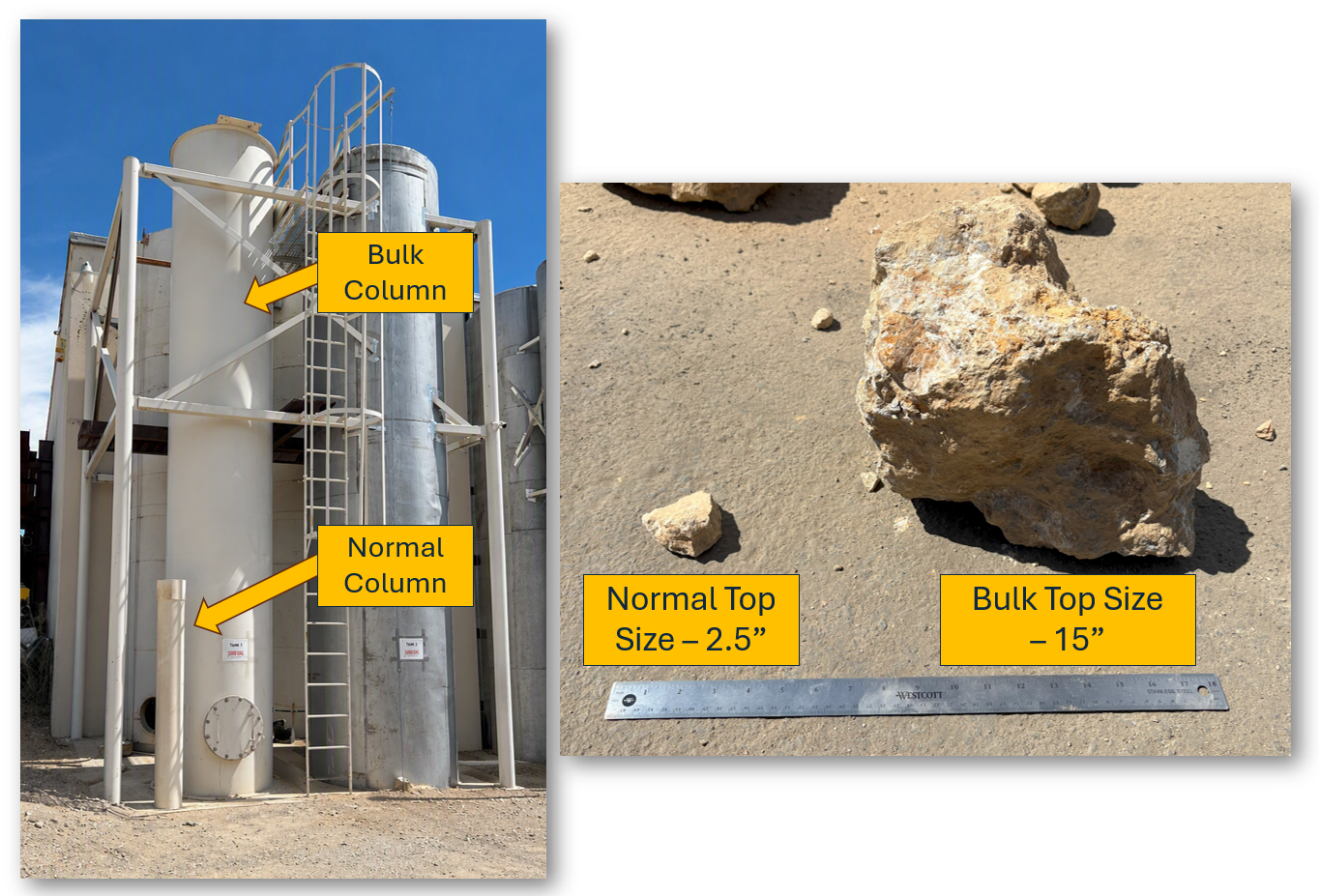
The Phase 6 program tested seven Black Pine ores, collected with an excavator (~20 tonnes per sample), six taken from historic pits and one taken off the surface (see Figure 1). Metallurgical composites were made up from bulk samples and leached at particle sizes ranging from a P80 of 75 microns up to ROM-size (8”). Larger particle size material was leached in bulk columns (dimensions 4’ diameter by 20’ high). These columns are much larger than a typical column test (see Figure 2) and are intended to simulate gold leach performance in commercial scale ROM leach pads.
Figure 1 – Summary Map of Black Pine Metallurgical Program Sample Locations
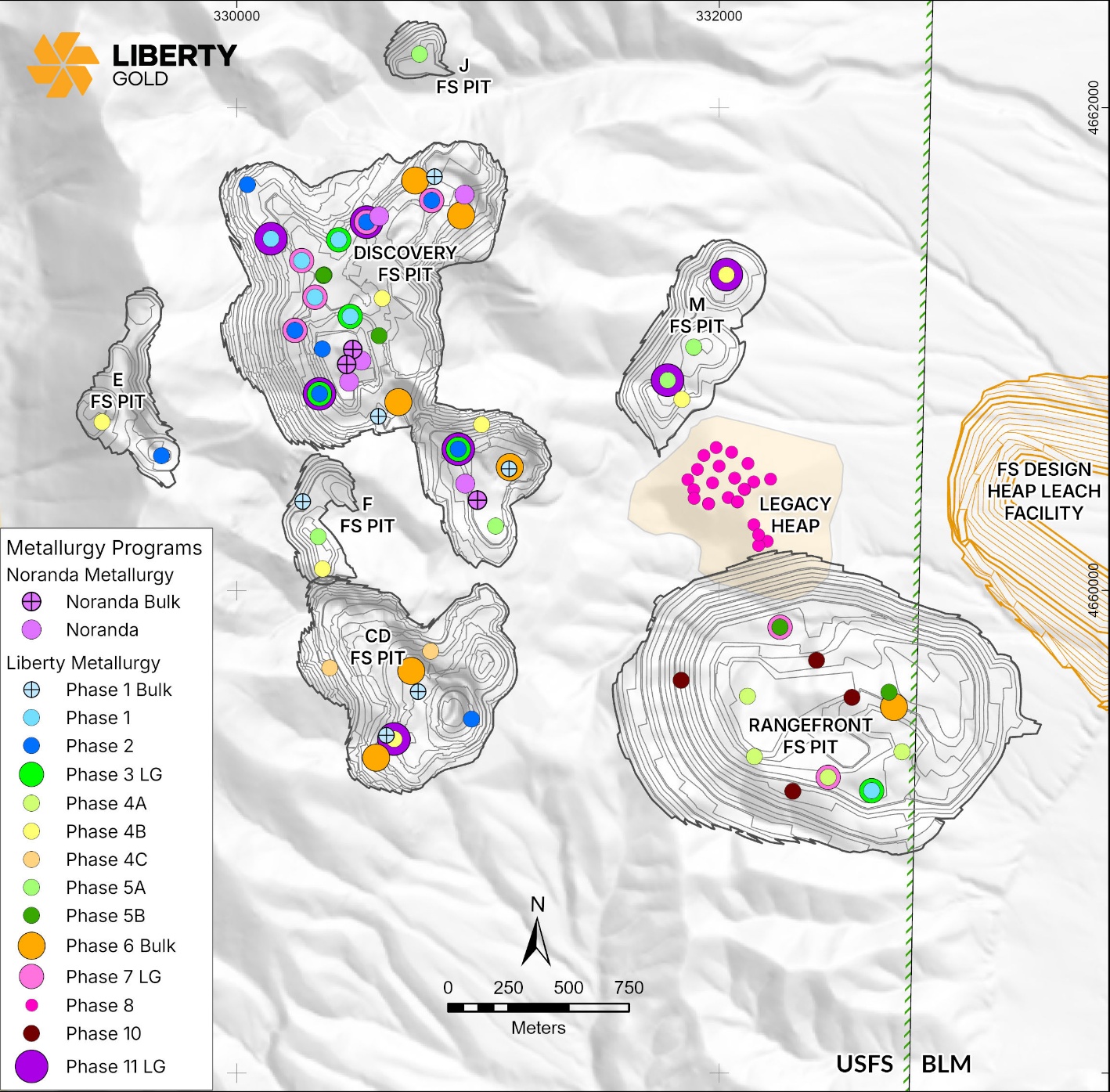
Figure 2 – Bulk columns (ROM Sizing) vs. normal columns and general difference in top size for particles
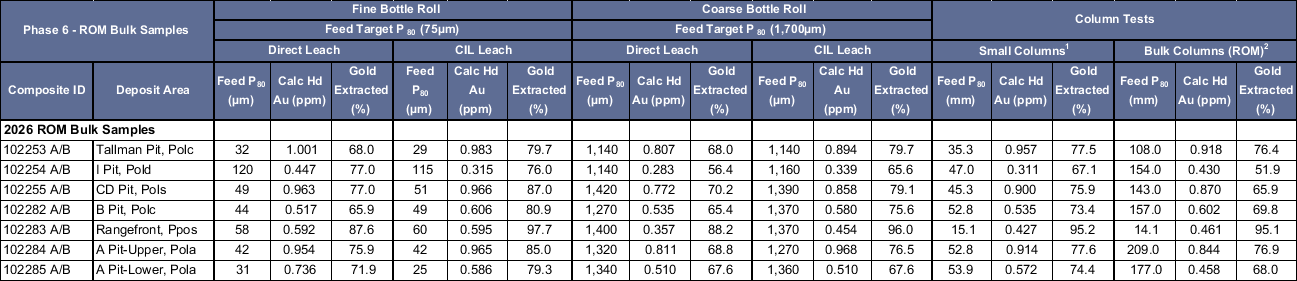
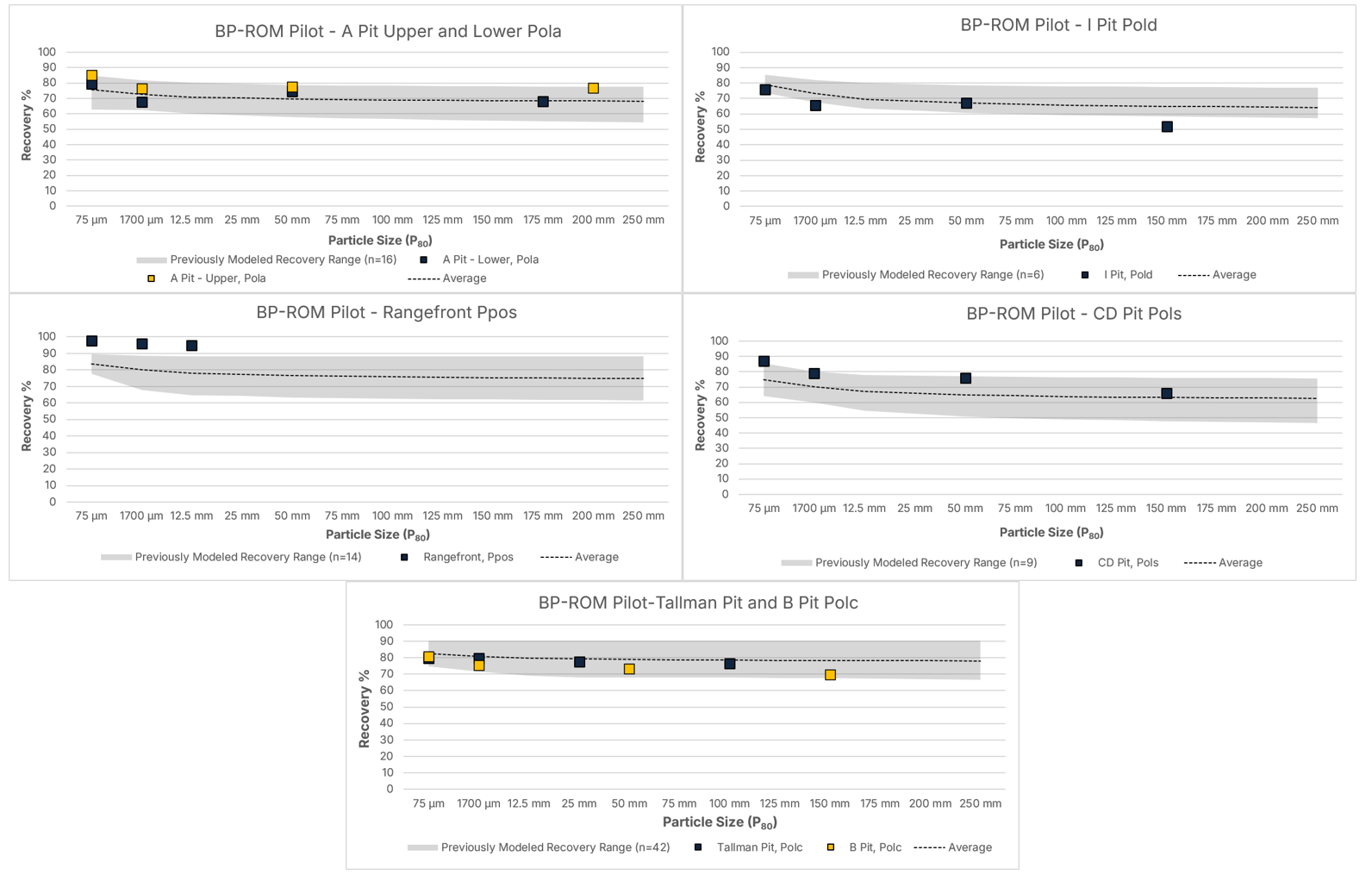
Seven samples were tested under standard test conditions for Black Pine oxide gold material, with results summarized below in Table 2. The average weighted gold extraction for the bulk columns was 72.4%, which is in line with modeled recoveries in the recent FS. All of the bulk column results fell within previously modeled recovery ranges, with the exception of Rangefront, which over-performed.
Two results are of particular note:
- The Rangefront Ppos sample had the highest extraction tested at 95% for a 0.43 g/t gold head grade. This recovery is high for material at this gold grade and is considerably in excess of modeled recovery for the Ppos unit in Rangefront, even at finer crush sizes. The result may have significant implications for increasing the value of Rangefront as the Ppos unit is currently viewed as low value stripping material in the recently published FS.
- The I-pit Pold sample extraction at 51.9% was an expected result as this rock unit is known to have lower gold extraction and the results are aligned with modeled recoveries.
It should be noted that columns which met or over-performed versus the modeled predictions are representative of a greater portion of the recoverable ounces within the resource, notably the larger mining phases at Black Pine, Discovery and Rangefront.
Table 1 shows results from the Phase 6 test work program with extraction results for all samples. Results include fine bottle rolls, coarse bottle rolls, small columns, and the bulk columns.
Table 1 – Phase 6 Gold Extraction Results
¹ Small columns are approximately 9 feet tall and 1 foot in diameter
2 Bulk columns are 20 feet tall and 4 feet in diameter
Black Pine ROM Modeling Methodology
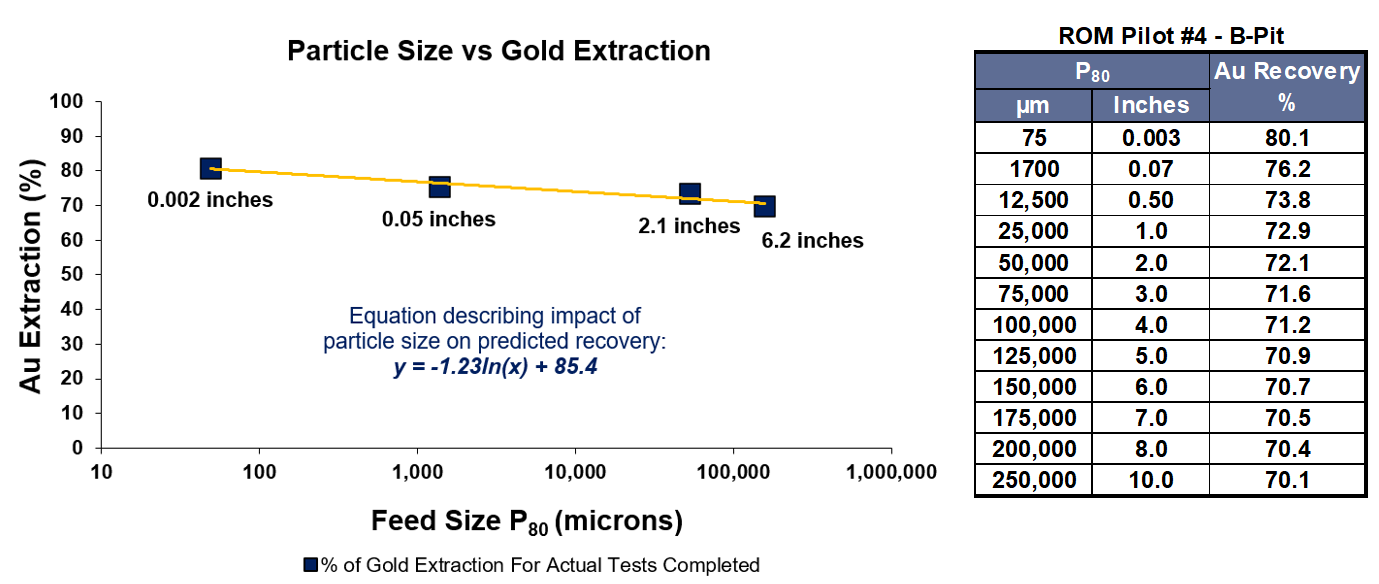
The metallurgical database at Black Pine comprises more than 200 column leach tests on composite material sampled from large diameter (PQ) drill core and nine (9) bulk samples (3 by Noranda and 6 by Liberty Gold in 12’’ diameter columns at a P80 between 2 and 3 inches). In typical metallurgical test programs for new oxide gold deposits, gold extractions are tested at a variety of particle sizes ranging from very fine (P80 of 75 microns) to relatively coarse (P80 of 1”). Particle sizes significantly larger than 1” are generally not tested as sampling and testing is cumbersome and expensive. Liberty Gold has adopted and implemented an industry-proven approach using laboratory bottle roll and column leach protocols to accurately project commercial gold and silver recoveries at any particle size from laboratory data. An example of this methodology can be seen in Figure 3 and Table 2.
Figure 3 and Table 2 – An example of the methodology used across Black Pine to predict recovery at larger particle sizes than tested in laboratory conditions. This plot is for the B-pit sample (ROM Pilot #4).
The Company took the view that laboratory bulk column testing was an important de-risking step for new production planning, despite having commercial information from the historic operations at Black Pine, where ~30 million tonnes of ROM-sized ore was heap leached in the 1990’s.
Detailed Results
Extraction versus time graphs illustrate both the leach kinetics (rapid leaching rate in first 10 to 30 days) and relative extraction performance over the leach cycle for the seven bulk samples (see Figure 4).
Figure 4 – Extraction vs time for bulk columns
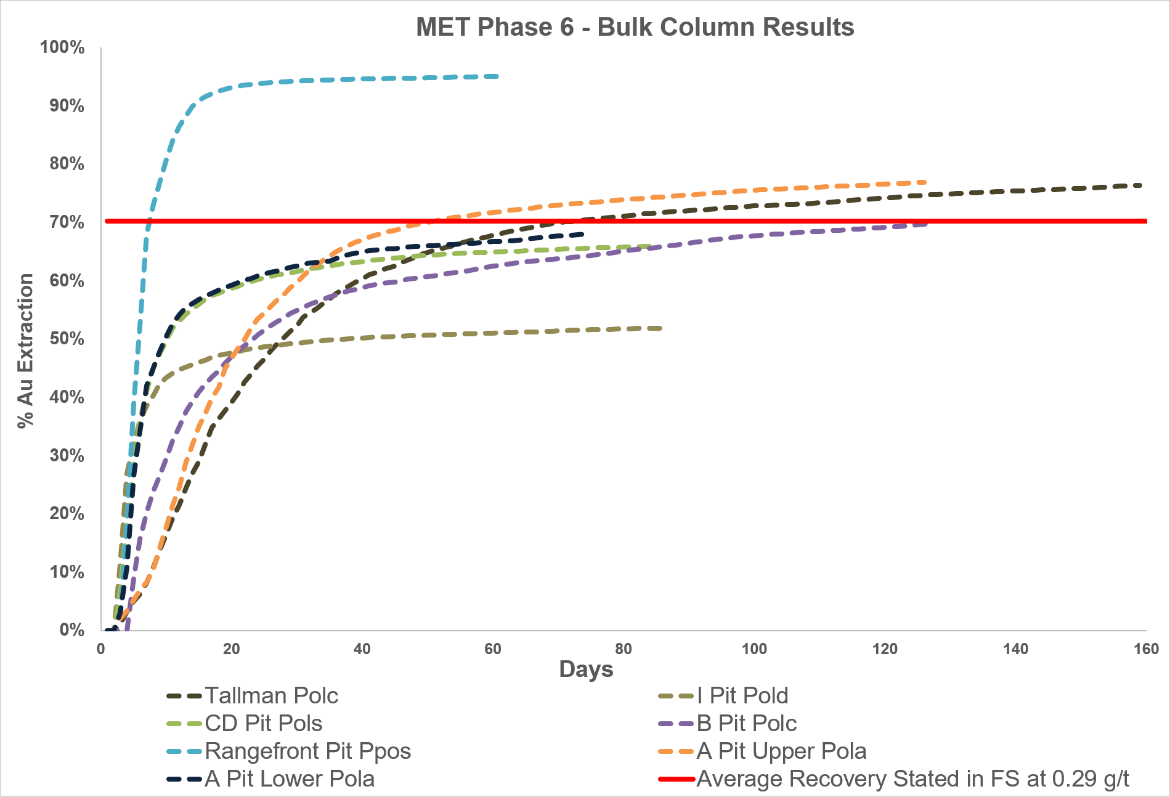
Figure 5 shows the recovery results for each sample tested, at variable size fractions, against ranges for recovery previously modeled by ore type. Ranges for extraction shown (shaded areas) are the P10-P90 ranges for previous variability sample results used to model extraction percentage as a function of particle size.
Figure 5 – Extraction vs particle size for material tested shown against previously modeled ranges by material type
Silver
Bulk column leach tests recorded silver (“Ag”) extractions up to 39%, with a weighted average Ag recovery of 21%. These silver grades and extractions are generally above previous variability composite averages and will be incorporated into future Ag recovery model updates to support prediction of silver production once the silver resource model is completed.
Ongoing Metallurgical Programs
Liberty Gold has an ongoing pre-production metallurgical program for Black Pine:
- Phase 8: Composites from 24 sonic drill holes (~1,400 meters) in the legacy heap leach pad are being tested for economic potential. Vat leach tests have been completed and a second round of column leach testing, Phase 8B, has started at KCA in Reno. Results are expected in H1 2027.
- Phase 9: Phase 9 involves a re-assay campaign of ~2,000 samples for LECO and Preg Rob focused on better understanding dilution risk with MET4 and Poc materials. Management considers current dilution assumptions to be conservative. These assays are pending and will be used to guide mining decisions in detailed engineering and future mine planning.
- Phase 10: 26 composites from additional core holes in Rangefront are being tested at KCA with a focus on all grade ranges across the primary gold hosting units in Rangefront. Results are expected in H1 2027. This program is focusing on increasing variability sample coverage in Rangefront.
- Phase 11: This program is focused on low grade samples (<0.1 g/t) across the deposit in order to improve the low-end gold extraction model. Results are expected in Q1 2027.
- Phase 12: Phase 12 will be focused on understanding potential extractions of waste dump material. This program will begin following completion of RC drilling currently happening on site.
These additional phases of work will continue to validate the feasibility level gold and silver recovery models. Further test work will be completed as needed to ensure model accuracy through detailed design and into production.
Quality Assurance – Quality Control
All metallurgical work at Black Pine was conducted at KCA Labs in Reno and is supervised by Gary Simmons, MMSA, formerly Director of Metallurgy and Technology for Newmont Mining Corp. Mr. Simmons has managed metallurgical programs on multiple Carlin-style oxide deposits in the Great Basin and has been the Metallurgical consultant for Black Pine since project inception.
The scientific and technical information contained in this news release has been reviewed and approved by Richard Zaggle, RM-SME, Senior Director, Mining and Metallurgy of Liberty Gold Corp., a Qualified Person as defined by NI 43-101.
ABOUT LIBERTY GOLD
Liberty Gold is a U.S.-focused gold company advancing Black Pine, its 100% owned oxide gold project in Idaho, located within the Great Basin, one of the world’s most productive and mining-friendly gold regions. Black Pine is a large-scale, past-producing, run-of-mine heap leachable gold deposit progressing through feasibility and permitting toward a modern open-pit mining operation. The Company’s strategy is centered on advancing high-quality, long-life gold assets, with a clear focus on technical simplicity, strong environmental performance, project executability, collaborative permitting processes, and value creation. This reflects Liberty Gold’s commitment to the discipline of delivery. The Company is led by an experienced team with a track record of discovery, development, and delivering sustained long-term value.
For more information, visit libertygold.ca or contact:
Susie Bell, Vice President, Investor Relations and Corporate Communications
Phone: 604-632-4677 or Toll Free 1-877-632-4677
info@libertygold.ca
Richard Zaggle, RM-SME, Senior Director Mining and Metallurgy, Liberty Gold, is the Company’s designated Qualified Person for this news release within the meaning of National Instrument 43-101 Standards of Disclosure for Mineral Projects (“NI 43-101”) and has reviewed and validated that the information contained in the release is accurate.
This news release contains “forward-looking information” and “forward-looking statements” within the meaning of applicable securities laws, including statements or information concerning, future financial or operating performance of Liberty Gold and its business, operations, properties and condition; planned de-risking activities at Liberty Gold’s mineral properties; future updates to the mineral resource, the potential quantity, recoverability and/or grade of minerals; the potential size of a mineralized zone or potential expansion of mineralization; proposed exploration and development of Liberty Gold’s exploration property interests; the results of mineral resource estimates or mineral reserve estimates and preliminary feasibility studies; and the Company’s anticipated expenditures.
Forward-looking information is often, but not always, identified by the use of words such as “seek”, “anticipate”, “plan”, “continue”, “planned”, “expect”, “project”, “predict”, “potential”, “targeting”, “intends”, “believe”, “potential”, and similar expressions, or describes a “goal”, or variation of such words and phrases or state that certain actions, events or results “may”, “should”, “could”, “would”, “might” or “will” be taken, occur or be achieved. Forward-looking information is not a guarantee of future performance and is based upon a number of estimates and assumptions of management at the date the statements are made including, among others, assumptions about future prices of gold, and other metal prices, currency exchange rates and interest rates, favourable operating conditions, political stability, timely receipt of governmental or regulatory approvals, including any stock exchange approvals; receipt of a financing on time, obtaining renewals for existing licenses and permits and obtaining required licenses and permits, labour stability, stability in market conditions, availability of equipment, results or timing of any mineral resources, resource conversion, pre-feasibility study, mineral reserves, or feasibility study; the availability of drill rigs, successful resolution of disputes and anticipated costs and expenditures. Many assumptions are based on factors and events that are not within the control of Liberty Gold and there is no assurance they will prove to be correct.
Such forward-looking information, involves known and unknown risks, which may cause the actual results to be materially different from any future results expressed or implied by such forward-looking information, including, risks related to the interpretation of results and/or the reliance on technical information provided by third parties as related to the Company’s mineral property interests; changes in project parameters as plans continue to be refined; current economic conditions; future prices of commodities; possible variations in grade or extraction rates; the costs and timing of the development of new deposits; failure of equipment or processes to operate as anticipated; the failure of contracted parties to perform; the timing and success of exploration activities generally; the timing or results of the publication of any mineral resources, mineral reserves or feasibility studies; delays in permitting; possible claims against the Company; labour disputes and other risks of the mining industry; delays in obtaining governmental approvals, financing, timing of the completion of exploration as well as those factors discussed in the Annual Information Form of the Company dated March 25, 2026, in the section entitled “Risk Factors”, under Liberty Gold’s SEDAR+ profile at www.sedarplus.ca.
Although Liberty Gold has attempted to identify important factors that could cause actual actions, events or results to differ materially from those described in forward-looking information, there may be other factors that cause actions, events or results not to be as anticipated, estimated or intended. There can be no assurance that such information will prove to be accurate as actual results, and future events could differ materially from those anticipated in such statements. Liberty Gold disclaims any intention or obligation to update or revise any forward-looking information, whether as a result of new information, future events or otherwise, except for material differences between actual results and previously disclosed material forward-looking information, or as otherwise required by law.
Except for statements of historical fact, information contained herein or incorporated by reference herein constitutes forward-looking statements and forward-looking information. Readers should not place undue reliance on forward-looking information. All forward-looking statements and forward-looking information attributable to us is expressly qualified by these cautionary statements.
Note to United States Investors Concerning Estimates of Measured, Indicated and Inferred Resources
The information, including any information incorporated by reference, and disclosure documents of Liberty Gold that are filed with Canadian securities regulatory authorities concerning mineral properties have been prepared in accordance with the requirements of securities laws in effect in Canada, which differ from the requirements of United States securities laws.
Without limiting the foregoing, these documents use the terms “measured resources”, “indicated resources”, “inferred resources” and “mineral reserves”. These terms are Canadian mining terms as defined in, and required to be disclosed in accordance with, NI 43-101, which references the guidelines set out in the Canadian Institute of Mining, Metallurgy and Petroleum (the “CIM”) – CIM Definition Standards, adopted by the CIM Council, as amended. However, these standards differ significantly from the mineral property disclosure requirements of the United States Securities and Exchange Commission (the “SEC”) in Regulation S-K Subpart 1300 (the “SEC Modernization Rules”) under the United States Securities Act of 1934, as amended. The Company does not file reports with the SEC and is not required to provide disclosure on its mineral properties under the SEC Modernization Rules and will continue to provide disclosure under NI 43-101 and the CIM Definition Standards.
Photos accompanying this announcement are available at:
https://www.globenewswire.com/NewsRoom/AttachmentNg/69f40f7d-7559-49d8-b158-9e9e5a6e35e2
https://www.globenewswire.com/NewsRoom/AttachmentNg/91630b0e-a182-4c48-97c7-808579514a8f
https://www.globenewswire.com/NewsRoom/AttachmentNg/1f615906-9679-4e25-8809-941a08214857
https://www.globenewswire.com/NewsRoom/AttachmentNg/aef4400b-9e4e-4b25-938a-65315bbf13b7
https://www.globenewswire.com/NewsRoom/AttachmentNg/7a051688-1ac1-4b60-b970-8435eba8cda6
https://www.globenewswire.com/NewsRoom/AttachmentNg/4159978c-bb86-45b7-9343-8e9811b8511b
