VANCOUVER, British Columbia, Sept. 17, 2026 (GLOBE NEWSWIRE) — Xali Gold Corp. (TSXV:XGC) (“Xali Gold” or the “Company”) is pleased to announce the advancement of environmental, metallurgical and exploration programs at its Pico Machay Gold Project (“Pico Machay” or the “Project”) in Peru, together with the planned commencement of work on an updated mineral resource estimate and Preliminary Economic Assessment (“PEA”). These coordinated programs are designed to support the continued evaluation of Pico Machay and prepare the Project for future engineering, permitting and development.

Highlights:

  • An experienced multidisciplinary engineering team has been assembled, with work now underway to simultaneously commence both an updated mineral resource estimate and a PEA;
  • The Ficha Técnica Ambiental (“FTA”) approval process for the planned drilling program continues to advance following two technical meetings with Peru’s Ministry of Energy and Mines (“MINEM”), while preparations are underway for a public workshop with the local community;
  • Three drilling contractors have submitted bids for the planned 3,000 metre (“m”) diamond drill program, which includes approximately 2,000 m of resource confirmation drilling; the Company is reviewing the bids and narrowing the field ahead of contractor selection.
  • As part of initiating the EIA-d (“Detailed Environmental Impact Assessment”), a research-grade meteorological station has been purchased and installation is underway. This will support engineering and environmental studies and provide long-term monitoring through potential construction, operations and post-closure;
  • A Phase 1 metallurgical program is planned to commence shortly, representing the first stage of a broader program designed to build on previous met work to support an updated feasibility study and potential development; and
  • Fieldwork has resumed to follow up on high-grade gold results and priority exploration targets identified during the Company’s earlier 2026 sampling program.

“These programs demonstrate that we are moving Pico Machay forward with a clear focus on potential development,” stated Joanne Freeze, President and CEO of Xali Gold. “Our field team is launching a detailed mapping program to follow up on the encouraging high-grade results and new exploration targets generated earlier this year. The team has also recently completed the relogging of all previous reverse-circulation drill chips and is now building a 3D model of the mineralization. PEA work will advance in tandem with the resource confirmation drilling, allowing the new results and updated mineral resource estimate to be incorporated into the study as soon as they become available. The PEA will draw on the Feasibility Study released by Aquiline Resources in 2008, updated with the results of the Company’s current technical programs.”  

Xali Gold has assembled a multidisciplinary team to advance the PEA and support subsequent engineering work through feasibility, potential development, construction and production. Team members each bring more than 25 years of experience in mine development or operations in Latin America, including Peru. Their expertise spans mineral resource estimation, mining, metallurgy and processing, project economics, project finance, environmental studies and environmental, social and governance (“ESG”) considerations. This approach allows key components of the PEA to advance before and during the planned drilling program.

The multidisciplinary team already working on the Project includes Adam Johnston, FAusIMM, CP (Met), a metallurgist with Transmin Metallurgical Consultants; David Thomas, P.Geo., a mineral resource geologist; and Aran Gough, R.P.Bio, a registered professional biologist.

Xali Gold has also recently engaged Brent Cochrane, M.A., ICD.D., and Gordon Zurowski, P.Eng. Mr. Cochrane brings more than 40 years of international mining finance experience and has worked in Peru’s mining industry since 2001, including as Vice President, Finance and Administration of Compañía Minera Antamina S.A. His project financing experience in Peru includes the Antamina and Mina Justa copper projects.

Mr. Zurowski, Principal Mine Engineer with AGP Mining Consultants, has more than 30 years of mine operations and consulting experience focused on open-pit mine planning, financial evaluation and economic studies. His project experience includes Cuajone, Cañariaco Norte, Cerro Lindo, Magistral and Marcona in Peru, as well as Los Azules, Filo del Sol and Aurizona elsewhere in South America.

“By assembling the full team now, we can advance much of the mining, metallurgical, environmental and economic work before and during the resource confirmation drilling,” continues Ms. Freeze. “The updated resource will form the basis for the PEA, and doing the studies in parallel should shorten the timeline to complete the PEA. The long-term meteorological monitoring station and planned staged metallurgical program are also important steps in preparing the Project for its next phases of evaluation and advancement.”

Updated Mineral Resource Estimate and PEA

Approximately 2,000 m of the Company’s planned 3,000 m diamond drill program will twin selected historical reverse-circulation holes within the historical resource area. The drill hole twinning, together with the completed historical data compilation, drill-chip relogging and sampling, is intended to provide the additional information required to prepare an updated mineral resource estimate.

Development of an initial three-dimensional geological model using Leapfrog software is currently underway and is expected to be completed by the end of September 2026. The model will integrate the historical drilling, geological, analytical and topographic information with our team’s relogging work and approximately 40 interpretive cross sections. Detailed mapping will help refine the interpretation of the controls on mineralization and guide the upcoming resource confirmation drill program. The model will subsequently be updated as new drilling results become available and will support the preparation of the updated mineral resource estimate and PEA.

Exploration Permitting and Community Engagement

The FTA approval process for the planned drilling program at Pico Machay continues to advance. The Company has participated in two technical meetings with the Mining Environmental Directorate of MINEM, which provided additional guidance regarding recent modifications to the FTA process. These modifications include more deliverables from the Company, implemented to speed up the evaluation process.

Following those meetings, Xali Gold engaged Embellie Advisory LLC (“Embellie”) to assess considerations relating to indigenous or native members of the Santa Ana community, including any potential impacts of the planned drilling program on collective rights. Embellie will assist the Company to incorporate those findings into its FTA submission.

In parallel, the Company is organizing a MINEM-facilitated public workshop for the local community regarding the planned exploration program. The workshop is planned for early October and will provide an opportunity to explain and discuss the proposed work and laws and practices in place to protect community interests. This fits well with Xali Gold’s ongoing transparent engagement with the community surrounding Pico Machay. The Company plans to submit its FTA application approximately one week after the workshop is completed and, based on current guidance, expects a review and approval period of approximately 10 days following submission.

Initiation of EIA-d

Xali Gold is beginning environmental data collection to support the preparation of the EIA-d, the longest lead-time component of the permitting process for mining operations in Peru. As an initial step, the Company has purchased and is installing a new wireless Vantage Pro2 Plus meteorological station at Pico Machay. The research-grade station will collect site-specific information on wind speed, temperature, humidity, barometric pressure, rainfall, solar radiation and ultraviolet radiation, as well as related meteorological measurements.

The data will be used to validate and supplement regional information available from Peru’s National Service of Meteorology and Hydrology (“SENAMHI”). Correlating site-specific observations with the longer-term regional record will also help the Company estimate historical meteorological conditions at Pico Machay for the years preceding installation of the station.

The station is intended to form part of the Project’s long-term environmental monitoring infrastructure, supporting detailed environmental assessment and engineering design and, subject to the Project advancing, continuing through construction, operations, closure and post-closure monitoring.

Exploration Follow-up Underway

Ground exploration has resumed at Pico Machay, with the field team conducting detailed mapping and additional sampling to follow up on high-grade gold results and priority exploration targets identified during the Company’s surface and underground sampling program completed earlier in 2026.

Results from that program included 2.92 grams per tonne (“g/t”) gold (“Au”) over 31.5 m from Surface Channel 1, including 13.76 g/t Au over 4.5 m, within the historical resource area. In addition, 67 of 119 surface samples returned more than 0.50 g/t Au, helping the Company define and refine multiple exploration targets. Gold mineralization and alteration characteristic of a high-sulphidation epithermal system were also identified in underground workings across an area measuring approximately 1.35 kilometres by 0.83 kilometres. Refer to Xali Gold news release dated July 28th, 2026 and titled “Xali Gold Continues to Demonstrate the Scale and Grade of Gold Mineralization at Pico Machay” for further details.

The current work is focused on further evaluating selected high-priority areas and improving the Company’s understanding of the distribution and controls of higher-grade mineralization. Results will be incorporated into the evolving geological model and used to support planning for the next phase of work at Pico Machay.

About Pico Machay

Located within the Southern Peru Epithermal Gold-Silver Belt, Pico Machay sits in a historically productive mining district in the Western Cordillera of the Andes (click here for location map). The Project benefits from existing infrastructure and a mining-friendly community eager to partner on sustainable development.

Xali Gold remains confident in the significant upside potential at Pico Machay, which hosts a historical resource and several untested exploration targets on the Project. Various historical engineering studies at Pico Machay were completed through 2009 and evaluated the potential for a low-cost, low strip-ratio, open-pit heap-leach operation. Given that those studies were based on a long-term gold price of $700/oz and several exploration targets remain untested, Xali Gold considers the upside potential to be very strong.

About Xali Gold

Xali Gold is a gold and silver exploration company focused on advancing opportunities in the Americas. The Company is focused on the exploration and development of Pico Machay, an advanced exploration-stage gold project in Peru with a near-term production goal. 

The Company’s approach to community engagement and responsible development is guided by strong governance principles and Board oversight that support long-term stakeholder relationships.

Joanne C. Freeze, P.Geo. is a Qualified Person as defined by National Instrument 43-101 and has reviewed and approved the contents of this release.

Neither the TSX Venture Exchange nor its Regulation Services Provider accepts responsibility for the adequacy or accuracy of this release.

On behalf of the Board of Xali Gold Corp.

“Joanne Freeze” P.Geo.
President, CEO and Director

For further information please contact:
Joanne Freeze, President & CEO                                
Tel: + 1 (604) 512-3359                                                                 
info@xaligold.com                

Forward-looking Disclaimer
This press release contains forward-looking information within the meaning of Canadian securities laws (“forward-looking statements”). Forward-looking statements are typically identified by words such as: believe, expect, anticipate, intend, estimate, plans, postulate and similar expressions, or are those, which, by their nature, refer to future events. All statements that are not statements of historical fact are forward-looking statements.

Forward-looking statements in this press release include, without limitation, statements regarding: the timing and completion of contractor selection; the timing of the planned public workshop and submission and approval of the FTA, if at all; the commencement, scope, timing and completion of the planned 3,000 m diamond drill program; the timing and completion of the three-dimensional geological model; the preparation and timing of an updated mineral resource estimate and PEA, including the anticipated benefits of advancing the related studies in parallel; the timing, scope and results of the planned metallurgical, mapping and sampling programs; the installation and use of the meteorological station; the preparation of the EIA-d; and the continued advancement and potential development, construction, operation and production of the Project.   These forward-looking statements are made as of the date of this press release. Although the Company believes the forward-looking statements in this press release are reasonable, it can give no assurance that the expectations and assumptions in such statements will prove to be correct. The Company cautions investors that any forward-looking statements by the Company are not guarantees of future results or performance, and are subject to risks, uncertainties, assumptions and other factors which could cause events or outcomes to differ materially from those expressed or implied by such forward-looking statements.

Known risk factors and assumptions include risks associated with exploration and project development; accessing further funding and related dilution: continuing its projected growth, or being fully able to implement its business strategies; the calculation of mineral resources and additional work required to convert historical resources to current mineral resources; the nature, quality and quantity of any mineral deposits that may be located on the project; operational risks associated with mining and mineral processing; fluctuations in metal prices and assumptions including costs; title matters; government regulation; obtaining and renewing necessary consents, authorizations, licenses and permits; environmental liability and insurance; reliance on key personnel; local community opposition; currency fluctuations; labour disputes; competition; variations in market conditions, and the volatility of our common share price and volume; future sales of shares by existing shareholders; and other risk factors described in Xali Gold’s MD&A and other filings with Canadian securities regulators, which may be viewed at www.sedarplus.ca. Although we have attempted to identify important factors that could cause actual actions, events or results to differ materially from those described in forward-looking statements, there may be other factors that cause actions, events or results not to be as anticipated, estimated or intended.

There can be no assurance that forward-looking statements will prove to be accurate, as actual results and future events could differ materially from those anticipated in such statements. Accordingly, readers should not place undue reliance on forward-looking statements. Xali Gold expressly disclaims any intention or obligation to update or revise any forward-looking information, whether as a result of new information, future events or otherwise, except in accordance with applicable securities laws.

WHAT

September 17, 2026 /3BL/ – On Tuesday, Sept. 22, 1% for the Planet, B Lab, Fairtrade America, and The Change Climate Project will convene Certified for the Future, a Climate Week NYC conversation at PlanetHAUS.

Nonprofit leaders and brands will discuss how different standards and certifications can complement one another, strengthen accountability, and support credible corporate sustainability strategies. The conversation will address how businesses can move beyond broad commitments, substantiate their claims, and use independent frameworks to advance measurable action for people and the planet.

The event will include a leadership panel and practical examples from brands, followed by networking with business leaders, sustainability practitioners, certification experts, and advocates.

WHO

1% for the Planet, B Lab, Fairtrade America, & The Change Climate Project

WHEN

Tuesday, Sept. 22, 2026
4:15-7:00 p.m. EDT
Leadership panel and brand discussion: 4:30-5:15 p.m. EDT

WHERE

PlanetHAUS at Chief Flatiron Clubhouse
13 E. 19th St.
New York, NY 10003

WHY

Businesses face growing pressure to back sustainability claims with credible evidence while also navigating concerns about greenwashing and climate inaction.

This event connects that challenge to practical solutions. Organizations working across business standards, fair trade, and funding environmental solutions will discuss how independent frameworks can strengthen accountability and help companies move from broad commitments to measurable progress. The conversation offers a timely source for reporters covering business, climate, sustainability, consumer trust, or corporate accountability.

INTERVIEWS

CEO / ED Panel:

– Kate Williams, CEO, 1% for the Planet
– Marcel Fukayama, Chief Impact & Movement Officer, B Lab
– Amanda Archila, Executive Director, Fairtrade America
– Austin Whitman, CEO/Co-founder, The Change Climate Project

Brand Spotlight:
– Jo Ehrenreich, VP of Brand Marketing, Bread Alone
– Kelley Brady, Director of Sustainability and Impact, Chomps
– Alicia Simmons, Director of Sustainability and Communications, Frontier Co-op

Moderated by: Dr. Kimberly McGlonn, Build it Boldly

ABOUT 1% FOR THE PLANET

Co-founded in 2002 by Yvon Chouinard (founder of Patagonia) and Craig Mathews (owner of Blue Ribbon Flies), 1% for the Planet® is a global organization on a mission to accelerate smart environmental impact so that our planet and future generations can thrive. Over the last decade, our network has grown to span more than 100 countries and 65 industries. Today, 1% for the Planet certification is one of the most trusted frameworks for corporate philanthropy, with more than $939 million in certified impact to date. By holding business members accountable to give at least 1% of revenue—not profits—each year, we ensure that their environmental commitments are real, verified and impactful. Learn more at www.onepercentfortheplanet.org and see Newsroom & Media Kit.

ABOUT B LAB

B Lab™ is the nonprofit organization behind the B Corp movement. B Lab creates standards, policies, tools, and programs to reimagine capitalism, and build a new economic system that benefits people and the planet. B Lab has created and led efforts to pass over 50 corporate statutes globally, advocating for stakeholder governance that requires business decisions to benefit workers, communities, and the environment.

Certified B Corporations™, or B Corps, are companies verified as meeting standards for social and environmental performance, transparency, and accountability. To date, the B Corp community spans over 10,000 B Corps across more than 100 countries and over 160 industries, collectively employing more than 1 million people. Around 300,000 companies proactively manage their impact with B Impact™.

To learn more and join the movement, visit www.bcorporation.net.

ABOUT FAIRTRADE AMERICA

Fairtrade America works to rebalance trade, making it a system rooted in partnership and mutual respect rather than exploitation. It’s about businesses, shoppers, farmers and workers all working together so we can all experience the benefits of trade. Fairtrade America is the U.S. branch of Fairtrade International, the original and global leader in fair trade certification with more than 30 years of experience working for fair trading practices in more than 30 countries across the globe. A non-profit 501(c)3 organization, Fairtrade America is part of the world’s largest and most recognized fair trade certification program — part of a global movement for change. Learn more at fairtrade.net, and by connecting with Fairtrade America on Facebook, Instagram and LinkedIn.

Fairtrade takes human rights, sustainability and trade personally. Though consequences often go unseen, companies’ and consumers’ choices have human and environmental costs. By choosing Fairtrade, businesses, shoppers, farmers and workers can create a better world – one that puts people and planet over profits. Together, we can prioritize global partnership and our shared humanity.

ABOUT THE CHANGE CLIMATE PROJECT

The Change Climate Project works to reduce global emissions by driving private-sector funding into verified climate solutions. Since 2019, the organization has worked with hundreds of companies and helped catalyze more than $70 million of funding for decarbonization projects.

The nonprofit administers The Climate Label, its flagship climate certification for companies that fund verified climate solutions at a scale that matches their emissions. It also operates The Business Emissions Evaluator (The BEE), an accessible carbon management platform that helps companies measure emissions, develop reduction strategies and track progress. Together, The Climate Label and The BEE help companies and consumers move from climate aspirations to measurable action. Learn more at www.changeclimate.org.

MEDIA CONTACTS

Elizabeth Limbach
Senior Communications Manager, 1% for the Planet
760.579.8215 | elizabeth@onepercentfortheplanet.org

Karen Lickteigs
Senior Manager, Events & Activations, B Lab U.S. & Canada
316.207.7332 | klickteig@usca.bcorporation.net

Liz Davis
Media Relations Manager, Fairtrade America
202.930.4349 | ldavis@fairtradeamerica.org

Cristina Mestre
Communications Consultant, The Change Climate Project
cristina.mestre@changeclimate.org

By , //05 August 2026

Originally published on Devex

Consider a patient: a woman in her forties who lives in Delhi and has never smoked. Neither has anyone in her family. She is aware that India’s cities carry high levels of air pollution. She has also read that low-dose computed tomography, or LDCT, scanning can detect lung cancer early, when treatment is most effective. She goes to a clinic and asks whether she should be screened.

The honest answer to her question today would be: We don’t know.

It is not because the science of lung cancer screening is immature. Two landmark trials, the U.S. National Lung Screening Trial and the Dutch-Belgian NELSON study, established lung cancer screening guidelines for people with a past or current history of smoking in high-income settings. Low-dose CT screening is now established in more than a dozen countries, with additional nations preparing to implement.

The reality is that current lung cancer screening eligibility criteria were not designed to consider nonsmokers or to capture risk across cultures and living conditions. This includes risk in India or other geographies with sustained PM2.5 exposure — fine particulate matter that can penetrate the lungs and further enter the body through the bloodstream, affecting all major organs. What we do know is that between 40% and 50% of patients living with lung cancer in India are never-smokers.

Lung cancer incidence in India is rising. Peer-reviewed forecasts project that trend will continue through at least 2030, with incidence rates already accelerating sharply across multiple regions. When diagnosed, the majority of patients present with disease that has already spread. Lung cancer in India also tends to present approximately a decade earlier than the global average, a reality that makes early detection an urgent problem.

The question that the female patient in Delhi asked— “Should I be screened?”— remains scientifically unanswered. It is the question driving two landmark research grants now underway at the All India Institute of Medical Sciences, or AIIMS, funded by the Bristol Myers Squibb Foundation.

What’s more, India’s answer could offer guidance for other countries facing the same question.

Quantifying air pollution as a lung cancer risk factor

Globally, air pollution is now estimated to be responsible for approximately 14%of all lung cancers. What is not yet established, particularly with the rigor required to inform national lung cancer screening policy, is the full picture of PM2.5’s role in India’s lung cancer burden. Understanding that picture requires distinguishing three related but separate questions: how carcinogenic PM2.5 exposure is in the Indian context (its inherent capacity to cause malignant cancer); what level of risk that exposure confers across India’s population (the quantified probability of developing the disease); and which individuals carry the greatest biological susceptibility to those exposures. It is also unresolved how PM2.5 interacts with other co-occurring risk factors, and what genetic signatures it produces. Each of these gaps must be closed before a scientifically defensible, India-specific screening policy can be effectively and sustainably built.

The first BMS Foundation-funded grant with AIIMS, the Air Pollution and Cancer Research Ecosystem, or AIRCARE, is designed to address those unknowns. Working from a cohort of approximately 3,200 participants across the Delhi National Capital Region, AIRCARE will: quantify the lung cancer risk associated with PM2.5 exposure; map its multiplicative interaction with behavioral and clinical risk factors; identify PM2.5-specific genomic signatures via next-generation sequencing; and define susceptible subpopulations. The output will be a validated and locally generated risk stratification model grounded in the impact of air quality on local Indian people.

The second grant — the Indian Lung Screening Trial — addresses a foundational question the existing evidence cannot answer: Does LDCT screening, developed and validated in high-income countries using smoking history as the primary eligibility criterion, have the same efficacy in India?

By screening 1,716 participants across 10 national institutions, the trial evaluates LDCT screening yield and staging outcomes in India’s context — generating the first locally grounded evidence of its effectiveness in India. Real-world evidence from other settings has confirmed that when screening shifts diagnosis to earlier stages, survival improves significantly — but whether that stage shift can occur under India’s conditions, for India’s patients, remains unproven. The trial will also assess, for those who screen positive, whether the care pathways exist to act on what screening finds: from diagnostic workup and molecular testing to surgical access and follow-up. Together, those two outputs will offer a blueprint for how LDCT screening can be responsibly integrated into India’s public health system.

AIRCARE and the Indian Lung Screening Trial are interdependent. A risk stratification model without a validated detection pathway has no operational home. A detection program without a locally grounded risk model cannot fully account for the range of patients who need it most.

Why India, and why now

The Bristol Myers Squibb Foundation’s investment in this work reflects a conviction that durable progress in cancer outcomes comes from locally led solutions, grounded in country context, and designed to strengthen the systems that sustain them. The evidence being generated at AIIMS for Indian patients, by Indian researchers, within the Indian health system will provide evidence the world does not yet have.

India’s national readiness is real. The Indian Ministry of Health and Family Welfare published evidence-based national lung cancer treatment guidelines, and these plans will require precisely the kind of locally generated, population-specific evidence that AIRCARE and the Indian Lung Screening Trial are designed to produce — screening guidelines. 

Since the Indian Lung Screening Trial and AIRCARE were registered on clinical trial databases this year, researchers from countries facing identical questions have reached out to AIIMS seeking to replicate it in their own settings.

The question a patient in Delhi is asking today is the same question being asked in regions around the world. AIRCARE and the Indian Lung Screening Trial are working to help provide the answer.

Visit Strengthening Care Systems — a series in collaboration with the Bristol Myers Squibb Foundation on raising awareness of the scale of the global lung cancer burden and the systems-level changes required to address it.

About the authors

Catharine Grimes

Catharine Grimes

Catharine Grimes serves as president of the Bristol Myers Squibb Foundation, an independent charitable organization committed to improving global health by strengthening local health systems. With more than 30 years of experience in the pharmaceutical and health care sector, she leads the foundation’s efforts across adult cancers, pediatric cancers and blood disorders, brain health, and clinical trials. Under Catharine’s leadership, the BMS Foundation focuses on capacity building and health systems strengthening programs, working with grantee partners to expand access to care and advance sustainable, community‑driven solutions for patients around the world.

Abhishek Shankar

Abhishek Shankar

Dr. Abhishek Shankar is a member of faculty in the department of Radiation Oncology at the All India Institute of Medical Sciences in Delhi, India, an institute of national importance under the Ministry of Health and Family Welfare of India. He serves on the WHO/IARC Lung Cancer Screening Handbook group, the IASLC Tobacco Control and Smoking Cessation Committee, the Lancet Commission, the Lung Cancer Policy Network and ASPIRE for Lung Cancer. He leads Indian Lung Screening Trial and AIRCARE, generating evidence on screening beyond smoking and environmental risk factors in LMICs. Shankar’s primary expertise and research interests span community-based cancer prevention and screening, global oncology, cancer policy, quality of living in cancer care, and tobacco control.


LONDON, Sept. 17, 2026 (GLOBE NEWSWIRE) — Facultative reinsurance is helping insurers pursue growth opportunities in a rapidly softening market, enabling them to maximize available capacity and expand into new geographies while managing an increasingly complex risk landscape. That’s the conclusion of a new Facultative Reinsurance Report 2026 published today by Willis, a WTW business (NASDAQ: WTW).

The report, conducted in partnership with Coleman Parkes Research, received responses from 380 senior decision makers at leading insurance companies across North America, Europe, Middle East, APAC and Latin America.

The findings show that growth and global expansion are among insurers’ top priorities as they seek to deploy the large reserves of capital built up during the hard market. In addition, the survey shows that:

  • More than half (52%) of insurers identified capital management as a key reason for buying facultative reinsurance, up from 44% in 2024.
  • 56% said global expansion was among their greatest opportunities in the next two years (up from 39%), indicating an increase in insurers writing business overseas to drive growth.
  • 52% named entering new markets and risk areas among their top strategic objectives over the next two years, up from 45% in our previous survey, while 55% named increasing capacity as a top objective, up from 48%.

The results confirm the trend identified in the 2024 survey that facultative insurance is no longer viewed only as a defensive position to protect against problem risks but also as a flexible tool to support business priorities such as expansion, while also managing risk and volatility.

  • 60% of insurers expect to increase their use of facultative reinsurance over the next two years, compared with just 13% who plan to buy less, highlighting its growing importance across the market cycle.
  • 82% saw facultative as a key part of their strategies for managing risk, capacity, capital and appetite, while only 22% said they used facultative as a last resort, down from 28% in the 2024 survey.

The report also highlights growing concern around emerging risks, including geopolitical tensions, cyber threats and climate-related exposures, which could begin to alter the current market dynamics.

  • 57% cited geopolitics among the emerging risks they are most concerned about, up from 52%, while 54% said cyber, up from 24%, and 40% climate, up from 30%.

Garret Gaughan, Global Head of Direct and Facultative at Willis said: “While market conditions are creating significant opportunities for growth, insurers remain aware of the risks that could quickly present themselves. Our research shows that facultative reinsurance is increasingly being used as a strategic tool to help insurers expand their capacity, enter new markets and manage capital efficiently. At the same time, it provides valuable flexibility as organisations navigate uncertain times.”

The survey report can be downloaded here.

About the survey

The survey was conducted between February and March 2026 and included 380 senior decision makers from leading insurance companies, including C-suite executives, vice presidents, and heads of property and casualty (P&C). Company size was distributed as follows: 47% with GWP of $1 billion-$5 billion, 35% with GWP of $5 billion-$10 billion, and 19% with GWP of $10 billion or more.

About WTW

At WTW (NASDAQ: WTW), we provide data-driven, insight-led solutions in the areas of people, risk and capital. Leveraging the global view and local expertise of our colleagues serving 140 countries and markets, we help organizations sharpen their strategy, enhance organizational resilience, motivate their workforce and maximize performance.

Working shoulder to shoulder with our clients, we uncover opportunities for sustainable success—and provide perspective that moves you. Learn more at wtwco.com.

Media Contacts
Jo Barrett
Jo.Barrett@wtwco.com

Lauren David
Lauren.David@wtwco.com

LONDON–(BUSINESS WIRE)–  FORM 8.3 PUBLIC OPENING POSITION DISCLOSURE/DEALING DISCLOSURE BY A PERSON WITH INTERESTS IN RELEVANT SECURITIES REPRESENTING 1% OR MORE Rule 8.3 of the Takeover Code (the “Code”) 1. KEY INFORMATION (a) Full name of discloser: Qube Research & Technologies Limited (b) Owner or controller of interests and short positions disclosed, if different from 1(a): The naming of nominee or vehicle companies is insufficient. For a trust, the trustee(s), settlor and beneficiari

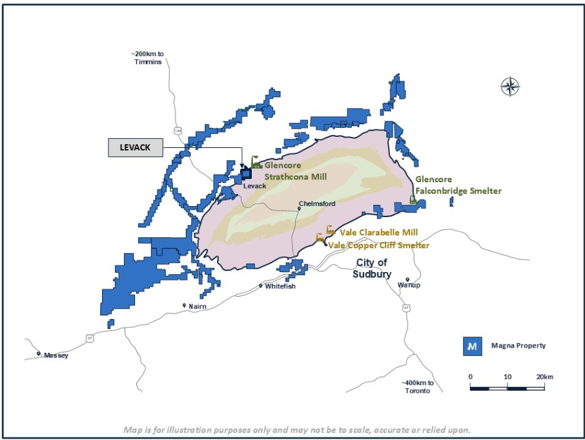
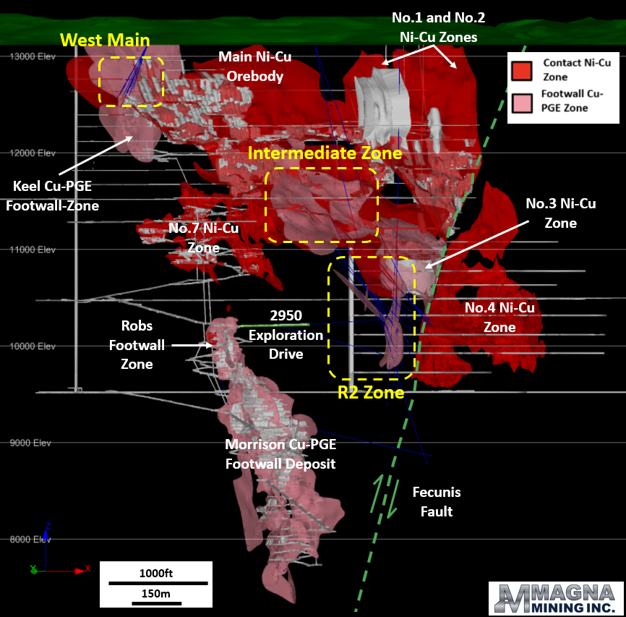
SUDBURY, Ontario, Sept. 17, 2026 (GLOBE NEWSWIRE) — Magna Mining Inc. (TSX: NICU) (“Magna” or the “Company”) is pleased to provide the results of ongoing exploration and an update on activities at the past-producing Levack Mine, located in the North Range of the Sudbury Basin, Ontario, Canada (Figure 1). Results released today include additional assays from expansion drilling of the R2 Footwall Zone, delineation drilling at the Intermediate Orebody, as well as initial drilling of the near-surface extension of the West Main Orebody (Figure 2).

Highlights from the new assay results include:

R2 Footwall Zone:

  • FNX2038A W1

    And  

9.5% Cu, 2.6% Ni, 17.5 g/t Pt+Pd+Au, 24.9 g/t Ag (23.5% CuEq) over 2.1
metres, from 999.2 metres down hole
15.4% Cu, 1.9% Ni, 7.0 g/t Pt+Pd+Au, 43.0 g/t Ag (19.1% CuEq) over 0.7   
metres, from 1068.6 metres down hole

     
West Main Orebody: 

  • MLV-26-64

  • MLV-26-68

    Including
    And 

1.7% Cu, 4.0% Ni, 3.5 g/t Pt+Pd+Au, 4.1 g/t Ag (8.3% CuEq) over 4.6 metres, 
from 198.7 metres down hole

0.4% Cu, 1.7% Ni, 0.4 g/t Pt+Pd+Au (2.9% CuEq) over 32.9 metres,
from 177.0 metres down hole
0.2% Cu, 3.2% Ni, 0.1 g/t Pt+Pd+Au (4.7% CuEq) over 3.2 metres
1.0% Cu, 2.9% Ni, 1.9 g/t Pt+Pd+Au (5.5% CuEq) over 3.8 metres 

Dave King, SVP Exploration and Geoscience at Magna, stated, “The R2 Footwall Zone continues to provide impressive results such as hole FNX2038A-W1 which returned five distinct veins, including 9.5% Cu, 2.6% Ni, 17.5 g/t Pt+Pd+Au, and 24.9 g/t Ag (23.5% CuEq) over 2.1 metres, and has continued to extend the zone towards the No.3 Orebody. The focus at R2 has now shifted to drilling from new underground platforms on the 2950 level with shorter drillholes and increasing the intersection frequency. In addition, we are excited to see thick, high grade intersections from initial surface drilling at the West Main Zone, including 0.4% Cu, 1.7% Ni, 0.4 g/t Pt+Pd+Au (2.9% CuEq) over 32.9 metres in drillhole MLV-26-68 and 1.7% Cu, 4.0% Ni, 3.5 g/t Pt+Pd+Au (8.3% CuEq) over 4.6 metres in drillhole MLV-26-64. This recent drilling has expanded this zone towards surface and could provide significant nickel-copper-precious metals-rich mineralized material early in the production profile upon a positive restart decision. Of particular interest is the increased copper and precious metal grades in hole MLV-26-64 which could indicate the potential for shallow, footwall style mineralization associated with this part of the Main Orebody, similar to the Keel, Morrison and R2 Footwall Zones.”

Table 1 summarizes the significant assay results received since the last Levack exploration results update (see news release dated June 22, 2026). Two surface drill rigs and three underground rigs have been active at Levack at various times during the past several months. Surface drill rigs have targeted both the R2 Footwall Zone as well as the upper western extension of the Main Orebody above historical mining. Underground drills have focused on continued drilling within the R2 Footwall Zone and the Intermediate Orebody from the 8450 Level exploration drift. Most recently, development of the 2950 Level exploration drift was completed in early August and two rigs are now active on this level, one completing infill definition drillholes within the R2 Footwall Zone and a second drilling exploration holes to test a geophysical target located between the R2 Footwall Zone and the Morrison Footwall Cu-PGE Deposit.

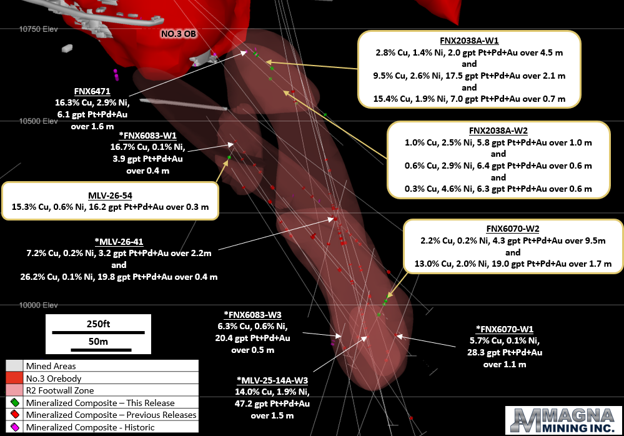
Today’s drill results from the R2 Footwall Zone are focused on the upper portions of the known mineralization to better define the veins and understand the relationship to the No.3 Orebody (Figure 3). They include assays from an additional three wedge holes drilled from surface, each of which intersected multiple mineralized veins. Drillhole FNX2038A-W1 intersected five distinct veins over 91.5 metres including 9.5% Cu, 2.6% Ni, 17.5 g/t Pt+Pd+Au, and 24.9 g/t Ag (23.5% CuEq) over 2.1 metres from 999.2 metres down hole and successfully expanded Magna’s drilling of the R2 Footwall Zone veins by approximately 30 metres towards the No.3 Orebody which is situated approximately 75 metres up dip. The R2 Zone remains open up dip towards the No. 3 Footwall Zone as well as at depth to the south. Since the completion of the 2950 Level exploration drift, drilling from this new underground platform has targeted the copper-precious metal veins of the R2 Footwall Zone at the approximate elevation where the 2950 Level would intersect the Zone, in preparation for a potential decision in early Q4 to advance development by an additional 300 metres to provide underground access to the R2 Footwall Zone.

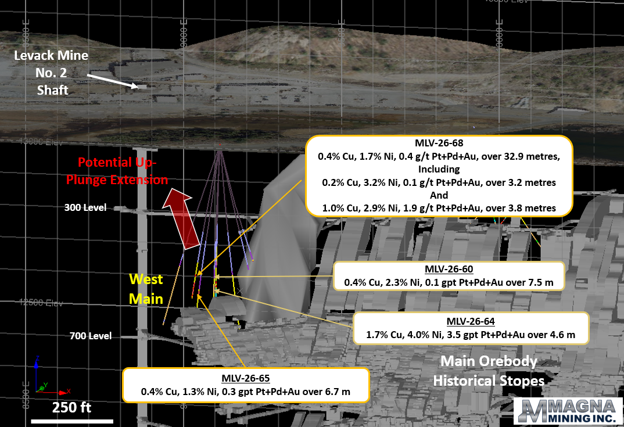
Today’s results from the Intermediate Orebody are from underground drill holes completed on the 8450 Level prior to the completion of development into this zone. Production from this area of the Intermediate Orebody could begin immediately upon a positive restart decision. Further definition and expansion drilling is underway within other areas being considered for early production in the Preliminary Economic Assessment (“PEA”), including the upper western portion of the Main Orebody (Figure 4). Significant widths of high grade nickel contact-type mineralization have been intersected in the initial drilling, including 1.7% Cu, 4.0% Ni, 3.5 g/t Pt+Pd+Au, and 4.1 g/t Ag (8.3% CuEq) over 4.6 metres from 198.7 metres down hole in drillhole MLV-26-64 and 0.4% Cu, 1.7% Ni, 0.4 g/t Pt+Pd+Au, (2.9% CuEq) over 32.9 metres from 177.0 metres down hole in drillhole MLV-26-68. These drill results from the West Main Orebody are located within 150 metres of surface and additional drilling is planned to test the up-plunge extension of this zone, as well as to investigate the potential for shallow, footwall-style mineralization associated with this part of the Main Orebody given the elevated copper and precious metal grades in drillhole MLV-26-64.

Underground development and refurbishment of production hoisting infrastructure have continued to advance in preparation of a formal restart decision at Levack. In July and August, 597 feet of development were completed. This development advanced the 2950 Level drift, located between the Morrison Footwall Cu-PGE Deposit and the R2 Footwall Zone, as well as from the 1800 Level to the 1600 Level ramp, providing additional exploration drilling platforms as well as the potential for early production. Shaft crews are changing guides in the skipping compartments of the shaft, while other crews are completing work on the loading pocket and the rehabilitation of drifts for exploration platforms. Detailed engineering is being completed to support a future portal on surface, which would facilitate a new ramp connecting to the Main, Western Main, Keel, No.1 and No.2 orebodies.

Magna Commends the Government of Canada on the Productivity Mega Deduction

Magna Mining commends the Government of Canada for its September 15, 2026, announcement of the Productivity Mega Deduction and the proposed changes to the tax treatment of Canadian Development Expenses (“CDE”). The proposed measures, including the ability to immediately expense 100% of eligible CDE incurred on or after September 15, 2026, represent an important step toward improving the investment environment for Canadian mining and encouraging the development of critical mineral resources. For Magna, these changes have the potential to provide meaningful benefits as the Company advances its portfolio of Sudbury Basin projects, including the Levack Mine and Crean Hill Project, by improving the after-tax economics of eligible development expenditures, strengthening project cash flows and potentially accelerating the deployment of capital into mine development and related infrastructure. Magna believes that a competitive and predictable tax framework can play an important role in supporting new mine development, investment and high-quality employment in Sudbury and across Canada’s critical minerals sector.

The Company is currently evaluating the potential impact of the Productivity Mega Deduction on the Levack PEA and the Crean Hill Pre-Feasibility Study (“PFS”) and now expects the results of both studies to be released in the first half of October.

Table 1: Summary of Drillhole Results

                                     
  Drillhole Property Zone   From
(m)
To
(m)
Length (m) Cu % Ni % Co % Pt g/t Pd g/t Au g/t Ag g/t Pt+Pd
+Au g/t
NiEq CuEq  
  FNX2038-W1 Levack R2   977.7 981.7 4.0 2.8 1.4 0.0 1.0 0.7 0.3 8.1 2.0 3.3 5.2  
        including 977.7 978.5 0.8 7.8 6.4 0.0 3.7 3.1 0.1 20.0 6.9 11.4 18.0  
        and including 981.3 981.7 0.4 10.7 0.6 0.0 1.7 0.7 2.8 32.0 5.2 8.8 13.9  
        and 999.2 1001.3 2.1 9.5 2.6 0.0 3.2 2.0 12.2 24.9 17.5 14.8 23.5  
        and 1038.5 1039.0 0.5 4.2 2.5 0.0 2.2 2.1 0.3 16.0 4.6 5.6 8.8  
        and 1052.6 1053.0 0.4 1.9 1.4 0.0 1.3 1.0 0.1 7.0 2.3 2.8 4.4  
        and 1068.6 1069.2 0.7 15.4 1.9 0.0 2.7 4.2 0.1 43.0 7.0 12.1 19.1  
  FNX2038-W2 Levack R2   1012.4 1013.4 1.0 0.7 2.5 0.1 3.4 2.3 0.1 2.0 5.8 3.7 5.9  
        and 1017.7 1018.4 0.6 0.6 2.9 0.0 2.2 4.1 0.1 1.0 6.4 3.9 6.2  
        and 1048.4 1049.0 0.6 0.3 4.6 0.1 4.1 1.7 0.5 1.0 6.3 5.5 8.7  
  FNX6070-W2 Levack R2   788.0 788.4 0.4 0.8 0.2 0.0 2.2 2.5 0.5 6.0 5.2 1.7 2.6  
        and 1035.7 1036.1 0.3 1.1 0.3 0.0 1.3 1.0 1.5 9.0 3.8 2.1 3.3  
        and 1046.0 1047.3 1.3 1.2 0.2 0.0 0.4 0.4 4.2 11.0 5.0 3.0 4.7  
        and 1050.5 1060.0 9.5 2.2 0.2 0.0 1.2 2.0 1.0 13.6 4.3 2.6 4.1  
        including 1053.0 1053.4 0.4 26.0 1.5 0.0 1.1 11.8 2.5 146.0 15.5 20.2 31.9  
        and including 1057.6 1057.9 0.3 13.3 1.6 0.0 1.2 11.5 12.5 78.0 25.2 17.4 27.5  
        and 1071.2 1072.8 1.7 13.0 2.0 0.0 4.1 11.3 3.5 85.2 19.0 13.7 21.7  
        including 1071.5 1072.2 0.8 27.3 4.0 0.0 7.4 23.5 2.0 175.0 32.9 25.8 40.7  
  MLV-26-46 Levack Footwall   98.1 98.4 0.3 0.2 0.1 0.0 4.2 3.3 0.6 16.0 8.1 1.7 2.8  
        and 99.7 100.0 0.3 0.4 0.1 0.0 3.7 4.4 1.2 22.0 9.3 2.3 3.6  
  MLV-26-47 Levack Footwall   No significant Results  
  MLV-26-48 Levack Footwall Exploration   No significant Results  
  MLV-26-49 Levack Intermediate   51.8 52.3 0.5 2.8 0.4 0.1 2.0 1.3 0.7 5.0 3.9 3.1 4.9  
  MLV-26-50 Levack Intermediate   60.5 62.1 1.6 0.4 1.1 0.0 0.5 1.5 0.1 3.4 2.1 1.5 2.4  
        and 73.8 74.2 0.4 0.2 2.1 0.0 1.3 2.3 0.0 3.0 3.6 2.5 4.0  
  MLV-26-51 Levack Intermediate   34.0 35.4 1.4 2.0 2.6 0.1 2.0 3.1 0.2 7.7 5.3 4.5 7.0  
        and 24.4 24.7 0.3 1.2 1.0 0.0 0.5 0.5 0.2 7.0 1.2 1.8 2.9  
  MLV-26-52 Levack Intermediate   42.5 44.3 1.7 1.1 1.8 0.0 1.2 0.3 0.2 3.3 1.7 2.6 4.1  
  MLV-26-53 Levack Intermediate   35.2 36.6 1.4 1.4 0.6 0.0 0.9 1.9 0.1 4.2 2.9 1.8 2.9  
  MLV-26-54 Levack Intermediate   91.9 99.2 7.4 1.3 0.8 0.0 0.9 1.6 0.1 4.3 2.6 1.9 3.1  
        including 98.5 99.2 0.8 7.2 2.4 0.0 2.8 3.5 0.3 22.8 6.6 7.6 12.1  
      R2 and 424.0 424.3 0.3 15.3 0.6 0.0 1.7 8.5 6.0 58.0 16.2 14.3 22.6  
  MLV-26-58 Levack Intermediate   31.7 32.0 0.3 0.6 2.1 0.1 0.7 0.9 0.3 3.0 1.8 2.6 4.2  
          73.2 75.5 2.3 1.4 0.7 0.0 0.4 1.4 0.1 5.2 1.8 1.8 2.9  
          93.1 93.6 0.4 1.1 1.2 0.0 0.8 0.9 0.1 7.0 1.7 2.0 3.2  
          112.5 113.0 0.5 1.5 0.5 0.0 0.7 3.2 0.2 9.0 4.1 2.1 3.3  
          126.3 126.6 0.3 0.4 3.3 0.0 2.5 4.0 0.1 2.0 6.6 4.2 6.6  
          134.7 135.2 0.5 2.4 0.3 0.0 0.7 0.9 0.1 11.0 1.7 2.0 3.2  
          147.4 148.6 1.2 1.0 1.5 0.0 1.4 1.9 0.1 3.8 3.5 2.5 4.0  
          155.3 159.1 3.8 2.4 2.7 0.1 2.0 2.4 0.1 7.4 4.5 4.6 7.2  
        and 166.0 166.5 0.5 1.2 1.1 0.1 3.0 2.2 0.2 5.0 5.4 2.8 4.5  
  MLV-26-60 Levack MOB   189.2 196.6 7.5 0.4 2.3 0.1 0.0 0.0 0.0 1.0 0.1 2.2 3.5  
        including 189.2 191.9 2.7 0.4 3.2 0.1 0.0 0.1 0.0 1.0 0.1 3.0 4.8  
        and including 194.4 196.6 2.2 0.6 3.3 0.1 0.0 0.1 0.0 1.0 0.1 3.3 5.2  
  MLV-26-64 Levack MOB   198.7 203.3 4.6 1.7 4.0 0.2 1.5 1.9 0.2 4.1 3.5 5.2 8.3  
  MLV-26-65 Levack MOB   178.1 184.8 6.7 0.4 1.3 0.0 0.1 0.1 0.0 1.0 0.3 1.5 2.3  
  MLV-26-68 Levack MOB   177.0 209.9 32.9 0.4 1.7 0.0 0.2 0.2 0.0 1.1 0.4 1.8 2.9  
        including 178.0 181.2 3.2 0.2 3.2 0.1 0.0 0.0 0.0 1.0 0.1 3.0 4.7  
        and 189.5 204.4 15.0 0.5 1.9 0.0 0.1 0.1 0.0 1.1 0.2 2.0 3.2  
        including 206.0 209.9 3.8 1.0 2.9 0.1 0.7 1.1 0.1 1.8 1.9 3.5 5.5  

All lengths are downhole length. True widths are highly variable and estimated to range from 30-80% of downhole length. Ni Eq % = (Ni% x 85% Recovery 2204 x Ni Price $/lb) + (Cu% x 96% Recovery x 2204 x Cu Price $/lb) + (Co% x 56% Recovery x 2204 x Co Price $/lb) + (Pt g/t x 69% Recovery / 31.1035 x Pt $/oz) +(Pd g/t x 68% Recovery / 31.1035 x Pd $/oz) + (Au g/t x 68% Recovery / 31.1035 x Au $/oz))/2204 x Ni $/lb. Cu Eq % = (Ni% x 85% Recovery 2204 x Ni Price $/lb) + (Cu% x 96% Recovery x 2204 x Cu Price $/lb) + (Co% x 56% Recovery x 2204 x Co Price $/lb) + (Pt g/t x 69% Recovery / 31.1035 x Pt $/oz) +(Pd g/t x 68% Recovery / 31.1035 x Pd $/oz) + (Au g/t x 68% Recovery / 31.1035 x Au $/oz))/2204 x Cu $/lb. Metal prices in US$: $7.72/lb Ni, $4.88/lb Cu, $18.12/lb Co, $1,410/oz Pt, $1,156/oz Pd and $3,815/oz Au.  

Figure 1: Location of Magna Mining’s Properties, Including the Levack Mine and Key Sudbury Infrastructure

Figure 1

Figure 2:  3D Longitudinal View Looking North, Showing the Levack Mine Mineralized Zones in Relation to the R2 Footwall Zone, Intermediate Orebody and West Main Orebody.

Figure 2

Figure 3:  3D Longitudinal View Looking North Northeast, Showing the R2 Footwall Zone and recent Assay Results.

Figure 3

Figure 4:  3D Longitudinal View Looking North-Northwest showing the Recent Drilling within the Near Surface Western Extension of the Main Orebody

Figure 4

Table 2: Drillhole Collar Coordinates

                 
  BHID Easting Northing Elevation Azimuth Dip Depth  
  FNX2038A-W1 471667 5167001 398 98 59 1182  
  FNX2038A-W2 471667 5167001 398 98 59 1180  
  FNX6070-W2 472109 5166291 339 17 72 1145  
  MLV-26-46 471829 5166195 -705 20 10 150  
  MLV-26-47 471829 5166195 -705 351 11 204  
  MLV-26-48 471829 5166196 -705 355 -24 176  
  MLV-26-49 471999 5166519 -169 319 6 99  
  MLV-26-50 472000 5166518 -169 318 -6 99  
  MLV-26-51 471999 5166519 -169 318 35 46  
  MLV-26-52 471999 5166518 -169 282 10 47  
  MLV-26-53 471999 5166518 -169 282 35 46  
  MLV-26-54 472004 5166523 -170 19 46 643  
  MLV-26-58 472004 5166523 -169 354 37 610  
  MLV-26-60 471531 5166372 336 305 52 227  
  MLV-26-64 471529 5166371 336 304 55 224  
  MLV-26-65 471529 5166370 336 294 59 230  
  MLV-26-68 471530 5166371 336 322 90 211  

Qualified Person for Technical Information

The scientific and technical information in this press release has been reviewed and approved by David King, M.Sc., P.Geo. Mr. King is the Senior Vice President, Exploration and Geoscience for Magna Mining Inc. and is a qualified person under National Instrument 43-101.

Quality Assurance and Control

Sample QA/QC procedures for Magna have been designed to meet or exceed industry standards. Drill core is collected from the diamond drill and placed in sealed core trays for transport to Magna’s core facilities. Levack drilling utilizes NQ or BQTK sized core and McCreedy West utilizes BQTK sized core. The core is then logged, and samples marked in intervals of up to 1.5m. Levack drill core is split and sampled ½ core, and McCreedy West is whole core sampled. Samples are then put into plastic bags with 10 bagged samples being placed into rice bags for transport to SGS Laboratories in Garson, Ontario for preparation, which are then shipped to Lakefield, Ontario for analysis.  Samples are submitted in batches of 50 with 4 QA/QC samples including, 2 certified reference material standards and 2 samples of blank material.

Cautionary Statement on Forward-Looking Statements

All statements, other than statements of historical fact, contained or incorporated by reference in this press release constitute “forward-looking statements” and “forward-looking information” (collectively, “forward-looking statements”) within the meaning of applicable securities laws. Generally, these forward-looking statements can be identified by the use of forward-looking terminology, such as “may”, “might”, “potential”, “expect”, “anticipate”, “estimate”, “believe”, “could”, “should”, “would”, “will”, “continue”, “intend”, “plan”, “target”, “forecast”, “prospective”, “significant” or other similar words or phrases or variations thereof. Forward-looking statements are necessarily based upon a number of assumptions that, while considered reasonable by management, are inherently subject to business, market, economic, technical and other risks, uncertainties and contingencies that may cause actual results, performance or achievements to be materially different from those expressed or implied by forward-looking statements, including risks and uncertainties relating to the failure of additional drilling and assays to support assumptions, expectations or estimates of potential mineralization, metal tons or grade, such as in the R2 Footwall Zone and the West Main Orebody at the Levack mine, the failure of additional drilling to support additional expansion or delineation of estimated resources, the failure to have accurately estimated declared mineral resources or mineral reserves, the failure of additional drilling to support production planning or replenish production or mined ore, the failure to maintain an adequate rate of development or access to stopes to maintain production, the failure to meet production, cost, cash flow or development expectations, forecasts or guidance, the lack of availability of drill rigs to implement exploration or other programs or the failure to proceed as quickly as planned with additional exploration, development, production or other drilling, continued delays for assay results, the failure to bring the Levack and Crean Hill mines back into production subsequent to the completion of the current preliminary economic assessment and pre-feasibility study now underway for these projects, and other risks disclosed in the Company’s most recent annual information form for the year ended December 31, 2025 , available on the SEDAR+ website (at: www.sedarplus.ca). Although the Company has attempted to identify important risks, uncertainties, contingencies and factors that could cause actual results to differ materially from those expressed or implied in forward-looking statements, there can be no certainty or assurance that the Company has accurately or adequately captured, accounted for or disclosed all such risks, uncertainties, contingencies or factors. Readers should place no reliance on forward-looking statements as actual results, performance or achievements may be materially different from those expressed or implied by such statements. Resource exploration and development, and mining operations, are highly speculative, characterized by several significant risks, which even a combination of careful evaluation, experience and knowledge will not eliminate. Forward-looking statements speak only as of the date they are made. The Company does not undertake to update any forward-looking statements, whether as a result of new information or future events or otherwise, except in accordance with applicable securities laws.

About Magna Mining Inc.

Magna Mining Inc. is a producing mining company with a strong portfolio of copper, nickel, and precious metal assets located in the world-class Sudbury mining district of Ontario, Canada. The Company’s primary asset is the McCreedy West Mine, currently in production, supported by a pipeline of highly prospective past-producing properties including Levack, Crean Hill, Podolsky, and Shakespeare.

Magna Mining is strategically positioned to unlock long-term shareholder value through continued production, exploration upside, and near-term development opportunities across its asset base.

Additional corporate and project information is available at www.magnamining.com and through the Company’s public filings on the SEDAR+ website at www.sedarplus.ca.

For further information, please contact:

Jason Jessup
Chief Executive Officer
or
Paul Fowler, CFA
Executive Vice President
705-482-9667
Email: info@magnamining.com

Photos accompanying this announcement are available at https://www.globenewswire.com/NewsRoom/AttachmentNg/3902fa0f-5bc5-4ffd-b66f-f50009def20c

https://www.globenewswire.com/NewsRoom/AttachmentNg/ab8c635d-9ebe-4558-9762-24ad9a036541

https://www.globenewswire.com/NewsRoom/AttachmentNg/bcf6a05e-4e2e-48ce-b37a-fd04e06c452d

https://www.globenewswire.com/NewsRoom/AttachmentNg/9cf82695-b217-4e8c-a61d-4b8038212b89

Privacy Overview

This website uses cookies so that we can provide you with the best user experience possible. Cookie information is stored in your browser and performs functions such as recognising you when you return to our website and helping our team to understand which sections of the website you find most interesting and useful.