In this episode, host Charlotte Buffoni (Inogen Alliance Leadership Team / Antea Group UK) is joined by Alessandro Intile (HPC Italy) and Julie Kreger-King (Antea Group USA) to explore the rapid global growth of data centers and the evolving environmental, health and safety (EHS) challenges that come with it. The discussion highlights how surging demand, driven by cloud computing, AI, and digitalisation, is outpacing supply, creating new risks and complexities across development, construction, and operations.
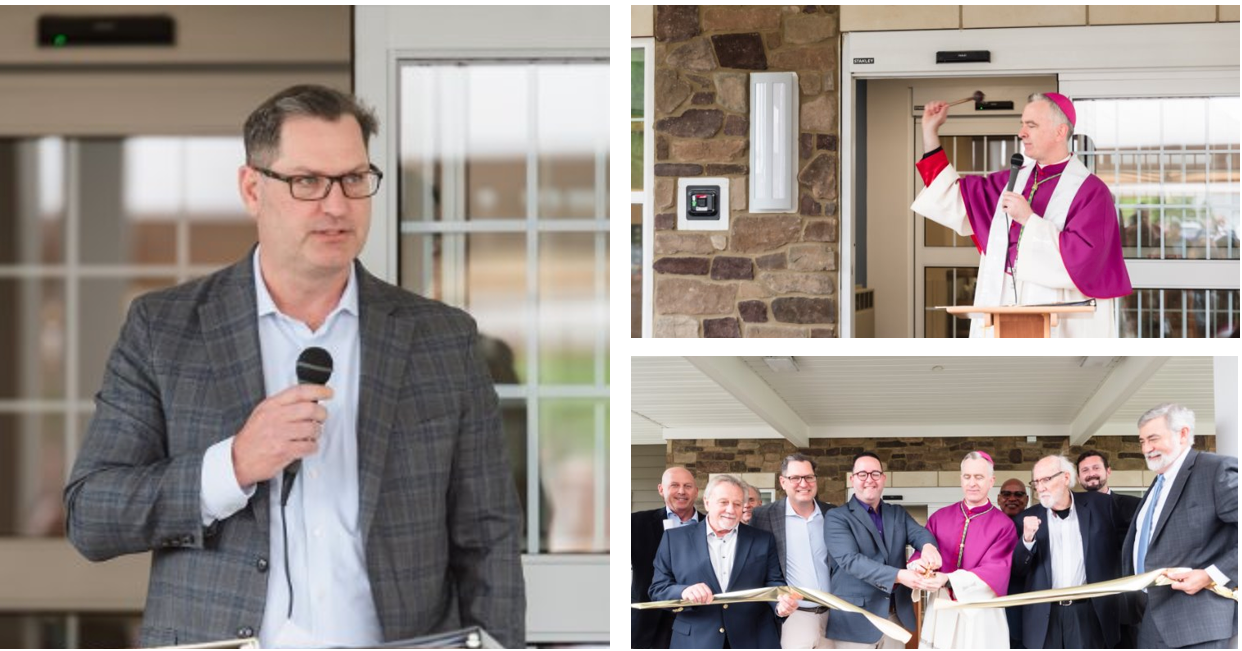
Last week, we proudly celebrated the Grand Opening and Building Dedication of Mews at St. Mary in Williamstown, NJ, alongside our amazing colleagues, local leaders, community organizations, development partners, and The Bishop of Camden. Mews at St. Mary is now home to 75 affordable homes for seniors, thoughtfully designed to encourage community, friendship, and support for our aging population. Developed by The Diocese of Camden and The Walters Group, Mews at St. Mary has become a safe space for residents. In addition to the senior-friendly design, this community features an on-site wellness nurse and resident-driven programming.
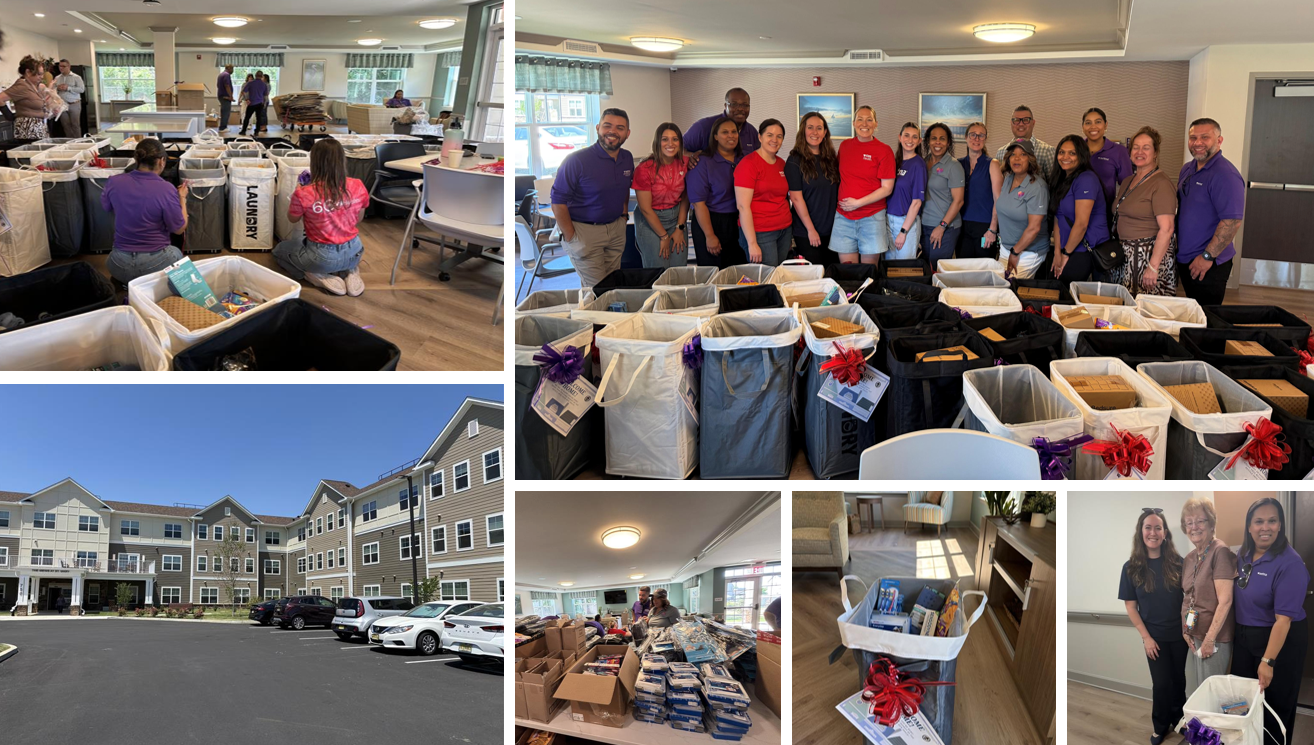
It was truly inspiring to celebrate this event with everyone. We are incredibly grateful to our colleagues who joined us and represented CVS Health and Aetna at the Grand Opening. We are even more proud of our dedicated group of colleagues that joined us to assemble 75 welcome baskets the day before. These baskets were a labor of love and include items from socks and toothpaste, to jar openers and laundry pods. Spending the afternoon passing out the baskets to each resident was inspiring. It reminded us of why we do this work and how small acts can make a huge impact.
A special thank you to all of our CVS and Aetna colleagues! Thank you to George Doyle for your wonderful remarks at the ceremony. Our colleagues presence and support truly made the day meaningful, and we could not do this without help from every corner of the company!
CVS Health‑Aetna is proud to support developments like Mews at St. Mary, which reflect our commitment to strengthening communities and showcasing that Housing is Healthcare. Developments like this remind us of the lasting impact our work has in the neighborhoods where we live and serve. We cannot wait until the next time we get to celebrate with you again in New Jersey!
A briefing on why CDP and SBTi’s shift to commercial capital is a sign of how central disclosure has become, and what that growth will cost you.
Permira’s acquisition of a majority stake in CDP, expected to close by year-end pending approval from the UK Charity Commission, ends 25 years of nonprofit-led carbon disclosure governance and replaces it with a hybrid structure: a commercial entity built for growth and investor returns, alongside an independent charitable foundation built to protect the mission.
We’ve seen this before. In 2023, SBTi spun off a commercial verification arm, SBTi Services, while retaining standard-setting under a nonprofit board. Two keystone sustainability systems restructuring the same way within a few years of each other is not a coincidence. And it is not, on its own, bad news. It is a sign of a maturing sustainability market.
What does this mean for sustainability? Net: it’s getting more attention, more resources, and more scrutiny. Based on historical precedent in AI, the medical field, and even stock exchanges, we are also likely to see this greater attention result in higher-quality services that command higher prices.
Private capital follows demand and fills in when this demand overwhelms the financial and technical resources of a nonprofit. CDP reports that more than 23,000 companies, cities, states, and regions disclosed through its platform in 2025, even as voluntary ESG activity lost momentum. SBTi created its commercial arm because the number of companies seeking validated targets grew close to 60 percent in nine months, with total validated targets up 102 percent for the year. No foundation grant or membership fee structure can fund that kind of volume. For 20 years, the view in sustainability has been that voluntary disclosure is a first step rather than a destination, and that the field’s real test of maturity is whether it can attract the kind of capital financial markets take for granted. By that measure, this looks like success—though not without its trade-offs.
The Real Driver Behind Disclosure Growth
What is in demand—sustainability or more accurate risk management? Trick question: both. To understand the CDP deal, we have to understand two parts of sustainability in business:
The Cultural and Political Narrative – sustainability as voluntary commitments, public pledges, symbolic projects, and marketing. This aspect of sustainability has genuinely lost ground over the past two years under political pressure in the United States and elsewhere.
The Operational and Strategic – sustainability as risk management and growth amplifier. Underneath the narrative, there is an increasingly sophisticated data infrastructure: the systems investors, insurers, operators, and supply chain managers actually use to price risk and make decisions. This trend has been growing for decades, and the recent influx of private capital to the space is another sign that it is now part of the main event, not a sideshow.
CDP’s and SBTi’s growth numbers and other reports show the demand for data is stable and growing. That is the real signal in this deal. Data infrastructure has become load-bearing in a way the marketing narrative no longer is. This kind of essential infrastructure attracts capital, regardless of whether it is fashionable to discuss.
What Other Industries Can Teach Us
We can learn from looking outside sustainability to see this same funding arc play out.
OpenAI is a highly visible current example. OpenAI began as a nonprofit committed to unlocking the potential for AI-led research. In doing so, it discovered that the demand for increasingly capable models required capital and computing power that philanthropy could not supply. The fix was a commercial subsidiary, theoretically supervised by a nonprofit board. When that board tried to slow the company down in late 2023 over safety concerns, the market reasserted itself within days—and the board lost.
Memorial Sloan Kettering (MSK) took a similar approach, but with physical assets rather than mission. The cancer center held millions of pathology slides, an archive whose value only became obvious once machine learning could use it at scale. Rather than build that capability in-house, MSK licensed the data exclusively to a for-profit spin-out, Paige.AI, in exchange for equity. Its own staff later objected that a public-purpose asset had gone to private investors without competitive bidding.
And finally, many forget the New York Stock Exchange and NASDAQ began as member-owned cooperatives in 1970s. When electronic trading drove sharp increases in volume and infrastructure costs in the late 1990s, members were unwilling to fund the buildout collectively, leading both exchanges to convert to for-profit, shareholder-owned corporations in the 2000s. Both immediately began charging premium rates for something that had previously been a shared utility: market data itself.
Commercial Growth Comes with Trade-Offs
The capital required for growth comes with control attached. Permira’s majority stake gives the commercial CDP entity direct legal leverage over the nominally independent CDP Foundation. This is the same trade SBTi made when it created SBTi Services, and the same imbalance that let OpenAI’s investors override its nonprofit board. SBTi’s version of this tension surfaced in 2024, when staff revolted after its board tried to fast-track carbon offset flexibilities under investor and corporate pressure. None of these boards intended to lose authority to their commercial arms; the funding made it happen anyway.
CDP’s revenue depends on keeping its base of participants enrolled—a challenge it has faced for several years—which creates pressure to soften requirements that growth itself made harder to meet. SBTi’s Corporate Net-Zero Standard V2.0 is the clearest case: facing corporate dropouts over rigid Scope 3 mandates and heavy lobbying from technology companies managing data center power demand, SBTi dropped several long-term goal requirements and scaled hourly-matching obligations down to only the largest electricity consumers. CDP, now answerable to a majority investor who needs that same enrollment to justify the deal, faces nearly identical pressure. For years, CDP has been facing mounting challenges associated with the burden of reporting and the cost of participation. In 2024, CDP responded by launching a streamlined Corporate Questionnaire, but it was riddled with technical issues and scoring errors. That year, more than 24,800 companies disclosed. Around the same time, companies were also paying close attention to the ESG regulations in California and the European Union. In 2025, CDP disclosures fell to just shy of 22,200 companies. Many expressed frustration with CDP’s 2024 cycle and also pointed to the need to shift their efforts and budgets towards regulatory compliance rather than a voluntary questionnaire.
Three Disclosure Strategy Considerations for 2026 and Beyond
None of this suggests walking away from CDP or SBTi. Both are more capable and better funded than they were. Some recommendations to consider with your team to manage a new world of privately funded reporting:
Expect the for-profit entity to move faster. Watch the CDP Foundation and SBTi’s nonprofit board for genuine changes to question banks, validation criteria, and underlying climate science. Monitor the commercial entities—CDP’s new private equity-backed business and SBTi Services—for changes in pricing, timelines, and software.
Plan for paywalls on anything beyond baseline submission or validation. Peer benchmarking, deeper supply-chain visibility, and clean interface integrations are the features most likely to migrate behind a premium tier over the next two to three years.
Prepare for greater scrutiny. A platform built to attract investor capital is also built to surface errors to investors more quickly. Data governance that was once “good enough” for a text field must now withstand an automated audit.
In sum, establish a disclosure strategy with defined accountability and data ownership. Build your core data set around the standards and frameworks that matter most to your organization, instead of allowing CDP, SBTi, and regulatory requirements to drive separate, disconnected collection processes. Each output will differ because the treatment of topics such as offsets, greenhouse gas accounting, and organizational boundaries vary by framework. A strong disclosure strategy reduces the cost and risk of fragmented reporting and leverages the same underlying data to inform better business decisions—the original purpose behind CDP, SBTi, CSRD, and California’s climate disclosure rules.
Now that CDP and SBTi sit on commercial entities, keep your own copy of the underlying data and negotiate export rights the way you would with any enterprise vendor. A profit-driven owner has more incentives than a nonprofit ever did to charge for access to your own historical submissions.
As reporting frameworks, disclosure platforms, and regulatory requirements become increasingly interconnected, organizations need a coordinated strategy for managing data, governance, and reporting obligations.
Contact Antea Group’s Corporate Disclosure & Reporting team to learn how we can help strengthen your reporting program, data governance, and disclosure readiness.
WHAT: Rachel Hodgdon, President and CEO of the International WELL Building Institute (IWBI), will join leading experts in public health, architecture and healthy buildings – including healthy buildings expert and author Dr. Joseph G. Allen, Director of Harvard University’s Healthy Buildings Program – for a discussion during 2026 Aspen Ideas – Health on how the design and operation of buildings can improve human health, resilience and quality of life.
The session, “Healthy Buildings for Healthy Lives,” will explore the growing body of evidence showing how healthier indoor environments—from cleaner air and better ventilation to healthier materials, daylight and biophilic design—can help reduce disease transmission, support mental health and strengthen resilience in the face of climate change.
As people spend approximately 90% of their time indoors, the conversation will examine why healthy buildings have become an increasingly important public health strategy and what building owners, employers and policymakers can do to create healthier places where people live, learn, work and heal.
WHO:
Rachel Hodgdon, President and CEO, International WELL Building Institute
Joseph Allen, Director, Healthy Buildings Program, Harvard T.H. Chan School of Public Health
Diana Araoz-Fraser, Vice President and Studio Design Leader, HKS Architects
Moderator: Céline Gounder, CBS News Medical Contributor and Editor-at-Large, KFF Health News
WHEN: Wednesday, June 24, 2026 1:40 p.m. – 2:30 p.m.
WHERE: Aspen Ideas: Health East Lawn Tent
MEDIA OPPORTUNITY: Rachel Hodgdon is available for interviews before and after the session to discuss:
Why investing in healthy buildings is an investment in public health and a C-suite mission
The business case for healthier workplaces and communities
Healthy buildings as a strategy for climate resilience and disease prevention
How evidence-based building design can improve health, well-being and organizational performance
The growing global movement to advance health through the built environment
WASHINGTON, D.C., June 22, 2026, /3BL/ — The Howard University & PNC National Center for Entrepreneurship will host its 2026 HBCU Empower Conference June 24–26 at the Westin DC Downtown in Washington, D.C.
This national convening brings together founders, investors and ecosystem leaders to explore how entrepreneurs can plant seeds for prosperity and ownership that extend far beyond a single generation.
For centuries, Historically Black Colleges and Universities (HBCUs) have served as engines of ingenuity, resilience and leadership, producing entrepreneurs and institution builders. Today, that legacy enters a new chapter as artificial intelligence (AI) transforms the global economy, reshapes industries, and redefines how businesses are built.
Now in its fourth year, the summit has grown into one of the nation’s premier convenings dedicated to HBCU entrepreneurship and innovation. With a theme of “Securing Our Place in the Future,” HBCU Empower will bring together professionals and students from across the country to explore how AI can drive entrepreneurial wealth and generational prosperity. Participants will examine how tradition and technology intersect to create pathways of ownership and opportunity.
“This summit reflects our continuing commitment to supporting entrepreneurs with the tools, insights, and connections they need to thrive,” said Johnny Graham, Ph.D., national executive director of the Howard University & PNC National Center for Entrepreneurship. “For students, faculty, and experienced and new founders, this conference will provide the connections, capital, and conversations needed to ensure that entrepreneurs are not just participants in the innovation economy but are leading it.”
The PNC Foundation supports the Howard University & PNC National Center for Entrepreneurship’s mission to build resources and support for entrepreneurs across the country. Since its founding, the National Center has awarded more than $800,000 in funding to students, faculty, staff, and community entrepreneurs; engaged 83 HBCUs and built a program community of more than 7,500 participants and attendees.
“Helping to expand access and opportunity is part of what community impact means to us at PNC,” said Stacy Juchno, PNC chief corporate responsibility officer. “When we help entrepreneurs succeed, we make positive impact in our communities, through job creation and small business expansion. We’re proud to support this work.”
This year’s conference highlights include the Mecca Marketplace and the HBCU Empower Pitch Competition, along with mainstage panels, expert-led workshops, and networking receptions. The conference closes with the HBCU Empower Awards, celebrating student, faculty and alumni innovators.
Attendees will hear from business experts and entrepreneurs, including: Cornell McBride Jr., president of Design Essentials; Donald Cravins Jr., president and CEO of the National Minority Supplier Development Council; Shaina Rainford, founder and CEO of Bask and Lather Co.; Nasir Qadree, founder & managing partner of Zeal Capital Partners; and Natalie Madeira Cofield, president and CEO of Association for Enterprise Opportunity.
Registration details and the program agenda are available at hbcuempower.com. Members of the media can request press credentials by contacting the Howard University Office of University Communications at mediarelations@howard.edu.
About The PNC Foundation The PNC Foundation, which receives its principal funding from The PNC Financial Services Group, Inc. (NYSE: PNC), actively supports organizations that provide services for the benefit of communities in which it has a significant presence. The Foundation focuses its philanthropic mission on early childhood education and community and economic development, which includes the arts and culture. Through PNC Grow Up Great®, its signature cause that began in 2004, PNC has created a bilingual $500 million, multi-year initiative to help prepare children from birth to age 5 for success in school and life.
About The Howard University & PNC National Center for Entrepreneurship The Howard University & PNC National Center for Entrepreneurship is a national consortium & hub focused on enhancing entrepreneurship education at Historically Black Colleges & Universities (HBCUs) and empowering entrepreneurs around the country. The National Center for Entrepreneurship enhances the success and growth of businesses through providing programming, capital, curriculum, research, and other resources in collaboration with Historically Black Colleges and Universities (HBCUs) and their surrounding communities.
LOUISVILLE, Ky., June 22, 2026 /3BL/ – Yum! Brands (NYSE: YUM) published its annual Global Citizenship & Sustainability Report, spotlighting how the company is integrating sustainability into its growth strategy to manage long-term risk, improve operational resilience and support franchisee success.
“In 2025, we made continued progress on our global citizenship and sustainability priorities while navigating meaningful change, both in our business and in the external environment,” said Yum! Brands CEO Chris Turner. “Across markets, evolving regulations and disclosure expectations are reshaping how companies approach issues like packaging and responsible sourcing. At the same time, our teams remain focused on building capabilities and systems that support our franchisees and strengthen our brands for the long term.”
2025 was a year of progress across the company’s People, Food and Planet pillars as it introduced its new growth plan. Sustainability efforts at Yum! support the company’s business strategy by building and managing long-term risks. Highlights from the report include:
Invested over $74 million to fight hunger worldwide, reaching 6.5 million people and delivering 46.8 million meal equivalents through food, product and cash donations
Strengthened global food safety systems through Global Food Safety Initiative (GFSI)-recognized certifications, with approximately 93% of required suppliers being GFSI-certified
Established Raised Responsibly framework, a unified, science-based approach focused on improving how chickens are raised through measurable, outcome-based indicators that builds on a strong foundation of KFC’s supply chain efforts including monitoring the welfare of more than 13 billion chickens since 2018
Decreased Scope 1 & 2 emissions 18% from 2019 baseline while improving corporate-owned restaurant emissions intensity by 40% since 2019
Continued investments in climate-focused supply chain pilots across beef, dairy, soy and chicken including KFC France chicken farm emissions reduction pilots, a new KFC and Conservation International project that supports more sustainable production of palm oil and soy, and the Taco Bell U.S. beef partnership with the National Fish and Wildlife Foundation
Elevated packaging with focus on circularity, including the Pizza Hut U.S. recyclable wing bowl, Habit’s shift from select plastic packaging to fiber-based formats and the company’s overall strategic management of compliance efforts such as extended producer responsibility
Assessed corporate risks related to sustainability through multiple reports including an initial Taskforce on Nature-related Financial Disclosures Report and an updated Taskforce on Climate-related Financial Disclosures Report
“We continue to integrate citizenship and sustainability at Yum! and within our brands, driving business resilience through efforts like strategic supply chain partnerships and operating more efficient restaurants,” said Jon Hixson, Yum! Brands Chief Sustainability Officer & Vice President, Government Affairs. “I’m proud of the work we’ve done to drive value creation and support our franchisees in growing our iconic restaurant brands globally.”
For further details, view the Yum! Brands’ 2025 Global Citizenship & Sustainability Report at www.yum.com/impact.
About Yum! Brands, Inc.
Yum! Brands, Inc., and its subsidiaries franchise or operate more than 63,000 restaurants across over 155 countries and territories under its iconic brands — KFC, Taco Bell, Pizza Hut and Habit Burger & Grill. KFC, Taco Bell and Pizza Hut are global leaders in the chicken, Mexican-inspired food and pizza categories, respectively. Habit Burger & Grill is a fast-casual concept known for made-to-order chargrilled burgers, sandwiches and more.
Fueled by Yum!’s Recipe for Good Growth, KFC, Taco Bell and Pizza Hut led Entrepreneur’s 2026 Franchise 500 rankings and its Top Global Franchises 2025 list. In 2026, Yum!’s unrivaled culture and talent led it to be named one of TIME magazine’s list of Best Companies for Future Leaders for the third consecutive year.
Somewhere in the world, right now, someone is naming an idea.
It might be a bakery in Lisbon. An AI startup in San Francisco. A small business owner in Mumbai turning a weekend side hustle into something bigger. Before any of it becomes real, one thing has to happen first: they need a domain name.
That’s where we come in.
For more than 25 years, GoDaddy has had the pleasure of being there for that moment. Today, over 20 million customers in more than 100 countries trust us to help them claim their corner of the internet – which means that when we look at our proprietary data, we’re not just looking at GoDaddy. We’re looking at a meaningful slice of the open web itself.
So once a year, we step back and ask a simple question: what is the world actually building?
In this blog post, we’ll cover the full answer. It’s a story about domain names, geography, language, ambition, and taste. About the enduring power of .com, the breakout of .ai, and a handful of shifts we didn’t see coming. And more than anything, it’s a thank-you — genuinely — to every single person who decided 2025 was their year to start something new, and trusted GoDaddy to help them register a domain and bring it to life.
.com is still the anchor. But the story is getting richer.
Let’s start with the number that barely moved and the one that shifted the most.
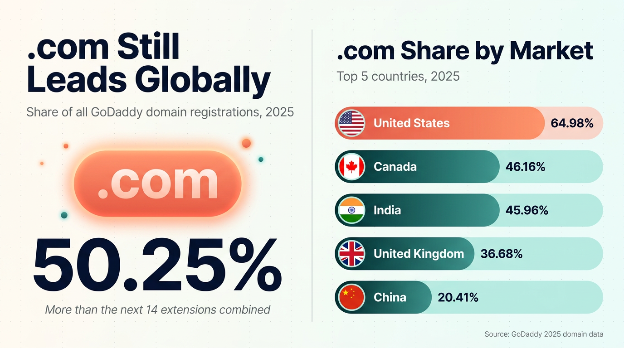
In 2025, .com accounted for 50.25% of every domain registered on GoDaddy. More than the next fourteen extensions combined. Four decades in, three letters still carry remarkable trust.
Look across our major markets, though, and the picture gets more textured:
United States – 64.98% .com
Canada – 46.16%
India – 45.96%
United Kingdom – 36.68%
China – 20.41%
In the U.S., customers who register a domain still reach for .com almost by reflex. In other markets, customers are thoughtfully building a mix, blending .com with local or specialty extensions that reflect where they are and what they do.
Five countries, most of our registrations
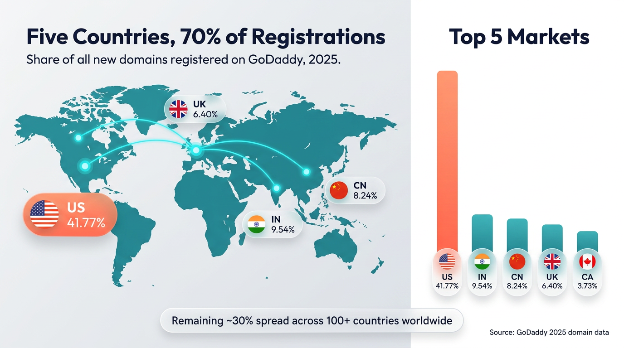
On GoDaddy, the domain market is more concentrated than you might expect. In 2025, nearly 70% of the new domains registered with us came from just five countries, with the U.S. leading at 41.77% of all GoDaddy registrations.
Rank
Country
Share of GoDaddy 2025 registrations
1
United States
41.77%
2
India
9.54%
3
China
8.24%
4
United Kingdom
6.40%
5
Canada
3.73%
A closer look at the U.S.
Since the United States drives over 40% of global registrations, it’s worth taking a closer look at what American business owners are actually choosing.
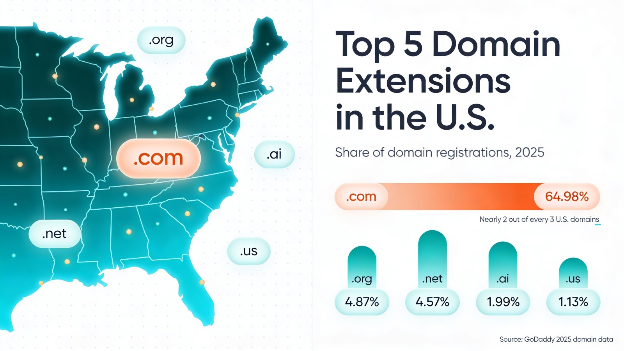
Here’s a quick breakdown of the top five domain extensions registered in the United States:
First, .com’s grip on the U.S. is unmatched. Nearly two out of every three American customers who register a domainon GoDaddy still reach for .com.
Second, .ai has cracked the top five. An extension that wasn’t on anyone’s radar three years ago now outranks .us in the U.S.
Outside the U.S., local extensions shine
If you’re building a business beyond American borders, here’s a pattern worth planning around: one .com is often not the full picture.
In the UK, .co.uk nearly matches .com among GoDaddy customers at 35.89%. Add .uk, and more than four in ten UK registrations are local extensions.
In India, .in alone accounts for 24.91% of GoDaddy registrations. Include .co.in, and close to one in three Indian domains on GoDaddy is a local ccTLD.
In Canada, .ca sits at 34.78% of Canadian registrations, about a third of the market. The takeaway is practical. Customers in these markets often want to see a local extension, and search engines reward the signal. If you’re expanding internationally, pairing your .com with a local ccTLD when you buy a domain is one of the simplest ways to build trust with local audiences.
The breakout story of 2025: .ai
Every year has an extension that defines it. In our 2025 data, that extension was .ai.
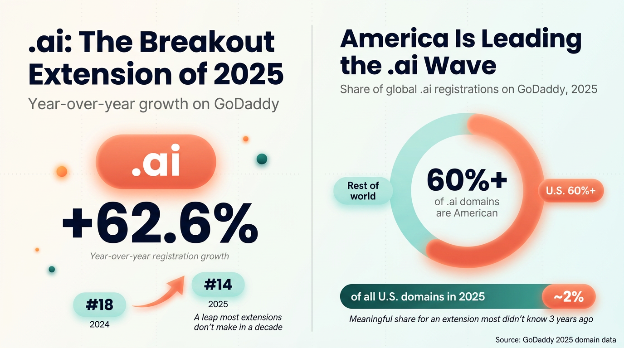
On GoDaddy, .ai registrations grew 62.6% year-over-year. In our rankings, it climbed from #18 to #14 in a single year.
And the growth wasn’t powered by a handful of large buyers. Total registrations and daily averages grew at nearly identical rates, which tells us this demand came from thousands of individual founders and teams, each making the same choice independently.
The U.S. led the way. More than 60% of .ai domains registered on GoDaddy came from American customers. Nearly 2% of every U.S. domain registered on GoDaddy in 2025 was a .ai, a meaningful share for an extension that most people didn’t really use three years ago. The signal is simple: if you’re building something in AI, .ai proves credibility. You can find your .ai domain on GoDaddy in seconds.
Ecommerce has its own lane
A few years ago, telling someone your domain ended in .shop might have sounded experimental. Not in 2025.
In 2025, .shop became the #4 extension on GoDaddy globally, at 2.82% of all registrations. .store landed at #11 with 1.93%. Together, they represent millions of merchants who decided the fastest way to tell a customer what they do is to put it right there in the URL. If you’re starting an online business and the .com you want is already taken, a .shop or .store isn’t a compromise. It’s a clear, confident signal of what you sell.
The internet has a favorite day
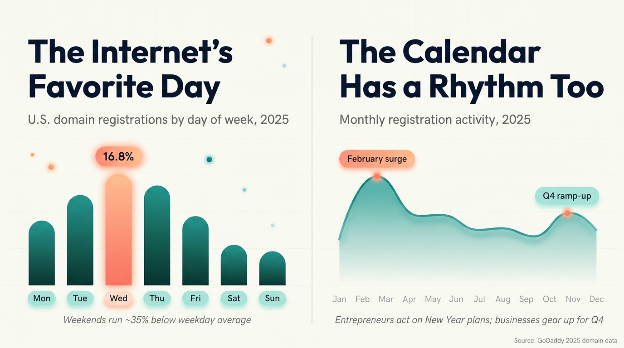
Wednesday is the busiest day for domain registrations on GoDaddy.
In 2025, 16.8% of every U.S. domain registration on GoDaddy happened on a Wednesday. Weekends run about 35% below the weekday average. The calendar has its own pattern too: February surges as entrepreneurs act on New Year plans, and mid-November picks up as businesses gear up for Q4.
So if you’re sitting on a name you love, don’t leave it for Saturday. Wednesday mornings are when the internet moves fastest, and the name you want today is likely the name someone else is searching for right now.
What 2025 is telling us about 2026
Here’s what the cumulative stats tell us about domain trends in 2026:
.com is still the anchor. Trusted, instinctive, and still more than half of GoDaddy registrations.
Local extensions matter more than ever. If you sell beyond the U.S., pairing your .com with a ccTLD is often a smart move.
.ai has graduated. No longer a tech flex. If you’re building in AI, you need a .ai domain.
Ecommerce extensions are credible. .shop and .store have earned their place.
Timing is an advantage. The best moment to find a domain name and lock it in is midweek, before demand peaks.
The domain landscape heading into 2026 is more diverse, more global, and more thoughtful than it has ever been. That’s the good news for anyone starting something new: there have never been more ways to plant your flag online.
The hardest part is just deciding to begin.
Your name is out there
Much of the internet has been built by people willing to name something new.
Somewhere in our 2025 proprietary data is a founder who registered a domain on an ordinary Wednesday in February and changed the trajectory of their life. In 2026, that could be you.
If you have an idea, a business, or a brand still waiting on a name, this is the moment. Find and register your domain on GoDaddy in minutes, and join the 20+ million customers already building what’s next.
GoDaddy customers registered millions of domains in 2025. The only one that matters for you is the one you haven’t registered yet.
Somewhere in the world, right now, someone is naming an idea.
It might be a bakery in Lisbon. An AI startup in San Francisco. A small business owner in Mumbai turning a weekend side hustle into something bigger. Before any of it becomes real, one thing has to happen first: they need a domain name.
That’s where we come in.
For more than 25 years, GoDaddy has had the pleasure of being there for that moment. Today, over 20 million customers in more than 100 countries trust us to help them claim their corner of the internet – which means that when we look at our proprietary data, we’re not just looking at GoDaddy. We’re looking at a meaningful slice of the open web itself.
So once a year, we step back and ask a simple question: what is the world actually building?
In this blog post, we’ll cover the full answer. It’s a story about domain names, geography, language, ambition, and taste. About the enduring power of .com, the breakout of .ai, and a handful of shifts we didn’t see coming. And more than anything, it’s a thank-you — genuinely — to every single person who decided 2025 was their year to start something new, and trusted GoDaddy to help them register a domain and bring it to life.
.com is still the anchor. But the story is getting richer.
Let’s start with the number that barely moved and the one that shifted the most.
In 2025, .com accounted for 50.25% of every domain registered on GoDaddy. More than the next fourteen extensions combined. Four decades in, three letters still carry remarkable trust.
Look across our major markets, though, and the picture gets more textured:
United States – 64.98% .com
Canada – 46.16%
India – 45.96%
United Kingdom – 36.68%
China – 20.41%
In the U.S., customers who register a domain still reach for .com almost by reflex. In other markets, customers are thoughtfully building a mix, blending .com with local or specialty extensions that reflect where they are and what they do.
Five countries, most of our registrations
On GoDaddy, the domain market is more concentrated than you might expect. In 2025, nearly 70% of the new domains registered with us came from just five countries, with the U.S. leading at 41.77% of all GoDaddy registrations.
Rank
Country
Share of GoDaddy 2025 registrations
1
United States
41.77%
2
India
9.54%
3
China
8.24%
4
United Kingdom
6.40%
5
Canada
3.73%
A closer look at the U.S.
Since the United States drives over 40% of global registrations, it’s worth taking a closer look at what American business owners are actually choosing.
Here’s a quick breakdown of the top five domain extensions registered in the United States:
First, .com’s grip on the U.S. is unmatched. Nearly two out of every three American customers who register a domainon GoDaddy still reach for .com.
Second, .ai has cracked the top five. An extension that wasn’t on anyone’s radar three years ago now outranks .us in the U.S.
Outside the U.S., local extensions shine
If you’re building a business beyond American borders, here’s a pattern worth planning around: one .com is often not the full picture.
In the UK, .co.uk nearly matches .com among GoDaddy customers at 35.89%. Add .uk, and more than four in ten UK registrations are local extensions.
In India, .in alone accounts for 24.91% of GoDaddy registrations. Include .co.in, and close to one in three Indian domains on GoDaddy is a local ccTLD.
In Canada, .ca sits at 34.78% of Canadian registrations, about a third of the market. The takeaway is practical. Customers in these markets often want to see a local extension, and search engines reward the signal. If you’re expanding internationally, pairing your .com with a local ccTLD when you buy a domain is one of the simplest ways to build trust with local audiences.
The breakout story of 2025: .ai
Every year has an extension that defines it. In our 2025 data, that extension was .ai.
On GoDaddy, .ai registrations grew 62.6% year-over-year. In our rankings, it climbed from #18 to #14 in a single year.
And the growth wasn’t powered by a handful of large buyers. Total registrations and daily averages grew at nearly identical rates, which tells us this demand came from thousands of individual founders and teams, each making the same choice independently.
The U.S. led the way. More than 60% of .ai domains registered on GoDaddy came from American customers. Nearly 2% of every U.S. domain registered on GoDaddy in 2025 was a .ai, a meaningful share for an extension that most people didn’t really use three years ago. The signal is simple: if you’re building something in AI, .ai proves credibility. You can find your .ai domain on GoDaddy in seconds.
Ecommerce has its own lane
A few years ago, telling someone your domain ended in .shop might have sounded experimental. Not in 2025.
In 2025, .shop became the #4 extension on GoDaddy globally, at 2.82% of all registrations. .store landed at #11 with 1.93%. Together, they represent millions of merchants who decided the fastest way to tell a customer what they do is to put it right there in the URL. If you’re starting an online business and the .com you want is already taken, a .shop or .store isn’t a compromise. It’s a clear, confident signal of what you sell.
The internet has a favorite day
Wednesday is the busiest day for domain registrations on GoDaddy.
In 2025, 16.8% of every U.S. domain registration on GoDaddy happened on a Wednesday. Weekends run about 35% below the weekday average. The calendar has its own pattern too: February surges as entrepreneurs act on New Year plans, and mid-November picks up as businesses gear up for Q4.
So if you’re sitting on a name you love, don’t leave it for Saturday. Wednesday mornings are when the internet moves fastest, and the name you want today is likely the name someone else is searching for right now.
What 2025 is telling us about 2026
Here’s what the cumulative stats tell us about domain trends in 2026:
.com is still the anchor. Trusted, instinctive, and still more than half of GoDaddy registrations.
Local extensions matter more than ever. If you sell beyond the U.S., pairing your .com with a ccTLD is often a smart move.
.ai has graduated. No longer a tech flex. If you’re building in AI, you need a .ai domain.
Ecommerce extensions are credible. .shop and .store have earned their place.
Timing is an advantage. The best moment to find a domain name and lock it in is midweek, before demand peaks.
The domain landscape heading into 2026 is more diverse, more global, and more thoughtful than it has ever been. That’s the good news for anyone starting something new: there have never been more ways to plant your flag online.
The hardest part is just deciding to begin.
Your name is out there
Much of the internet has been built by people willing to name something new.
Somewhere in our 2025 proprietary data is a founder who registered a domain on an ordinary Wednesday in February and changed the trajectory of their life. In 2026, that could be you.
If you have an idea, a business, or a brand still waiting on a name, this is the moment. Find and register your domain on GoDaddy in minutes, and join the 20+ million customers already building what’s next.
GoDaddy customers registered millions of domains in 2025. The only one that matters for you is the one you haven’t registered yet.
Fuel logistics remain a critical vulnerability in modern operations because continuous resupply slows maneuver, extends supply lines, and increases risk to personnel.
Leidos’ ongoing participation in the ExCURSion program combines the strengths of fuel and batteries by storing energy as regenerable carbon-based fuel in a closed, rechargeable system.
This regenerative approach to expeditionary energy aims to enable on-demand fuel production, reducing convoy requirements while increasing operational flexibility and mission endurance.
The risk of fuel in modern operations
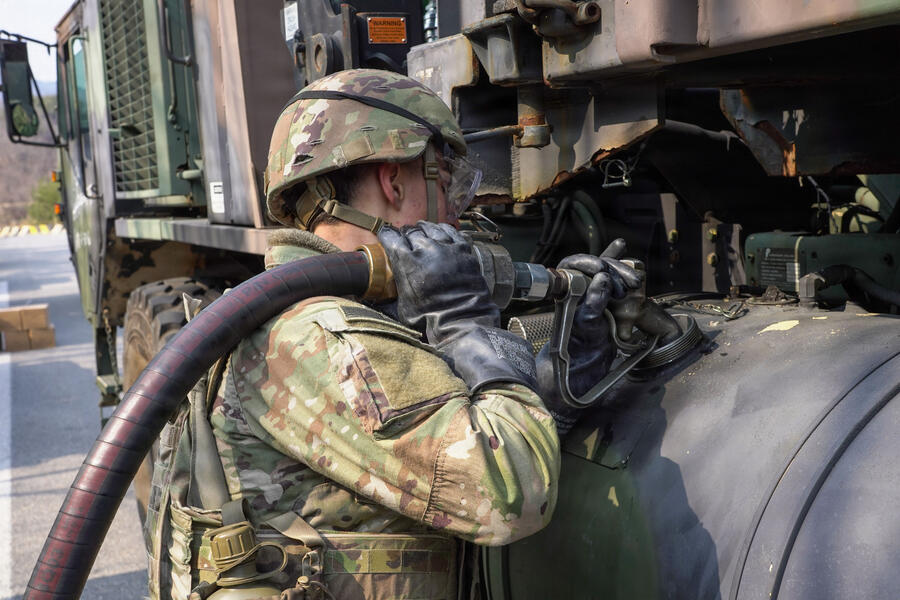
Moving fuel remains one of the most persistent risks in modern military operations. It slows maneuvers, extends vulnerable supply lines, and exposes personnel to unnecessary danger.
Leidos is working with the Defense Advanced Research Projects Agency (DARPA) to address that challenge at its root. Energy resilience is not just a technical hurdle, it is a strategic priority as missions demand more secure, adaptable, and sustainable power.
The limits of today’s power options
Today, portable energy involves a fundamental tradeoff. Batteries are efficient, quiet, and adaptable, with the ability to recharge from many different energy inputs. However, their relatively low energy density limits runtime and can drive up size and weight.
Fuels, by contrast, pack far more energy into a smaller footprint, offering strong size, weight, and power performance. But they depend on ongoing resupply, imposing a logistical burden that is costly, constraining, and potentially hazardous.
A new model: the ExCURSion program
Through DARPA’s Expeditionary Carbon Utilization for Energy Resilience and Stabilization (ExCURSion) program, Leidos is helping develop a fundamentally different approach to expeditionary power.
ExCURSion aims to eliminate the tradeoff between batteries and fuel by creating a closed, rechargeable system designed to store energy as carbon-based fuel. By integrating carbon combustion, capture, and regeneration into a single platform, ExCURSion systems are intended to combine attributes of fuel-based endurance with the flexibility of a rechargeable battery, with the goal of producing fuel on demand from inputs such as carbon dioxide, water, and electricity.
Advancing the technology: 1,000 recharges
The Leidos approach to ExCURSion depends on two core innovations: 1) high-rate carbonate reduction processes performed in carefully engineered electrolytes and 2) advanced materials capable of shuttling critical chemical species between the electrodes in addition to providing chemical and physical stability to the electrochemical cells themselves.
Together, these technologies are designed to enable a system that can regenerate its own fuel, operate for extended periods, and adapt to diverse energy inputs. In partnership with the Massachusetts Institute of Technology, Leidos has demonstrated a working cell prototype that recharged rapidly and cycled up to 1,000 times in testing, representing progress toward potential operational use.
Impact at the tactical edge
“This is about fundamentally changing how energy is delivered and sustained in contested environments,” said John Dresios, division manager of Chemistry/Biology/Materials Sciences at Leidos. “By combining the strengths of batteries and fuel into a single, regenerative system, we can reduce logistical risk, increase operational flexibility, and give warfighters more control over their energy supply wherever they operate.”
The intended operational benefits include the potential for fewer fuel convoys, reduced exposure to threats, and improved mission endurance. The approach also helps reduce dependence on certain critical minerals and traditional fossil fuels, addressing both logistical and environmental considerations.
Scaling for the future
ExCURSion reflects a broader effort by Leidos to invest in resilient, scalable mission systems, from energy at the tactical edge to secure infrastructure across the mission environment. Recent strategic actions, including the acquisition of ENTRUST, are intended to expand our ability to deliver integrated capabilities aligned with evolving national needs.
Approved for Public Release, Distribution Unlimited.
This material is based upon work supported by the Defense Advanced Research Projects Agency (DARPA) under Contract No. HR001125C0012. Any opinions, findings and conclusions or recommendations expressed in this material are those of the author(s) and do not necessarily reflect the views of the Defense Advanced Research Projects Agency (DARPA).
Fuel logistics remain a critical vulnerability in modern operations because continuous resupply slows maneuver, extends supply lines, and increases risk to personnel.
Leidos’ ongoing participation in the ExCURSion program combines the strengths of fuel and batteries by storing energy as regenerable carbon-based fuel in a closed, rechargeable system.
This regenerative approach to expeditionary energy aims to enable on-demand fuel production, reducing convoy requirements while increasing operational flexibility and mission endurance.
The risk of fuel in modern operations
Moving fuel remains one of the most persistent risks in modern military operations. It slows maneuvers, extends vulnerable supply lines, and exposes personnel to unnecessary danger.
Leidos is working with the Defense Advanced Research Projects Agency (DARPA) to address that challenge at its root. Energy resilience is not just a technical hurdle, it is a strategic priority as missions demand more secure, adaptable, and sustainable power.
The limits of today’s power options
Today, portable energy involves a fundamental tradeoff. Batteries are efficient, quiet, and adaptable, with the ability to recharge from many different energy inputs. However, their relatively low energy density limits runtime and can drive up size and weight.
Fuels, by contrast, pack far more energy into a smaller footprint, offering strong size, weight, and power performance. But they depend on ongoing resupply, imposing a logistical burden that is costly, constraining, and potentially hazardous.
A new model: the ExCURSion program
Through DARPA’s Expeditionary Carbon Utilization for Energy Resilience and Stabilization (ExCURSion) program, Leidos is helping develop a fundamentally different approach to expeditionary power.
ExCURSion aims to eliminate the tradeoff between batteries and fuel by creating a closed, rechargeable system designed to store energy as carbon-based fuel. By integrating carbon combustion, capture, and regeneration into a single platform, ExCURSion systems are intended to combine attributes of fuel-based endurance with the flexibility of a rechargeable battery, with the goal of producing fuel on demand from inputs such as carbon dioxide, water, and electricity.
Advancing the technology: 1,000 recharges
The Leidos approach to ExCURSion depends on two core innovations: 1) high-rate carbonate reduction processes performed in carefully engineered electrolytes and 2) advanced materials capable of shuttling critical chemical species between the electrodes in addition to providing chemical and physical stability to the electrochemical cells themselves.
Together, these technologies are designed to enable a system that can regenerate its own fuel, operate for extended periods, and adapt to diverse energy inputs. In partnership with the Massachusetts Institute of Technology, Leidos has demonstrated a working cell prototype that recharged rapidly and cycled up to 1,000 times in testing, representing progress toward potential operational use.
Impact at the tactical edge
“This is about fundamentally changing how energy is delivered and sustained in contested environments,” said John Dresios, division manager of Chemistry/Biology/Materials Sciences at Leidos. “By combining the strengths of batteries and fuel into a single, regenerative system, we can reduce logistical risk, increase operational flexibility, and give warfighters more control over their energy supply wherever they operate.”
The intended operational benefits include the potential for fewer fuel convoys, reduced exposure to threats, and improved mission endurance. The approach also helps reduce dependence on certain critical minerals and traditional fossil fuels, addressing both logistical and environmental considerations.
Scaling for the future
ExCURSion reflects a broader effort by Leidos to invest in resilient, scalable mission systems, from energy at the tactical edge to secure infrastructure across the mission environment. Recent strategic actions, including the acquisition of ENTRUST, are intended to expand our ability to deliver integrated capabilities aligned with evolving national needs.
Approved for Public Release, Distribution Unlimited.
This material is based upon work supported by the Defense Advanced Research Projects Agency (DARPA) under Contract No. HR001125C0012. Any opinions, findings and conclusions or recommendations expressed in this material are those of the author(s) and do not necessarily reflect the views of the Defense Advanced Research Projects Agency (DARPA).