FedEx team members experience the impacts of climate change firsthand — often facing extreme heat, flood-prone routes, and poor air quality on their daily deliveries. Planting for Good, our global urban greening strategy, helps address these risks head-on with community and nature-based solutions.

With technology and guidance from environmental nonprofits like the Arbor Day Foundation, National Fish and Wildlife Foundation, and One Tree Planted, FedEx can increasingly use data to pinpoint where trees and healthy green spaces can do the most good. We then mobilize thousands of team member volunteers to bring these projects to life, building stronger neighborhoods and a more resilient delivery network.

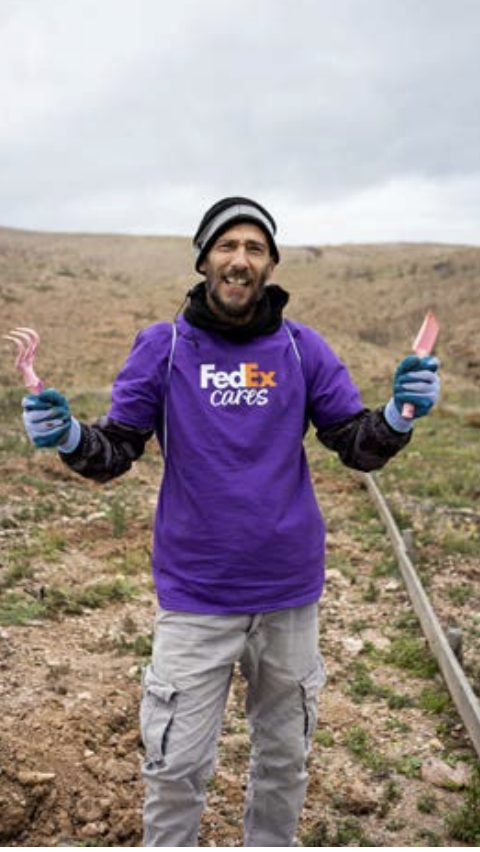
Person wearing FedEx shirt holding gardening tools

Planting for good

Planting for Good unites FedEx team members, local and global community organizations, and environmental experts to grow greener, healthier communities with purpose. Since 2009, FedEx and our team members have helped plant 5.8 million trees, restore nearly 10,000 acres of habitat, and clear 241 miles of riverbanks across the globe.

This spirit shows up at FedEx planting events around the world. Watch highlights from World Environment Day in Greece, when our team members and their families planted 250 trees with the Arbor Day Foundation to help restore a forest devastated by wildfire. Since 2022, our team members in Greece have added 8,500 trees to bring fire-damaged forests back to life.

Click here to see the team from Greece in action.

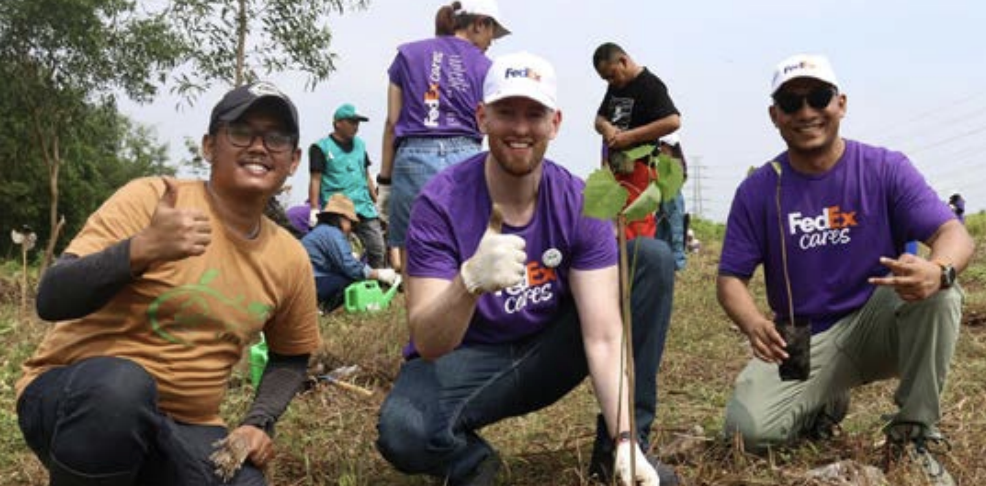
Group gardening

Picture proof of planting

Picture Proof of Planting is our annual photo contest celebrating FedEx team members in action at treeplanting events around the world. In 2025, global team members cast votes to choose five winning photos from over 250 entries — and each winner directed a $10,000 grant to the local nonprofit that made their planting event possible.

2025 Winners

  • Trees4Trees: Jakarta, Indonesia 
  • Pittsburgh Parks Conservancy: Pittsburgh, Pennsylvania, USA 
  • Fundación Tlaloc A.C.: Santiago Tlacotepec, Mexico 
  • Green Columbus: Columbus, Ohio, USA 
  • Nación Verde: Tijuana, Mexico

“At FedEx, we are committed to leading responsibly, driving change forward, and channeling innovation to deliver a brighter future for the people and communities we serve and the planet we share.”
Kawal Preet, EVP, Planning, Engineering, & Transformation

Click here to read more about all the 2025 winners.

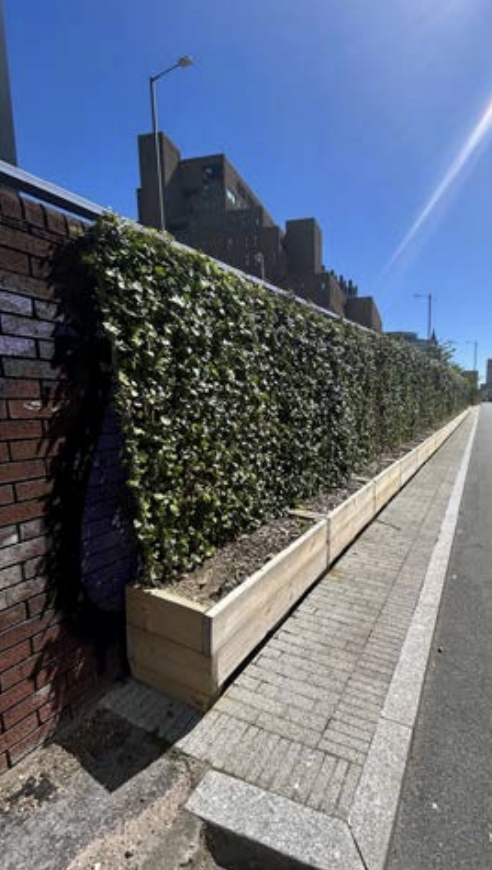
Wall of greenery

Building climate-resilient communities across Europe

To accelerate the shift toward cleaner, more inclusive mobility, FedEx and Climate KIC issued their third annual call for entries to the Sustainable Mobility Challenge, which invites European cities to submit bold, climate resilient transportation concepts.

Selected projects receive funding and expert support to execute their visions. The 2025 cohort includes Brașov (Romania), Viseu Dão Lafões (Portugal), The Hague (Netherlands), and Üsküdar, Istanbul (Turkey). 

Project update: greening the way forward in the UK

A 2024 Challenge winner in Liverpool, UK is empowering residents to trade their car keys for bike helmets, turning sub-5km car trips into cycling journeys. With FedEx funded green infrastructure, protected bike lanes, green walls, and pollinator plantings are being woven into active travel routes, making cycling safer, streets cooler, and neighborhoods more resilient. The project supports Liverpool’s city-wide goal of a tenfold increase in cycle journeys by 2027.

“These projects prove that when local leadership is engaged and citizens are empowered, we can reshape the places we live to be more just and climate-resilient than ever before.”
Kirsten Dunlop , CEO of Climate KIC

Click here to learn about the 2025 selected projects.

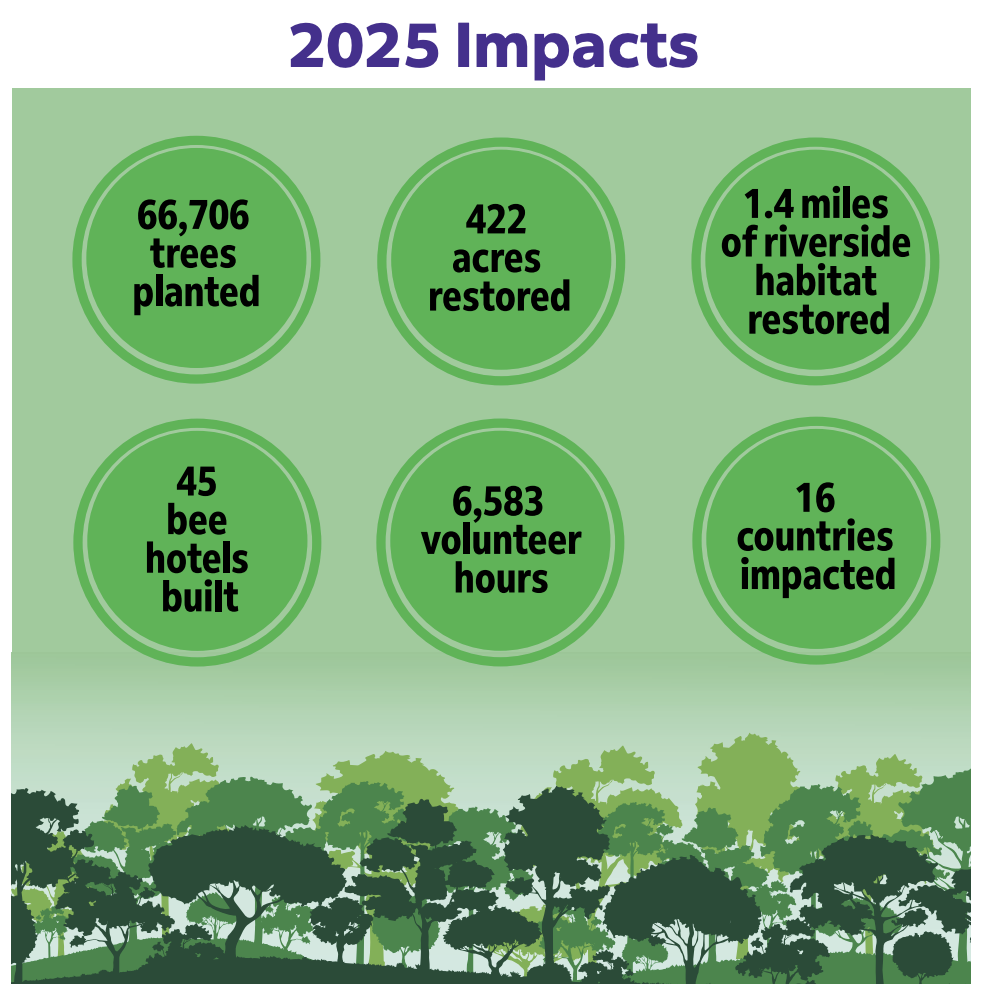
Infographic: 2025 Impacts

Learn more about how FedEx is advancing climate solutions in the 2025 FedEx Cares Report

Summary
Everpure uses impact accounting to translate environmental impacts into monetary value, helping teams integrate sustainability into business decisions.

Last year was one of the warmest years on record, and the last 11 years have been the warmest 11 consecutive years ever. There was a time, not too long ago, when unusually warm weather was dismissed as “just the weather being the weather,” but we can no longer look away from what climate change is doing to our planet. 

Corporations obviously play a massive role in the sustainability picture. Climate Week NYC, which took place last week, was as good a moment as any to ask: How can we turn sustainability ambition into something businesses can actually act on? I was at Climate Week to talk about the work Everpure is doing in impact accounting, for which we recently received an award (more on that later). 

While the award is great validation, Climate Week was all about sharing ideas on how we can all help move the needle and continue a conversation that has at its center the health of our planet. Sustainability can’t just be something companies measure and report on. The opportunity is to change the way we make decisions and move the market toward impact-informed, integrated decision-making—and a more sustainable future grounded in financial principles.

What is impact accounting?

Simply put, impact accounting is a way to translate a company’s non-financial environmental and social impacts into monetary value. Where traditional financial accounting tracks revenue, expenses, and profits, impact accounting assigns a financial cost (or benefit) to factors like water usage, carbon emissions, and employee well-being, ultimately creating a profit and loss statement that shows, with actual numbers, how a company is helping or harming people and the planet alongside its traditional financial returns.

Why data alone isn’t enough anymore

Most companies have gotten significantly better at tracking their carbon footprints, water consumption, and waste volumes across their value chain. But reporting those numbers at the end of the fiscal year doesn’t automatically mean they get factored into everyday operational decisions.

The core challenge isn’t a lack of data—it’s context.

When a product team evaluates material options or an operations team chooses a new facility, traditional financial metrics offer a clear common currency: dollars and cents. Environmental metrics, by contrast, often sit off to the side in separate spreadsheets, with measurements reported in metric tons or cubic meters. Because these data sets speak completely different languages, evaluating trade-offs across innovation, supply chain resilience, and long-term cost gets tricky.

How impact accounting bridges the gap

At Everpure, we apply established cost accounting principles to environmental impacts. By using standardized valuation factors—developed by the Value Balancing Alliance and the International Foundation for Valuing Impacts—we can actually monetize environmental factors like greenhouse gases, waste, and water consumption.

What this is really about: creating a clearer lens for decision-making. Monetizing impacts helps our teams:

  • Compare apples to apples: It translates disparate metrics across energy, waste, water, materials, and land use into a consistent, unified view.
  • Add location-specific context: The real-world cost of water usage varies significantly depending on whether a facility operates in a water-scarce region or a water-abundant one. Impact accounting reflects those nuances.
  • Inform customer choices: Beyond internal optimizations, translating these impacts into monetary terms helps us equip our customers to make smarter, more impact-informed buying decisions.

What we’ve learned from putting this into practice

Integrating environmental accounting into standard business practice is a journey, and we certainly don’t have every answer. But as our work has expanded across R&D, supply chain management, real estate, and customer-facing teams, a few key insights have emerged:

  1. Visibility changes the conversation. When environmental impacts are expressed in terms that align naturally with financial analysis, sustainability stops being an outlier and starts functioning as a core business input.
  2. Silos break down naturally. Sustainability can’t live solely within a dedicated sustainability department. By grounding impact in financial terms, cross-functional teams—from procurement to engineering—begin speaking the same language.
  3. Progress beats perfection. You don’t need absolute precision before you start acting. Waiting for flawless data delays insights that can happen right now.

Validation on a global stage

While our work is ongoing, having external validation signals that we’re headed in the right direction. Everpure was recently honored with the 2026 Finance for the Future Award for Leadership in Nature and Biodiversity.

What made this recognition particularly meaningful was the judges’ emphasis on our collaborative, system-wide approach. They highlighted how our diverse teams—spanning real estate, supply chain, R&D, and commercial operations—have worked together to operationalize these concepts. It reinforces a simple truth: When sustainability is treated as an integrated business discipline, people take notice.

From New York back to the business

At Climate Week NYC, I participated in “Finance for the Future: Innovation Stories and Insights for Systems Change,” hosted alongside the Cornell SC Johnson College of Business, the Cornell Atkinson Center for Sustainability, and Accounting for Sustainability.

We shared what we’ve learned at Everpure, but we were just as eager to learn from others in the room. Moving from lofty commitments to practical, daily execution is a challenge every forward-thinking organization faces. By sharing real-world frameworks, asking hard questions about implementation, and partnering to scale what works, we can move the market together toward a more sustainable future—one grounded in both environmental responsibility and sound financial principles.

Learn more about our impact accounting work by reading our FY26 Impact Report.

WASHINGTON, D.C., October 1, 2026 /3BL/ – Fairtrade America, the organization behind the world’s most recognized label for social justice and sustainability, the Fairtrade certification, has commissioned a new mural at Two Rivers Public Charter School, 1234 4th St. NE, Washington, D.C. 20002, to mark Fairtrade Month this October and celebrate the long-term partnerships that are working to change our global food system.

Created as part of Fairtrade Month’s 2026 theme, “The Real Deal,” the mural highlights the people and relationships behind the food we enjoy every day: farmers growing food, families making purchasing decisions, retailers connecting products to communities, and businesses investing in responsible supply chains.

For more than 30 years, Fairtrade has worked hand in hand with farmers to help eradicate poverty and create more equitable trade. What began as a grassroots movement has grown into a global network committed to ensuring farmers receive a fair deal for their crops, their labor, and their future. In the last decade, farmers have collectively earned more than $2 billion in Fairtrade Premium.

Mexican-born, D.C.-based artist Salvador Rubio Rivera painted the mural, which features three smallholder farmers.

  • Dora Atiiga, a cocoa farmer from Ghana
  • Ana Polo Aguilar, a banana farmer from Ecuador
  • Jeminem, a coconut sugar farmer from Indonesia

The piece reflects Rivera’s signature focus on everyday experiences and the people who shape them. The artwork is made possible through partnerships with Two Rivers Public Charter School and NoMa Business Improvement District (NoMa BID).

At a time when rising temperatures are threatening agricultural production and global trade systems continue to leave many farmers without enough income to meet their basic needs, the mural serves as a powerful reminder that behind every cup of coffee, chocolate bar, or banana there are real people whose livelihoods depend on fair and transparent trade.

Too often, the well-being of the people who grow our food is treated as less important than the prices paid or profits earned. Despite producing crops that power global supply chains worth billions of dollars, many farmers lack the negotiating power needed to earn a decent living. As a result, millions remain trapped in cycles of poverty while facing increasing climate-related challenges.

Fairtrade farmers are the real deal. Through Fairtrade’s democratic model, farmers help develop standards that address workers’ rights, gender equity, climate change, child labor prevention, organizational development, and economic opportunity because they understand firsthand the challenges facing their communities and the solutions needed to address them.

A better food system is possible. Trade can create stable livelihoods, strengthen communities, and enable responsible stewardship of natural resources when it is built on greater transparency, equity, and shared responsibility.

Long-term partnerships between farmers, families, retailers, and food companies are essential to making that vision a reality. Fairtrade connects farming communities around the world, helping farmers share knowledge, strengthen their organizations, and access resources through the power of real partnerships. Brands and retailers that choose Fairtrade certification make real commitments to responsible sourcing and help distribute more value throughout supply chains, supporting farmers and workers around the world.

Only by working together can we build a dependable global food system that nourishes us with real food, enables farmers and their lands to thrive, and strengthens the resilience of international supply chains in a rapidly changing climate.

“Bringing people together for a better future is what Fairtrade is all about,” said Amanda Archila, Executive Director, Fairtrade America. “This mural recognizes the real people behind our food. On October 22nd, everyone in the community is invited to celebrate the mural with us and be surrounded by people who contribute meaningfully to both the local and global food systems. Dedicating time and space to think about where our food comes from and how we can bring about the changes needed to make our food and the livelihoods of the people who grow our food more sustainable can help inspire desperately needed progress across some of the most pressing issues we’re facing today.”

Fairtrade America is bringing farmers, families, retailers, and food companies together this October to celebrate those partnerships and demonstrate how all people can contribute to a fairer food system.

Everyone is invited to attend the mural unveiling on October 22, 2026, at the Third Street Art Garden, where Fairtrade America, NoMa BID, Two Rivers Public Charter School, certified food brands, and local civil society organizations will all be popping up. This free, public party right here in the District will showcase farmers that power international supply chains alongside the NoMa Farmers’ Market, where local farmers serve the community regularly. Join us for food, drinks, prizes, performances, and more.

###

Editor’s Notes

  • The following people are available for interviews. Contact Fairtrade America for scheduling.
    • Dora Atiiga, a cocoa farmer from Ghana
    • Ana Polo Aguilar, a banana farmer from Ecuador
    • Jeminem, a coconut sugar farmer from Indonesia
    • Amanda Archila, Executive Director, Fairtrade America
    • Maura Brophy, President, NoMa BID
    • McKenzie Baecker, Principal, 4th Street Elementary Campus
    • Megan DeRitter, Principal, Young Elementary Campus
    • Belicia Reaves, Executive Director, Two Rivers Public Charter School
    • Salvador Rubio Rivera, artist
  • Fairtrade certified food brands in attendance will include Ben & Jerry’s, Equal Exchange, Feastables, Grace Farms Tea & Coffee, Hu, and Rockin’ Cat.
  • A media alert with details about the October 22 mural unveiling event will be disseminated on October 15, 2026.

Quotes from Farmers

“Fairtrade is the most life-impacting partner for farmers I have ever met. Fairtrade should extend their educational and life-impacting programs to others to help achieve the vision of having a fairer future for all,” Dora Atiiga, Kukuom District Cooperative Cocoa Farmers & Marketing Union, Ghana.

“I am constantly participating in capacity-building opportunities to learn how I can improve and support my household economy and my community. I know that Fairtrade can provide me with the tools and knowledge I need to collaborate better,” Ana Polo Aguilar, Asociación de Pequeños Productores el Guabo, Ecuador.

“With Fairtrade, we can be prepared for basic and new needs,” said Jeminem, Koperasi Karya Manis Sejahtera, Indonesia. “It has helped us get basic equipment, health care funds, and grants. And in past years, we’ve run many programs that have benefitted all the members of the cooperative.”

About Fairtrade America

Fairtrade America works to rebalance trade, making it a system rooted in partnership and mutual respect rather than exploitation. It’s about businesses, shoppers, farmers and workers all working together so we can all experience the benefits of trade. Fairtrade America is the U.S. branch of Fairtrade International, the original and global leader in fair trade certification with more than 30 years of experience working for fair trading practices in more than 60 countries across the globe. A non-profit 501(c)3 organization, Fairtrade America is part of the world’s largest and most recognized fair trade certification program —part of a global movement for change. Learn more at fairtrade.net, and by connecting with Fairtrade America on Facebook, Instagram and LinkedIn.

About NoMa Business Improvement District

The NoMa Business Improvement District (NoMa BID) is the driving force behind the transformation and vitality of one of D.C.’s most dynamic neighborhoods. The BID is dedicated to enhancing the overall quality of life and economic vitality of the NoMa neighborhood through innovative programs, strategic partnerships, and community engagement initiatives. The NoMa BID was created by the Council of the District of Columbia and Mayor in March 2007. The NoMa BID is funded through a special assessment collected from property owners within a 35-block area.

About Two Rivers Public Charter School

Nestled in the fast-growing area near the Union Market District, NoMa, and Gallaudet University, Two Rivers Public Charter School embraces the idea that the community is the classroom. Educators and administrators at Two Rivers Public Charter School strive to nurture a diverse group of students to become lifelong, active participants in their own education, develop a sense of self and community, and become responsible and compassionate members of society. Their strong sense of crew sets them apart, as they live out “We are crew, not passengers,” strengthened by meaningful service to others.

Media Contact

Liz Davis, ldavis@fairtradeamerica.org | +1 202-930-4349

MAILAND–(BUSINESS WIRE)–NHOA Energy, ein globaler Anbieter von Energiespeichersystemen im Versorgungsmaßstab, hat für sein Managementsystem zur Geschlechtergleichstellung in Italien die UNI/PdR 125:2022-Zertifizierung für Geschlechtergleichstellung erhalten. Die von RINA nach einem unabhängigen Audit erteilte Zertifizierung bewertet den Ansatz des Unternehmens zur Gleichstellung der Geschlechter anhand qualitativer und quantitativer Indikatoren in sechs Schlüsselbereichen: Personalbeschaffung

MILAN–(BUSINESS WIRE)–NHOA Energy, fournisseur mondial de systèmes de stockage d’énergie à grande échelle, a obtenu la certification UNI/PdR 125:2022 en matière d’égalité entre les sexes pour son système de gestion de l’égalité entre les sexes en Italie. Délivrée par le RINA à l’issue d’un audit indépendant, cette certification évalue l’approche de l’entreprise en matière d’égalité entre les sexes à l’aide d’indicateurs qualitatifs et quantitatifs couvrant six domaines clés : le recrutement e

MILÁN–(BUSINESS WIRE)–NHOA Energy, proveedor internacional de sistemas de almacenamiento de energía a escala industrial, ha obtenido la certificación UNI/PdR 125:2022 en materia de igualdad de género por su sistema de gestión de la igualdad de género en Italia. La certificación, expedida por RINA tras una auditoría independiente, evalúa el enfoque de la empresa en materia de igualdad de género mediante indicadores cualitativos y cuantitativos en seis áreas clave: selección y contratación, ges

RIADE, Arábia Saudita–(BUSINESS WIRE)–A Saudi Eksab for International Investments Company, a IDB Invest, a CAF e a IDC Network estabeleceram uma parceria para criar o “Saudi Eksab IDC Network Impact Fund”, visando apoiar o financiamento do desenvolvimento de empresas privadas em crescimento. A Valante Capital, plataforma de private equity da IDC Network, foi nomeada gestora do fundo, sendo responsável pela execução de seus investimentos em toda a região. O fundo investirá em empresas consolid

RIAD, Arabia Saudita–(BUSINESS WIRE)–La empresa Saudi Eksab for International Investments, IDB Invest e IDC Network, en calidad de socios fundadores, lanzan el “Fondo de Impacto Saudi Eksab-IDC Network”, con la participación de la CAF para apoyar el financiamiento del desarrollo de empresas privadas en crecimiento. Valante Capital, la plataforma de capital privado de IDC Network, fue designada como administradora del Fondo y liderará la ejecución de las inversiones del Fondo en toda la región

RIYADH, Saudi Arabia–(BUSINESS WIRE)–Saudi Eksab for International Investments Company, IDB Invest, and IDC Network, as founding partners, launch the “Saudi Eksab, IDC Network Impact Fund” with the participation of CAF to support development financing for private growing companies. Valante Capital, IDC Network’s private equity platform, was appointed as the Fund Manager and will lead the Fund’s investment execution across the region. The Fund will invest in established, high-growth businesses

AUSTIN, Texas–(BUSINESS WIRE)–Da Versorgungsunternehmen ihre bestehende Infrastruktur modernisieren, werden Smart Meter ein zentraler Baustein für das vernetzte Energie-Ökosystem der Zukunft. Landis+Gyr bedient weltweit mehr als 2.000 Versorgungsunternehmen und verfügt über mehr als 180 Millionen vernetzte intelligente Geräte im praktischen Einsatz. Laut Berg Insight wird erwartet, dass allein in Nordamerika die Anzahl der installierten intelligenten Stromzähler von 152,4 Millionen im Jahr 20

Privacy Overview

This website uses cookies so that we can provide you with the best user experience possible. Cookie information is stored in your browser and performs functions such as recognising you when you return to our website and helping our team to understand which sections of the website you find most interesting and useful.