
TEMPE, Ariz.–(BUSINESS WIRE)–VisualVault launches AI-powered licensing software to help governments speed approvals and boost local economies.
Author: sHq_LoGiNz
QUÉBEC–(BUSINESS WIRE)–iA Groupe financier (TSX: IAG) annonce l’ajout de cinq nouvelles options d’investissement à sa gamme de fonds distincts. Ces nouvelles options d’investissement viennent renforcer une gamme déjà reconnue pour sa performance, sa diversité, son innovation et sa capacité à évoluer avec les besoins des conseillers et des clients. « La bonification de notre offre de fonds distincts reflète notre engagement à fournir aux investisseurs et aux conseillers des solutions toujours
SAN FRANCISCO–(BUSINESS WIRE)–Ripple, the leading provider of blockchain solutions across traditional and digital finance, and Robinhood, a global leader in financial services, today announced a strategic partnership that provides one of the industry’s largest consumer and institutional trading platforms with a single, trusted entry point to Ripple’s infrastructure across stablecoins, institutional markets and treasury management. Ripple USD (RLUSD) will be a key stablecoin across Robinhood’s
AUSTIN, Texas–(BUSINESS WIRE)—- $DBGI #DBG–Digital Brands Group, Inc. (“DBG” or the “Company”) (NASDAQ: DBGI), a publicly traded company specializing in apparel and e-commerce, today announced its decision to maintain its public listing, following a strategic review of the Company’s compounding growth drivers. This decision is underpinned by three immediate catalysts: the immense e-commerce success of the August digital relaunch, accelerated execution under its binding government contract, and a highly sc
SÃO PAULO–(BUSINESS WIRE)–Agi Inc (NYSE: AGBK), (“Agi”) announced today that its board of directors has approved a share repurchase program. Under the repurchase program, Agi may repurchase up to 3 million shares of its outstanding Class A common shares in the open market, based on prevailing market prices, or in privately negotiated transactions, over a period beginning on October 27th, 2026 continuing until the earlier of the completion of the repurchase or October 27th, 2027, depending upo
LONDON–(BUSINESS WIRE)– FORM 8.3 PUBLIC OPENING POSITION DISCLOSURE/DEALING DISCLOSURE BY A PERSON WITH INTERESTS IN RELEVANT SECURITIES REPRESENTING 1% OR MORE Rule 8.3 of the Takeover Code (the “Code”) 1. KEY INFORMATION (a) Full name of discloser: NATIXIS SA (b) Owner or controller of interests and short positions disclosed, if different from 1(a): The naming of nominee or vehicle companies is insufficient. For a trust, the trustee(s), settlor and beneficiaries must be named. (c) Name o
Originally published on PSEG ENERGIZE!
When severe weather damages electric equipment or an inspection reveals a potential problem, getting a clear view of the situation quickly can help our crews determine what needs to be done. Drones give our teams another way to do that — helping us inspect equipment, identify potential problems and assess storm damage while keeping employees out of hazardous areas.
It’s one of the ways we’re using new technology to better serve our customers. Whether it’s strengthening the electric grid, preparing for severe weather or embracing new technologies, our goal is the same: deliver safe, reliable service while working to keep energy affordable and care for the communities we serve.
How does PSE&G use drones to inspect the electric grid?
Drones are changing the way we inspect critical electric infrastructure. Equipped with cameras, they give our teams a close-up view of transmission lines, substations and other equipment without requiring employees to climb structures or, in many situations, wait for a helicopter to be available. That means inspections can often be completed more quickly, safely and efficiently.
How can drones help prevent power outages?
In addition to increasing safety, the real value of these inspections is what they help us find.
Drones can identify early signs of equipment wear, damaged insulators, loose hardware or vegetation growing too close to power lines before these situations contribute to outages. Finding them early gives our crews an opportunity to make planned repairs and address potential problems before customers lose power.
Making every infrastructure investment count
By planning ahead, we can use our resources more efficiently to maintain our system. Emergency repairs are often more complex and costly than scheduled maintenance. By using drone inspections to identify and prioritize work before equipment fails, we can better plan maintenance, deploy resources more efficiently and make the most of every investment in our infrastructure. Those efficiencies help us continue providing reliable service while being responsible stewards of our customers’ dollars.
How are drones helping PSE&G respond after severe storms?
Drones are also proving to be an invaluable tool after severe storms, like the severe thunderstorms that impacted our area this past July. Instead of waiting for crews to access difficult or hazardous areas, drones were quickly deployed to capture detailed images of damaged equipment across large sections of the electric system.
That real-time information helped us assess conditions faster, prioritize repairs and restore power to customers as safely and efficiently as possible.
In one case, drones were used to survey and assess a complex backyard area that had significant access challenges. This provided a real-time view of the damage, allowing dispatch of the correct crew and materials more efficiently. As a result, the overall outage duration was several hours shorter than it may have been without utilizing the drones.
How do drones help keep PSE&G employees safer?
Just as importantly, drone technology enhances employee safety.
For some inspections, drones can capture detailed images from a distance, giving our teams the information they need while reducing employees’ exposure to heights, damaged equipment and other hazardous conditions. This helps our field teams assess equipment and facilities more safely and efficiently.
Reducing those risks while improving the quality of inspections is a win for both our employees and the customers we serve.
FAA approval unlocks new capabilities
We recently reached an exciting milestone in our drone program with approval from the Federal Aviation Administration (FAA) to expand how we use this technology.
The approval allows our docked drones to fly Beyond Visual Line of Sight (BVLOS), meaning they can inspect infrastructure farther from their operators. One remote pilot can safely oversee up to four drones at the same time.
The approval reflects the safety procedures and risk controls required for these advanced drone operations, marking an important achievement and another example of the utility industry adopting advanced technology to enhance customer value. It reflects our continued focus on using innovative technology to improve safety, strengthen system reliability and perform inspections even more efficiently.
What’s next for PSE&G’s drone program?
As drone technology evolves, so will the capabilities of our drone program.
Advances in imaging, automation and data analysis will continue to help us monitor the health of our infrastructure and make smarter, more informed maintenance decisions to keep the electricity flowing.
At PSE&G, we don’t just adopt new technology for technology’s sake. We adopt new tools when we are confident they will help us deliver better outcomes for our customers. Our drone program is one more way we’re building a stronger, more resilient electric system while improving safety, enhancing reliability and helping keep energy affordable for the communities we proudly serve.
Learn more about other ways we’re helping strengthen New Jersey’s energy systems and prepare for severe weather on Energize!
Sara Rosner | Director—Responsible Investing Research
Dr. Michael Puma | Director and Research Scientist—Columbia University Earth Institute
Henna Nordqvist, CFA | Corporate Credit Analyst—Fixed Income
James Russo | Portfolio Manager—US Strategic Core Equities; Senior Research Analyst—Strategic Core Equities
Water scarcity and purity are critical risks for semiconductor makers in the AI era.
As companies race to capitalize on the AI boom, water security is emerging as a material risk across the value chain. While data centers attract headlines, semiconductor fabrication remains one of the value chain’s most water-intensive activities, requiring reliable supplies of high-purity water. As a result, managing water risk is becoming a strategic capability for semiconductor companies.
Clean Water’s Pivotal Role in Semiconductor Production
Chip manufacturing is highly water intensive, particularly during wafer fabrication. Producing advanced semiconductors requires large volumes of ultra-pure water, which cannot always be sourced directly from municipal systems, especially during droughts.
Meanwhile, AI-driven demand for chips is expected to propel the semiconductor industry to a market size of at least $1 trillion by 2030 (Display), with a recent McKinsey analysis putting the industry’s 2030 size at $1.6 trillion and BofA at $2.7 trillion.
Global Semiconductor Market Expected to Top $1 Trillion by 2030

Historical analysis does not guarantee future results.
As of September 30, 2024
Source: Columbia Business School Climate Knowledge Initiative, company reports, PwC and AllianceBernstein (AB)
While China, Taiwan and Japan remain manufacturing leaders, US production is poised to grow as reshoring accelerates under the CHIPS and Science Act of 2022.
The Impact of Water Stress on Semiconductor Makers
As fabrication capacity expands, the semiconductor industry’s global water withdrawal is on track to rise from roughly 260 billion gallons a year today to around 390–455 billion by 2030, and to double by the mid-2030s. Without meaningful mitigation efforts, manufacturers in water-stressed regions could face growing operational and financial risks. The challenge is urgent, as roughly 40% of existing fabrication facilities are based in watersheds either experiencing or prone to severe water stress.
Water demand is already staggering. Taiwan Semiconductor Manufacturing (TSMC), Samsung Electronics and Intel are among the top consumers, with annual withdrawals in the billions of liters (Display). NVIDIA’s direct water footprint is much smaller because it outsources fabrication. However, it’s still vulnerable to associated supply chain risks, in our view.
Water Use to Make Microchips Is High and Varies by Company
Annual Water Withdrawal by Leading Semiconductor Companies (Billions of Liters)
Historical analysis does not guarantee future results.
Withdrawal disclosures and methodology vary by company.
As of December 31, 2025
Source: Columbia Business School Climate Knowledge Initiative, company reports and AB
Further, as AI adoption accelerates, rising electricity demand may place additional pressure on water resources in some regions, compounding existing challenges for semiconductor manufacturers. As a result, water stewardship is becoming a differentiator across the semiconductor industry.
How Chipmakers Address Water Risks
Whether too much, too little or too contaminated, water risks come in different forms but are inherently local, requiring equally localized solutions.
In 2021, TSMC faced government-imposed water restrictions during Taiwan’s worst drought in a half century. To sustain operations, the company trucked water to key fabrication centers along with strict conservation controls. Today, it’s investing for long-term resilience at its new operations in the dry American southwest, including a 15-acre water reclamation plant in Arizona to support sustainable growth.
Samsung Electronics is pursuing a different path, targeting a return to 2021 water-withdrawal levels by 2030. Central to that effort is expanding water reuse by treating and recycling production water, thereby reducing dependence on new water withdrawals. Pilot projects at its Giheung and Hwaseong facilities aim to reuse 120,000 metric tons daily by 2029.
NVIDIA water consumption appears comparatively small, but it operates a “fabless” business model, outsourcing chip fabrication to partners like TSMC and Samsung. Yet, the underlying water risks remain embedded via its partners.
Taken together, these examples suggest that managing water risk is becoming a strategic capability rather than a compliance exercise.
What Strong Water Stewardship Looks Like
In our view, the companies best positioned for future growth may be those that can adapt their operations and supply chains to local water constraints. Ultimately, strong water stewardship may support better long-term company performance.
Most investors rely on company disclosures to assess water risk, but disclosures alone rarely tell the full story. We believe that evaluating water resilience requires a broader framework that goes beyond reported metrics. We look for evidence that companies are investing in water-reuse systems, reducing freshwater withdrawals, disclosing meaningful performance metrics, engaging with community stakeholders, understanding local watershed conditions and integrating those considerations into capital-allocation decisions. This deeper analysis can help investors assess whether companies are effectively managing water-related risks and positioning their operations for long-term resilience.
As part of this analysis, we see active engagement* as critical, not only between investors and chipmakers but between the firms and the communities that share their limited water resources. Engagement can help investors distinguish between companies that are proactively managing water risks and those that may be underestimating them. Discussions around reuse targets, reclamation investment, disclosure practices and site-level water planning provide important insight into a company’s ability to navigate future water constraints.
Water availability and quality are critical inputs to semiconductor manufacturing and, ultimately, profitability. As AI-driven demand accelerates, investors may benefit from looking beyond production growth alone to evaluate whether companies will have the water resources needed to support that growth. As we see it, the industry’s leaders will be those that can secure, manage and diversify water resources most effectively, turning a growing resource challenge into a competitive edge.
The authors would like to thank Maxwell Lulavy, Responsible Investing Research Analyst at AB, for his significant contributions to the research behind this blog.
*AllianceBernstein (AB) engages issuers where it believes the engagement is in the best financial interest of its clients.
The views expressed herein do not constitute research, investment advice or trade recommendations, do not necessarily represent the views of all AB portfolio-management teams and are subject to change over time.
References to specific securities discussed are for illustrative purposes only and should not to be considered recommendations by AllianceBernstein L.P. It should not be assumed that investments in the securities mentioned have necessarily been or will necessarily be profitable.
Learn more about AB’s approach to responsibility here.
Originally published by Tata Consultancy Services
MUMBAI and NEW YORK, October 27, 2026 /3BL/ – Tata Consultancy Services (TCS) (BSE: 532540, NSE: TCS), a global leader in IT services, consulting and business solutions, has published The Fastest Path to Increased Opportunity: Insights from Digital Inclusion Stakeholders in Chicago, Dallas, Detroit and New York City.
The report is based on insights from TCS’ Digital Empowers’ Collaborating for Connected Futures event series, which convened leaders across industry sectors to examine how coordinated action can help close gaps in digital access and skills, as well as broaden pathways to economic opportunity.
Participants identified early exposure to technology skills, supported by schools, nonprofits, philanthropy and employers, as essential to helping young people prepare for a changing workforce. They also explored urgent needs in their communities and developed collective actions to strengthen workforce readiness, science, technology, engineering and math (STEM) education, and digital inclusion.
The report identifies five key priorities: building transparent, long-term partnerships; shifting workforce programs toward lifelong learning and adaptability; increasing private-sector engagement in workforce pathways; introducing young people to technology skills-development opportunities early; and involving people affected by the digital divide as partners in designing solutions.
It also presents TCS recommendations for cross-sector partners seeking to expand digital opportunity:
- Expose young people to technology skills early through programs co-designed and co-delivered by schools, nonprofits, philanthropy, and the private sector.
- Fund the full delivery model, including transportation, meals, hardware, software and trained instructors, to reduce barriers to participation.
- Design programs to evolve as technology and community needs change.
- Use asset mapping, shared measurement, and transparent data practices to strengthen coordination and accountability.
To learn more, download the full report.
Visit https://www.tcs.com/who-we-are/worldwide/tcs-na to more about TCS and its work and social impact in North America.
About TCS Empowers
TCS’ flagship corporate social responsibility (CSR) programs and other initiatives conducted under the TCS Empowers initiative are building greater futures by supporting communities and connecting people to opportunities in the digital economy. Through service, innovation, and collective knowledge, TCS is helping create equitable, inclusive pathways for everyone, especially women, youth, and marginalized groups. Follow #TCSEmpowers on social media for more information about CSR at TCS.
About Tata Consultancy Services
Tata Consultancy Services (BSE: 532540, NSE: TCS) is the technology partner of choice for industry-leading organizations worldwide. Since its inception in 1968, TCS has upheld the highest standards of innovation, engineering excellence, and customer service.
It has set an aspiration to become the world’s largest AI-led technology services company and is enabling its clients to transform themselves across the full AI stack, from infrastructure to intelligence.
Rooted in the heritage of the Tata Group, TCS is focused on creating long term value for its clients, its investors, its employees, and the community at large. With a highly skilled workforce spread across 56 countries and 194 service delivery centers across the world, the company has been recognized as a top employer in six continents. With the ability to rapidly apply and scale new technologies, the company has built long-term partnerships with its clients. Many of these relationships have endured into decades and navigated every technology cycle, from mainframes in the 1970s to artificial intelligence today.
TCS sponsors 14 of the world’s most prestigious marathons and endurance events, including the TCS New York City Marathon, TCS London Marathon, Tata Mumbai Marathon, and TCS Sydney Marathon with a focus on promoting health, sustainability, and community empowerment.
TCS generated consolidated revenues of over US $30 billion in the fiscal year ended March 31, 2026.
For more information, visit www.tcs.com.
Follow TCS on LinkedIn | Instagram | YouTube | X.
TCS media contacts:
| Corporate Communications & India |
Email: corporate.communications@tcs.com Email: santosh.castelino@tcs.com | Phone: +91 22 67789098 |
| U.S. | Email: andrew.corcione@tcs.com | Phone: +1 646 617 8221 |
| North America Corporate Social Responsibility | Email: eve.pidgeon@tcs.com | Phone: +1 313 605 1026 |
###
Every harvest, millions of potatoes begin their journey underground only to lose their value before they even get peeled to become a potato chip. The source of this loss is unexpectedly small: a bruise which affects crop quality, storage life and ultimately farmer income if potatoes have to be discarded as waste. Mostly this bruising occurs during harvesting using complex machines where factors such as speed, soil type, slopes and operator experience can impact the quality of the final crop. Bruising is one of the most persistent and expensive forms of waste in the potato supply chain.

Training as a missing link
The people who operate these harvesters are often seasonal, remote or maybe new to the equipment and so training every year is essential but a challenge to deliver across the thousands of farms and multiple languages of those using harvesting equipment.
“Training operators at scale has long been an issue for the industry but can result in a costly impact if harvesting equipment is not used effectively,” said Frank Nordmann, general manager key accounts and sustainable development at agricultural machinery manufacturer, Grimme.
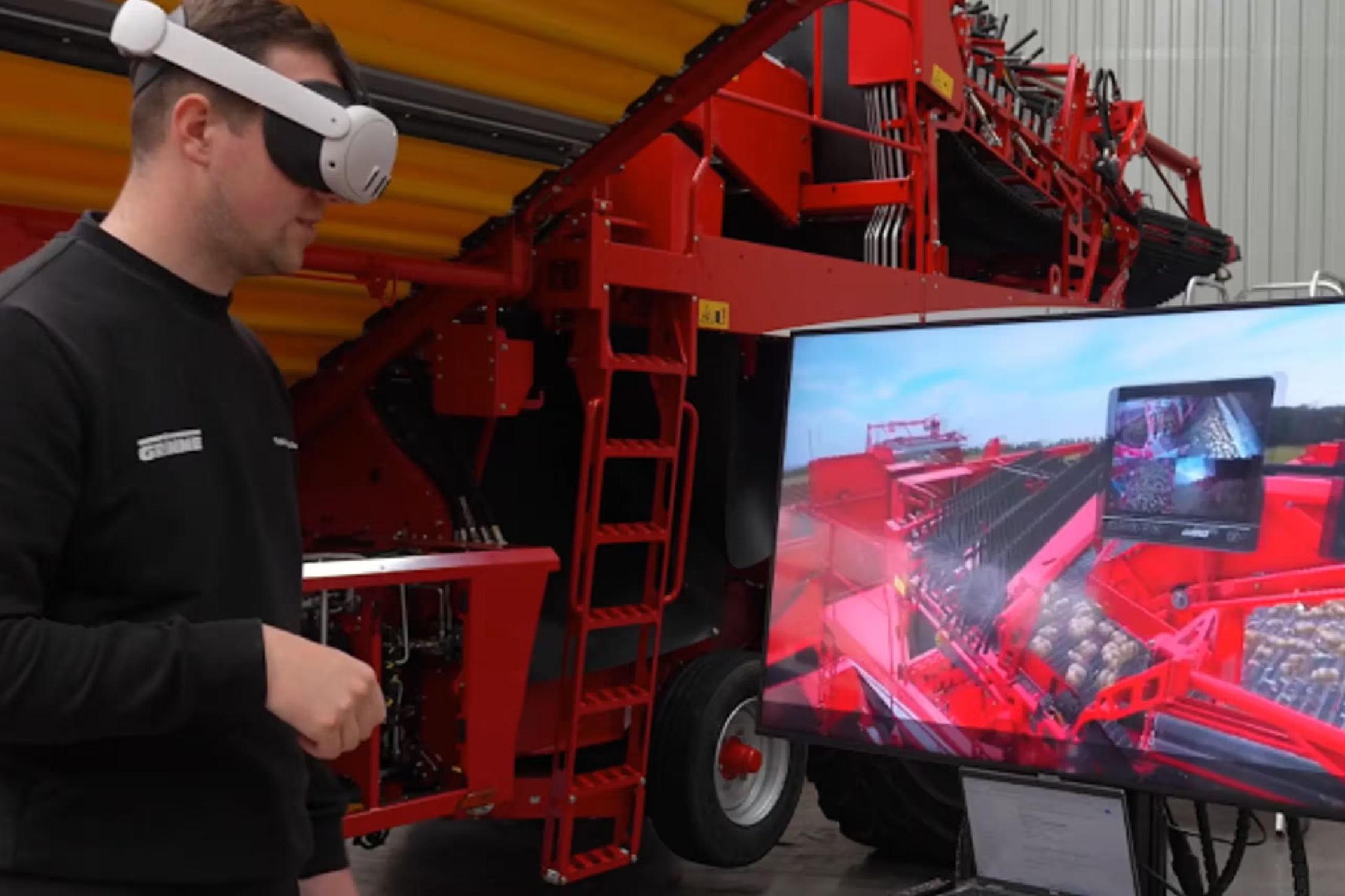
Building a harvester inside a farmer headset
Together, PepsiCo and Grimme created a hyper realistic digital twin of a potato harvester that replicates the internal mechanics and settings, enabling operators to learn how to optimize equipment performance through realistic, interactive training. The technology is accessible via virtual reality headset, smartphone, or tablet and can be sent to any farm around the globe. It allows users to virtually walk around the machine, remove panels, experiment with settings that would be impossible — or unsafe — in a real field as well as learning best practice operation in multiple languages.
“This digital approach dramatically expands our ability to support growers globally and improve the amount of quality crop that a farmer can sell,” explained Frank Nordmann.
Bringing a virtual idea to the fields
The collaboration began with pilots in Brazil and Mexico, which assessed bruising levels and operator performance before and after training. The pilots showed that digital twin training delivered an average 87% increase in bruise-free potatoes and a 1.7x reduction in severe bruising helping improve harvest quality and protect yield through enhanced operator performance and machine optimization. The headsets and training have now rolled out to Romania and Poland and the technology was also showcased at PepsiCo’s recent Global Agro University in Germany, where farmers from more than 35 markets were in attendance.
As the technology rolls out, growers supplying PepsiCo will be the first to have access to this training, however, the technology has been made available on a non-exclusive basis so others can also benefit from its development. The impact could also reach far beyond potatoes, helping to establish a change in how operators interact with farming machinery which may help redefine how the agricultural workforce is trained in the decades to come.
“We aim to find solutions to challenges that farmers face every growing season while ensuring we get a sustainable supply of quality potatoes. By pairing Grimme’s engineering expertise with PepsiCo’s agronomy insights, we’ve created a scalable tool that can help improve both crop quality and farmer livelihoods and reduce waste that can impact land use and carbon emissions,” said Rob Meyers, vice president, Global Agriculture at PepsiCo.
This collaboration aims to also enable PepsiCo’s broader pep+ agenda. Reducing loss may mean fewer potatoes need to be grown, stored and transported to produce the same amount of food. This can help reduce water, energy and fertilizer use, while increased yields may also improve farmers’ livelihoods.

What’s next
As PepsiCo and Grimme learn from the pilot programs, the teams plan to refine the training modules, expand language support and explore how digital twin experiences can help operators adopt best practices faster — so more of each harvest can make it from field to factory.