Centennial, Colo., October 23, 2026 /3BL/ – When former IndyCar driver Sam Schmidt was left paralyzed after a crash in 2000, he assumed his racing career was over. 

“I crashed, backed into the wall and just disintegrated my C3, C4, and C5 vertebrae,” said Schmidt. “I was paralyzed from the neck down. You know, that was that.”

But Schmidt’s story shifted when Arrow Electronics reached out in 2013, asking if he would consider getting back behind the wheel in a vehicle powered by semi-autonomous technology.  The collaboration between Arrow and Schmidt resulted in the Arrow SAM (semi-autonomous motorcar) Car Project, which modifies performance cars with electronic interfaces to allow Schmidt to drive at racetrack speeds using head movements and breath and voice commands.

Schmidt’s return to racing is chronicled in a new film produced for Arrow by BBC StoryWorks. The film, “Getting back on the racetrack,” is part of the original content series All In, which highlights how technology is helping improve accessibility for disabled people. 

Since the SAM Car Project launched, Schmidt has driven these uniquely equipped race cars in dozens of high-speed demonstrations, including at the Indy 500, the Pikes Peak International Hill Climb in Colorado, and the Goodwood Festival of Speed in England.

“This guy is not afraid of anything, said Arrow Principal Field Applications Engineer Stephen Harper of Schmidt. “Like, you get in the car and he’s six inches from the wall at 200 miles an hour.”

Schmidt drives the car – currently a 2021 McLaren 720S Spyder – using head motions for steering, sip-and-puff assistive technology for acceleration and braking and additional voice controls. 

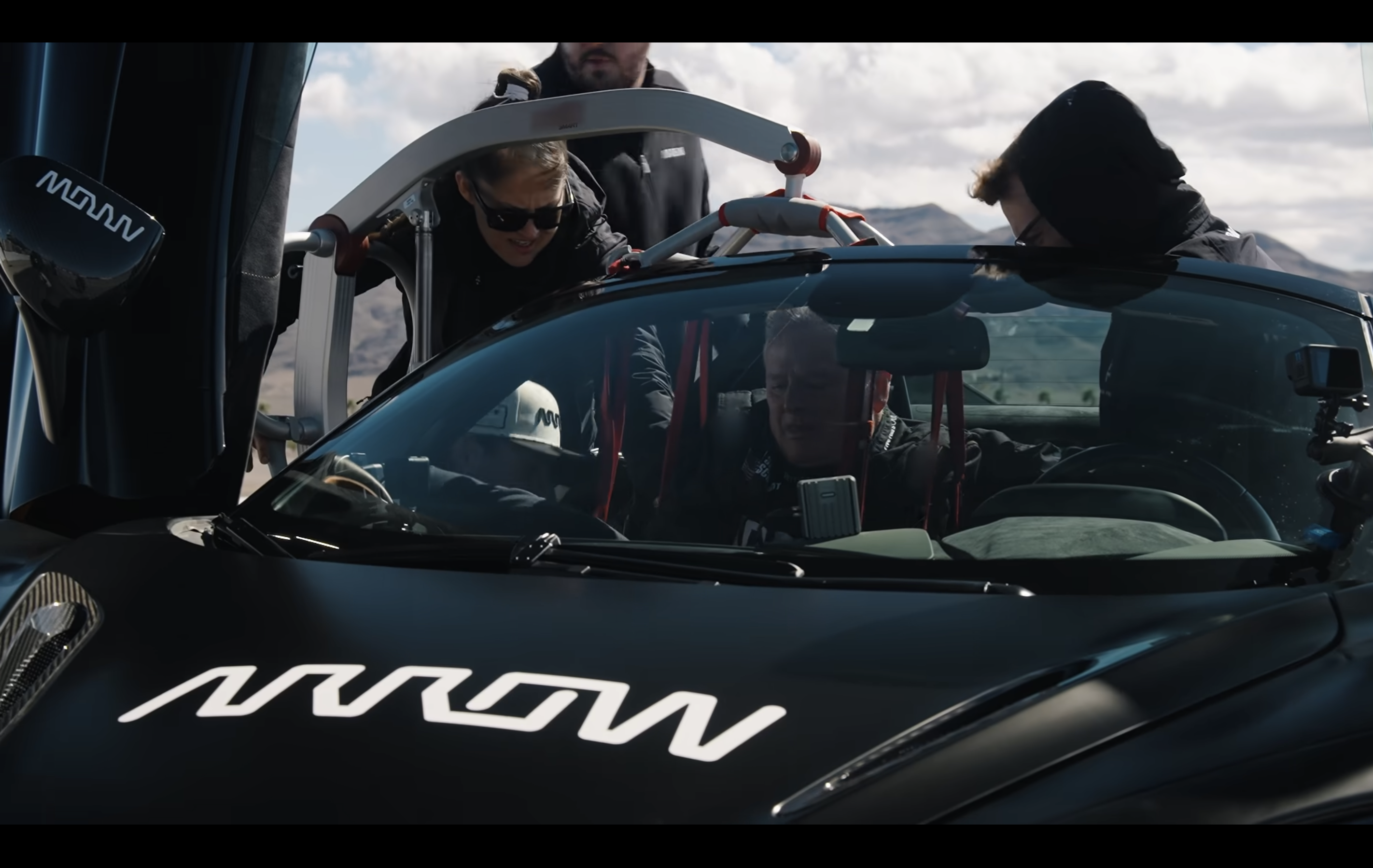
SAM car being filmed in the desert

Arrow has evolved the car as Schmidt’s skills and technology have improved. The most recent advancements include a new AI steering system (built on the NVIDIA Jetson Orin platform) and a redesign of the sip-and-puff controller that operates the throttle and brakes. Powered by Edge AI, which integrates artificial intelligence with edge computing, the new steering system can process Schmidt’s head movements in real time and adjust the steering angle automatically and incredibly quickly – within a few thousandths of a second. This enables a faster and more responsive driving experience. 

“I’m controlling the brakes, I’m controlling the gas, and it’s all on me, and it’s completely changed my life. It’s amazing,” said Schmidt. 

The integration of edge AI shows how Arrow has turned the SAM Car Project into an engineering platform for new technology, with applicability far beyond the racetrack.

“If we can do this in a race car, we can do this in just about anything – wheelchairs, autonomous machines, tractors and farming, trucking,” said Harper. 

Sam Schmidt being lowered into the accessibly built Arrow SAM Car

About Arrow Electronics

Arrow Electronics (NYSE:ARW) sources and engineers technology solutions for thousands of leading manufacturers and service providers. With 2025 sales of $31 billion, Arrow’s portfolio enables technology across major industries and markets. Learn more at www.arrow.com/company.

About All In

All In is an original content series presented by The Valuable 500 and produced by BBC StoryWorks. The series brings together stories from across industries, including health, technology, arts and culture, and consumer goods, to explore more inclusive innovation, accessibility by design and productive partnerships in business. The series is hosted at www.allinthevaluable500.com  and distributed across BBC.com and BBC StoryWorks’ social platforms.

LANSING, Mich.–(BUSINESS WIRE)–Jackson National Life Insurance Company® (Jackson®), the main operating subsidiary of Jackson Financial Inc.1 (NYSE: JXN), today launched Jackson Fixed Index Accumulation™ and Jackson Fixed Index Accumulation™ Advisory, fixed index annuities that protect retirement savings while providing growth potential. Jackson Fixed Index Accumulation (commission-based) and Jackson Fixed Index Accumulation Advisory (fee-based) each offer 5- and 7-year options, giving consume

NEW YORK–(BUSINESS WIRE)–Cantor Fitzgerald Asset Management (“CFAM”), the asset management business of leading global financial services firm Cantor Fitzgerald, L.P., and Lincoln Energy Partners (“Lincoln”), a Colorado-based oil and gas asset management company, today announced the launch of the Cantor Fitzgerald Energy Fund (the “Fund”), available under the tickers: CNRAX, CNRCX, CNRGX, and CNRSX. Structured as a publicly registered, continuously offered interval fund, the Fund seeks to maxi

Social impact: Supporting communities globally

Everpure and the Everpure Foundation support communities through strategic grantmaking, employee giving, and volunteerism.

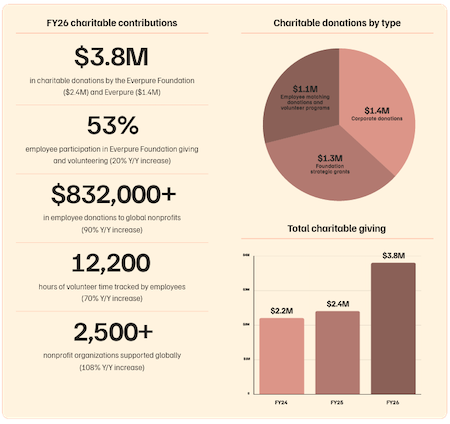
Guided by our commitment to “Go Do Good,” we partner with nonprofits and engage employees as donors, volunteers, and community champions. In FY26, we expanded global volunteer opportunities and increased charitable contributions from the company and foundation, resulting in more than $3.8 million donated to community-based nonprofits. These efforts have the added benefit of supporting the company’s goals to recruit top talent, retain employees, and foster a purpose-driven company culture.

This year, we focused on expanding volunteer events globally to engage more employees and grow our culture of purpose. We also increased charitable contributions from both the company and foundation.

Supporting global communitites infographic

Strategic grantmaking

The company and foundation provide strategic grants in areas that intersect corporate strategy, employee passion, and community need. Collectively, we award grants focused on the environment, workforce development, and community needs, including disaster response.

Environmental sustainability

We are committed to leveraging our philanthropic resources for the planet’s benefit. The foundation completed a strategic redesign of its environmental sustainability grantmaking program, resulting in three priority areas:

  • Nature-based solutions: Harnessing the power of nature to preserve the environment, the foundation supported the Nature Conservancy efforts to advance peatland restoration in Minnesota and Sázíme Stromy’s tree planting activities in the Czech Republic.
     
  • Community-led transitions to low-carbon energy: Funding solar energy projects led by locally rooted community organizations worldwide, the foundation embarked on a new partnership with The Honnold Foundation.
     
  • Data and climate: Ensuring that stakeholders and decision-makers can access high-quality, real-time data about the climate, the foundation began its work to identify suitable partner(s) to advance this work.

Workforce development

An inclusive workplace enables creativity and business success. Everpure Foundation provides grants that break down barriers and expand access to opportunity, helping strengthen pathways into technology careers, in alignment with the company’s broader efforts to build a more diverse and inclusive workforce.

In FY26, the foundation acted on its commitment to supporting emerging talent from low-income communities, providing strategic grants to Rewriting the Code (RTC), ColorStack, and Last Mile Education Fund, among other community-based organizations. In addition to financial support from the foundation, Silicon Valley employees participated in speed networking sessions with RTC members and conducted mock interviews with university students at ColorStack’s annual summit.

In London and Las Vegas, we continued our tradition of hosting female students and young professionals at our Pure Accelerate conferences. In Prague, employees collaborated with PyLadies to offer technical workshops and networking events. And in Bangalore, employees packed feminine hygiene products so students don’t miss school due to lack of supplies or support.

Community and disaster response

We believe everyone should have access to nutritious food, clean water, and safe and stable housing. In FY26, the foundation launched its community and disaster response portfolio, providing financial support to food banks in key locations across the United States. In addition, Everpure employees in the Czech Republic, Japan, Singapore, the UK, and various US offices volunteered throughout the year with community service agencies, sorting food, preparing meals, and assembling snack packs for neighbors in need.

Learn more about our support of global communities and grantmaking scorecard in the 2026 Impact Report

Yum! Brands

Habit Burger & Grill employees came together for a two-hour Pack-a-Box volunteer event at the Orange County Food Bank in Garden Grove, California.

Thirty-eight Habit employees worked side by side to build and fill food boxes for more than 2,200 local seniors and children facing food insecurity.

Together, Habit employees packed 1,109 food boxes containing 35,488 lbs. of nutrient-rich food.

By the end of their two-hour volunteer shift, Habit employees packed enough boxes to provide 66,540 meals for their neighbors.

The efforts were all part of parent company Yum!’s Food & Futures in Action Month, which is rooted in the belief that everyone should have access to good food and a bright future. In total, the Habit employees logged 76 total volunteer hours, attributing to Yum!’s 8-Hour Challenge, which encourages every above-restaurant employee to volunteer at least eight hours each year.

The KeyBank Foundation is investing $300,000 in the Boys & Girls Clubs of Buffalo to help rebuild essential organizational capacity including strengthening staffing, infrastructure, and operations.

The Boys & Girls Clubs of Buffalo has served Buffalo youth since 1926, providing safe, affordable after-school and summer programming that supports academic success, social-emotional development, and long-term opportunity. The organization provides programs that are designed to address the barriers that place young people at risk for academic disengagement and unsafe environments during out-of-school hours. Staff provide homework help, individualized academic support, nutritious meals, mentoring, and structured enrichment activities in a safe, supervised setting.

“Key Bank’s extraordinary generosity marks the beginning of a new chapter for the Boys & Girls Clubs of Buffalo,” said Melanie Rushforth, CEO of Boys & Girls Clubs of Buffalo. “Following federal funding shifts that forced us to close school-based satellite clubs across Buffalo, we are actively raising funds to rebuild our capacity and strengthen the five clubhouses we own and operate. Through this capacity building campaign, we aim to ensure that every child we serve has every chance to succeed in school and in life by providing robust experiences in a safe environment with caring mentors.”

Grant funds will be allocated to rebuild essential organizational capacity that was strained by shifting federal funding. The investment will restore critical infrastructure by hiring dedicated data and IT staff, providing cost-of-living adjustments and one-time staff bonuses, and supporting a Chief Development Officer role to diversify revenue and strengthen long-term sustainability. These changes are aimed at stabilizing operations and reducing burnout among frontline staff who directly serve youth.

“Organizations like the Boys & Girls Clubs of Buffalo are critical to the strength of our community because they provide services and opportunities that families rely on every day,” said Michael McMahon, KeyBank Buffalo Market President. “This investment is designed to help the organization build for the future by strengthening its operational foundation and positioning it for long-term success. We are proud to support the Boys & Girls Clubs of Buffalo as they continue their important work serving our community’s children, families, and neighborhoods.”

Approximately 1,600 children and teens benefit from Boys & Girls Clubs of Buffalo programs each year, the majority of whom come from low-income and ALICE (Asset Limited, Income Constrained, Employed) households. However, the impact extends well beyond the young people served. Strengthening the organization’s staffing, technology and operational capacity will enhance program delivery, expand access to academic support and mentorship, and provide more consistent, high-quality experiences for youth. Improved data systems will help measure outcomes more effectively and inform future program development, while diversified funding will strengthen long-term sustainability and help ensure critical services remain available for years to come.

“Every young person deserves a safe place where they are known, supported and encouraged to see what is possible for their future,” said Chiwuike Owunwanne, KeyBank Buffalo Corporate Responsibility and Community Relations Officer. “The Boys & Girls Clubs of Buffalo provides that foundation for children and families throughout our city. By investing in the organization’s long-term strength and stability, we are helping ensure it can continue showing up for Buffalo’s young people with the consistency and care they deserve.”

Since 2017, KeyBank has made more than $1.8 billion in investments in Buffalo and Western New York, supporting affordable housing and community development projects; small business and home lending to low-to-moderate income individuals and communities, and transformative philanthropy.

Originally published on GoDaddy Resource Library

You’ve been with GoDaddy for 20 years! Can you share your career path and how your role has evolved?

I grew up between two worlds: the analog 80s and 90s on one side, and the early digital age arriving on the other. I was immediately drawn to technology and the desire to know how things worked. That passion led me to pursue computer science (CS), beginning with introductory courses in high school taught by truly inspiring teachers. I later continued my studies in college, working towards a CS degree that I ultimately did not complete. I ended up in the banking world for a while and eventually moved out to Arizona, where a coworker told me about GoDaddy and thought it would be a good fit for my background. I applied, got hired, and I have been here ever since.

Like almost everyone in the early days of the company, I started on the phones in Sales and Support. My technical background made me successful, so I moved to outbound, where I did well in sales. It wasn’t the technical nature of the role that appealed to me. It was the opportunity to quickly solve customers’ technical problems while on the phone and then guide them toward products that could help their businesses succeed.

I was in sales for many years, but I still wanted the technical role I always pictured. Over the next few years I transitioned between hosting support, server support, hosting administration, then eventually into Site Reliability Engineering.

The role changed how I thought about the work. Traditional support is about the singular issue in front of you: resolve it, move to the next one, and keep the queue down. While that behavior may be appropriate for that role, as an SRE it is a liability. Resolving something quickly, while still important, is not the same as fixing the underlying issue so it does not come back. The instinct has to shift towards asking why something happened, and what that tells us about everything else we might not yet see. The same went for repetition. When I found myself doing something manual and time consuming more than a few times, I realized there was almost always an opportunity there, and I would rather spend the time automating it once, whether that is a script or tool, rather than doing the extra work over and over.

Today, I am focused on building reliable infrastructure and securing the platforms and applications that run on it. We manage a variety of infrastructure and services: every environment from development and testing through production, and everything from standalone web servers to large, complex Kubernetes clusters to the various supporting systems around them. All of it is handled with configuration management and GitOps, so changes stay consistent and repeatable. All of it is well monitored, with alerting built for early, proactive detection, so we catch issues before they turn into incidents or outages.
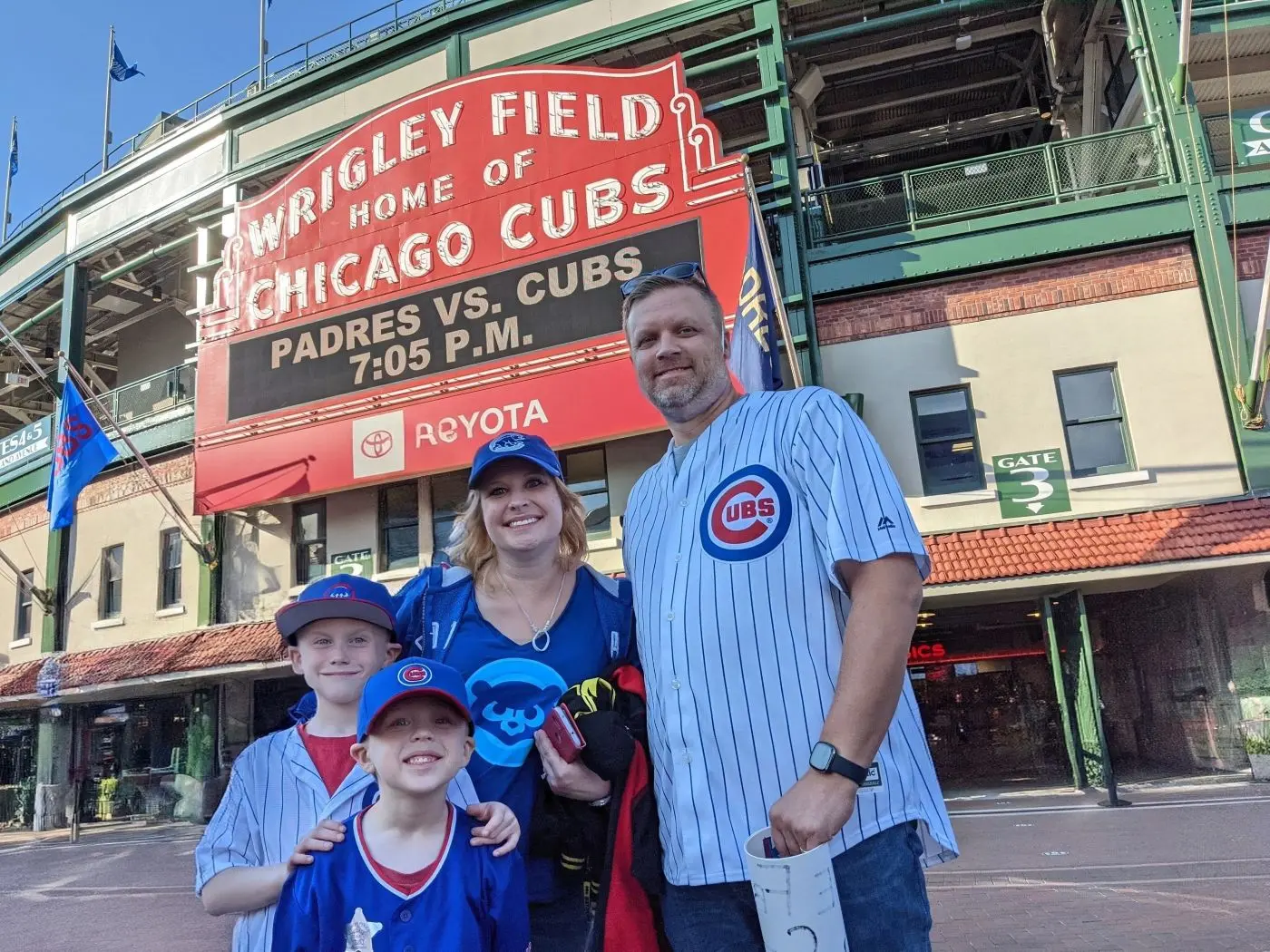
JP Lindquist and family


What’s the most challenging yet rewarding thing you’ve worked on at GoDaddy?

Less a single project and more a defining decision: getting out of my comfort zone. I chose to leave a path I knew well and excelled in to pursue one I wanted even more.

I was successful in sales. I knew the role, consistently delivered results, and could have easily stayed on that path. Walking away from that to start at the bottom of a technical organization meant trading the thing I was confident in for the thing I had wanted since I was a kid but had never actually done professionally.

Every step after that was a version of the same trade. Hosting support, server support, hosting administration, SRE: each one meant handing back expertise I had built and becoming the least experienced person in the room again. It often took months before I felt comfortable and had a solid grasp of the tech stack. It took even longer before I could move beyond simply keeping up and start identifying opportunities to improve processes and automate work.

What got me through it every time was a willingness to get my hands dirty, and to say “I don’t know, but I’ll find out,” then actually going and finding out. That is an uncomfortable thing to say out loud, especially when you are new and want to prove you belong. It beats guessing. It gives you a reason to go get the right answer and understand it.

The reward is what sits on the other side of all that. Availability and performance look like numbers on a dashboard, but for our customers, and their customers, that is someone’s business and livelihood on the line. Being on call during the football commercials, watching dashboards while the ad airs and a wave of people arriving all at once, making sure everything holds through a window that does not come back. There are real stakes to it, and I have been on every side of it: the customer, the person on the phone taking that call, and now one of the people responsible for the systems underneath.

Looking back, what felt like a difficult transition at the time, or a goal that seemed a long way off, has been worth every bit of it. Every step added something that carried forward: automation, configuration management, observability, debugging complex systems, and remembering why we are here and who we are working for. None of that came from a class. It came from doing the work, breaking a few things, and building the tools along the way.
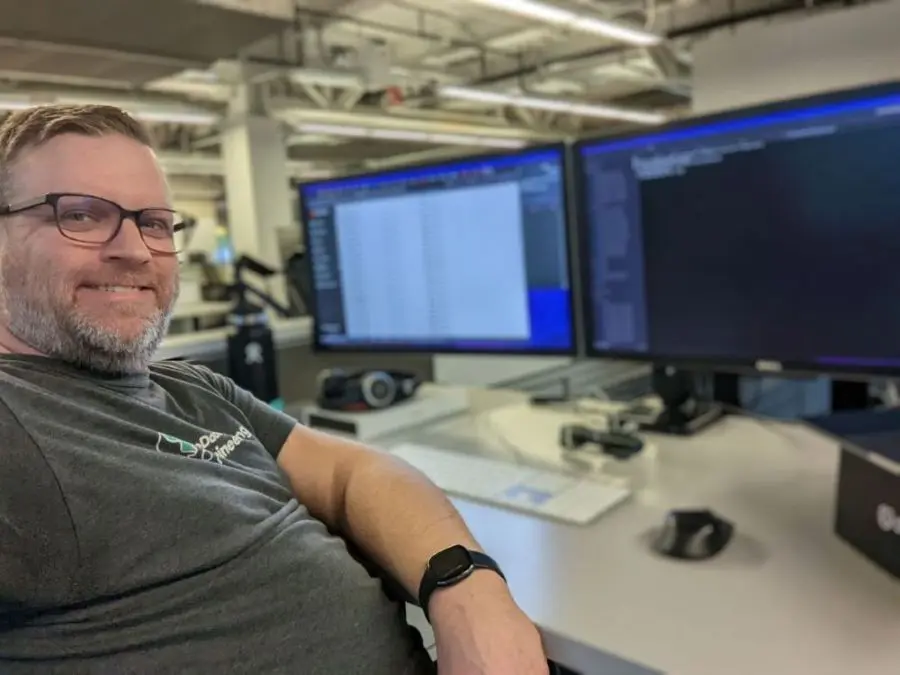
JP Lindquist


Which emerging technologies or patterns do you think will matter most in the next 2 years?

Without a doubt, AI. I do not think there is much debate left about that. It is the most transformative technology I have seen in my career, and it is moving faster than anything else has.

I still have the same goals: solve the problem, find a way to make it easier, or automate it entirely so it is not a future problem. How we go about it, and how fast we get there, has changed drastically. Research that once took weeks before producing anything useful can now be accomplished in a matter of hours. Going from an idea to something tangible that quickly still feels like magic, and it’s become an invaluable partner for troubleshooting, research, and breaking down large, complex projects into manageable pieces.

How do you stay motivated and disciplined in your learning journey, especially when faced with setbacks?

I have to learn by doing. You can tell me a thousand times to do something a certain way, but I am hands on. I need to see it and feel it myself. While it is a great way to learn, it can be an efficient way to break things as well. The discipline for me is less about study habits and more about being willing to get into something I do not understand yet and stay with it until I do.

Setbacks are part of that. Every incident or outage has a cost, and affects real customers who are trying to run something that matters. When something fails, the questions come immediately: how could we have caught this sooner, how could we have prevented it, and what are we doing to make it better?

What keeps me motivated is the satisfaction in solving problems, helping people, having a great team, and building infrastructure and tools we can be proud of.

When something does go wrong, the setback itself is usually what motivates me most. I would rather spend the time making sure it cannot happen again, or that we would catch it far earlier next time, than move on and hope. There is always something to improve, and an incident tends to point right at it.

Are there any resources that you would recommend to others interested in personal development?

Just be a sponge. Have the desire to learn and understand everything you touch, all the way down to root cause, every time. Learn to harness the powerful tools available to you, whether that is automation, AI, or whatever comes next. Keep asking the big-picture questions: how can I be better, how can I make this better, how can I make this simpler for the person who comes after me?

As for mentors, I have been fortunate enough to have an amazing support system: family, teachers, and coworkers who encouraged me to follow what I was actually interested in and pursue a career that would be fulfilling. I knew where I wanted to go, and I was always lucky to have people supporting me along the way.

What’s your motto or personal mantra?

I have two:

“Some things you have to learn the hard way.” I learn best hands on, so for me this one means do not be afraid to get your hands dirty, and learn from your mistakes.

“With great power comes great responsibility.” I am a huge Spider-Man fan, and this one has always meant something to me. If you can help, you should help. Be accountable.
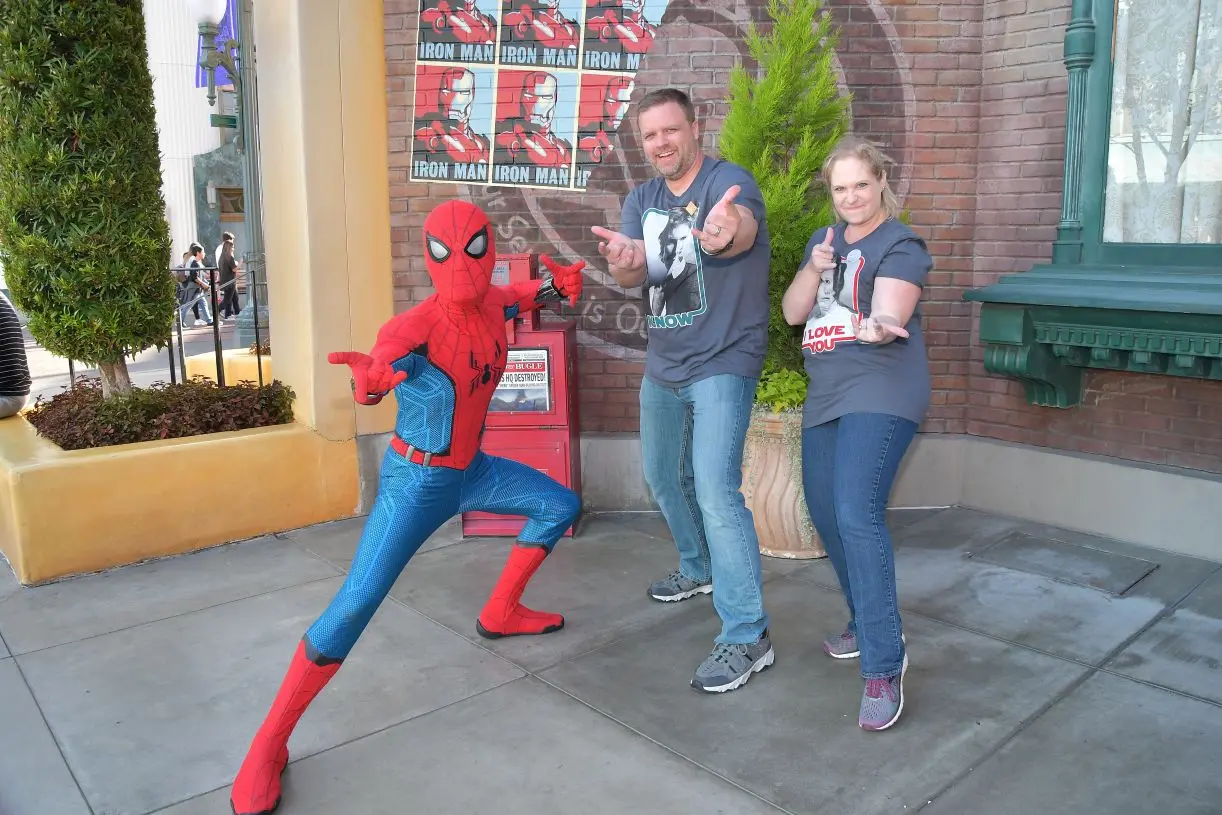
JP Lindquist and family


Are you enjoying this series and want to know more about life at GoDaddy? Check out our GoDaddy Life social pages! Follow us to meet our team, learn more about our culture (Teams, ERGs, Locations), careers, and so much more. You’re more than just your day job, so come propel your career with us.


BEDFORD, Mass.–(BUSINESS WIRE)–PharmaEssentia Innovation Research Center (PIRC), a subsidiary of PharmaEssentia Corporation (TWSE: 6446), a global biopharmaceutical innovator based in Taiwan leveraging deep expertise and proven scientific principles to deliver new biologics in hematology and oncology, today announced two poster presentations at the Society for Immunotherapy of Cancer’s (SITC) 41st Annual Meeting, taking place November 4-8 in Phoenix, Arizona. The two presentations feature pre

Privacy Overview

This website uses cookies so that we can provide you with the best user experience possible. Cookie information is stored in your browser and performs functions such as recognising you when you return to our website and helping our team to understand which sections of the website you find most interesting and useful.