
ボストン–(BUSINESS WIRE)–(ビジネスワイヤ) — AMGTAは、2026年の年次メンバーサミットの開催を受け、「Additive Manufacturing in Resource-Efficient Manufacturing Systems」と題する独立報告書を発表しました。この報告書は、付加製造を部品、システム、および企業の各レベルでどのように評価し、説明し、導入すべきかを示すものです。 この報告書は、付加製造をどのように評価すべきかについての構造的な考え方を示しています。評価対象は部品レベルのみにとどまらず、資源効率、サプライチェーンの強靱性、資本配分におけるAMの最も重要な利点が実際に顕在化する、部品、システム、および企業の各レベルに及びます。また、AMエコシステムの両側面、すなわち技術開発者と製造ユーザーを対象に6年間継続して観察した結果に基づいており、いずれか一方の立場だけでは到達できない知見を導き出しています。さらに、投資家向けプレゼンテーション、政策に関する議論、調達に関する協議、および組織の意思決定に活用できるよう設計されています。 この報告
Author: sHq_LoGiNz
BOSTON–(BUSINESS WIRE)–Suite à son sommet annuel des membres 2026, l’AMGTA a publié aujourd’hui « La fabrication additive dans les systèmes de fabrication économes en ressources », un rapport indépendant qui indique comment évaluer, communiquer et déployer la fabrication additive aux niveaux des pièces, des systèmes et de l’entreprise. Ce rapport présente une argumentation structurelle sur la manière dont la fabrication additive devrait être évaluée : non pas uniquement au niveau des pièces,
波士頓–(BUSINESS WIRE)–(美國商業資訊)– 在2026年度會員高峰會結束後,AMGTA今日發表了《資源高效型製造體系中的積層製造》(Additive Manufacturing in Resource-Efficient Manufacturing Systems)獨立報告,確立了應如何在零組件、系統和企業層面評估、傳達和應用積層製造。 該報告建構了一套系統性論述,說明積層製造不應僅在零組件層面進行評估,而應涵蓋零組件、系統和企業三個層級,積層製造在資源效率、供應鏈韌性和資金配置方面的核心優勢正是在這些層面得以真正體現。報告依據對積層製造生態系統雙方——技術開發商和製造應用企業——長達六年的持續觀察,得出了任何一方僅憑自身視角都無法獲得的結論。報告可用於投資人簡報、政策討論、採購洽談和組織決策。 該報告與配套的《2030策略》文件一起,在4月13日於波士頓舉辦的2026年度會員高峰會上向AMGTA全球會員進行了展示和研討。 積層製造與傳統製造的標準成本對比僅核算了雙方相同的直接生產成本,卻系統性忽略了傳統製造中隱含的隱性成本——需求確定前投入的模具資金、庫存持有成
April 16, 2026 /3BL/ – Invasive species, introduced accidentally or purposefully outside their original range, can wreak havoc in their new environments, contributing to 60% of global wildlife extinctions and costing $423 billion per year. A new report from World Wildlife Fund (WWF) explores how, when eradication is not possible, developing commercial uses for these pests can help manage their populations and provide environmental and economic benefits to local communities. It presents a first-of-its-kind framework to help businesses and ecologists evaluate the potential benefits and unintended consequences of large-scale harvesting for commercial use.
“The complex part of creating new markets is the chicken-and-egg problem,” said Julia Kurnik, senior director for innovation startups at the Markets Institute at WWF and co-author of the report. “It’s risky to build procurement and processing infrastructure without existing market demand; but companies won’t launch new products until there’s stable supply and processing capabilities. But we’re working on solutions to this problem and already seeing progress.”
Using market forces is a new approach to addressing invasive species, and success will require collaboration from both the conservation and business worlds. To address this challenge, WWF has created a ‘Market Uses for Invasives’ framework. The framework aims to de-risk market-based solutions while centering positive environmental outcomes.
“Creating large-scale markets for invasive species requires planning and rigorous analysis. Our framework helps answer questions that haven’t been fully explored before,” said Emily Moberg, senior director at the Markets Institute and report co-author. “There is a very real risk of unintended consequences with commodifying invasive species; it’s essential we get this right and only use market solutions when they make ecological and business sense.”
To illustrate the framework’s utility, the report applies it to two invasive species causing considerable environmental and economic damage: carp and black locust trees. The analysis examines carp for pet food and black locust for lumber.
There are several companies working to address the bottleneck in processing capacity for invasive carp for the pet food and consumer markets. In 2026, pet food company Chippin launched IGNIZA, a new brand with a large-scale processing facility so other pet food companies can incorporate invasive species into their own products. Other companies, like Two Rivers Fisheries and Impact Fisheries, are developing carp burgers and fish cakes to serve in schools as part of a larger educational campaign about the impacts of invasive species.
“Most pet food in the U.S. comes from byproducts of human food processing. But with demand growing and more consumers seeking human‑grade options, we need new ingredients that don’t add environmental pressure,” said Haley Russell, founder of Chippin and IGNIZA. “Sourcing nutrient‑dense invasive carp for pet food protects native fish, reduces environmental harm, and turns an ecological challenge into part of the solution.”
Going forward, WWF will continue to support and explore the potential of using market forces to address invasive species. This will include revising, refining, and sharing the framework, along with encouraging efforts through business and supply chain support. WWF will also develop additional case studies and share lessons learned, ensuring that all collected wisdom is available long-term.
Read the full report: https://www.worldwildlife.org/publications/from-pest-to-profit-market-use-of-invasive-species/
Media Contact: Lorin Hancock | Lorin.Hancock@wwfus.org
####
Disclosure: WWF Impact, the impact investing arm of WWF-US, supports investment solutions to solve some of the most pressing environmental challenges facing people and the planet. WWF Impact is invested in Chippin. This investment aligns with WWF Impact’s impact investing mandate and internal governance procedures.
####
About World Wildlife Fund
WWF is one of the world’s leading conservation organizations, working for 60 years in nearly 100 countries to help people and nature thrive. With the support of 1.3 million members in the United States and more than 5 million members worldwide, WWF is dedicated to delivering science-based solutions to preserve the diversity and abundance of life on Earth, halt the degradation of the environment, and combat the climate crisis. Visit worldwildlife.org to learn more; follow @WWFNews on X, formerly known as Twitter, to keep up with the latest conservation news; and sign up for our newsletter and news alerts here.
That trip home to Peru changed her digital habits—now it’s less about screen time limits, and more about using it intentionally to keep language and family close.
Traveling with kids always teaches you something. Traveling back to the place where you grew up, with your child beside you, teaches you even more.
Earlier this year, I took my 5-year-old son, Ford, to Peru. It’s where my roots are, where my family history began, and where many of my earliest memories originated.
Watching him walk the same cobblestone streets, hearing Spanish spoken all around him, was more emotional for me than I expected.
The trip wasn’t just about sightseeing. It was about introducing Ford to his story, his language and his heritage. When we returned home to Miami, I realized the introduction provided by that trip wasn’t enough. The connection needed to continue in our everyday life.
How Peru came home with us
At five, connection is simple but powerful. It comes from hearing familiar voices, seeing familiar faces and feeling included.
Back home, we found small ways to keep Peru part of our routine. Ford uses a Verizon Gizmo Watch 3, which allows him to call or text only the contacts I’ve added. He can send a short voice message in Spanish to family to say good night. Sometimes he calls to share something he learned.
We also use family group chats and video calls so he can practice Spanish, stay engaged with relatives and start building healthy digital habits. As a result, what started as a meaningful trip has become an ongoing relationship with his culture.
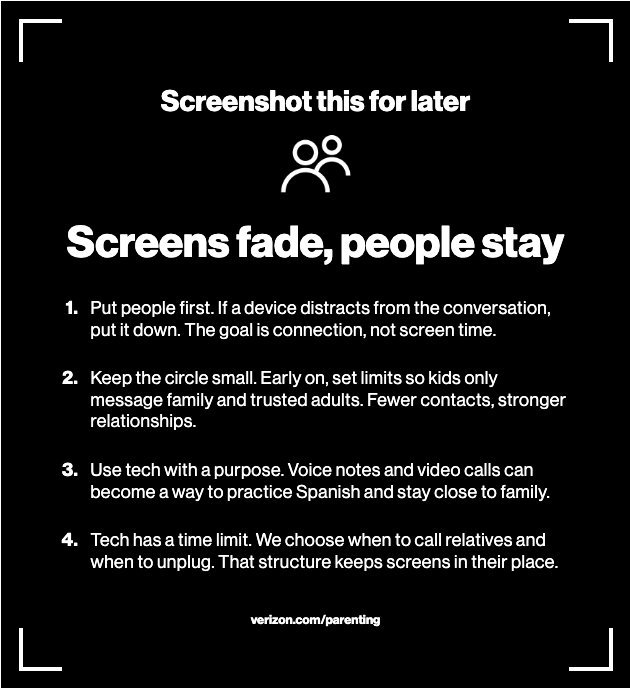
Screens fade, people stay: Our family screen time rules
The trip also has me thinking about the kind of digital habits I want Ford to grow up with. These aren’t just rules or screen-time limits, but are the structure we’re using as a family. They’ll change over time, but these five ideas are our starting point:
- People first. The goal is connection. If a device distracts from the conversation, we put it down.
- Known contacts only. He can call and message only family and trusted adults we’ve added.
- Connection on a screen has a time limit. We decide when it’s time to call relatives and when it’s time to unplug.
- Short and meaningful conversations. A quick voice note in Spanish can have more impact than extended scrolling.
- Boundaries that grow with him. As he gets older, the tools will change, but the expectations won’t.
We use Verizon Family Plus to help support those rhythms and set clear boundaries for devices beyond his Gizmo watch. The app allows me to manage screen time and set screen time limits, pause internet access when needed and adjust filters as he grows. Not to hover—but to create structure.
At five, structure and screen-time limits matter. They reinforce a simple message: Technology should support real relationships, not replace them.
Turning a trip into something lasting
The trip to Peru helped Ford see where he comes from. Now, we can continue to have an impact through ordinary moments: when he chooses to send a voice note in Spanish, calls a relative in Peru, practices Spanish in a video chat or asks questions about our family history.
Technology, when used thoughtfully, can bridge distance and generations. It can help a child feel connected not only to people, but also to identity. For me, this season of parenting is about raising a child who knows his roots and is using technology to strengthen relationships.
The memories we made in Peru were powerful. The connections we continue to build are what will last.
We got you: You’re there for them with Verizon Family. Verizon’s there for you—including our 3-year price lock*.
*Learn more about our 3-year price lock guarantee.
About the author:
Pamela Silva is a journalist, the co-host of Motherish and a mom navigating modern parenting, cultural identity and the evolving ways technology can support families as kids grow.
The author has been compensated by Verizon for this article.
Follow Me: 
That trip home to Peru changed her digital habits—now it’s less about screen time limits, and more about using it intentionally to keep language and family close.
Traveling with kids always teaches you something. Traveling back to the place where you grew up, with your child beside you, teaches you even more.
Earlier this year, I took my 5-year-old son, Ford, to Peru. It’s where my roots are, where my family history began, and where many of my earliest memories originated.
Watching him walk the same cobblestone streets, hearing Spanish spoken all around him, was more emotional for me than I expected.
The trip wasn’t just about sightseeing. It was about introducing Ford to his story, his language and his heritage. When we returned home to Miami, I realized the introduction provided by that trip wasn’t enough. The connection needed to continue in our everyday life.
How Peru came home with us
At five, connection is simple but powerful. It comes from hearing familiar voices, seeing familiar faces and feeling included.
Back home, we found small ways to keep Peru part of our routine. Ford uses a Verizon Gizmo Watch 3, which allows him to call or text only the contacts I’ve added. He can send a short voice message in Spanish to family to say good night. Sometimes he calls to share something he learned.
We also use family group chats and video calls so he can practice Spanish, stay engaged with relatives and start building healthy digital habits. As a result, what started as a meaningful trip has become an ongoing relationship with his culture.
Screens fade, people stay: Our family screen time rules
The trip also has me thinking about the kind of digital habits I want Ford to grow up with. These aren’t just rules or screen-time limits, but are the structure we’re using as a family. They’ll change over time, but these five ideas are our starting point:
- People first. The goal is connection. If a device distracts from the conversation, we put it down.
- Known contacts only. He can call and message only family and trusted adults we’ve added.
- Connection on a screen has a time limit. We decide when it’s time to call relatives and when it’s time to unplug.
- Short and meaningful conversations. A quick voice note in Spanish can have more impact than extended scrolling.
- Boundaries that grow with him. As he gets older, the tools will change, but the expectations won’t.
We use Verizon Family Plus to help support those rhythms and set clear boundaries for devices beyond his Gizmo watch. The app allows me to manage screen time and set screen time limits, pause internet access when needed and adjust filters as he grows. Not to hover—but to create structure.
At five, structure and screen-time limits matter. They reinforce a simple message: Technology should support real relationships, not replace them.
Turning a trip into something lasting
The trip to Peru helped Ford see where he comes from. Now, we can continue to have an impact through ordinary moments: when he chooses to send a voice note in Spanish, calls a relative in Peru, practices Spanish in a video chat or asks questions about our family history.
Technology, when used thoughtfully, can bridge distance and generations. It can help a child feel connected not only to people, but also to identity. For me, this season of parenting is about raising a child who knows his roots and is using technology to strengthen relationships.
The memories we made in Peru were powerful. The connections we continue to build are what will last.
We got you: You’re there for them with Verizon Family. Verizon’s there for you—including our 3-year price lock*.
*Learn more about our 3-year price lock guarantee.
About the author:
Pamela Silva is a journalist, the co-host of Motherish and a mom navigating modern parenting, cultural identity and the evolving ways technology can support families as kids grow.
The author has been compensated by Verizon for this article.
Follow Me: