2025 marked a proud moment for DaVita as we met our goal to power 100% of our global operations with renewable energy. We achieved this by securing multiple virtual power purchase agreements in the US and Europe over the past five years — offsetting our global energy consumption with renewable solar and wind power.

This milestone was one of multiple environmental goals DaVita established five years ago and has met in the time since. This marks an important step in DaVita’s long-term sustainability journey.

Our Journey to Net Zero
In addition to our near-term, self-identified goals, we are committed to net-zero scope 1 and 2 emissions by 2050. These are emissions related to DaVita’s operations. We call this commitment our Journey to Net Zero, and have focused our action plan in three critical areas:
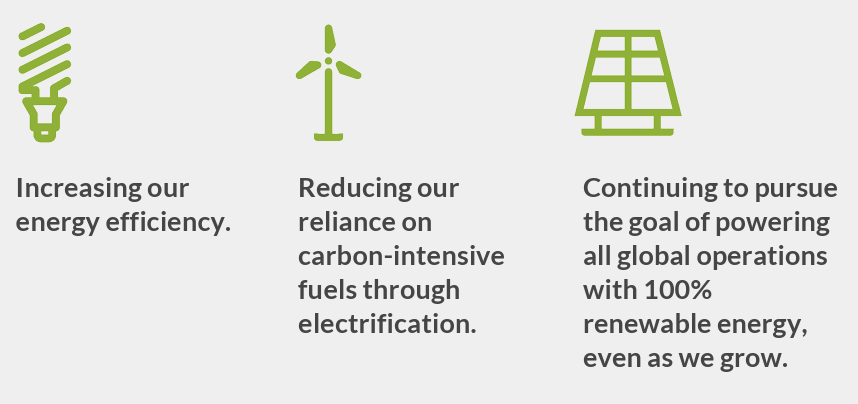
Energy infographic highlighting DaVita’s plans pursuing net zero, including increasing our energy efficiency, reducing our reliance on carbon-intensive fuels through electrification, and continuing to pursue the goal of powering all global operations with 100% renewable energy even as we grow.

Science-Based Climate Goals
A review by the Science Based Targets initiative (SBTi) verifies our climate targets are in line with the scale of reductions required to keep global warming from rising more than 1.5 degrees Celsius from pre-industrial levels. Our many energy efficiency initiatives and clean energy investments have driven notable progress to date.

81% reduction of scope 1 and 2 emissions, as of December 31, 2025, as compared to a 2018 baseline.
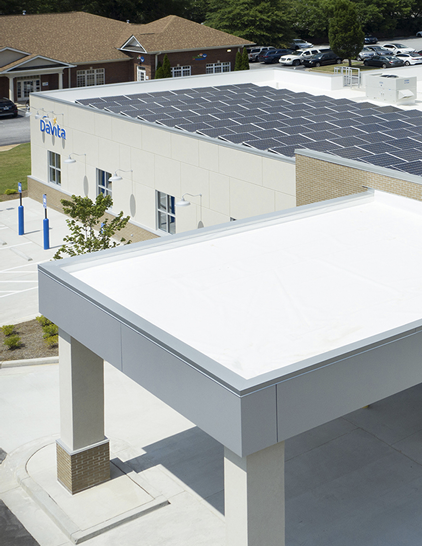
solar panels on a roof

Meeting Our Renewable Energy Goals
2025 marked a proud moment as we met our goal to power 100% of our global operations with renewable energy. We achieved this by securing multiple virtual power purchase agreements in the US and Europe over the past five years. Through these agreements, we now offset our global energy consumption with renewable solar and wind power.

Energy Efficiency
DaVita has been focused on energy efficiency improvements for over a decade. These include efficient LED lighting systems and smart building controls. We also upgrade water heaters and HVAC units to high-efficiency systems whenever replacements are required. As a result of our systematic approach to upgrades, the majority of our U.S. centers now have these energy efficient features.

Continued Progress in Electrification
In 2023, we were proud to announce the launch of our first ever net-zero dialysis center featuring all electric systems and solar power. In 2025 we continued to build on this progress by replacing gas-fired roof top HVAC units with heat pumps in select facilities — another step toward scaled adoption of higher-efficiency equipment.

Vendor Engagement
DaVita encourages its suppliers to set meaningful climate goals. By the end of 2025, 71% of vendors, by emissions, had publicly stated science-based targets.

Water Stewardship
Access to clean, fresh water is essential to the dialysis process, and we are committed to being good stewards of this resource. In 2025, we utilized a targeted Top Water Users reduction program to identify and address areas with the greatest room for efficiency improvement. We also continued ongoing work to upgrade reverse-osmosis water purification systems to newer, more efficient models to reduce water consumption in our clinics.

Through these initiatives, we saved more than 90 million gallons of water in 2025 and 468 million gallons from 2021 to 2025, greatly surpassing our publicly reported goal of saving 240 million gallons of water from 2021 to 2025.

windmills

External Recognition as a Sustainability Leader
Our sustainability leadership has earned recognition from leading institutions and publications.
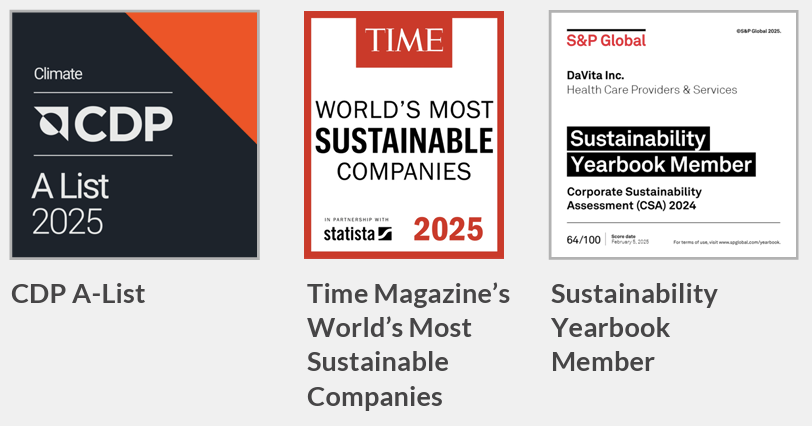
logos of awards

  • USA Today America’s Climate Leaders
  • Dow Jones Best-in-Class Indices1
  • RE100 member
  • Green Power Partnership Fortune 500® Partners List
  • Newsweek America’s Greenest Companies

We report environmental data aligned with recommendations from the Task Force on Climate-Related Financial Disclosures (TCFD), a leading authority on environmental reporting. Details on our environmental footprint and supporting data can be found in our TCFD Report and Data Tables in the second half of this document.

Teammates United for a Healthier World
Recognizing that our teammates play an important role in sustainability, we encourage involvement through Earth Day, events at our offices and Green Action challenges.

In 2025, teammates logged nearly 67,000 Green Actions, which are defined as intentional actions or behaviors that support positive environmental change.

Over our entire 5-year reported goal period, our dedicated teammates logged 135,400 Green Actions in total.

1Previously known as Dow Jones Sustainability Indices. Renaming effective February 2025: https://www.spglobal.com/spdji/en/client-services/currenttransitions/sp-dow-jones-indices-announces-renaming-of-some-sustainability-indices/ 

Key Takeaways

  • The most important aspect of your GHG emissions calculations is their defensibility. Your organization needs to demonstrate the methodologies, record-keeping, and assumptions that underpin the data. 
  • Evolving regulatory requirements add a sense of urgency to the need for independent assurance. 
  • After-the-fact documentation can be much more time-consuming, challenging, and expensive to gather after an inventory is already in the process of being developed. 
  • Impartial review is critically important—a consultancy that prepares an organization’s GHG inventory cannot also provide assurance of their own work. 

If your company has been reporting greenhouse gas (GHG) emissions for years but has never had the inventory independently assured, the first assurance engagement can feel like a major hurdle. 

Perhaps surprisingly, the emissions calculations themselves usually aren’t the hard part.  The real challenge comes down to documentation and traceability—being able to demonstrate where the data came from, why certain methodologies and assumptions were used, and whether the record keeping behind the inventory can stand up to independent review. 

A GHG assurance engagement benefits from practitioners who deeply understand GHG accounting—not just the auditing process. Utility bills, fuel records, refrigerant logs, renewable electricity purchases, changing facility boundaries, emission factors, estimates: these are the complexities and details behind a corporate GHG inventory. An advisory team that works with that kind of data every day knows where gaps are likely to be. For many companies, there are multiple reasons to start looking for those gaps now.

1. The Data You Are Collecting Today May Be the Data That Gets Assured Tomorrow 

California SB 253 is an obvious driver. Companies will be required to obtain limited assurance over FY26 Scope 1 and Scope 2 emissions for 2027 reporting, making independent GHG assurance a brand-new requirement for many organizations.  

The Corporate Sustainability Reporting Directive (CSRD) is another driver for companies within its evolving scope, while other organizations are pursuing assurance in response to customer, investor, or voluntary reporting expectations. 

Whatever the reason, the point is the same: Don’t wait until the assurance engagement starts to determine whether the underlying data are ready for it. 

For companies preparing for California SB 253 in particular, the first assurance cycle will involve emissions data being collected before the assurance engagement itself. Waiting until later can mean trying to reconstruct utility records, track down fuel data, explain an old estimate, or remember why a particular emission factor was selected months after the fact. 

That is harder, more time-consuming, and potentially more expensive than getting the documentation right while the inventory is being developed.

2. Assurance Is More Than Checking Calculations 

A limited assurance engagement is a risk-based evaluation designed to determine whether reported emissions are free from material misstatement. It isn’t a review of every invoice or every individual data point. Instead, the assurance provider will look at where material errors are most likely to occur and will gather evidence to support a conclusion about the reported emissions. 

That may include evaluating whether: 

  • Organizational and operational boundaries are clearly defined and consistently applied 
  • Activity data are complete, traceable, and supported by appropriate records 
  • Emission factors and calculation methodologies are appropriate and consistently applied 
  • Estimates and assumptions are reasonable and documented 
  • Sufficient evidence exists to support reported emissions

This is where first-time assurance can reveal issues that weren’t necessarily visible when the goal was only to complete the annual inventory. It’s very common for a calculation to be perfectly reasonable but lack the documentation behind it. 

Consider some real-world examples: Perhaps operational control of a facility changed during the reporting year, and the treatment of that facility was never formally documented. Maybe refrigerant data are incomplete. Maybe someone used an estimate for a few months of energy consumption because a utility bill wasn’t available but only jotted it down on a sticky note. Or maybe the person who built the inventory knows exactly how everything works—but that knowledge is available only through that person, not documented in an Inventory Management Plan. None of those situations means the inventory is incorrect, but they can make assurance much harder in ways that are avoidable.

3. Good Preparation Makes First-Time Assurance Much Easier 

The focus shouldn’t be to create a flawless inventory before assurance. That isn’t realistic, and it isn’t even the purpose of assurance. 

The goal is to make the inventory defensible. 

Can you explain your boundaries? Can you trace material data back to source documentation? Can you explain your assumptions and estimates? Are your methodologies documented? If someone unfamiliar with the inventory reviewed the files six months from now, could they understand how you got from the source data to the reported emissions? 

Those are the questions to start asking. 

For organizations that aren’t confident in the answers, an assurance readiness review can be useful before formal assurance begins. A readiness engagement looks at the inventory through an assurance lens—identifying documentation gaps, methodology issues, data-quality concerns, and other areas likely to draw attention during independent review. 

Importantly, independence and impartiality matter. A consultancy that prepares a company’s GHG inventory cannot provide independent assurance over their own work. The consultant can, however, help that organization prepare for assurance by another provider. If the inventory was developed internally, through software, or by another advisor, the consultant may be able to provide the independent limited assurance engagement.

Prepare Now for a Smoother Assurance Engagement 

First-time GHG assurance does not need to be overwhelming. Spend the time now to look at the data trail—or simply be sure you’ve got one. Document the decisions. Make sure assumptions and estimates can be explained. Identify areas where the data are messy—and address what you reasonably can. 

Across corporate GHG inventories, one thing has remained remarkably consistent: Good GHG accounting is much more than getting the calculation right; it’s about being able to explain and support how you got there.  

Questions about how to prepare for your first GHG assurance engagement? Contact Antea Group’s GHG Assurance Readiness team to discuss the process and how we can support your organization.  

ATLANTA–(BUSINESS WIRE)—- $QMLS #QumulusAI–QumulusAI (Nasdaq: QMLS), a neocloud infrastructure provider purpose-built for the AI computing era, today announced it has completed deployment of NVIDIA Blackwell B300 GPU capacity at its Philadelphia colocation site, reaching full customer handoff and activating the $18 million, two-year take-or-pay agreement QumulusAI announced July 22, 2026, with a GPU cloud marketplace currently serving AI teams in more than 100 regions worldwide. The deployment represents the fu

UTRECHT, Netherlands–(BUSINESS WIRE)–New research from ReBound Returns and Advanced Supply Chain (ASC) has revealed a gap between retailers’ circularity ambitions and the value they are recovering from returned products. The Circularity Index, based on research among 150 senior leaders at mid-to-large UK and European retailers, found that 86% have an established approach to circularity in returns, with practices including resale, refurbishment, repair and recycling regularly used across the b

Watch Season 6 Episode 1 – Built Differently: The New Rules of Data Center Design

As AI rapidly transforms data centers, the challenge is designing data center cooling and infrastructure that can keep pace with rising compute demands, increasing heat loads and long asset lifecycles.

In this episode, Oakley Roberts, President of Data Centers at Trane Technologies, discusses how teams are adapting through climate-responsive cooling strategies, the balance of liquid and air cooling, lower water use and modular system design, while Michael Winterson, Secretary General of the European Data Centre Association, explores the broader implications of Europe’s expanding data center capacity, including grid constraints, energy demand, regulation and decarbonization.

Together, they highlight a fundamental shift in data center design: building systems that balance speed, repeatability and flexibility while adapting to evolving technologies, local conditions and infrastructure needs.

Key Moments

  • 0:00: Why the era of the standard data center is over
  • 03:26: How AI is changing data center cooling
  • 06:45: Rethinking data center water usage
  • 11:36: Europe’s ambitions for the digital decade
  • 19:52: How data center innovation benefits the whole economy

Featured in this Episode:

Hosts:
Dominique Silva, Marketing Leader EMEA, Trane Technologies
Scott Tew, Vice President Sustainability and Managing Director, Center for Energy Efficiency and Sustainability, Trane Technologies

Guests:
Oakley Roberts, President, Data Centers, Trane Technologies
Michael Winterson, Secretary General, European Data Centre Association (EUDCA)

About Healthy Spaces

Healthy Spaces, a podcast by Trane Technologies, brings together engineers, innovators and industry leaders for bold conversations at the frontier of sustainable technology.

In Season 6, we zero in on the moment when innovation becomes infrastructure – when breakthroughs move beyond the lab and start transforming industries.

From pioneering AI research and next-generation data center cooling to climate-resilient cities and pathways to decarbonization, each episode explores the innovations at the cutting-edge of sustainable technology.

Designed for leaders, builders and anyone with a stake in the future of sustainable technology, the series offers a front-row seat to the ideas and innovations shaping what comes next.

The challenges are real. The solutions are being built now.

Listen and subscribe to Healthy Spaces on your favorite podcast platforms:

Apple Podcasts 
Spotify 
YouTube 
Amazon Music

ARLINGTON, Va. & DENVER–(BUSINESS WIRE)–RTX Ventures, the venture capital arm of RTX, has made a minority investment in laser fusion company Xcimer Energy Corporation (XEC) to support Xcimer’s development of scalable multi-kilojoule-class pulsed-laser technologies. In addition to the investment, RTX and Xcimer have signed a teaming agreement to explore the integration and containerization of Xcimer’s pulsed-laser technologies into RTX’s defense systems, offering the U.S. military potential ne

TORONTO–(BUSINESS WIRE)–Dani Reiss, Chair of the Board of Directors and Chief Executive Officer of Canada Goose Holdings Inc. (NYSE: GOOS, TSX: GOOS) (“Canada Goose”), is pleased to announce that on September 9, 2026, through DTR LLC (“DTR”), his investment holding company, he acquired an aggregate of 100,000 subordinate voting shares (“SVS”) of Canada Goose through open market purchases on the Toronto Stock Exchange (“TSX”) and other Canadian published markets.The acquisition increases Mr. Re

Privacy Overview

This website uses cookies so that we can provide you with the best user experience possible. Cookie information is stored in your browser and performs functions such as recognising you when you return to our website and helping our team to understand which sections of the website you find most interesting and useful.