
LONDON–(BUSINESS WIRE)– Funds Date TIDM ISIN Code Shares in Issue Currency Net Asset Value NAV/per Share First Trust Cloud Computing UCITS ETF 24.09.2026 CPQ IE00BFD2H405 6,275,002.00 USD 440,022,126.27 70.123
Author: sHq_LoGiNz
WESTLAKE VILLAGE, Calif.–(BUSINESS WIRE)—- $LTC #LTC–LTC Properties, Inc. (NYSE: LTC) (“LTC” or the “Company”), a real estate investment trust specializing in seniors housing and health care properties, today announced that Pam Kessler and Clint Malin, Co-Presidents and Co-CEOs, have been elected to its Board of Directors effective September 22, 2026, increasing the total number of directors from six to eight, five of whom are independent. Kessler and Malin have each spent more than two decades at LTC an
LONDON–(BUSINESS WIRE)– Funds Date TIDM ISIN Code Shares in Issue Currency Net Asset Value NAV/per Share First Trust Nasdaq Cybersecurity UCITS ETF 24.09.2026 NQCYBREN IE00BF16M727 28,940,562.00 USD 1,860,955,512.09 64.303
LONDON–(BUSINESS WIRE)– Funds Date TIDM ISIN Code Shares in Issue Currency Net Asset Value NAV/per Share First Trust NYSE Arca Biotechnology UCITS ETF 24.09.2026 FBTU.LN IE00BL0L0H60 500,002.00 USD 16,731,608.04 33.463
LONDON–(BUSINESS WIRE)– Funds Date TIDM ISIN Code Shares in Issue Currency Net Asset Value NAV/per Share First Trust Dow Jones Internet UCITS ETF 24.09.2026 FDNU IE00BG0SSC32 1,275,002.00 USD 51,463,361.34 40.363
LONDON–(BUSINESS WIRE)– Funds Date TIDM ISIN Code Shares in Issue Currency Net Asset Value NAV/per Share First Trust Vest U.S. Equity Max Buffer UCITS ETF – September 24.09.2026 MSEP.LN IE0009DRFET8 50,002.00 USD 1,417,974.59 28.358
PORT ST. LUCIE, Fla.–(BUSINESS WIRE)–Wire 3 announced the expansion of its Port St. Lucie build plans in response to strong demand from residents and businesses across the community.
IRVING, Texas–(BUSINESS WIRE)– #FluorBuildsABetterWorld–Fluor Joint Venture Celebrates Opening of Oak Hill Parkway in Austin, Texas
by Kristen Coco
Building on the Global Commission on Healthy Indoor Air’s landmark launch of the Global Framework for Action, Rachel Hodgdon, President and CEO of the International WELL Building Institute (IWBI) and Co-Chair of the Global Commission, delivered an urgent call to action, encouraging leaders to deliver on a forward-looking “health-first agenda” for educational institutions worldwide.
Presented during today’s UN High-Level Side Event on Healthy Indoor Air in Schools: Every Breath Shapes Learning, Hodgdon’s remarks leveraged the Global Framework’s roadmap to drive systemic improvements in indoor air quality across learning environments.
IWBI was at the heart of convening the inaugural Healthy Schools for Healthy Kids Summit, a first-of-its-kind national gathering held in Washington, D.C. this past summer. Today, Hodgdon urged leading experts, advocates and policymakers to continue efforts to produce a forward-looking health-first agenda, focused on school modernization, healthy materials, indoor air quality and ventilation, emergency preparedness and resilience, healthy lighting and acoustics, pollution prevention, remediation of legacy environmental hazards, technical assistance for schools and communities, and priority research needs.
Also delivering remarks at today’s UN event were Ministers, MPs and senior officials from the governments of France, the United Kingdom, Montenegro and Eswatini. As well, fellow Commissioners Dr. Ian Longley of the Air Quality Collective and Air Club Co-Founders Dr. Georgia Lagoudas and Dr. Bronwyn King, alongside other global experts, collectively spotlighted the importance of indoor air quality across public health, education, biosecurity and climate resilience.
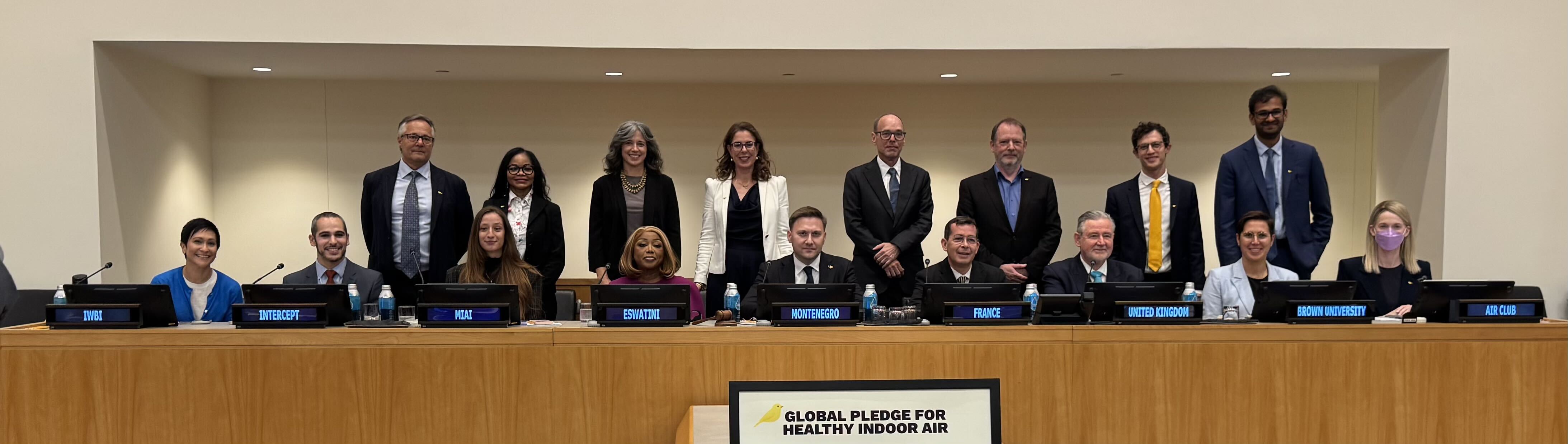
Read Rachel Hodgdon’s full remarks below or watch the recording of the UN High-Level Side Event on UN Web TV, Healthy Indoor Air in Schools: Every Breath Shapes Learning.
To learn more about the Global Commission on Healthy Indoor Air and its newly-launched Global Framework for Action, read the press release and visit the website.
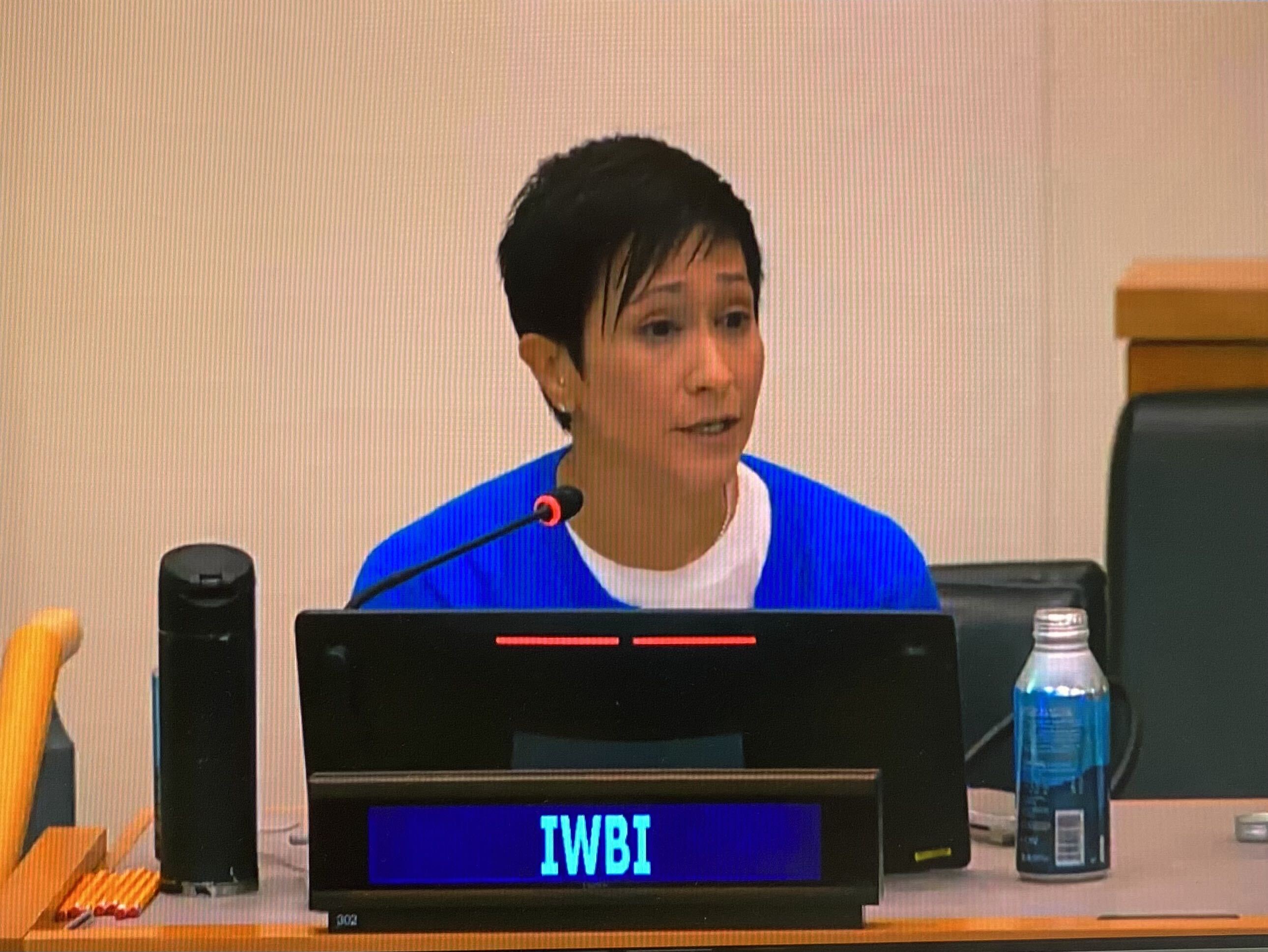
I keep coming back to one word today: hope.
We have heard from so many inspiring speakers about the hope of a world in which everyone—no matter who they are or where they live—has access to healthy indoor air.
And what we are witnessing is more than momentum. It is a growing belief that we are rapidly approaching a global tipping point.
Last year, we came together around the Global Pledge for Healthy Indoor Air. And two days ago, the Global Commission launched the Global Framework for Action—a game plan for turning the fundamental human right of healthy indoor air into a reality.
And this gathering is another reason for hope. Government leaders, school districts, philanthropy, NGOs, industry and academia—all coming together to stand up for our schools.
Because when we talk about indoor air in schools, we are not talking about air for its own sake.
Healthy air is the entry point. Health is the purpose.
At IWBI, our singular focus is advancing a health-first agenda for the places and spaces where we live our lives. And nowhere is that more important than in our schools.
This summer, IWBI joined four other national organizations to host our Healthy School Summit, where we announced a health-first agenda for America’s schools.
And that word—first—matters.
For too long, health has been something important, but rarely urgent. Something that can wait.
But our children cannot wait.
I remember talking to a school district leader who told me about a little girl who, due to poor indoor air quality, was having asthma attacks day after day at school. Her family finally pulled her out and moved her to another district simply so she could be well enough to learn.
For that little girl, this wasn’t a facilities problem. This wasn’t a line item in a capital budget.
It was her life.
And that’s what urgency looks like.
For too many students and educators, health has been deferred to the next budget, the next capital plan, the next year.
But when health is delayed, health is denied.
We must also make our schools more energy-efficient, sustainable and resilient. Those goals matter enormously.
But when it comes to our children, they are the means, not the ultimate measure of success.
A school can meet an energy target and still fail a child who is struggling to breathe.
The ultimate measure is whether that building supports the health, well-being and learning of the people inside it.
The Global Framework gives us a path from aspiration to action. Now we need that same health-first commitment for schools around the world.
No child should have to trade their health for an education.
So today let’s make—and keep—one simple promise to every child:
Your health and well-being comes first.
View original content here.
NEW HAVEN, Conn. and AMSTERDAM and HONG KONG and OAKLAND, Calif., September 25, 2026 /3BL/ – Cascale and Worldly will collaborate directly with a Yale instructor to bring the Higg Index and real-world case studies to a fashion value chain course at the Yale School of the Environment.
The collaboration centers on three industry-informed case studies for the semester commencing in September 2026, as part of a broader curriculum, and brings interdisciplinary real-world examples to the classroom across subject areas for more in-depth learning. The course is titled “Transforming Global Value Chains for Sustainability: The Case of Fashion and Textiles’” at the Yale School of the Environment. Yale will also be joining Cascale’s membership base.
“Yale is where I learned how to analyze complex systems where there were no clear answers. In the years since, mentoring students who want to work at the intersection of business and sustainability, I’ve seen how a lack of access to the tools and data the industry actually runs on holds back brilliant students’ abilities to understand the whole picture,” said J.R. Siegel, vice president of sustainability at Worldly, who is also a Yale alumni and mentor. “This course closes that gap. Last year alone, facilities shared verified data with brands through Worldly more than 100,000 times. Students who work with the same platform and data will start their careers understanding how the work gets done, not just in theory but in practice.”
“Students want real industry experience in sustainability fields, but they rarely get access to the leaders, frameworks, and real-world context shaping global value chains,” said Lee Green, vice president of marketing, communications, and public affairs at Cascale. “Convening that expertise is what Cascale does. Bringing it into a Yale classroom is simply how we put it to work preparing the next generation. ”
Students will dive deeper into how environmental factors such as water use, chemical management, greenhouse gases, land use, waste, and more influence sustainability progress. They will also examine the social impact of the industry and how it addresses human rights. Uniquely, the course is open to Yale students across disciplines.
“Complex industries like consumer goods and fashion offer an incredibly rare opportunity for multi-disciplinary engagement and discoveries,” said Michelle Gabriel, lecturer at Yale School of the Environment (YSE) and resident fellow at the Yale Center for Business and the Environment (CBEY) . “Known for its significant environmental footprint, deeply entwined social implications, and historic underregulation, the subject matter is prime for students across Yale to engage in real-world problem solving. There is immense value that emerges when academia mingles with industry. In collaborating directly with reputable organizations like Cascale and Worldly, I’m confident that we will lay the groundwork for closer collaboration between academia and industry.”
Brands, retailers, and manufacturers came together 15 years ago to develop the Higg Index and continue to shape its impact today. It is one of the most widely adopted impact measurement frameworks in consumer goods. Organizations worldwide rely on the Higg Index to identify, understand, measure, and act to improve social and environmental performance. It is exclusively available on the Worldly platform, with methodology shaped by Cascale and its members. Consumer goods companies and their suppliers use Worldly to prove how their products are made so they can report, comply, and act.
The contributed case studies will explore the role and value of multi-stakeholder initiatives (MSIs) and unique stakeholder perspectives and the value of responsible purchasing practices using Cascale Better Buying survey insights.
Academia is a valued part of Cascale membership and Worldly’s platform user base. For more information on Cascale membership, explore membership. Learn about the Higg Index and explore Worldly’s current offerings.
This partnership signals a broader shift in how the industry develops talent. By embedding real tools and real data into academia, Worldly and Cascale are raising the bar for the next generation of sustainability professionals.
Media Contact: Forster Communications, cascaleforster@forster.co.uk
ABOUT CASCALE
Cascale is the global nonprofit industry alliance where consumer goods organizations turn shared sustainability ambitions into measurable progress at scale to combat climate change and support decent work for all. We unite 300 Corporate and Affiliate members in pre-competitive collaboration, turning shared measurement and collective action into reduced risk, stronger credibility, and long-term resilience. Our work is anchored by Cascale’s stewardship of the Higg Index frameworks (accessed through the Worldly compliance and sustainability platform), along with the Better Buying and Sustainable Furnishings Council tools.
LinkedIn | Instagram | YouTube
ABOUT WORLDLY
Worldly is the compliance and sustainability platform where consumer goods companies and their suppliers prove how their products are made, so they can report, comply, and act. Suppliers save time by reporting through one industry framework, sharing their assessments over 100,000 times annually on Worldly. Retailers and consumer goods brands get environmental, social, and chemical data together in one place, at the facility and product level. AI built on verified facility data, not estimates, turns that data into answers, showing companies where risk sits in their supply chains and where to act first.