
Month: August 2026
After years of unexplained fainting spells, Sofia Jalenak found answers that would ultimately shape her future career.
Violet Oliver saw firsthand how cardiac technology could bring comfort and peace of mind to a family.
Melissa Hermosillo Nava discovered her calling through the impact medical technology had on her sister Kaylee’s life.
Their stories began in different places, but each eventually led them to the same destination: a Medtronic internship and a desire to help others.
Sofia Jalenak
Jalenak’s experience as a patient inspired her to pursue engineering.
When Jalenak was about 8, she started experiencing symptoms that were diagnosed as syncope, or fainting spells. At first, they happened infrequently, once every six months. She and her family were told she would likely grow out of it.
But as she got older, the episodes became monthly, then weekly, and eventually three or four times each day. Symptoms would often strike during the night and frequently result in fainting.
During overnight monitoring, doctors discovered that an AV node block was causing the episodes. The condition prevents electrical signals from properly traveling through the heart, disrupting its normal rhythm.
She began seeing a pediatric cardiologist, who eventually recommended a Medtronic pacemaker. She got it implanted when she was 15 years old.
Her experience as a patient showed her how medical technology can change lives. It also sparked her curiosity about the people who design those devices.
“When I got my pacemaker, I was thrown into a space that was biomedical engineering.”
Jalenak is fascinated by medicine and technology, and biomedical engineering allows her to combine her interests in both areas. Now, she studies biomedical engineering at Washington University in St. Louis.
She applied for an internship at Medtronic because she was passionate about the company.
“I want to make an impact as Medtronic has made an impact on me,” she said. She joined the Cardiac Rhythm Management team, specifically within Defibrillation Solutions.
Her internship includes collecting data that could benefit algorithms used in devices like hers. She has been using AI extensively to narrow down the specific data segments she needs to study, making the analysis process much more manageable.
Jalenak thinks being a patient gives her a unique perspective. Having grown up attending cardiology appointments, Jalenak is familiar with many of the devices, apps, and software systems people talk about at Medtronic and in her coursework — giving her a unique perspective.
“I want to help others so that they can have beneficial treatment like I did,” she said. “And I think that my studies and the knowledge that I gained from my degrees will help me pursue that passion. I would be very proud of myself to be able to give back in a way that has given so much to me.”
Violet Oliver
For Oliver, engineering is personal.
She has a family history of cardiac issues on her mother’s side. Her grandmother experienced ventricular fibrillation, a serious heart rhythm disorder, and passed away after she was unable to receive treatment in time.
As a preventative measure, her mother has a Medtronic implantable cardioverter defibrillator (ICD), device that monitors heart rhythms and can help correct dangerous abnormalities.
Oliver said the devices give her family peace of mind because they can monitor their heart information in real time on their phones.
Now, Oliver is helping develop technologies for families like hers.
“I’ve always felt this need to really give back to those who have helped my family in such a profound way,” she said.
She became interested in biology and engineering when she was around 10. That fascination led her to become a mechanical engineering student at Georgia Tech and pursue an internship at Medtronic.
Now a two-time Medtronic intern, she most recently worked on an early-stage prototype for a technology that could support future surgeries within Cranial and Spinal Technologies. She is also developing AI tools that could support mechanical engineering work.
One of the biggest lessons she has learned is the patient-focused mindset. In contrast to studying engineering at the university where projects are opportunities to experiment, learn, and grow, at Medtronic everything is rooted in a real impact, she said.
“Whenever I’m designing something at Medtronic, I always envision who is this going to help? Could this help someone like my mother? Do I want mediocre technology for my mom, or do I want the very best? Of course I want the very best,” she said. “That shift has really helped me grow as an engineer. And it’s really made me more aware of just how important it is to keep patients at the center of everything that I touch.”
For Oliver, engineering is an opportunity to help create technologies that could support patients and families facing challenges similar to hers.
“It’s so cool to imagine the countless lives that I’m helping to improve through my internship,” she said. “It’s a very powerful feeling and it’s one that I’m very grateful to have the opportunity for.”
Melissa Hermosillo Nava
Hermosillo Nava carries her sister Kaylee’s legacy into every step of her engineering journey.
Kaylee lived with several complex medical conditions, including cerebral palsy, Dandy-Walker malformation, scoliosis, sleep apnea, muscle spasms, and chronic pain. She couldn’t eat independently, speak, move, or breathe easily without assistance.
Despite everything Kaylee endured, she found joy in her life.
“She was always a constant in my family’s life,” she said. “As someone who went through so much pain, she would always find a way to smile for simple things.”
A Medtronic intrathecal baclofen pump was implanted in her abdomen to deliver medication that helped manage her muscle spasms through a catheter.
Before the pump, her parents were responsible for administering medications and responding to medical issues at all hours. The pump gave Kaylee’s family more freedom than they had experienced before.
“We were able to take her on drives a lot more and just go out to the mountains and do all those things that we couldn’t do prior to having that device,” she said. “It really changed our lives for the time that she had it.”
Doctors originally predicted that Kaylee might live only a few months to a year because of the severity of her conditions. Instead, she lived to be 25 years old. Those additional years were a gift they never expected to have.
Toward the end of her life, she passed peacefully at home, surrounded by family.
“She taught us a lot of lessons in life, empathy, and how we can share that with others. How do we care for people like my Kaylee and what kind of technologies do we need to help someone like her as well?”
The impact medical technology had on her family shaped the kind of engineer she wanted to become.
She decided to develop technologies that could improve quality of life for patients and caregivers, just as those technologies helped her sister and her family. She is currently a sophomore at the University of Colorado Boulder studying mechanical engineering.
Hermosillo Nava joined the Surgical Operating Unit as an intern after a mentor from her high school robotics team encouraged her to apply for the WISE internship program.
This summer, she is working on technology that could improve the experience of surgeons and operating room staff. Hermosillo Nava has used AI to quickly learn new concepts, better understand which tests to perform, and identify where to focus her efforts.
Hermosillo Nava still carries her sister’s influence into her work today.
“I’m a lot more empathetic now and a lot more connected to the human side of the field,” she said. “I’m looking into how we can make this person live more comfortably or how we can help this person’s family spend more time with them. I feel like my sister is with me in some way while I’m working.”
Want to make an impact while helping engineer the extraordinary? Applications for the 2027 Summer Internship Program are open through October 15, 2026. Learn more and apply here.
A Cascale webinar recently explored the benefits of the Cascale Better Buying Snapshot Survey (formerly known as the BBPI).
Though the Snapshot opens to suppliers beginning October 1, interested buying companies must confirm their participation and provide supplier contacts by September 14.
Katie Hess, head of product at Better Buying, began by telling attendees the differences between Cascale Better Buying offerings and why Cascale Corporate members have an advantage this year.
Key Takeaways
- Buyer companies who are interested in being part of this year’s Cascale Better Buying Snapshot Survey must simply: Contact Katie Hess, receive the on-boarding packet, and provide supplier contacts by Sept. 14.
- Nominated Suppliers invited to participate receive access to the Snapshot Survey on Oct. 1 – and it’s all fully confidential.
- In late November, buying companies get custom reports highlighting strengths, potential areas of risk, and opportunities to improve purchasing practices and supplier relationships.
- For the first time, Cascale Corporate Membership now includes both Cascale Better Buying e-learning and the Snapshot Survey, plus an additional discount on the Cascale Better Buying Purchasing Practices Index (BBPPI).
Why Participate in Cascale Better Buying?
Purchasing practices are deeply connected to decent work outcomes. “There are three main ways that companies can engage in Cascale Better Buying, and I like to think of them as different ways to support the work,” said Hess.
Cascale Better Buying’s e-learning program offers a common language around responsible purchasing. Meanwhile, the upcoming Snapshot Survey offers a quick, confidential pulse from suppliers to help companies understand the health of their purchasing relationships and identify priority areas for improvement. The more extensive Cascale Better Buying Purchasing Practices Index (BBPPI) survey provides a deeper assessment of purchasing practices and will next run from April to May 2027.
And for the first time, Cascale Corporate Membership now includes both Cascale Better Buying e-learning and the Snapshot Survey. The Cascale Better Buying Purchasing Practices Index, on the other hand, is offered at a discount for Corporate members. Hess said the Snapshot is “designed to establish a baseline, check health, and identify priorities,” adding the two surveys are “complementary, not duplicative.”
Based on Cascale Better Buying’s “Five Principles of Responsible Purchasing” – which are detailed in the e-learning course – buying companies who participate every year see the greatest return on their investment (and impact).
How to Get Started Now
Leah Marsh, Cascale’s Better Buying research associate, reiterated the Snapshot is a “direct, confidential pulse from your suppliers on the health of your relationships.”
Buyers need to prepare their supplier lists now according to Marsh, who recommends they share a list of all current and active suppliers. At least five eligible supplier responses are required to generate results, so companies are encouraged to invite a broad group of suppliers to participate. She added that companies must take the first step now – so suppliers can be on-boarded and prepped accordingly for the October survey cycle.
Supplier feedback is confidential, helping protect the integrity of the survey and enabling suppliers to provide candid feedback. Companies should do their part and not ask whether or or how suppliers responded.
She encouraged teams to have the conversations now by looping in cross-functional teammates, informing suppliers, and scheduling time on the calendar for internal report review meetings. For suppliers they would like to be invited to participate, companies should include typical supplier information, including supplier company name, contact name, email address, and HQ country. There is no limit to supplier contacts for the Snapshot Survey.
What To Expect Later
Cascale’s Better Buying team delivers trusted support, insights, and custom reporting into the health of the overall partnership. By the end of November, participating companies will receive their custom reports including their overall results, one pre-selected breakout dimension, and results for each eligible supplier group with at least five supplier responses. Types of breakout dimensions include supplier type, product category, region, and brand or channel.
At depth, Cascale’s team offers insights on benchmarking, priority areas, as well as company-specific guidance to help teams translate supplier feedback into action.
Of course, Cascale offers many opportunities for deeper engagement on decent work. The Responsible Purchasing Practices Learning Series will run on Oct. 21, Oct. 28, and Nov. 3. It unpacks how commercial decisions may either enable or undermine better purchasing practices and decent work outcomes. As well, Cascale also offers a Decent Work Community of Practice – led by Member Activation – for deeper engagement. The next session takes place on Nov. 3, with more information offered on Cascale Connect, a members-only platform.
For questions on getting started and additional resources, contact Katie Hess.
For questions about Cascale Corporate membership and its benefits, contact the Membership Team.
Elanco’s robust innovation pipeline is powered by people. Behind every research initiative, product launch, communication effort and industry milestone stands a team of dedicated professionals, including Elanco’s own interns, working to shape the future of animal health. The Elanco internship program is more than just a summer learning opportunity, it provides college students with the opportunity to contribute first-hand to business advancements, build lasting connections and develop the technical and interpersonal skills needed to succeed in their future careers. With meaningful work, dedicated mentorship and opportunities to grow both professionally and personally, Elanco empowers interns to go beyond — making an impact today while preparing to become the next generation of leaders in animal health.
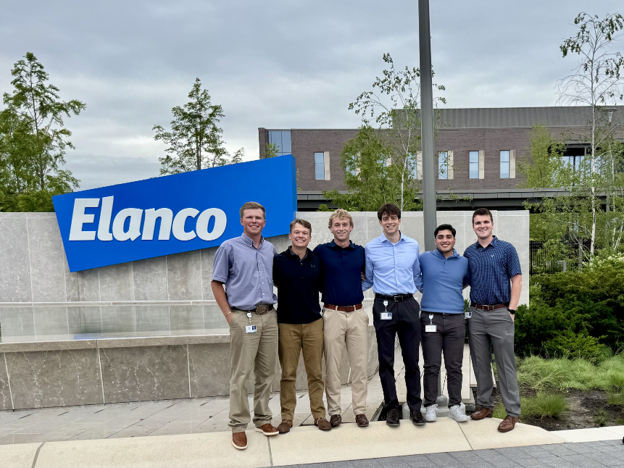
For at least a decade, Elanco has selected college students with high character and strong skillsets to dedicate 12 weeks of their summer to immersing themselves in animal health, expanding their skills to prepare them for the workforce and contribute to advancing the industry. Elanco offers several intern positions throughout the organization, which include:
- Manufacturing & Quality
- Research & Development
- Pet Health
- Farm Animal
- IT
- Finance
For the Summer of 2026, 74 interns were selected from a pool of 4,100 applicants and supported by 37 intern coordinators — full-time Elanco employees who dedicate part of their role to helping manage interns across different departments. Interns spend their summer fully immersed in their team and department, learning from leading professionals in animal health. Additionally, they own their own personal project throughout the 12-week program. Through this aspect of the internship program, each intern takes initiative by solving an Elanco system, creating something new or advancing the technologies and resources used in the different departments. This unique opportunity allows them to take charge of the development and execution of their projects and highlight their ability to deliver outcomes.
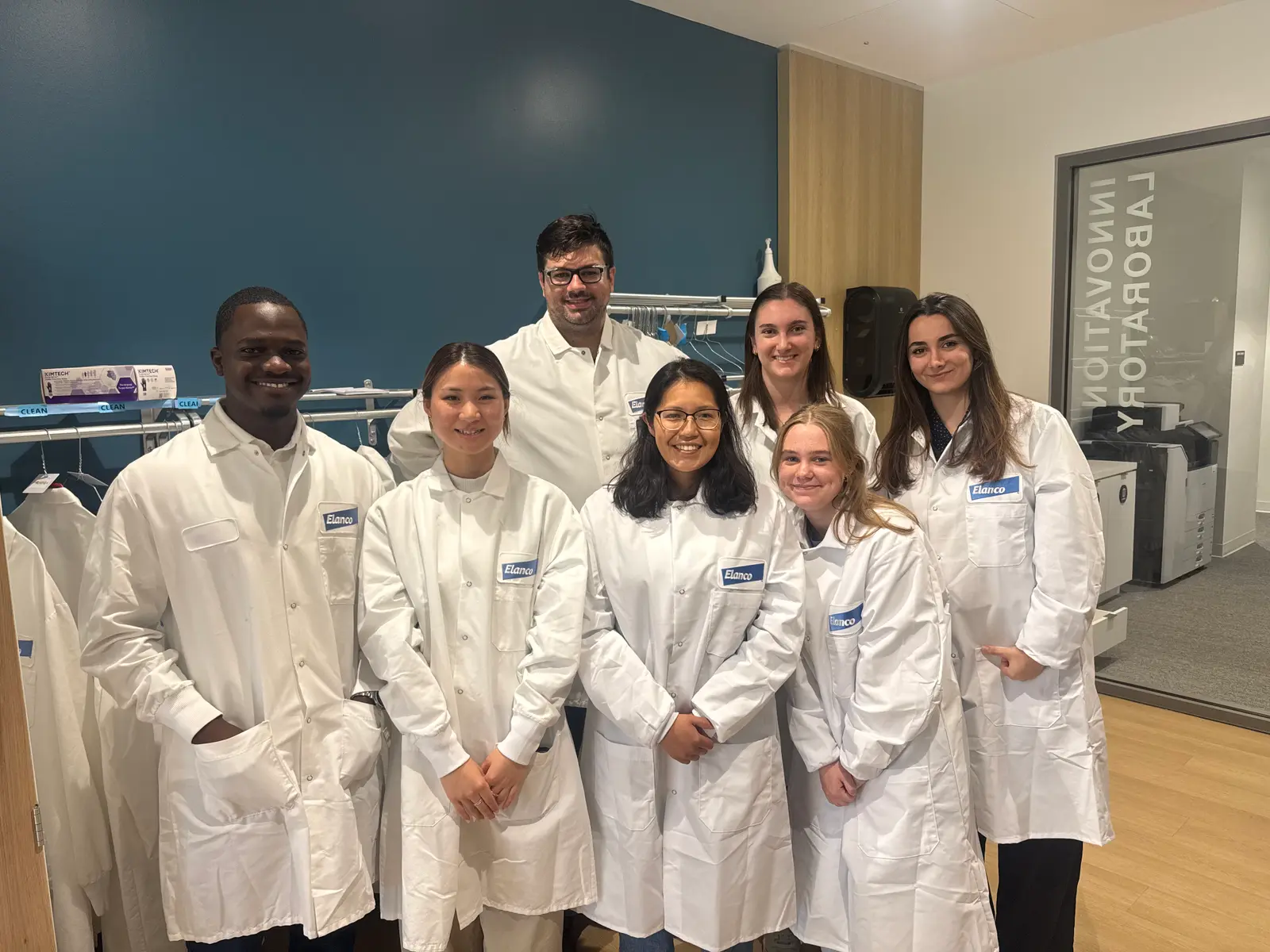
While no two internships look the same, each one represents a different piece of the same mission. One intern may spend the summer visiting veterinary clinics and producer operations across the country, helping customers understand how Elanco’s products fit into their everyday work. Another may be in an Indiana manufacturing facility, ensuring that those same products are produced safely, consistently and to the highest quality standards. Others may be developing new innovations in the lab or supporting the teams that keep the business moving behind the scenes. Together, these experiences give interns a firsthand look at how every function within Elanco is connected — and how collaboration across teams ultimately helps improve the health of animals around the world.
The extensive industry exposure they receive also helps Elanco interns get one step closer to their own unique goals. Hear from some of the 2026 cohort on how this program has helped them prepare for their future and taught them valuable lessons:
- “As I am preparing for a graduate degree, this internship has been a vital opportunity to learn skills that will help me be a great scientist. From being able to explain key concepts, present my data to those unfamiliar with the topic and conduct on-the-spot analysis of my outcomes, this internship has helped me work on all of that.” – Lana Malek, R&D SynTD intern, Purdue University
- “This internship has given me valuable hands-on experience working in a collaborative R&D environment. It has helped me better understand the development pipeline, how the R&D team operates and how cross-functional teams work together to achieve project goals.” – Di Cao, Indiana University, R&D CLD group intern
- “It has been instrumental in identifying my areas of weakness, both in terms of analysis and laboratory techniques, and with interpersonal work relationships. I’ve been able to fill in a lot of gaps that were missing from my training prior to starting at Elanco, and I’ve been able to build skills in diverse areas through thoughtful and supportive guidance.” – Sydney Womack, R&D intern, Cornell University
- “I plan to attend vet school, so this internship has given me a ton of animal handling experience, veterinary research experience and has really showed me that I would love to do a job like this in the future.” – Casey Gannon, Manufacturing/Quality Control intern, Iowa State University
- “Elanco has prepared me with the skills to be able to carry professional conversations with producers, consumers and fellow companies around problems and solutions in today’s industry. I feel prepared and excited to step into the workforce thanks to Elanco’s guidance!” – Lauren Beyer, Swine Sales intern, Iowa State University
Elanco teaches students how to go beyond in the workforce and their own lives. During their 12 weeks at the company, interns develop years’ worth of valuable experiences, connections and skills that will directly contribute to their personal goals and the industries they join after graduation.
Originally published on CVS Health Company Newsroom
WOONSOCKET, R.I., August 24, 2026 /3BL/ – CVS Health® (NYSE: CVS) announced it has redeveloped a mini soccer pitch in collaboration with National Women’s Soccer League icon Alex Morgan and the Alex Morgan Foundation, as well as Musco Lighting and the U.S. Soccer Foundation. The mini-pitch, which is located at Pantera Park in Alex’s hometown of Diamond Bar, CA, is now open and is the third location for Alex and her Pitch Forward initiative, which creates new outdoor spaces for sports where youth can feel supported, empowered, and inspired to reach their full potential.
The Pantera Park location also marks the next chapter of CVS Health’s multi-year field revitalization commitment, which aims to develop welcoming, accessible spaces where families, kids and neighbors can gather, play and connect. It follows a previously announced multi-use field redevelopment project at Garfield Park Bridge Spot in Washington, D.C, which will open this fall.
“Health is shaped by more than the care we receive – it’s also shaped by the communities where we live, play and connect. This new mini-pitch creates opportunities for young people and families to be active, build relationships and strengthen their overall well-being,” said Joanne Armstrong, M.D., MPH, Vice President and Chief Medical Officer, Women’s Health, CVS Health. “We’re proud to work alongside Alex Morgan and the Alex Morgan Foundation to help make those opportunities more accessible in Diamond Bar.”
“The city of Diamond Bar has helped shape who I am today, which is why I’m so thrilled to give back to the community and support its next generation of athletes,” said Alex Morgan. “Access to welcoming, safe spaces like this new mini-pitch plays a huge role in helping kids get active, build confidence and develop life skills. I can’t wait to see the positive impact it will have.”
The new Mini-Pitch System repurposes one of Pantera Park’s three basketball courts, creating a multi-sport space for soccer and pickleball, in addition to basketball. The space is uniquely positioned for drop-in play – without needing to be part of a league or to reserve the space in advance – which further increases opportunity for movement and connection in the Diamond Bar community.
“This new mini-pitch is especially meaningful given it’s in Diamond Bar, CA, a community that has remained close to Alex ever since she was given the keys to the city after winning the 2015 World Cup,” said Laura Wolf Stein, Executive Director, Alex Morgan Foundation. “We’re proud to expand access to sports at a park that Diamond Bar residents already know and love. Thank you to CVS Health for supporting this work and ensuring more kids will have access to play.”
“Pantera Park has always been a popular recreational amenity for our community, and it’s now even better. This mini-pitch gives residents a new way to stay active, try a new sport, or spend time outdoors with family and friends. Thank you to CVS Health, the Alex Morgan Foundation and Musco Sports Lighting for making this possible,” said Diamond Bar Mayor Steve Tye. “In January 2016, the City Council honored Alex Morgan for her accomplishments as a world champion and for the inspiration she has been to so many young people, especially girls, here in her hometown. Ten years later, her foundation is helping turn that inspiration into something real – a place where that next generation can play, have fun, and possibly find a sport that becomes a lifelong passion.”
The mini-pitch’s opening was officially commemorated on Tuesday, August 4th, through a ribbon cutting ceremony featuring Alex Morgan, local Diamond Bar officials, and leadership from CVS Health, Musco Lighting, Alex Morgan Foundation and the U.S. Soccer Foundation, followed by a kick-around with Alex and local AYSO girl soccer players.
CVS Health is dedicated to supporting California markets on and off the pitch. In 2024, the company helped generate $98.2B in annual economic impact across the state, provided over $8M in community support and supported and sustained over 212,000 jobs.
To learn more about CVS Health’s ongoing commitment to strengthen its communities through soccer, visit https://www.cvs.com/content/soccer.
###
About CVS Health
CVS Health is a leading health solutions company simplifying health care one person, one family and one community at a time. As of March 31, 2026, the Company had approximately 9,000 retail pharmacy locations, more than 1,000 walk-in and primary care medical clinics and a leading pharmacy benefits manager with approximately 88 million plan members. The Company also serves an estimated more than 37 million people through a broad range of health insurance products and related services. The Company’s integrated model uses personalized, technology driven services to connect people to simply better health, increasing access to quality care, delivering better outcomes, and lowering overall costs.
About Alex Morgan Foundation
Alex Morgan Foundation was founded in 2023 to support girls and women as they build their own confident path forward in sports and in life. Dedicated to a more equitable and empowered future, the foundation invests in programs that target its core areas of impact: sports equity, opportunities for girls, and support for moms. Alex Morgan Foundation is a fiscally sponsored initiative under the umbrella of the Edward Charles Foundation, a 501c3 non-profit organization, and raises funds through Alex’s community of partners, supporters, and grant funders.
Media Contact
Kara Page
Kara.Page@CVSHealth.com
By Liz Normandy
Three things to remember
- Cybersecurity requires defense, intelligence, resilience and proactive operations—not just protection.
- AI is accelerating cyber threats and defenses, making human-machine collaboration essential.
- Government and industry must collaborate to secure infrastructure, supply chains and the future cyber workforce.
During a recent Women In Defense webinar, Katea Murray, vice president and chief technology officer for Mission Solutions at Leidos, discussed how leaders can prepare for a rapidly evolving cyber landscape shaped by artificial intelligence (AI), non-state actors and a growing dependence on digital interconnected systems.
The threat landscape has fundamentally changed
Today’s cyber threats are more persistent, adaptive and interconnected than ever before. AI has enabled adversaries to automate attacks, accelerate vulnerability discovery and operate at machine speed. The challenge for both government and industry is how to integrate AI into operations while maintaining trust, governance and human oversight.
While challenges such as supply chain compromises and nation-state cyber activity are not new, advances in technology are increasing the speed and scale at which attacks can occur.
Katea Murray, VP & CTO for Mission Solutions, Leidos
Resilience matters as much as protection
Murray emphasized that organizations should move beyond a traditional “protect and defend” mindset. While strong defenses remain essential, resilience is increasingly defined by the ability to continue operating during an attack rather than simply recovering afterward.
That requires organizations to assume compromise, understand their risks and design systems that can withstand disruption. It also means paying closer attention to supply chain security, vendor monitoring and the broader ecosystem that supports critical operations.
Leadership starts with people
Technology alone will not solve cybersecurity challenges. Murray highlighted the importance of building high-performing teams by investing in continuous learning, creating opportunities for growth, and connecting employees to mission impact.
She encouraged leaders to focus on skills, curiosity and adaptability while giving teams room to experiment, learn and innovate. As AI becomes more integrated into cyber operations, organizations will need professionals who can combine human judgment with machine-enabled speed and scale.
Watch the full webinar
Originally published on GoDaddy Resource Library
Tell us a little bit about yourself and your career journey to date.
My Workforce Management career began in 2014 at an insurance company in Washington State. When my office closed, I was given the opportunity to relocate to Arizona, which became an exciting new chapter in both my personal and professional life.
In 2019, I noticed that GoDaddy was hiring. Working for GoDaddy had been a childhood dream of mine, so I immediately applied. I’ve now been with GoDaddy for seven years, growing my career within Workforce Management. Throughout that time, I’ve had the opportunity to expand my knowledge and take on new challenges. Today, I proudly serve as a Command Center Analyst II.
What does a typical work day look like for you?
A typical day involves monitoring real-time queues to ensure the right resources are in the right place at the right time to meet service level objectives. I proactively respond to fluctuations in call and messaging volumes by making staffing adjustments and communicating operational impacts or known issues to leadership and operations teams. I collaborate closely with cross-functional departments to support business needs and respond to schedule update requests by processing and implementing changes for Guides. Using workforce management tools, I monitor performance, optimize operational efficiency, and help deliver an exceptional customer experience.
If you had to describe GoDaddy’s culture in one word, what would it be and why?
Collaborative. GoDaddy’s culture is built on teamwork, open communication, and supporting one another.
Everyone works together toward shared goals while striving to deliver the best possible experience for both our customers and one another.
How has ERG involvement influenced your time at GoDaddy?
I’m actively involved in several Employee Resource Groups (ERGs), and each has impacted me in different ways.
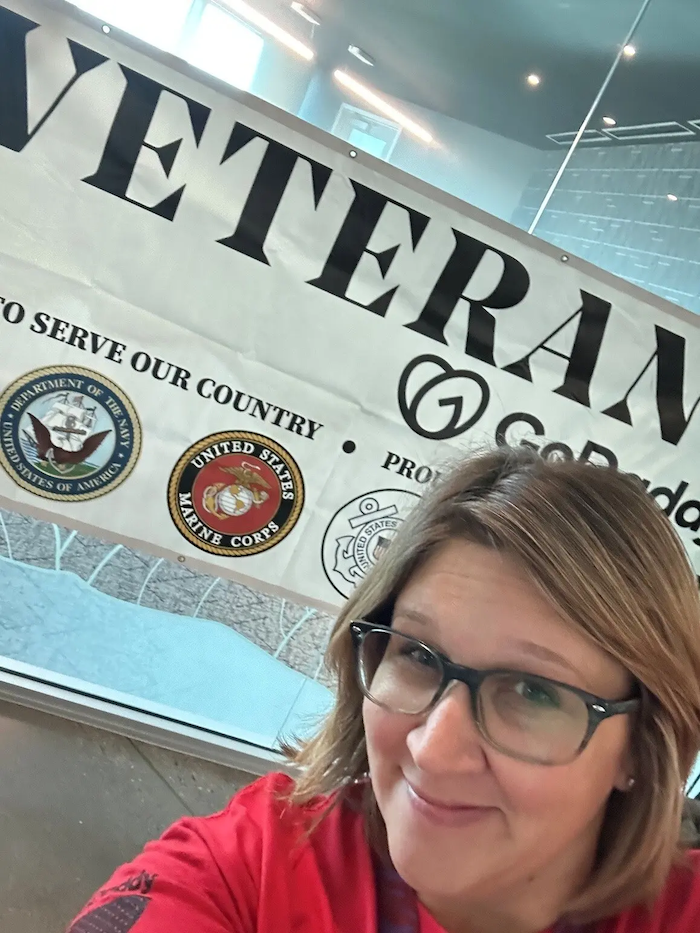
Most recently, I was honored to be nominated and accepted into a leadership role with GoDaddy Veterans (GDVET) as an Ally. GDVET actively supports initiatives that serve veterans and local communities. This opportunity has strengthened my leadership skills while allowing me to support the ERG from a workforce perspective by helping with Guide scheduling. I’m also passionate about educating others and promoting ERG programs and policies that encourage Guide involvement across the company.
What do you enjoy doing outside of work?
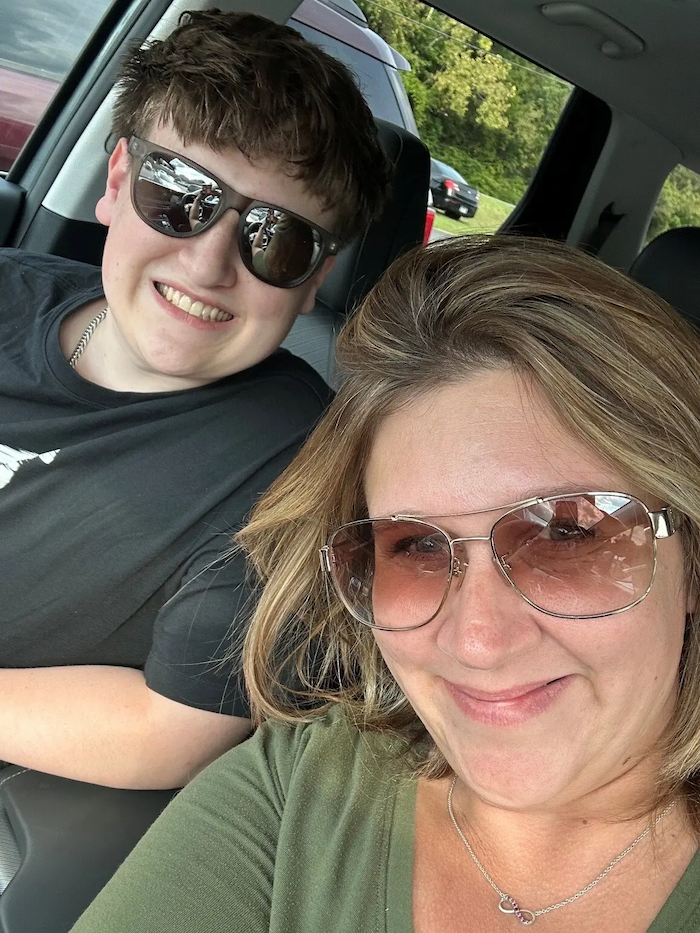
Outside of work, my life revolves around my 16-year-old son, who eats, sleeps, and breathes hockey and fishing. We spend a lot of time at the rink, the lake, or in our backyard shooting pucks! I also have two dogs—Titus, my German Shepherd, and Zoey, my rescue mixed breed—who keep life entertaining. When I have free time, I enjoy taking road trips, exploring local farmers markets, and baking sourdough.

Are you enjoying this series and want to know more about life at GoDaddy? Check out our GoDaddy Life social pages! Follow us to meet our team, learn more about our culture (Teams, ERGs, Locations), careers, and so much more. You’re more than just your day job, so come propel your career with us.
Sustainability 101 is a blog series that you can turn to for information about different environmental terms that may come up at work, during discussions with friends, and even at your family gatherings.
Why Materials Matter
Materials are at the center of the technology that keeps people, businesses, and communities connected. Every hardware product depends on a complex mix of inputs, including metals, plastics, packaging, and the minerals used in electronic components. As demand for digital infrastructure grows, so does the importance of understanding where these materials come from, how they are produced, and how that can affect both people and the environment.
Sourcing materials responsibly requires both environmental and human rights considerations, including working conditions; energy use; community, water and land impacts; greenhouse gas emissions; material efficiency; and reuse and recycling. It also requires working across multiple tiers of a complex global value chain. For example, a mineral may be mined in one region, processed in another, incorporated into components by suppliers in multiple countries, and assembled into products elsewhere. At the end of a product’s useful life, it may be broken down and processed into minerals that are sent back into the global supply chain.
Attention to these issues can support business resilience. An understanding of material flows through the value chain can give visibility to potential bottlenecks. Increasing recycled content can also help ease shortages. And traceability is a growing trend in laws and regulations. But a more sustainable, compliant, and resilient supply chain cannot be achieved by one company alone; it calls for collaboration across industries, governments, and civil society throughout the global value chain.
Cisco’s Approach: Act, Engage, and Collaborate
At Cisco, when it comes to minerals, we act where we have control, engage to influence what we cannot control, and collaborate to reach further into our value chain.
- Acting on what we control includes Cisco’s product design. Cisco’s Circular Design Program helps our engineers incorporate environmental sustainability from the beginning. Since approximately 80% of a product’s environmental impact is influenced by the design phase, Cisco embeds circular design principles under five focus areas into every new product and packaging design: material use; standardization and modularization; packaging and accessories; smart energy consumption; and disassembly, repair and reuse.
In one example, the Cisco Webex Room Bar’s streamlined redesign reduced the number of internal components compared to its predecessor, resulting in over 32,000 pounds of material savings annually. This is 16 tons of material that now does not enter Cisco’s supply chain each year, while also avoiding greenhouse gas emissions.
At the other end of the lifecycle, Cisco product return programs prevent waste. Over 99% of equipment returned to Cisco is sent to reuse or recycling, giving a second life for equipment where possible and supporting materials recovery.
- Engaging to influence includes working with suppliers to support more socially and environmentally responsible minerals sourcing. We conduct due diligence on multiple minerals in our supply chain. We require our suppliers to shift sourcing through their supply chain to minerals processors who are compliant with our Responsible Minerals Policy. We are also active members of the Responsible Minerals Initiative, which sets standards for minerals processors and collaborative actions across mineral supply chains. Taken together, this work helps assure that the sources of minerals in our products align with our policies to uphold human rights and mitigate environmental impacts.
- Collaborating to reach further helps drive change in the deepest tiers of our mineral supply chain. As a member of the European Partnership for Responsible Minerals (EPRM) we support projects to improve working conditions in small scale and artisanal mines, and to connect them to global supply chains. And we support the Initiative for Responsible Mining Assurance to help increase the number of mines audited to standards for social and environmental responsibility and business integrity.
Connecting responsibility and resilience
Sourcing minerals responsibly is also a business resilience opportunity. Companies depend on access to materials and components to deliver products and services. Disruptions, regulatory changes, shifting customer expectations, and environmental or social risks can all affect supply chains.
A more responsible approach can help companies better understand where materials come from, identify potential risks, improve supplier engagement, and support business continuity over time. Designing products with reuse and recycling in mind can also help reduce dependence on newly extracted materials. Supplier engagement can support greater visibility into responsible sourcing practices. Collaboration across the value chain can help address issues that are too complex for any single organization to solve alone.
A shared responsibility
Minerals will continue to be essential to the technology and infrastructure that support our connected world. As demand grows across industries, so does the importance of sourcing and using these materials responsibly.
Cisco recognizes the complexity of the challenge and the need for continued engagement, transparency, and collaboration. By acting on what we control, engaging with suppliers and partners, and collaborating across the value chain, we can help advance progress in a way that supports people, the planet, and long-term business resilience.
View original content here.
Sustainability 101 is a blog series that you can turn to for information about different environmental terms that may come up at work, during discussions with friends, and even at your family gatherings.
Why Materials Matter
Materials are at the center of the technology that keeps people, businesses, and communities connected. Every hardware product depends on a complex mix of inputs, including metals, plastics, packaging, and the minerals used in electronic components. As demand for digital infrastructure grows, so does the importance of understanding where these materials come from, how they are produced, and how that can affect both people and the environment.
Sourcing materials responsibly requires both environmental and human rights considerations, including working conditions; energy use; community, water and land impacts; greenhouse gas emissions; material efficiency; and reuse and recycling. It also requires working across multiple tiers of a complex global value chain. For example, a mineral may be mined in one region, processed in another, incorporated into components by suppliers in multiple countries, and assembled into products elsewhere. At the end of a product’s useful life, it may be broken down and processed into minerals that are sent back into the global supply chain.
Attention to these issues can support business resilience. An understanding of material flows through the value chain can give visibility to potential bottlenecks. Increasing recycled content can also help ease shortages. And traceability is a growing trend in laws and regulations. But a more sustainable, compliant, and resilient supply chain cannot be achieved by one company alone; it calls for collaboration across industries, governments, and civil society throughout the global value chain.
Cisco’s Approach: Act, Engage, and Collaborate
At Cisco, when it comes to minerals, we act where we have control, engage to influence what we cannot control, and collaborate to reach further into our value chain.
- Acting on what we control includes Cisco’s product design. Cisco’s Circular Design Program helps our engineers incorporate environmental sustainability from the beginning. Since approximately 80% of a product’s environmental impact is influenced by the design phase, Cisco embeds circular design principles under five focus areas into every new product and packaging design: material use; standardization and modularization; packaging and accessories; smart energy consumption; and disassembly, repair and reuse.
In one example, the Cisco Webex Room Bar’s streamlined redesign reduced the number of internal components compared to its predecessor, resulting in over 32,000 pounds of material savings annually. This is 16 tons of material that now does not enter Cisco’s supply chain each year, while also avoiding greenhouse gas emissions.
At the other end of the lifecycle, Cisco product return programs prevent waste. Over 99% of equipment returned to Cisco is sent to reuse or recycling, giving a second life for equipment where possible and supporting materials recovery.
- Engaging to influence includes working with suppliers to support more socially and environmentally responsible minerals sourcing. We conduct due diligence on multiple minerals in our supply chain. We require our suppliers to shift sourcing through their supply chain to minerals processors who are compliant with our Responsible Minerals Policy. We are also active members of the Responsible Minerals Initiative, which sets standards for minerals processors and collaborative actions across mineral supply chains. Taken together, this work helps assure that the sources of minerals in our products align with our policies to uphold human rights and mitigate environmental impacts.
- Collaborating to reach further helps drive change in the deepest tiers of our mineral supply chain. As a member of the European Partnership for Responsible Minerals (EPRM) we support projects to improve working conditions in small scale and artisanal mines, and to connect them to global supply chains. And we support the Initiative for Responsible Mining Assurance to help increase the number of mines audited to standards for social and environmental responsibility and business integrity.
Connecting responsibility and resilience
Sourcing minerals responsibly is also a business resilience opportunity. Companies depend on access to materials and components to deliver products and services. Disruptions, regulatory changes, shifting customer expectations, and environmental or social risks can all affect supply chains.
A more responsible approach can help companies better understand where materials come from, identify potential risks, improve supplier engagement, and support business continuity over time. Designing products with reuse and recycling in mind can also help reduce dependence on newly extracted materials. Supplier engagement can support greater visibility into responsible sourcing practices. Collaboration across the value chain can help address issues that are too complex for any single organization to solve alone.
A shared responsibility
Minerals will continue to be essential to the technology and infrastructure that support our connected world. As demand grows across industries, so does the importance of sourcing and using these materials responsibly.
Cisco recognizes the complexity of the challenge and the need for continued engagement, transparency, and collaboration. By acting on what we control, engaging with suppliers and partners, and collaborating across the value chain, we can help advance progress in a way that supports people, the planet, and long-term business resilience.
View original content here.
Sustainability 101 is a blog series that you can turn to for information about different environmental terms that may come up at work, during discussions with friends, and even at your family gatherings.
Why Materials Matter
Materials are at the center of the technology that keeps people, businesses, and communities connected. Every hardware product depends on a complex mix of inputs, including metals, plastics, packaging, and the minerals used in electronic components. As demand for digital infrastructure grows, so does the importance of understanding where these materials come from, how they are produced, and how that can affect both people and the environment.
Sourcing materials responsibly requires both environmental and human rights considerations, including working conditions; energy use; community, water and land impacts; greenhouse gas emissions; material efficiency; and reuse and recycling. It also requires working across multiple tiers of a complex global value chain. For example, a mineral may be mined in one region, processed in another, incorporated into components by suppliers in multiple countries, and assembled into products elsewhere. At the end of a product’s useful life, it may be broken down and processed into minerals that are sent back into the global supply chain.
Attention to these issues can support business resilience. An understanding of material flows through the value chain can give visibility to potential bottlenecks. Increasing recycled content can also help ease shortages. And traceability is a growing trend in laws and regulations. But a more sustainable, compliant, and resilient supply chain cannot be achieved by one company alone; it calls for collaboration across industries, governments, and civil society throughout the global value chain.
Cisco’s Approach: Act, Engage, and Collaborate
At Cisco, when it comes to minerals, we act where we have control, engage to influence what we cannot control, and collaborate to reach further into our value chain.
- Acting on what we control includes Cisco’s product design. Cisco’s Circular Design Program helps our engineers incorporate environmental sustainability from the beginning. Since approximately 80% of a product’s environmental impact is influenced by the design phase, Cisco embeds circular design principles under five focus areas into every new product and packaging design: material use; standardization and modularization; packaging and accessories; smart energy consumption; and disassembly, repair and reuse.
In one example, the Cisco Webex Room Bar’s streamlined redesign reduced the number of internal components compared to its predecessor, resulting in over 32,000 pounds of material savings annually. This is 16 tons of material that now does not enter Cisco’s supply chain each year, while also avoiding greenhouse gas emissions.
At the other end of the lifecycle, Cisco product return programs prevent waste. Over 99% of equipment returned to Cisco is sent to reuse or recycling, giving a second life for equipment where possible and supporting materials recovery.
- Engaging to influence includes working with suppliers to support more socially and environmentally responsible minerals sourcing. We conduct due diligence on multiple minerals in our supply chain. We require our suppliers to shift sourcing through their supply chain to minerals processors who are compliant with our Responsible Minerals Policy. We are also active members of the Responsible Minerals Initiative, which sets standards for minerals processors and collaborative actions across mineral supply chains. Taken together, this work helps assure that the sources of minerals in our products align with our policies to uphold human rights and mitigate environmental impacts.
- Collaborating to reach further helps drive change in the deepest tiers of our mineral supply chain. As a member of the European Partnership for Responsible Minerals (EPRM) we support projects to improve working conditions in small scale and artisanal mines, and to connect them to global supply chains. And we support the Initiative for Responsible Mining Assurance to help increase the number of mines audited to standards for social and environmental responsibility and business integrity.
Connecting responsibility and resilience
Sourcing minerals responsibly is also a business resilience opportunity. Companies depend on access to materials and components to deliver products and services. Disruptions, regulatory changes, shifting customer expectations, and environmental or social risks can all affect supply chains.
A more responsible approach can help companies better understand where materials come from, identify potential risks, improve supplier engagement, and support business continuity over time. Designing products with reuse and recycling in mind can also help reduce dependence on newly extracted materials. Supplier engagement can support greater visibility into responsible sourcing practices. Collaboration across the value chain can help address issues that are too complex for any single organization to solve alone.
A shared responsibility
Minerals will continue to be essential to the technology and infrastructure that support our connected world. As demand grows across industries, so does the importance of sourcing and using these materials responsibly.
Cisco recognizes the complexity of the challenge and the need for continued engagement, transparency, and collaboration. By acting on what we control, engaging with suppliers and partners, and collaborating across the value chain, we can help advance progress in a way that supports people, the planet, and long-term business resilience.
View original content here.