
Month: July 2026
Watch Entergy Chair and CEO Drew Marsh’s remarks and the entire event above
NEW ORLEANS, July 24, 2026 /3BL/ – Earlier today, Entergy Chair and CEO Drew Marsh highlighted how the company is protecting its customers while powering innovation, creating opportunity and economic growth for its communities.
“In Louisiana, we were honored to partner with Governor Landry to win the transformational Meta data center for Richland Parish,” Marsh said. “This effort that we’ve undertaken in Louisiana is a great example of the state working together to bring business and communities together to protect existing customers and to move with speed to win the AI race.”
The White House today announced the expansion of its Ratepayer Protection Pledge, building on the success America’s electric companies have had prioritizing reliability and affordability for all customers. Entergy has signed the pledge.
Marsh joined President Donald Trump, Louisiana Governor Jeff Landry, Meta President and Vice Chair Dina Powell McCormick, other elected officials, and utility and data center company executives on stage in support of the pledge.
“In Louisiana,” President Trump announced, “public school teachers in Richland Parish are getting as much as $50,000 in bonuses this year thanks to a $27 billion project by Meta that will also save local residents $2.6 billion on their electricity bills.”
Entergy supported the initial March unveiling of the White House Ratepayer Protection Pledge, where technology companies committed to pay their fair share for energy infrastructure needed to power data centers, advanced manufacturing facilities and other large load customers.
The Ratepayer Protection Pledge creates a fair deal for everyone, while helping protect American consumers, grow our economy and lead the world in Artificial Intelligence and the high-tech industry.
Marsh continued by saying, “Our Fair Share Plus pledge is modeled after the Ratepayer Protection Pledge that the Trump administration put in place and it will deliver approximately $7 billion of benefits to [all Entergy] customers over the next two decades.”
“The White House’s Ratepayer Protection Pledge, Governor Landry’s recent executive order and our Fair Share Plus pledge are all aligned to ensure that we grow and support this transformational investment opportunity and we do it in a way that creates benefits for all customers. That’s how we win the AI race and responsibly serve all our customers at the same time,” Marsh concluded.
Entergy’s Fair Share Plus pledge protects all customers from risks through contractual conditions designed to prevent undue electricity bill inflation. These customer protections include prepayment requirements, multi-year contract terms, credit and collateral requirements, and early termination penalties. Entergy’s pledge also ensures large-load projects — particularly data centers and other power-intensive facilities — create net benefits for everyone we serve. These customers must pay the full costs for service and contribute additional value that lowers costs for our existing customers on the grid.
Learn how Entergy is protecting its customers and bringing big benefits to our communities at Entergy.com/DataCenters.
About Entergy
Entergy (NYSE: ETR) generates, transmits and distributes electricity to power life for more than 3 million customers through our operating companies in Arkansas, Louisiana, Mississippi and Texas. We’re focused on keeping costs for our customers as low as possible while providing reliable energy that our communities count on. We’re also investing in growth for the future with a more resilient, cleaner energy system that includes modern natural gas, nuclear and renewable energy generation. As a nationally recognized leader in sustainability and corporate citizenship, we deliver more than $100 million in economic benefits each year to the communities we serve through philanthropy, volunteerism and advocacy. Entergy is a Fortune 500 company headquartered in New Orleans, Louisiana, and has approximately 12,000 employees. Learn more at Entergy.com and connect with @Entergy on social media.
Media inquiries:
Neal Kirby
504-576-4238
nkirby@entergy.com
View original content here.
Furniture has traditionally been difficult to repair or recycle, with many products ending up in landfills at the end of their useful life.
For Cascale Corporate member Dunelm, a publicly-traded company that is one of the UK’s largest home furnishings retailers, that industry reality sat at the heart of a more specific business challenge. Sourcing and manufacturing account for approximately 60 percent of the company’s Scope 3 greenhouse gas emissions — and without consistent, comparable data across a growing supplier base – it is difficult to know where to act first.
In response, Dunelm developed its Good & Circular approach to sustainability — a commitment to rethinking how products are designed, sourced, used, and recovered. Central to that strategy is a data-driven approach to supplier engagement: rather than relying on spend-based emissions estimates, Dunelm adopted Higg Facility Environmental Module (Higg FEM) through its Better Manufacturing program to build a credible, comparable picture of environmental performance across its supply chain. In this case study, we go deeper on how Dunelm used circular design, supplier collaboration, and Higg Index data to reduce environmental impact and create products that last longer.
Key Takeaways
- Identified sourcing and manufacturing as approximately 60 percent of Scope 3 emissions and launched the Better Manufacturing programme to address it — adopting Higg FEM as the shared measurement framework across Tier 1 suppliers.
- Achieved 84 percent Tier 1 supplier Higg FEM completion in FY25, reaching target a month ahead of schedule despite supplier base growing 6.4 percent year-on-year.
- Completed Higg FEM assessments across its own UK made-to-measure manufacturing sites in FY2025, expanding environmental performance measurement beyond its supply chain.
- Designed the Full Circle Sofa to extend product life through modularity, repairability, and recyclability.
- Embedded circularity into its broader Good & Circular sustainability strategy through takeback, repair, and lower-impact materials.
A Common Framework for a Complex Supply Chain
Dunelm launched its Better Manufacturing program in FY24, adopting the Higg Facility Environmental Module (Higg FEM) as the shared measurement framework across its Tier 1 supplier base. Part of the Higg Index — a suite of frameworks and methodologies stewarded and governed by Cascale and delivered globally through Worldly’s technology platform — the Higg FEM enables suppliers to assess, track, and improve performance across key environmental areas, including energy, water, waste, and carbon.
Rather than developing a proprietary assessment system, Dunelm chose an industry-standard tool — one that suppliers could share with other brands, reducing duplication and lowering the barrier to adoption.
As Lisa Ly, senior sustainability manager at Dunelm, explained on Cascale’s Source of Good podcast: “For our suppliers, having one tool that can be shared among other brands and retailers is a huge benefit. Before we even started, we did a bit of a survey to figure out how many of our suppliers were already using it, and it was like 15 percent of our Tier 1. So that gave us confidence.”
In FY25, Dunelm extended Higg FEM to its own UK made-to-measure manufacturing sites — enabling the company to identify operational hotspots firsthand and share best practice solutions directly with its supplier base. To further support supplier capability, Dunelm hosted an in-depth renewable energy webinar in partnership with climate consultancy South Pole, covering renewable electricity market trends, green tariffs, on-site options, and PPAs. The company also launched a quarterly supplier newsletter and engaged specialist partner Verisio to strengthen Tier 2 visibility through Worldly’s Facility Data Manager (FDM).
Ahead of Target, Across a Growing Supplier Base
In FY25, Dunelm achieved 84 percent Tier 1 supplier completion of the Higg FEM self-assessment — reaching its target a month ahead of schedule, despite its supplier base growing 6.4 percent year-on-year.
Improved data quality is now enabling a transition away from spend-based Scope 3 estimates toward primary facility-level data, giving commercial teams greater visibility to make more responsible sourcing decisions. Scope 3 emissions increased just 1 percent against 4 percent sales growth in FY25 — an early signal of progress on decarbonization relative to business growth.
Looking ahead, Dunelm is actively encouraging suppliers to develop decarbonization roadmaps supported by Higg FEM data and ongoing training through its dedicated supplier platform.
Building Products That Last
Beyond measurement, Dunelm is applying sustainability principles to product design — recognizing that reducing environmental impact requires thinking about the full product lifecycle, not just manufacturing emissions.
One example is the Full Circle Sofa, introduced in 2024. Developed collaboratively with suppliers, its modular design allows customers to replace individual sections rather than the entire sofa. A staple and glue-free frame makes components significantly easier to separate and recycle at end of life — directly addressing one of the most persistent barriers to furniture recyclability.
Dunelm’s rug takeback program accepts rugs from any brand for cleaning, repair, and refurbishment before donating them through charitable partners. Community repair workshops further encourage consumers to extend product life rather than replace items prematurely.
Together, these initiatives reflect Dunelm’s Good & Circular approach to sustainability — a commitment to rethinking how products are designed, sourced, used, and recovered.
Measurement as a Foundation for Progress
Dunelm’s experience shows how a shared, industry-aligned measurement framework can accelerate supplier engagement, improve data quality, and support more responsible sourcing decisions — at scale and ahead of target.
By choosing Higg FEM over a proprietary system, Dunelm reduced adoption barriers, leveraged existing supplier familiarity with the tool, and created a common language for continuous improvement across its value chain. As Dunelm continues to build on this foundation — extending measurement into its own operations, deepening Tier 2 engagement, and embedding circularity into product design — the Better Manufacturing program provides a credible, data-driven platform for meeting its SBTi-validated targets: a 50 percent absolute GHG reduction by FY30 and net zero by FY40.
Originally published in GoDaddy’s 2025 Global Stakeholder Impact Report
Learning & Development
We believe everyone has a unique way of learning and growing.
We foster a culture of continuous learning and development that helps employees build skills and grow their careers. When our people grow, they tend to be more engaged in their work and are better equipped to help our entrepreneurs succeed, creating shared success across our company.
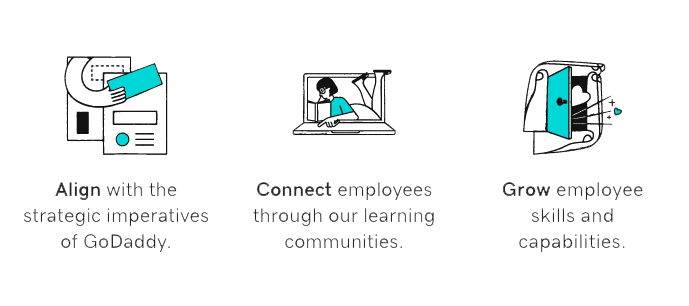
Our Learning and Development strategy is built around three pillars: align, connect, and grow. These pillars guide how we design programs that support our people, strengthen collaboration, and build the capabilities needed to meet our business priorities.
Employee Learning
Learning at GoDaddy is designed to be practical, accessible, and shared. We empower employees to take ownership of their development while learning alongside one another and applying new skills in real work. Our approach centers on learning by doing. Employees are encouraged to explore new tools, including AI tools, build confidence through hands-on experience, and grow capabilities that support both their careers and our business.
We also invest in learning that delivers lasting value beyond GoDaddy, offering education reimbursement and credentialed opportunities that support continued learning and long-term growth.
Technology & Community for Continuous Learning
GoLearn, our learning management platform, anchors our learning ecosystem as a single destination for employee development, providing access to thousands of courses. Through on-demand courses, microlearning, certification programs, curated learning paths, and content from trusted partners, employees can build skills in ways that fit how they learn.
Learning is strengthened through connection. Using GoLearn and our #learning_connect Slack channel, employees share courses, recommend content, and learn together in topic-based communities, helping embed learning into daily work.
Investing in Our Care Teams
We offer focused development programs for Customer Care Teams, helping our Guides build the skills and confidence needed to deliver strong customer experiences. These include Elevate, a leadership program focused on operational excellence and people leadership, and the Care & Services Learning Summit, an annual event centered on leadership, coaching, and change management.
We also help Guides earn academic credit for the work they already do. Through our partnership with Rio Salado College in Arizona, U.S.based Guides completing our sales training program earn a CCL Web Hosting: Customer Service certificate with six transferable college credits toward an associate in applied sciences degree. In 2025, more than 170 employees enrolled, earning more than 1,000 total college credits.
EXPANDING EMPLOYEE CAPABILITIES WITH AI
Our AI training helps employees build confidence, fluency, and practical skills to use AI in their everyday work, supporting productivity and creativity while enabling better customer experiences. Training includes learning across GoDaddy-built AI-powered tools such as GoDaddy Content as a Service (GoCaas) and GABI.
These offerings are reinforced through AI office hours led by internal experts and our “Moments of Spark” video series, which features short, two -to-three-minute tutorials focused on practical, how-to applications of AI.
For more information on AI and our employees, visit the Responsible AI section of the report.
Leadership Training
We believe that strong leadership drives engaged teams and better outcomes. In 2025, we expanded access to leadership development through a new external training partner, giving all leaders access to courses that support both foundational and advanced skills. We also offer additional pathways for leaders to continue building their skills, including:
- New Manager Onboarding: A required multi-week program that introduces new managers to GoDaddy’s values, expectations, and practical tools for success.
- GoDaddy Leadership Development Program: A structured course series focused on core leadership skills, including leading virtually, navigating change, coaching, and delivering effective feedback.
- Self-paced Leadership Training: Press Start, Leadership Arcade is our self-paced, on-demand learning program focused on leadership soft skills and connection across the GoDaddy community.
Employee Performance
Being “Better Every Day” is central to how we approach performance, growth, and open communication. Our mid-year and year-end reviews focus on goal setting, career development, peer feedback, and selfreflection, helping employees track progress and keep growing. To further support fair and consistent advancement, we use a proactive promotion flagging process that applies consistent, company-wide criteria to identify employees who may be ready for their next step. This reduces reliance on subjective identification, helps mitigate bias, and supports more equitable career advancement.
We also encourage employees to explore opportunities across teams and functions, giving them the chance to build new skills, gain diverse experiences, and deepen their understanding of the business.
75/100
We achieved an average score of 75/100 on the question, “I have good opportunities to learn and grow at GoDaddy.”
27%+ Million
More than 27% of global hires were filled by internal candidates in 2025.
Learn more about GoDaddy’s 2025 Global Stakeholder Impact Report.
About this Report
The GoDaddy 2025 Global Stakeholder Impact Report details our progress toward our corporate sustainability goals, strategies, and initiatives in support of our overarching purpose and values. Unless otherwise noted, this report reflects our corporate sustainability performance across our global operations covering the fiscal year period from January 1 to December 31, 2025. To demonstrate our commitment to transparent communication regarding our sustainability progress, we routinely share updates through our website and our annual reporting. We welcome your questions, comments, and feedback on this report by contacting ESG@GoDaddy.com.
This report references the Global Reporting Initiative Standards, includes select Sustainability Accounting Standards Board metrics for the Internet Media and Services sector, and the Task Force on Climate Related Financial Disclosures. We also disclose our contributions and progress toward priority UN SDGs. For additional information on how we align with these frameworks and key indicators demonstrating our sustainability performance, please refer to the Frameworks & Metrics section.
About GoDaddy
GoDaddy, the world’s largest domain name registrar, helps millions of entrepreneurs globally start, grow, and scale their businesses. People come to GoDaddy to name their idea, build a website and logo, sell their products and services and accept payments. GoDaddy Airo®, the company’s AI-powered experience, makes growing a small business faster and easier by helping them to get their idea online in minutes, drive traffic and boost sales. GoDaddy’s expert guides are available 24/7 to provide assistance. To learn more about the company, visit www.GoDaddy.com.
Through The Ray’s ongoing collaboration with the Washington State Department of Transportation (WSDOT), they’ve recently deployed advanced natural capital solutions at the Scatter Creek Rest Area, demonstrating how active transit corridors can perform double duty for local ecosystems and public infrastructure.
Targeted Wildlife Support: The project demonstrates how federally protected species (in this case, the regionally threatened Mazama pocket gopher) can safely coexist with active transportation corridors.
Botanical Design for Ecological Health: Custom-engineered native seed mixes were specifically adapted to the site’s unique soil profile. Deep-rooted plants anchor the roadside, optimizing natural stormwater runoff, and providing long-term forage for local pollinators.
Smart Environmental Monitoring: The Ray and WSDOT integrated PheNode® automated sensor systems from Agrela Ecosystems. The on-site units continuously stream microclimate data, allowing the team to track real-time soil and weather conditions as the habitat develops.
لاغوس، نيجيريا–(BUSINESS WIRE)–نشرت اليوم شركة .Moniepoint Inc (يشار إليها هنا باسم “Moniepoint” أو “الشركة”)، وهي منصة النظام المالي المتكامل في أفريقيا للأفراد والشركات وعملائهم، تقريرها الافتتاحي حول الأثر بعنوان “خلق السعادة المالية”.يوثق التقرير تطور Moniepoint من مزود للبنية التحتية المالية إلى منظومة مالية شاملة، حيث تخدم الآن أكثر من 20 مليون شركة وفرد، وتُعالج قيمة معاملات تتجاوز 250 مليار دولار سنويًا. ويبرز أيضًا أثر توسيع نطاق الوصول إلى الائتمان والخدمات المصرفية وأدوات إدارة الأع