What happens when young girls are given the opportunity to design, build, and problem-solve alongside women engineers?

Confidence grows. Curiosity takes over. And for many, a future in engineering suddenly feels within reach.

That’s exactly what unfolded at Camp Engies BC, where 80 girls from across British Columbia gathered for a two-day, one-night engineering camp in Squamish. Supported by DP World, the program introduced campers ages 10 to 14 to engineering through hands-on challenges, mentorship, and conversations with women already working in the profession.

Creating Opportunities Through STEM

Engineering plays a vital role in solving many of the world’s biggest challenges, from building resilient infrastructure to advancing sustainable technologies. Programs like Camp Engies help ensure more young people – especially girls, who remain underrepresented in STEM fields – have the opportunity to see themselves in these careers.

With DP World’s support, this year’s camp welcomed 80 campers to Camp Summit in Squamish. Twelve volunteers and six female engineers shared their experiences, mentored participants, and guided campers through interactive activities designed to spark creativity, teamwork, and problem-solving.

The program also expanded access to engineering education by providing complimentary attendance for girls from Girls Who LEAP, KidSport, and the Tsleil-Waututh Nation, helping remove barriers for young people who may not otherwise have had the opportunity to participate.

For many campers, the experience offered more than an introduction to engineering – it showed them what is possible. As one camper shared, hearing directly from women in the profession and tackling real engineering challenges transformed how she saw her own future.

Investing in Canada’s Communities

Camp Engies is one example of how DP World is investing in stronger, more resilient communities across Canada. By supporting hands-on STEM education and connecting young girls with women working in engineering, the company is helping inspire the next generation of innovators, problem-solvers, and leaders.

That commitment extends well beyond the classroom. In 2025, DP World employees volunteered more than 750 hours supporting initiatives focused on environmental stewardship, education, food security, and community resilience. The company also partnered with the Vancouver Canucks to host DP World Game Night, bringing fans together while supporting local charitable initiatives and strengthening community connections.

Whether introducing a young camper to engineering or volunteering in communities across the country, DP World believes meaningful community investment starts by creating opportunities for people to learn, grow, and succeed.

As one camper expressed, attending Camp Engies changed how she viewed her future. What began as a two-day camp ended with a new ambition: to become an engineer and designer who creates products that improve people’s lives.

Sometimes, the biggest impact starts with a single opportunity.

Watch the video above to learn more about Camp Engies and their mission of empowering girls to explore careers in STEM.

Artificial intelligence has moved well beyond the experimental phase, and organizations across North Carolina are facing the challenge of using AI responsibly, effectively, and at scale.

Industry leaders gathered for North Carolina Technology Day 2026, Lenovo’s annual celebration of the state’s tech innovation to discuss the opportunities, challenges, and real-world applications shaping the future of AI. In a panel discussion moderated by I-Sah Hsieh, deputy secretary for AI and policy at the North Carolina Department of Information Technology and leaders from AMD, Cisco, Lenovo, SAS, and North Carolina Central University explored topics ranging from cybersecurity and workforce development to data governance and responsible innovation.

AI Is Moving Into Everyday Operations

The prevailing theme of the discussion was that AI is no longer a future technology.

Panelists shared examples of how their organizations are integrating AI into daily operations, and how they are moving beyond pilot projects and experimentation. Kumaran Siva, corporate vice president of enterprise AI at AMD, described the company’s evolution from early computer vision applications on manufacturing lines to broader enterprise adoption efforts that now touch multiple areas of the business.

Panelists noted that successful AI implementation requires more than access to powerful tools. Long-term success depends on infrastructure, governance, and employee readiness.

The conversation also addressed adoption challenges within organizations. Ada Lopez, senior manager of inclusive product design at Lenovo, said the technology itself is not the main barrier but the associated stigma of AI use as employees worry about how AI use will be perceived by their colleagues. Lopez said leaders can help remove the hesitation by sharing how they use AI in their own work, which can help foster an environment for AI experimentation.  

Data Remains the Foundation

The public conversation around AI focuses on new models and capabilities; however, the panel repeatedly returned to a less visible topic: data.

New AI tools can only be as effective as the information that powers them. They emphasized the importance of data governance, access controls, and intellectual property protection as organizations expand their AI efforts.

“Your data layer is still the most important asset you have,” Udo Sglavo, vice president of applied AI and modeling R&D at SAS, said. “Machine learning models do not unlearn. Once it’s out there, it’s out there.”

The discussion highlighted a common trend: organizations often rush to evaluate new AI tools before establishing the policies and safeguards necessary to protect sensitive information. Panelists emphasized that even the most advanced technology can create unnecessary risks without this foundational work.

A New Era for Cybersecurity

 The Impact of AI on Cybersecurity drew some of the most substantial commentary.

Omar Santos, distinguished engineer of cyber and AI security at Cisco, described how rapidly advancing AI capabilities are changing the threat landscape and lowering barriers for bad actors. “A teenager with $100 of API access on a frontier model can do what a nation-state was able to do last year,” Santos said.

Despite those risks, Santos expressed optimism about the opportunities AI creates for defenders. He described how organizations use AI-powered tools to simulate attacks, identify vulnerabilities, and strengthen security posture at a speed that was previously impossible. “We can flip the table,” Santos said. “We do have the opportunity right now to accelerate and modernize.”

A key takeaway was that while AI has expanded the capabilities available to threat actors, it has also strengthened organizations’ ability to identify threats and improve defenses.

Expanding Access to AI Education

The conversation extended beyond technology and into education, led by Dr. Siobahn Day Grady, founding director of the AI & Emerging Research Institute at NC Central University. Dr. Grady outlined the impact of the institute as it is the first AI Institute established at a historically Black college or university in the United States. It is supported by funding from Google.org and serves students from a wide range of academic backgrounds while also engaging community members outside the university.

“AI is for everyone,” Grady said. “This moment is no different than when the internet arrived, and some people got left behind then too.”

Rather than focusing exclusively on engineering or computer science students, the institute works to introduce AI concepts across disciplines. The panel agreed that broad AI literacy will be important as the technology blends into daily routine.

Human Judgment Still Matters

As AI systems become more capable, concerns about accountability continue to grow.

Discussion turned to where AI can operate independently and why human governance remains necessary. The panelists agreed that AI can streamline operations and enhance productivity, but responsibility should always remain with people. “Responsibility belongs to humans,” Siva said. “That will never change, and that is what will underpin wherever AI actually takes us.”

Sglavo reinforced that perspective. “Innovation and creativity are human traits,” Sglavo said. “The technology will not solve our problems. We have to solve our problems using that technology.”

 AI’s Human Impact

The most memorable discussion highlighted the people that utilize this technology, and the positive effect AI has had on their lives.

Lopez shared an example from Lenovo’s work with the Scott-Morgan Foundation, which uses AI technology to help people living with ALS preserve their voice, stories, and likeness through digital avatars. The project also sparked discussion around privacy, ownership, and personal rights, highlighting broader considerations for policymakers, technology companies, and communities as advances in AI continue to outpace the laws and regulations designed to govern them.

Looking Ahead

The panel covered a variety of topics, but the following remained consistent throughout the conversation.

  • Organizations must invest in strong data practices before scaling AI.
  • Cybersecurity strategies will need to evolve alongside emerging threats.
  • AI literacy will become increasingly important.
  • As AI technology is optimized, human governance remains essential.

Panelists encouraged leaders to engage with AI now rather than wait for the technology to mature. “Use it. Build it. Make it better,” Santos said. “We are now in the exponential. This thing will get significantly better next year.”

For North Carolina’s technology, business, and education leaders, the message was clear: the AI era is here. The focus has shifted from understanding what this technology can do to determining how it can be used responsibly and effectively.

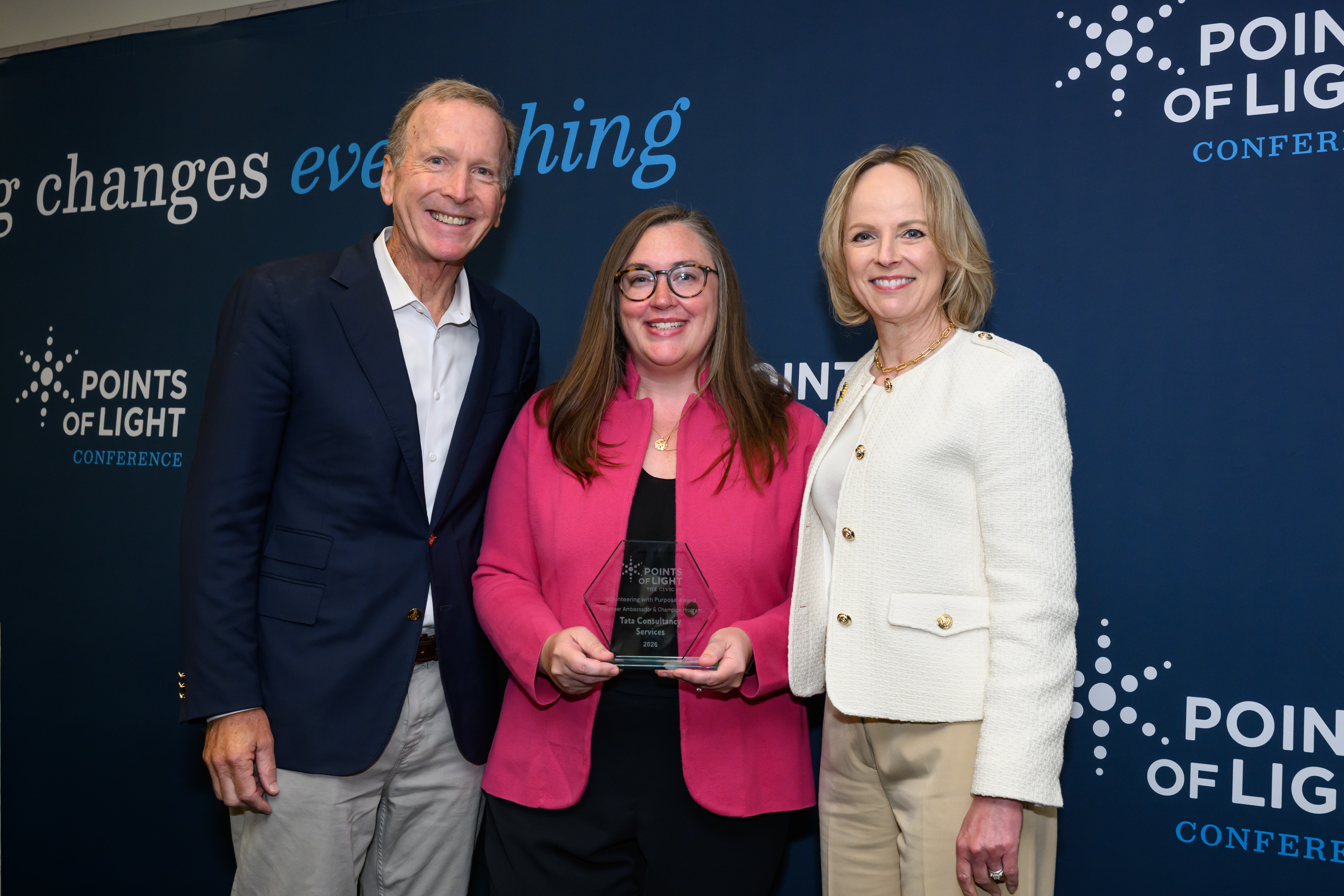
MUMBAI, India and NEW YORK, July 28, 2026 /3BL/ – Points of Light, a global nonprofit dedicated to volunteer service and civic engagement, has bestowed its inaugural Volunteer Ambassador & Champion Program Award to Tata Consultancy Services (TCS) (BSE: 532540, NSE: TCS), a global leader in IT services, consulting and business solutions. TCS received the accolade for its Leaders with Purpose program, which trains employees to become leaders in community engagement.

The award recognizes TCS Leaders with Purpose program for empowering employee leaders who champion volunteerism, inspire community engagement, and mobilize meaningful action across teams and the organization. Throughout North America, participants in the Leaders with Purpose program support STEM education and nonprofit organizations through sustained volunteer initiatives that expand opportunities, strengthen community resilience, and help address critical social needs.

“We believe companies have an important role to play in mobilizing people, strengthening communities and creating lasting, sustainable impact,” said Jennifer Sirangelo, president and CEO of Points of Light. “Tata Consultancy Services’ leadership demonstrates what is possible when service, purpose and partnership come together to address community needs. We are proud to celebrate Tata Consultancy Services and its continued commitment to building stronger, more resilient communities.”

Points of Light announced the award on June 23 at its annual conference in Washington, D.C. For TCS, the recognition reflects a long-standing approach to corporate social responsibility that encourages employees to contribute time, skills and leadership to nonprofit organizations across North America.

Stefanie McCall accepting award

“We created Leaders with Purpose to help our people develop the leadership skills necessary to become truly effective at local community engagement,” said Lina Klebanov, Head of Corporate Social Responsibility, North America, TCS. “Nonprofits are doing challenging and important work that requires volunteers who listen, learn and contribute as trusted partners over time. I’m proud of the TCS volunteers whose commitment to giving back to local communities made this recognition possible.”

Through the Leaders with Purpose program, TCS employees build relationships with nonprofit organizations and use their leadership and professional skills to tackle community priorities. The program’s capstone project model helps participants transition from learning to action, while giving nonprofit partners access to volunteer leaders who can support projects, mentoring, skills-based service and sustained engagement.

The Points of Light Volunteer Ambassador & Champion Program Award underscores TCS’ broader efforts to advance social impact in North America through employee volunteering, STEM education, digital inclusion and nonprofit partnerships.

Leaders with Purpose: By the Numbers

  • 450+ TCS employees have graduated from Leaders with Purpose to date.
  • 200+ North American nonprofits have been supported through Leaders with Purpose capstone projects.
  • Participation has increased 165% since the program launched in 2018.
  • 73% of program graduates remain active volunteers.
  • 75% of program graduates are interested in mentoring future cohort members.
  • Program alumni collectively contribute an average of 8,500 volunteer hours each year.

About Tata Consultancy Services Ltd (TCS)

Tata Consultancy Services (BSE: 532540, NSE: TCS) is the technology partner of choice for industry-leading organizations worldwide. Since its inception in 1968, TCS has upheld the highest standards of innovation, engineering excellence and customer service.

It has set an aspiration to become the world’s largest AI-led technology services company and is enabling its clients to transform themselves across the full AI stack, from infrastructure to intelligence.

Rooted in the heritage of the Tata Group, TCS is focused on creating long term value for its clients, its investors, its employees, and the community at large. With a highly skilled workforce spread across 56 countries and 194 service delivery centres across the world, the company has been recognized as a top employer in six continents. With the ability to rapidly apply and scale new technologies, the company has built long term partnerships with its clients. Many of these relationships have endured into decades and navigated every technology cycle, from mainframes in the 1970s to artificial intelligence today.

TCS sponsors 14 of the world’s most prestigious marathons and endurance events, including the TCS New York City Marathon, TCS London Marathon, Tata Mumbai Marathon, and TCS Sydney Marathon, with a focus on promoting health, sustainability, and community empowerment.

TCS generated consolidated revenues of over US $30 billion in the fiscal year ended March 31, 2026. 

For more information, visit www.tcs.com.

Follow TCS on LinkedIn | Instagram | YouTube | X.

TCS media contacts:

Corporate Communications & India

Email: corporate.communications@tcs.com

Email: santosh.castelino@tcs.com | Phone: +91 22 67789098

U.S. Email: andrew.corcione@tcs.com | Phone: +1 646 617 8221
North America Corporate Social Responsibility Email: eve.pidgeon@tcs.com | Phone: +1 313 605 1026

###

Noah Hernandez was the first person in his family to attend college. It was his passion for science and math, and a belief that engineering shapes the future, that led him to pursue mechanical engineering with a focus on thermodynamics, heat transfer and fluid mechanics.

And his participation in Trane Technologies’ Graduate Training Program, helped prepare him for his next role as an account manager for new systems. “HVAC is a lot more complex than people think,” Noah says. “There’s definitely a lot more engineering involved than just making cool air.”

VIDEO: How the Graduate Training Program Prepared Noah for a Meaningful Career in Energy Efficiency

Knowledge, confidence and camaraderie in the Graduate Training Program

Before joining the Graduate Training Program, Noah worked full time as an estimator in his local Trane Technologies office, where he first heard about the program from account managers and leadership. “This isn’t something other companies in our industry really offer,” he says.

“From day one, we’ve been getting real training, and we’re coming out well-equipped for the field.”

Noah Hernandez
Account Manager, Trane Technologies

The program, which mixes deep technical education with real-world learning and leadership development, is designed to close the university-to-industry gap. “I studied all the fundamentals in school — thermodynamics, fluid mechanics — and now I’m seeing how it all fits together in actual HVAC systems,” Noah explains. “It’s powerful to tie that theory to real-life practice.”

Just as important as the technical learning has been the people around him in the program. “One of the best parts of the program has been the camaraderie. We’re all going through this together. Everyone here is smart, driven and collaborative. I’ve made such great friends here.”

Mentorship and growth

Alongside the camaraderie, mentorship plays a central role in the Graduate Training Program experience. Each participant is paired with a mentor who provides one-on-one support throughout the program. “Our mentors are there to help guide us, to talk about where we’re struggling and identify what we need to develop. 

“The Graduate Training Program’s not just growing us technically; it’s growing as people.”

That whole-person development is built into the program’s design. “It’s intense,” Noah admits. “The days are long, but the weeks go by quickly. We’ve learned how systems work, how to manage our time, how to present and understand ourselves and how we learn.”

The Graduate Training Program also dives deeply into sales, including the differences between new systems, service and controls sales, giving each participant the tools to succeed in their chosen track.

HVAC’s role in climate impact

For Noah, one of the most eye-opening takeaways of the program has been HVAC’s role in global emissions. “HVAC systems make up a third of the world’s energy usage,” he says. “I didn’t realize just how big of an impact we can make. And I think that’s really inspiring.”

While sustainability wasn’t the initial reason Noah joined Trane Technologies, it’s become a core part of his mission. “Now that I understand how much our systems matter, I see my role differently. I’m helping engineers and building owners move toward a more sustainable future.”

That shift starts with education. “We’re consultants. Customers look to us for expertise. So, staying educated and sharing that knowledge with our customers is one of the best ways we can contribute to a more sustainable world.”

Building a purposeful career 

After graduating from the program, Noah will return to his office in Texas, where he’ll work with engineers and contractors to lay out HVAC systems for large-scale building projects. But this time, he’s stepping in with confidence, tools and a network of support behind him.

“Trane Technologies is a great company to work for. The culture, the people, the training — it’s all been incredible,” he says.

“If you’re an engineer who wants to make a difference, this is one of the greatest decisions you can make.”

Noah Hernandez
Account Manager, Trane Technologies

Sell something meaningful with Trane Technologies. Ready to make an impact? Explore your future in sales with Trane Technologies.

At WK Kellogg Co, we believe healthy soils are the foundation of resilient farming communities, thriving ecosystems and a more sustainable food system. Through our support of the Dan Gillespie Soil Health Fund, we are helping expand opportunities for soil health education, farmer-led innovation and youth engagement initiatives across Nebraska.

The Dan Gillespie Soil Health Fund is working to strengthen the future of agriculture by investing in projects that advance regenerative agriculture, soil biology, water stewardship, biodiversity and hands-on agricultural learning. Together, these efforts are helping producers, students and communities explore practical approaches that improve soil health, strengthen farm productivity, protect natural resources and build resilience for future generations.

One example of this impact is Battle Creek High School FFA member Claire Schmidt, whose award-winning agriscience research demonstrates the leadership and innovation emerging from the next generation of agricultural stewards. Schmidt won the Nebraska State Agriscience Competition in the Environmental Service/Natural Resource Systems category with her project, “Optimizing Nitrogen Application to Maximize Crop Yield, Economic Returns, and Soil Health.” Supported through funding from the Dan Gillespie Soil Health Fund and an anonymous donor through Nebraska Community Foundation’s Youth Engagement Grant, her research showed how optimized nutrient management can improve economic returns while supporting soil health and protecting water quality.

The Dan Gillespie Soil Health Fund continues to invest in farmers, educators and community organizations working to advance soil health knowledge and adoption throughout Nebraska. By supporting locally driven solutions and practical on-farm learning opportunities, these investments help create agricultural systems that are productive, environmentally responsible and economically sustainable.

Here at WK Kellogg Co, we are proud to support this work alongside other donors and community partners who share a commitment to sustainable agriculture, natural resource stewardship and agricultural education.

As a result of this collective investment, the Dan Gillespie Soil Health Fund will increase its maximum grant award to $2,500 for the next two grant cycles, creating additional opportunities for farmers, educators and students to pursue innovative soil health projects that deliver lasting environmental and community benefits.

“We’re proud to support the Dan Gillespie Soil Health Fund and its efforts to expand opportunities for soil health education and innovation,” said Sarah Ludmer, Sustainable Business Officer at WK Kellogg Co “Healthy soils are foundational to resilient farming communities, thriving ecosystems and a sustainable food system. Investing in soil health helps create opportunities for farmers today while supporting future generations of agricultural leaders.”

Supporting initiatives like the Dan Gillespie Soil Health Fund reflects WK Kellogg Co’s broader commitment to advancing sustainable agriculture and building resilient communities through its Feeding Happiness sustainable business strategy. By investing in soil health education, farmer innovation and youth leadership, WK Kellogg Co is helping create positive outcomes for people and the planet while supporting the long-term sustainability of the agricultural systems that help feed communities across the country.

Privacy Overview

This website uses cookies so that we can provide you with the best user experience possible. Cookie information is stored in your browser and performs functions such as recognising you when you return to our website and helping our team to understand which sections of the website you find most interesting and useful.