
Month: June 2026
Sustainability is no longer a side conversation. For technology partners, it is increasingly shaping how businesses win, retain, and grow customer relationships. It is influencing procurement decisions, driving new regulatory expectations, and redefining what long-term value looks like across the IT ecosystem.
As sustainability becomes increasingly embedded in business strategy, the focus is shifting towards measurable outcomes, scalable transformation, and commercial value creation. That is what the Lenovo 360 Circle Summit 2026 set out to address.
Held from 2–4 June 2026, the Lenovo 360 Circle Summit brought together senior partners for a focused, executive-level exchange on how sustainability can move beyond ambition and into practical business transformation. Rather than acting as a forum for discussion alone, the Summit was designed to equip partners with tangible frameworks, peer-led insight, and real-world approaches they could take back into their organisations.
At its core, the Summit reflects the broader ambition of the Lenovo 360 Circle community: to help partners turn sustainability into a driver of growth, differentiation, and long-term resilience.
As Virginie Le Barbu, Executive Director, Global Sustainability International Markets, Lenovo said:
“Sustainable transformation is not only about doing the right thing. It is about building stronger, more resilient businesses that are ready for the future. Through Lenovo 360 Circle, we are helping partners move from ambition to action, from action to measurable impact, and from individual progress to shared leadership across the ecosystem.”
Turning ambition into action
Across the industry, sustainability strategies are becoming more defined. Yet many organisations still face a gap between intent and execution. Translating high-level commitments into operational change, customer value, and measurable outcomes remains complex.
The theme of this year’s Summit, “From Vision to Value”, reflected a clear shift in the sustainability conversation. Many organisations now understand why sustainability matters. The harder question is how to operationalise it.
That challenge shaped the Summit experience. Executive panels, peer discussions, working sessions, external perspectives, and hands-on experience zones were designed to help partners move beyond broad intent and into practical application. Contributions from external speakers, including John Elkington, author and founder of the Triple Bottom Line, and Sir Ronald Cohen, a pioneer of impact investing, added wider context and challenge, helping partners connect sustainability priorities to the realities of leadership, transformation, and long-term business value.

Lenovo’s role throughout was as a convenor and enabler. Rather than using the Summit as a product showcase, Lenovo created a space for shared learning, honest discussion, and practical progress. This reflects the purpose of Lenovo 360 Circle itself: to bring partners, business leaders, sustainability experts, and alliance organisations together so that shared challenges can become collective strengths.
Artificial intelligence also featured as part of this conversation, particularly in how it can support smarter decision-making, optimise resource use, and accelerate sustainability outcomes when applied with intent. The importance of responsible AI was also highlighted, recognising that strong governance, transparency, and accountability are essential to building trust and ensuring AI delivers sustainable, long-term value.
Throughout, the emphasis remained consistent: sustainability must deliver business value. It must support growth, strengthen customer relationships, and create new opportunities rather than sit alongside them.
A practical journey from data to value
A key feature of the Summit was the experience-led zones, which brought the “From Vision to Value” theme to life through a practical sustainability journey. The Experience Zone emerged as one of the Summit’s defining features, giving participants a vivid, hands-on view of what it means to move “From Vision to Value.” Rather than presenting sustainability as an abstract ambition, the zone invited attendees to experience it as a practical business journey, one that begins with trusted data, advances through circular innovation, and culminates in more efficient, higher-performing operations.
Across three interconnected spaces, participants saw how ESG data can sharpen decision-making, how circular economy models can extend product life and recover value, and how energy efficiency is becoming a critical lever for both resilience and competitiveness. More than an exhibition, the Experience Zone captured the spirit of the Lenovo 360 Circle Summit itself: sustainability not as a parallel conversation, but as a fast-evolving force shaping the future of technology and business.
Beyond the sessions, the Summit also included the experiential blind football activity, “Football for All”, designed to encourage empathy, inclusion, and shared perspective, reinforcing the human side of sustainable transformation.

Lenovo 360 Circle Summit sponsors AMD, Intel, Logitech, and Schneider Electric also contributed to the wider conversation, bringing perspectives across performance, circularity, energy management, and sustainable technology innovation.
Collaboration as a business advantage
One of the strongest messages from the Summit was that no organisation can solve sustainability challenges alone. The IT industry operates through ecosystems, and sustainable progress depends on those ecosystems working more intelligently together.
This is where Lenovo 360 Circle creates distinct value. The community is structured to support partners at different stages of maturity, from those taking their first steps to those already leading with advanced sustainability strategies. Through the Connect, Learn, and Lead stages, partners can access the right level of guidance, resources, and peer collaboration to accelerate progress.
For early-stage partners, that may mean gaining clarity on priorities and accessing practical learning. For more advanced partners, it may mean engaging in focus groups, sharing best practices, accessing deeper ESG insight, and helping shape future approaches to sustainability across the channel.
This staged model matters because sustainability transformation is not linear. Different partners face different pressures, customer expectations, and market opportunities. Lenovo 360 Circle provides a framework that allows partners to progress in a way that is structured, relevant, and commercially meaningful. Pioneering a staged engagement approach aligned to the UN Global Compact engagement framework, the community supports partners at every stage of their sustainability journey, from early exploration through to industry leadership.
Recognising progress and leadership
The Lenovo 360 Circle Awards also formed an important part of the Summit’s wider purpose. The awards recognise more than achievement. They highlight meaningful progress across the ecosystem and celebrate partners that are translating sustainability commitments into measurable impact.
By recognising transformation, collaboration, climate action, social impact, and continuous improvement, the awards reinforce the behaviours the wider community is designed to encourage. They also help create proof points that partners can take back into their own businesses and customer conversations.
This recognition matters because sustainability leadership is increasingly visible. Customers want evidence. Partners want differentiation. The wider ecosystem needs examples of what progress looks like in practice. The Lenovo 360 Circle Awards are judged by an independent panel of leading sustainability experts, practitioners, and thought leaders, bringing deep industry expertise and a broad perspective on what meaningful progress and impact look like across the partner ecosystem.
Lenovo executives assess the regional partner excellence awards, while the specialist sustainability categories are evaluated by external practitioners and thought leaders with deep expertise across sustainability, innovation, and business transformation.
Our Lenovo 360 Circle Summit ’26 award winners are…
- Outstanding Global Partner Excellence Award – Computacenter
- Outstanding Global Partner Excellence Award CONNECT – Professional Technology Solutions
- Outstanding Partner Excellence Award EMEA – Softcat and TD SYNNEX
- Outstanding Partner Excellence Award AP – Redington
- Outstanding Partner Excellence Award NA – CDW
- Outstanding Partner Excellence Award LATAM – Exing
- Sustainability Individual Champion Award – Sheryl Moore, Converge Technology Solutions
- Most Improved Sustainability Partner Award – SHI
- Outstanding Sustainability Collaboration Spirit Award -TD SYNNEX
- Energy Efficiency Leadership Award – Ingram Micro
- Outstanding Climate Action Award – SHI
- Circular Economy Leadership Award – Foxway
- Best Social Impact Initiative Award – CDW
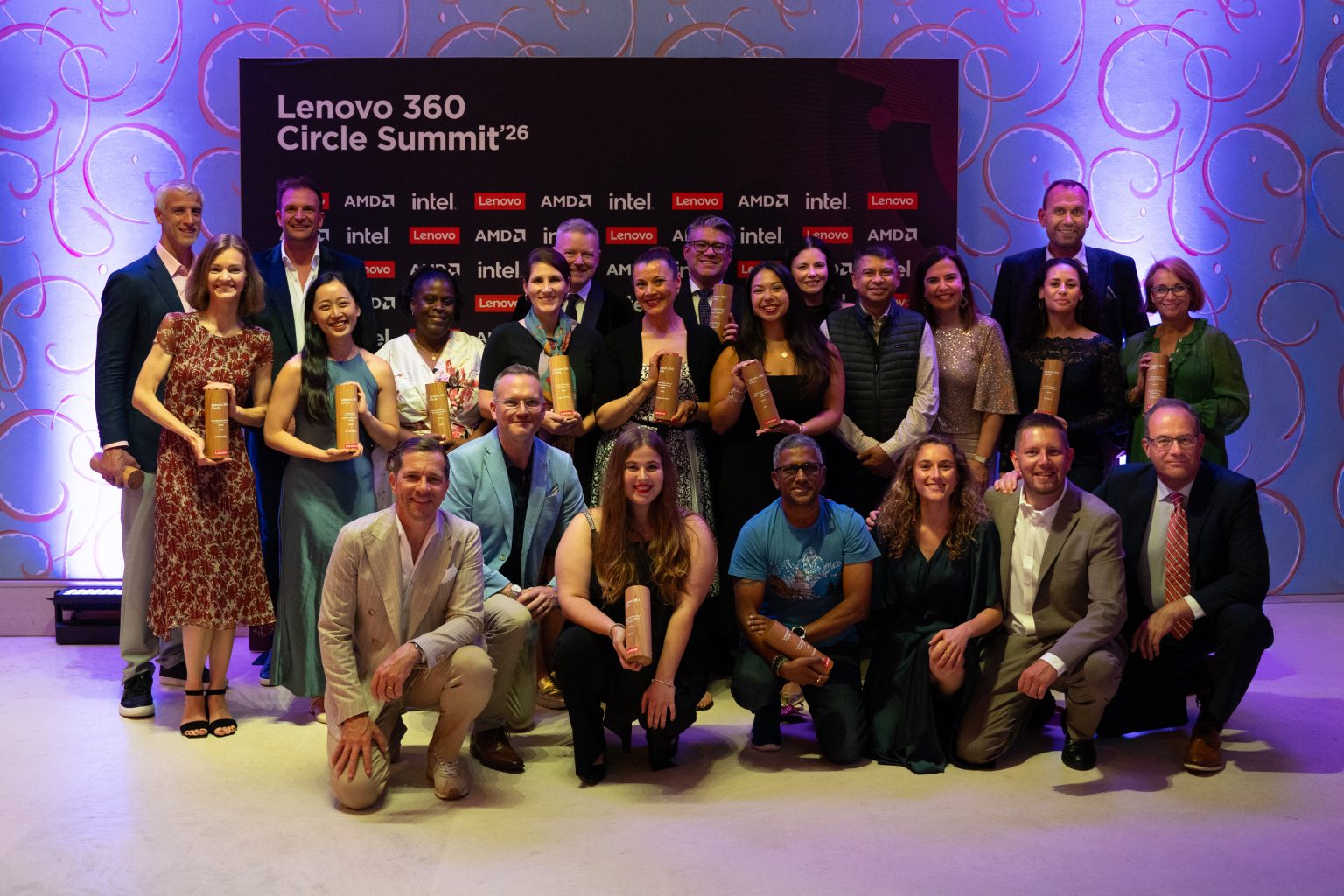
A community built for long-term transformation
The Summit demonstrated the strength of Lenovo 360 Circle as a community that enables partners to build capability, share expertise, and create measurable business value through sustainability.
That is what makes the Lenovo 360 Circle Summit relevant even beyond those in attendance. For senior partners across the Lenovo ecosystem, the message is clear: sustainability is becoming central to how technology businesses compete, grow, and create value. The organisations that act now will be better prepared for future customer expectations, regulatory demands, and market change.
Lenovo 360 Circle gives partners a way to act with more confidence. It brings together expertise, structure, peer learning, practical tools, and recognition. It helps turn sustainability from something complex and sometimes overwhelming into something that can be understood, measured, embedded, and scaled.
The Lenovo 360 Circle Summit 2026 demonstrated how sustainability can be translated into measurable value, stronger partnerships, and meaningful business transformation through practical action and collaboration.
If you’re running a small business, one of the most important investments you can make is securing your own domain name.
Whether you’re just starting out or looking to grow your brand online, a domain name serves as your business’s online home base.
Entrepreneurs today rely solely on social media profiles or online marketplace listings. While those channels can help you reach customers, they don’t give you full control over your online presence. A domain name does.
At GoDaddy, we’re known as the world leader in domains. We understand the importance a domain plays in empowering entrepreneurs at every stage of their business.
To help you better understand these benefits, we’re sharing our top 10 reasons every small business should own a domain name.
Take a look…
-
Own Your Online Identity
Social media platforms can change overnight. Your domain is a digital asset that belongs to you.
-
Protect Your Brand
Securing your domain prevents others from claiming your business name online.
-
Look More Professional
A custom domain like YourBusiness.com instantly makes your business appear more credible and established.
-
It’s Affordable
A domain is one of the lowest-cost investments you can make in your business’s long-term success.
-
Help Customers Find You
A domain gives customers a central place to learn about your business, products, and services.
-
Support Your Marketing
Use your domain for your website, landing pages, email campaigns, promotions, and more.
-
Create Branded Email Addresses
An email like info@yourbusiness.com builds trust with customers and reinforces your brand.
-
Stand Out from Competitors
A memorable domain helps customers remember your business and choose you over the competition.
-
Prepare for Growth
A domain creates a foundation for future expansion, whether that’s ecommerce, bookings, or new services.
-
Meet Customer Expectations
Today’s customers expect legitimate businesses to have a website they can visit.
A domain name is much more than a website address. It’s the foundation of your online brand.
It helps customers find you, builds trust, protects your business identity, and gives you the flexibility to grow on your own terms. Whether you’re launching a new venture or strengthening an existing one, securing a domain name is one of the smartest and most cost-effective decisions you can make.
Visit GoDaddy Domains today to start building a stronger online presence for your business.
Originally published on Devex.com
Lung cancer continues to be a leading cause of cancer-related mortality in the United States — a statistic made more tragic by the fact that early-stage diagnoses carry an 80% cure rate. However, screening rates remain critically low — particularly within medically underserved communities — leading to a cycle where most patients are only diagnosed once the disease has reached an advanced, symptomatic, and less treatable stage.
Speaking with Devex, Dr. Drew Moghanaki, professor and chief of thoracic oncology at the University of California, Los Angeles School of Public Health’s Department of Radiation Oncology, discusses the evolution of lung cancer screening infrastructure, including how public-private partnerships are successfully translating clinical evidence into scalable, equity-focused solutions.
This conversation has been edited for length and clarity.
What factors most strongly contribute to disparities in lung cancer risk and diagnosis, and why is early detection such a critical intervention point for addressing them?
I have discovered that a key factor that influences lung cancer outcomes is largely tied to access to care. That is, patients who are adequately insured are more likely to receive timely diagnoses, access high-quality treatment, and ultimately achieve better outcomes than those who are uninsured or underinsured.
Another factor concerns the challenges that underresourced communities face in providing appropriate lung cancer screening and treatment expertise, regardless of individual patient insurance status. For example, a local hospital might not have high-quality surgery, radiotherapy, or medical oncology services. They might not even be committed to supporting a lung cancer screening, diagnosis, or treatment program due to competing priorities and limited resources.
Finally, I’ve come to appreciate the significant role of individual patient health literacy in lung cancer outcomes — particularly at the earliest stages of detection. Some patients may not fully understand that lung cancer, when caught early, can be treatable or even curable. This gap in understanding can lead to individual nihilism, which can contribute to missed appointments and incomplete evaluations, which can delay diagnosis and allow the lung tumor to spread and no longer be curable.
What are some of the lessons you learned from the VA-PALS implementation program that made it the most successful lung screening program across the VA, and how did it address healthcare disparities?
VA-PALS [the Veterans Affairs Partnership to Increase Access to Lung Screening] was a public-private partnership from 2017-2022 that was cosponsored by the VA Office of Rural Health and the Bristol Myers Squibb Foundation. It built a network of lung screening centers across the VA [Department of Veteran Affairs] by using an implementation approach that ensured all veterans — regardless of where they lived — were informed and counseled about the potential benefits of early detection.
The success of VA-PALS, in which we screened over 30,000 veterans, ultimately led the VA to establish the National Center for Lung Cancer Screening, which gave rise to enterprise-wide policies requiring that all veterans over the age of 50 be assessed for screening eligibility wherever they receive care. This now allows the VA to offer lung screening as standard of care for all veterans confirmed eligible, which truly minimizes disparities, given it supports the entire population receiving care through the VA.
A key lesson we learned through VA-PALS is that successfully implementing a new clinical program, such as lung cancer screening, requires a critical mass of engaged people, sufficient resources, and a genuine commitment from each hospital’s administration to enact the policy changes needed to sustain its growth. We learned that without those foundational elements, individual screening programs can become isolated and unsupported, leaving the people doing that work feeling alone and vulnerable to burnout and attrition.
These lessons ultimately led us to understand that when you build a team across diverse geographic locations around a shared mission that everyone feels a sense of ownership in, the team becomes passionate and, frankly, unstoppable. People show up differently when they understand they are part of something larger than themselves and that their work is directly saving lives. We have certainly carried this awareness into our latest lung screening implementation project, named CAL-PALS (California Partnerships to Increase Access to Lung Cancer Screening), where everyone involved is highly engaged and willing to make time to build new lung screening programs.
Why did you choose to get involved in building lung screening programs outside the VA?
Following my recruitment to UCLA in 2021 to lead our department’s lung cancer program, I recognized a significant gap in the state’s priority for lung screening. I learned the state of California was second to last in the nation in lung cancer screening, which, to me, was simply unacceptable for a state that is a leader in public health and first outlawed smoking in the 1990s.
In response, a collaboration was established between leading implementation scientists at UCLA from the schools of medicine and public health, who drew on lessons from VA-PALS to develop a partnership with two regional community hospitals that had expressed interest in developing lung screening programs but had not yet moved forward with a concrete plan. We felt that if we could launch two new lung screening programs in regional hospitals, we could later replicate the implementation approach statewide by leveraging the network of the University of California healthcare systems and help get the state back into a leading position in driving down lung cancer mortality beyond smoking cessation strategies.
With a generous grant from the BMS Foundation, we helped kick-start each local hospital’s hiring of a full-time advanced practice provider and supported them in building the clinical workflows necessary to reach patients at risk for lung cancer and to get those eligible screened. Our team at UCLA is now providing each of these hospitals, which are both part of CommonSpirit Health, with expertise in public health, implementation science, lung cancer screening, and treatment to help them accelerate their development.
You previously shared that cancer outcomes within the VA have a narrow, or even potentially nonexistent, racial disparity gap compared to what we see in the general population. Can you tell us more about this?
Our research teams in the VA had observed over the years, through a growing body of published literature, that Black veterans receiving care through the VA were achieving similar cancer outcomes as compared to non-Black veterans. This stands in stark contrast to what we see in the general U.S. population, where disparities between racial groups persist — and, in many cases, are not narrowing.
Our research team investigated this by analyzing the body of literature published over the past decade on outcomes for veterans with cancer to determine whether this was true. What we found was that race did not predict worse outcomes among those with different cancer types, which implies that integrated healthcare systems like the VA, which provide near-equitable access to comprehensive cancer care, have the potential to substantially reduce or even eliminate racial disparities in cancer outcomes. Our research report was recently accepted and will be published soon.
Smoking history often carries a social stigma that prevents people from seeking help. How does your team approach patient outreach to make screening feel like a proactive health step rather than a judgment?
We are acutely aware that the public at large has long marginalized people who smoke. We consider this an unintended consequence of smoking cessation programs that, for more than half a century, have used fear, guilt, and shame as motivational tools to discourage people from starting and to encourage those currently smoking to quit. Unfortunately, the stigma this creates carries over whenever a person who is or was addicted to cigarettes later develops lung cancer, which can affect not only their well-being but also their willingness to pursue treatment.
This issue is real, and something we address head-on in the VA, where there is a culture that aims to never discriminate against any of our veterans to embody the military culture of leaving no one behind, regardless of their circumstances, including a history of smoking addiction. I wish every healthcare system had a similar culture, as I believe it is absolutely critical to destigmatize the smoking component of lung screening eligibility if we want to reach all patients who need this preventive service.
As you look ahead, how do programs such as CAL‑PALS point toward a future “gold standard” for lung cancer screening, and what would it take to replicate this model in other high‑burden communities nationwide?
Our CAL-PALS implementation project is actually quite straightforward. It partners a high-resource institution, such as UCLA, that has expertise in public health and lung cancer screening, diagnosis, and treatment, with a pair of highly motivated community hospitals with strong administrative support that want to make a meaningful and measurable difference in their patients’ lives. I encourage all healthcare environments to seek similar partnership opportunities as we aim to build more robust lung screening programs nationwide.
I also recommend that community hospitals explore emerging software technologies that are now available to simplify the implementation and maintenance of early detection programs. Particularly through commercially available software tracking systems that are now implemented in hundreds of hospitals across the country and are successfully leveraging artificial intelligence and computational linguistics to scan electronic medical records, review radiology reports, flag incidental findings, and automate care coordination to ensure that patients who receive a diagnosis are transitioned promptly into workup and treatment. Our CAL-PALS partner hospitals have already installed one of these systems, and it is helping us build our programs even more efficiently than we did during the VA-PALS program.
Visit Strengthening Care Systems — a series in collaboration with the Bristol Myers Squibb Foundation on raising awareness of the scale of the global lung cancer burden and the systems-level changes required to address it.
MONTREAL, Quebec, June 26, 2026 /3BL/ – Gildan Activewear Inc. (GIL: TSX and NYSE) (“Gildan” or “the Company”) is pleased to announce that it has been included on Canada’s Best 50 Corporate Citizens list by Corporate Knights for a fifth consecutive year. Gildan is one of only two companies in the Textiles and Clothing Manufacturing sector to be included. Additionally, the Company has once again been placed in TIME’s World’s Most Sustainable Companies ranking, which is now in its third edition. It is one of 19 Canadian companies featured on this global list and is one of only two Canadian companies recognized in the “Apparel, Footwear & Sporting Goods” industry subcategory.
“Our consistent recognition from key rankings like Corporate Knights and TIME reflect the longstanding importance of sustainability within Gildan’s corporate strategy,” says Glenn J. Chamandy, President and CEO of Gildan. “Thanks to the dedication of our teams across the business, I am confident that we will continue to deliver on our commitment to Making Apparel Better®.”
Canada’s Best 50 Corporate Citizens of 2026 by Corporate Knights is derived from a data set of companies with more than $1 billion in annual revenues, with potential contenders including publicly listed companies, privately-owned corporations, Crown corporations and credit unions as well as members of the TSX / S&P Renewable Energy and Clean Technology Index. For 2026, the methodology was updated to focus on three equally weighted metrics: share of investments and share of revenues that are sustainable (as defined under the Corporate Knights Sustainable Economy Taxonomy), and the sustainable-revenue momentum score, which tracks growth in sustainable revenues from 2022 to 2024.
View the full ranking here.
TIME’s World’s Most Sustainable Companies 2026 ranking recognizes leading companies in corporate social responsibility from around the globe. Companies were evaluated in more than 20 key performance indicators related to sustainability, such as compliance with international reporting standards, emissions, or commitment to goals and initiatives. Based on this multi-layered analysis, a score was determined for each company. Out of over 5,800 of the world’s largest and most influential companies assessed, the top 750 were awarded based on revenue, market capitalization, and public prominence.
View the full ranking here.
About Gildan
Gildan is a leading manufacturer of everyday basic apparel. The Company’s product offering includes activewear, underwear, socks, and intimates sold to a broad range of customers, including wholesale distributors, screenprinters, embellishers, retailers or e-commerce platforms, as well as global lifestyle brand companies and directly to consumers. Gildan markets its products in North America, Europe, Asia Pacific, and Latin America, under a diversified portfolio of Company-owned brands including Gildan®, Hanes®, Comfort Colors®, American Apparel®, ALLPRO™, GOLDTOE®, Peds®, Bali®, Playtex®, Maidenform®, Bonds®, as well as Champion® which is under an exclusive licensing agreement for the printwear channel in the U.S. and Canada and Polo Ralph Lauren® also under a licensing agreement.
Gildan owns and operates vertically integrated, large-scale manufacturing facilities which are primarily located in Central America, the Caribbean, North America, and Asia. Gildan integrates industry-leading labour, environmental, and governance practices into its operations and supply chain under a sustainability program that is aligned with its long-term business strategy. More information about Gildan and its sustainability commitments and initiatives can be found at www.gildancorp.com
Investor inquiries:
Jessy Hayem, CFA
Senior Vice-President, Head of Investor Relations and Global Communications
(514) 744-8511
jhayem@gildan.com
Media inquiries:
Jonathan Binder
Director, Corporate Communications
(336) 519-6330
communications@gildan.com