Local leaders across Georgia can now see a more detailed picture of what impacts to expect from climate change with a new map tool released by Drawdown Georgia.

The group, which aims to reduce the state’s greenhouse gas emissions, unveiled the maps at the Super South Summit in Atlanta last week.

Scientists warn that Georgia can expect hotter, longer summers, more extreme weather, more rainfall overall and also longer droughts. But those impacts will vary across the state.

Now, researchers have found ways to scale down big-picture data so they can project not just how climate change is affecting Georgia or the Southeast broadly, but also how it’s changing conditions in specific locations.

Read the full story on WABE.

Local leaders across Georgia can now see a more detailed picture of what impacts to expect from climate change with a new map tool released by Drawdown Georgia.

The group, which aims to reduce the state’s greenhouse gas emissions, unveiled the maps at the Super South Summit in Atlanta last week.

Scientists warn that Georgia can expect hotter, longer summers, more extreme weather, more rainfall overall and also longer droughts. But those impacts will vary across the state.

Now, researchers have found ways to scale down big-picture data so they can project not just how climate change is affecting Georgia or the Southeast broadly, but also how it’s changing conditions in specific locations.

Read the full story on WABE.

Antea Group’s Data Center EHSxTech® events continue to bring together environmental, health, and safety (EHS) leaders from across the data center industry to share insights, challenges, and solutions in a rapidly evolving landscape.

Across recent events in the U.S. and Europe, a consistent message has emerged: as data center growth accelerates, EHS must evolve from a compliance function to a strategic driver of safety, resilience, and operational performance.

Highlights from Our Most Recent Event

  • Air permitting increasingly becoming a critical project risk. Delays or denials in regulatory approval can halt development, with increasing complexity across jurisdictions, growing public scrutiny, and a need for specialized expertise.
  • EHS compliance ownership is getting more complex. Varying business models (e.g., triple net leases, multi-party operations) are making it harder to clearly define responsibility for permitting and ongoing compliance.
  • Power availability is a primary constraint. Grid limitations and moratoriums are pushing developers to rethink site selection and invest in onsite generation and alternative energy solutions.
  • Community expectations are reshaping development. Scrutiny around energy, water, noise, and land use is driving stricter permitting and higher expectations for transparency and engagement. Industry advocacy has never been more important.
  • Self-performing operations are changing EHS models. As organizations move away from outsourced operations, they need stronger internal systems, technical expertise, and workforce training.
  • Workforce shortages are impacting safety and execution. Rapid growth is outpacing skilled labor availability, increasing pressure on training, competency, and retention.

Core Trends Across Data Center EHSxTech® Events

1. AI in EHS: From Experimentation to Everyday Operations

Across all events, AI has rapidly evolved from a curiosity to a practical tool embedded in daily EHS activities.

Organizations are using AI to:

  • Summarize incidents and generate reports
  • Review safety documentation and RAMS
  • Develop training materials and toolbox talks
  • Analyze safety observations and prioritize risks
  • Optimize daily document review and e-mail management

What’s changed most is scale and normalization. AI is now becoming part of standard workflows instead of just viewed as a new tool on the block. However, companies consistently emphasize the importance of governance, data privacy, and human oversight.

2. Safety by Design: Eliminating Risk Before It Exists

A recurring theme across every event is the shift toward designing safety into data centers from the very beginning.

Best practices include:

  • Embedding safety reviews at key design stages (30/60/90%)
  • Incorporating technician and operational feedback early
  • Designing for ergonomics, access, and maintenance safety
  • Integrating sensors and monitoring for predictive maintenance

This approach reflects a broader mindset shift: the safest risks are the ones removed before operations begin.

3. Managing High-Risk Activities (HRAs)

As data centers scale, organizations are aligning around a more consistent and structured approach to high-risk work.

Key focus areas include:

  • Standardizing definitions of HRAs across organizations
  • Identifying and verifying critical controls
  • Embedding HRA checks into planning and execution, not just documentation
  • Measuring effectiveness through leading indicators

Examples of HRAs frequently discussed include electrical work, confined spaces, lifting operations, and vehicle movements.

4. From Lagging Metrics to Meaningful Insights

Traditional safety metrics are no longer enough. Across events, participants emphasized the need to move beyond incident rates toward more actionable indicators.

Emerging approaches include:

  • Tracking the percentage of high-risk work with verified controls
  • Measuring time to close corrective actions
  • Using AI to filter and prioritize observations
  • Integrating safety with operational performance metrics

Measure what actually prevents incidents, not just what reports them.

5. Contractor and Supply Chain Risk Management

Data centers are inherently multi-employer environments, making contractor management a critical EHS priority.

Common challenges include:

  • Limited visibility into subcontractors
  • Inconsistent safety standards across vendors
  • Communication gaps during project execution
  • Influx of employees with limited to no industry experience

Leading practices highlighted across events:

  • Early EHS involvement during contracting
  • Strong prequalification and onboarding processes
  • Clear contractual safety expectations
  • Continuous monitoring and performance evaluation

Organizations are increasingly treating supplier quality and contractor safety as directly linked to operational risk.

6. Operational Realities: Heat, Noise, and Lone Work

While innovation is accelerating, many core operational risks remain constantly complex.

Key topics discussed include:

  • Heat stress in both indoor and outdoor environments
  • Noise exposure from high-density equipment and cooling systems
  • Risks associated with lone workers in 24/7 operations

Solutions range from engineering controls and PPE innovations to monitoring technologies and improved communication systems.

7. Energy, Power, and Sustainability Challenges

The rapid expansion of data centers is placing new pressure on energy infrastructure and creating new EHS considerations.

Key discussion areas:

  • Grid capacity constraints and onsite generation
  • Battery Energy Storage Systems (BESS) risks
  • Cooling strategies and water use
  • Emerging technologies like SMRs and carbon capture

EHS professionals are increasingly expected to play a role in:

  • Assessing community and environmental risks
  • Supporting emergency preparedness for new energy systems
  • Engaging with regulators and stakeholders

This is where EHS and sustainability are clearly converging.

8. Building a Culture of Safety and Collaboration

Across all events, one constant stands out: collaboration is essential.

Whether its sharing lessons learned, aligning on best practices, or addressing industry-wide challenges, these events reinforce the value of open dialogue.

EHS leaders are not just regulators, they are:

  • Educators
  • Facilitators
  • Strategic partners

And increasingly, they are responsible for helping organizations navigate complexity while maintaining a strong culture of safety.

Key Takeaways for Data Center EHS Leaders

  • Treat AI as an enabler, but implement it with governance and purpose
  • Design safety into every phase of the data center lifecycle
  • Focus on high-risk activities and verify critical controls in real conditions
  • Move beyond traditional metrics toward leading indicators that drive prevention
  • Strengthen contractor and supplier safety programs
  • Address operational risks with both technology and human-centered solutions
  • Engage early in energy and infrastructure decisions
  • Prioritize collaboration to solve industry-wide challenges

Conclusion: Advancing Together

One of the most valuable outcomes of Data Center EHSxTech® events is the opportunity to step outside of day-to-day operations and learn from peers facing similar challenges, but the real impact happens in what comes next.

As the industry continues to evolve, the focus is shifting from sharing ideas to applying them at scale—embedding lessons learned into design decisions, operational practices, and performance metrics across organizations.

The challenges ahead, from AI integration to energy infrastructure and high-risk work, will continue to grow in complexity. Meeting them will require not just collaboration, but consistency, accountability, and a willingness to evolve how EHS is implemented across the data center lifecycle.

By turning insight into action, EHS leaders are responding to change and helping define what safe, resilient data center operations look like in the future.

Want to attend the next gathering of data center EHS thought leaders? Contact us to get involved!

The Tire Emissions Research Conference is an event supported by the Tire Industry Project (TIP), and is taking place on 8-10 December 2026 in Cambridge, England.

Building on the strong momentum of last year’s edition, the 2026 conference will take place at Jesus College in the University of Cambridge, focusing exclusively on discussing scientific research and promoting actionable solutions in tire emissions.

Engage with experts as they address the critical challenges and opportunities in reducing tire and road wear emissions.

Learn about the latest research and its impact, including mitigation strategies on use-phase tire emissions.

2026 Tire Emissions Research Conference topics

1. Tire and road emissions generation and characterization (particulates and constituents)
This section is expected to cover the following topics:

  • The levels of and types of emissions per kilometer/mile, including average emissions (emission factors) and considering influent factors (driving style, vehicle, road, climate, etc.)
  • What do we know about potential particles of nanometer size from tires?
  • What do we know about physical/chemical characteristics of tire emissions and TRWP in particular (e.g., density, size distribution)?

2. Environmental distribution and fate of tire emissions
This section is expected to cover the following topics:

  • Analytical methods for quantification of tire emissions in different environmental compartments.
  • Sampling and modeling of tire emissions of distribution in different environmental compartments.  

3. Behavior and impact of tire emissions on the environment (Environmental impact of tire emissions) 
This section is expected to cover the following topics:

  • Transformation and interactions of TRWP, rubber, and associated additives in the environment.
  • Measurement of TRWP leachates in environment.
  • Ecotoxicity and mode of action of TRWP/Leachates/Transformation products.  

4. Design alternatives  
This section is expected to cover innovation and new approaches pertaining to the development and adoption of tire and vehicle design alternatives with the potential to reduce the generation and/or impact of tire emissions such as: 

  • Tire designs.
  • Alternative tire materials.
  • Vehicle design.
  • Vehicle mounted capture devices.
  • Impacts of EV vs conventional internal combustion engine on tire emissions. 

5. Civil engineering measures and environmental practices for mitigation of TRWP and chemicals
This section is expected to cover the following topics:

  • Roadside runoff and stormwater management technologies and practices.
  • Vehicle capture device technologies and practices.
  • Wastewater treatment technologies and practices.
  • Road surface and compositional impacts.
  • Street cleaning techniques and management practices.
  • Analytical characterization of stormwater composition.

Why attend?

Be part of a science-based conference dedicated to discussing tire emissions research and addressing actionable solutions.

Collaborate and share insights with leading experts.

Who is it for?

This independent conference is focused on collaboration and designed for scientists, regulators, NGOs, and academia who are actively pursuing science-based research and solutions relating to tire and road wear emissions.

Click here to read more.

Abstracts

Abstract submission is open for the 2026 Tire Emissions Research Conference! 

Why submit an abstract? 

  • Present your work on a global stage and give it more visibility.
  • Connect with experts around the world who share your research interest.
  • Contribute to promoting actionable solutions in tire and road wear emissions.

Deadline approaching: 11 May 2026

Click below to submit your abstract.

Submit your abstract

Verizon
By: Neil Mitchell

Teens are already using AI for homework. Research suggests they use it more responsibly when clear expectations are in place—yet many say they don’t have them. To support learning instead of replacing it, parents can set simple, shared rules for research, writing and studying with AI.

In surveys and focus groups conducted by the Family Online Safety Institute (FOSI), nearly half of teens said they are using generative AI for academic work. But their feelings about it are mixed. Many teens say that convenience and speed are a big reason why they’re reaching for AI, but they also worry about losing critical thinking skills, with concern significantly higher among teen girls (25% vs. 13%).

The study suggests that teens know there are tradeoffs with AI. But it also shows they’re mostly trying to figure it out on their own, as administrators are still developing AI policies for schools: Only 37% of teen generative AI users surveyed said that their schools set very clear rules, and 57% say their parents have no rules about AI use.  

Clarity on responsible use matters, especially as the use of generative AI becomes more common. Here’s how parents can have meaningful AI conversations with teens about using AI for homework.

Set clear tech limits for school and homework with Verizon Family Plus.
Learn more

AI in high school: Where parents come in

Using AI in research

AI can help you get started, but double-check the citations and sources it turns up.

In the FOSI study, many teens said AI helped them get into assignments quickly, especially if their schedule meant they had a late start. AI also helped them finish the assignment faster.

“AI can save time,” says Alanna Powers-O’Brien, research specialist at FOSI, “but students need to take the extra step of clicking through to those study sources.”

  • What parents can say:
    “AI is an okay way to get started on your research, but make sure you click through to verify where the info came from.”
  • What this looks like in homework:
    Kick off the research process with AI, then look beyond AI to verify. That could mean reviewing cited sources, running a separate search beyond the AI overview or asking a teacher.

Using AI for writing assignments

AI can help you brainstorm, but it shouldn’t replace your voice.

In FOSI’s research, some teens shared that they had used AI to write full essays. But once they understood that they crossed a line, they changed how they used the technology.

“It uses words I would never use,” teens told researchers.

  • What parents can say:
    “AI can help you get ideas going, but the final writing should be you.”
  • What this looks like in homework:
    Brainstorm the approach or dictate your first draft and use the generated transcript as a starting point. Read drafts out loud to make sure they make sense.

Using AI to study

AI can help you review what you learned, but it can’t replace your notes.

In the FOSI study, teens gave mixed reviews to using AI to generate study guides.

“It probably depends on what prompts they’re using,” Powers says. “But if they put in their exact class notes, it can generate something that’s more helpful to their exact situation.”

  • What parents can say:
    “Take your own notes in class, then retype those notes to use in AI prompts to generate your own flash cards, study guides or quizzes to test what you’ve learned.”
  • What this looks like in homework:
    AI can help turn notes into practice questions or review tools instead of replacing note-taking altogether.

AI for homework: What parents should keep in mind

AI for homework works best when it’s treated more as a tool and less as a teacher, says Powers-O’Brien.

Parents don’t need to understand every AI feature. They just need to help slow things down. A few clear expectations can give teens something they’re already asking for: permission to learn, not just keep up.

We got you: You’re there for them with Verizon Family. Verizon’s there for you—including our 3-year price lock*.

*Learn more about our 3-year price lock guarantee.
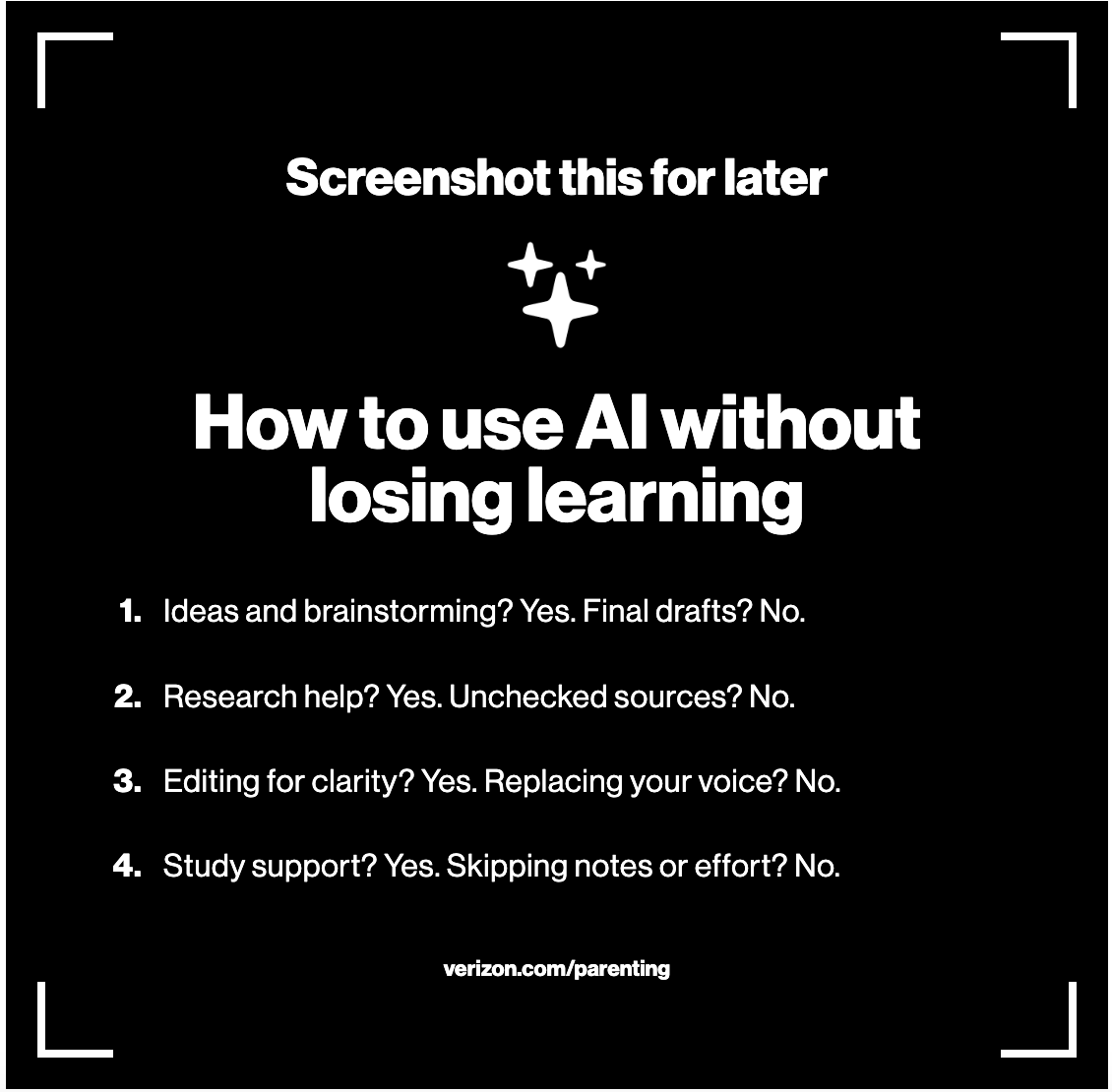
 

"How to use AI without losing learning 1. Ideas and brainstorming? Yes. Final drafts? No. 2. Research help? Yes. Unchecked sources? No. 3. Editing for clarity? Yes. Replacing your voice? No. 4. Study support? Yes. Skipping notes or effort? No."

Should teens use AI for homework?

Students are already using AI for homework. The key question isn’t whether they should use it, but how. Experts recommend treating AI as a support tool for brainstorming, research or review, not as a substitute for original thinking or final drafts. Clear expectations at home and school can help teens understand where the line is.

How is AI used in high school classrooms today?

AI in high school is commonly used for writing, research summaries, study guides and practice questions. Many schools are still developing AI policies, so students often experiment on their own. As classroom use expands, educators are working to clarify when AI is appropriate and when independent work is expected.

What are the biggest concerns teens have about AI for homework?

Teens say their top concern is losing critical thinking skills. In research from the Family Online Safety Institute (FOSI), 19% identified this as their primary worry, with concern higher among girls. Many teens fear AI could become a shortcut that weakens their ability to think independently, even as they feel pressure to work faster.

What are the best strategies for ethical AI use in homework?

Practical guidelines for responsible AI use include:

  • For research: Use AI to get started, then verify information by checking cited material or going through original sources.
  • For writing assignments: Brainstorm with AI, but ensure the final draft reflects your own voice and ideas.
  • For studying: Take original notes first, then use AI to generate flash cards or practice questions.
  • Experts recommend framing AI as a tool, not a teacher, and setting clear expectations before assignments begin.

How should parents talk to teens about AI and homework?

Begin by asking open questions: “How are you using AI for school?” or “What have you found helpful about AI?” From there, share your experience and start to talk about boundaries. This also can be a way to share your expectation that AI can be helpful for brainstorming or creating study tools, but not for the finished work. Framing AI as a tool that supports learning instead of one that replaces effort can help teens use it more responsibly.

For more tips and guidance from the experts, visit Parenting in a Digital World.  

About the author:
Neil Mitchell is an online safety specialist. He has advised Verizon on online safety issues for 15+ years.
The author has been compensated by Verizon for this article.


ROCHESTER, N.Y., April 20, 2026 /PRNewswire/ — Philanthropist and entrepreneur Tom Golisano announced a $125 million investment in three children’s hospitals which will now be added to the nationwide network of the Golisano Children’s Alliance. As part of the investment, Akron Children’s Hospital in Akron, Ohio will receive $50 million, Dayton Children’s Hospital in Dayton, Ohio will receive $40 million, and Avera Health in Sioux Falls, S.D. will receive $35 million.

The addition of these three hospitals brings the total number of Golisano Children’s Alliance hospitals to 15 across the United States. The Alliance is a growing national network of children’s hospitals united by a shared commitment to improving pediatric healthcare delivery, advancing innovation, and ensuring children and families have access to high-quality, compassionate care close to home.

Each hospital will become active members of the Golisano Children’s Alliance and will prominently recognize the Golisano name. Akron Children’s Hospital will name its Akron Campus “Akron Children’s, Golisano Campus”; Dayton Children’s Hospital will name its main campus the “Golisano Comprehensive Care Campus”; and Avera Health will name its children’s hospital “Avera Golisano Children’s Hospital” which will be in its new patient care tower set to open in 2027.

“All three of these hospitals provide outstanding care for the children in their communities, and we look forward to seeing what they can do with the added resources being a member of the Golisano Children’s Alliance provides,” said Tom Golisano. “As a father and grandfather, nothing brings me greater joy than seeing how better access to healthcare improves the lives of children and their families. It is my plan to continue with this mission, and I look forward to working with more hospitals and building out the network further over the months and years to come.”

“We’re excited to expand the Golisano Children’s Alliance once again,” said Erica Dayton, Executive Director for the Golisano Foundation. “Millions of children will have better access to state-of-the-art healthcare close to their homes thanks to these donations and the close collaboration and connection the alliance creates between hospitals that join the network.”

The Golisano Children’s Alliance was founded in October 2025 when Mr. Golisano significantly expanded his support of children’s hospitals with a transformative philanthropic commitment totaling $403 million. Today’s announcement brings Mr. Golisano’s total giving toward this initiative to $578 million.

Mr. Golisano continues to actively build relationships with children’s hospitals across the country, with a long-term goal of expanding the Golisano Children’s Alliance to 40 hospitals over the next several years. More hospital partnerships are expected to be announced in the coming year.

For more information on the Golisano Children’s Alliance, visit golisanofoundation.org/alliance.

About Tom Golisano
Tom Golisano—entrepreneur, philanthropist, and civic leader—is the founder of Paychex, Inc., the nation’s largest human resource company for small to medium-sized businesses. Mr. Golisano’s vision, perseverance, and action have left an indelible mark on a broad spectrum of issues that touch our lives in business, healthcare, education, animal welfare, voter policies, politics, and tax reform. His investments are advancing entrepreneurship and driving the success of numerous businesses and start-ups. His philanthropic contributions to education, hospitals—including multiple children’s hospitals across the country that bear his name and numerous other organizations exceed $1 billion. 

A fierce advocate for dignity and inclusion, in 1985 Tom Golisano applied his pioneering spirit to establish the Golisano Foundation to make the world a better place for people with intellectual and developmental disabilities. With more than $120 million in gross assets, it is one of the largest private foundations in the U.S. devoted to supporting programs for people with intellectual and developmental disabilities awarding grants to non-profit organizations in Western New York and Southwest Florida.

In 2025, Mr. Golisano launched the Golisano Children’s Alliance, a national initiative that provides strategic funding and brings together children’s hospitals across the United States to elevate pediatric care by expanding services, strengthening collaboration, and ensuring that children and families have access to the highest quality medical attention close to home. Together, Alliance members are building a nationally recognized network that exemplifies excellence, dignity, and innovation in pediatric health care.

Media Contact
Wendy Boyce, McDougall Communications
wendy@mcdougallpr.com or (585) 752-5805 

Cision View original content to download multimedia:https://www.prnewswire.com/news-releases/tom-golisano-invests-125-million-in-three-additional-childrens-hospitals-expanding-golisano-childrens-alliance-to-15-members-nationwide-302746659.html

SOURCE Golisano Foundation

ROCHESTER, N.Y., April 20, 2026 /PRNewswire/ — Philanthropist and entrepreneur Tom Golisano announced a $125 million investment in three children’s hospitals which will now be added to the nationwide network of the Golisano Children’s Alliance. As part of the investment, Akron Children’s Hospital in Akron, Ohio will receive $50 million, Dayton Children’s Hospital in Dayton, Ohio will receive $40 million, and Avera Health in Sioux Falls, S.D. will receive $35 million.

The addition of these three hospitals brings the total number of Golisano Children’s Alliance hospitals to 15 across the United States. The Alliance is a growing national network of children’s hospitals united by a shared commitment to improving pediatric healthcare delivery, advancing innovation, and ensuring children and families have access to high-quality, compassionate care close to home.

Each hospital will become active members of the Golisano Children’s Alliance and will prominently recognize the Golisano name. Akron Children’s Hospital will name its Akron Campus “Akron Children’s, Golisano Campus”; Dayton Children’s Hospital will name its main campus the “Golisano Comprehensive Care Campus”; and Avera Health will name its children’s hospital “Avera Golisano Children’s Hospital” which will be in its new patient care tower set to open in 2027.

“All three of these hospitals provide outstanding care for the children in their communities, and we look forward to seeing what they can do with the added resources being a member of the Golisano Children’s Alliance provides,” said Tom Golisano. “As a father and grandfather, nothing brings me greater joy than seeing how better access to healthcare improves the lives of children and their families. It is my plan to continue with this mission, and I look forward to working with more hospitals and building out the network further over the months and years to come.”

“We’re excited to expand the Golisano Children’s Alliance once again,” said Erica Dayton, Executive Director for the Golisano Foundation. “Millions of children will have better access to state-of-the-art healthcare close to their homes thanks to these donations and the close collaboration and connection the alliance creates between hospitals that join the network.”

The Golisano Children’s Alliance was founded in October 2025 when Mr. Golisano significantly expanded his support of children’s hospitals with a transformative philanthropic commitment totaling $403 million. Today’s announcement brings Mr. Golisano’s total giving toward this initiative to $578 million.

Mr. Golisano continues to actively build relationships with children’s hospitals across the country, with a long-term goal of expanding the Golisano Children’s Alliance to 40 hospitals over the next several years. More hospital partnerships are expected to be announced in the coming year.

For more information on the Golisano Children’s Alliance, visit golisanofoundation.org/alliance.

About Tom Golisano
Tom Golisano—entrepreneur, philanthropist, and civic leader—is the founder of Paychex, Inc., the nation’s largest human resource company for small to medium-sized businesses. Mr. Golisano’s vision, perseverance, and action have left an indelible mark on a broad spectrum of issues that touch our lives in business, healthcare, education, animal welfare, voter policies, politics, and tax reform. His investments are advancing entrepreneurship and driving the success of numerous businesses and start-ups. His philanthropic contributions to education, hospitals—including multiple children’s hospitals across the country that bear his name and numerous other organizations exceed $1 billion. 

A fierce advocate for dignity and inclusion, in 1985 Tom Golisano applied his pioneering spirit to establish the Golisano Foundation to make the world a better place for people with intellectual and developmental disabilities. With more than $120 million in gross assets, it is one of the largest private foundations in the U.S. devoted to supporting programs for people with intellectual and developmental disabilities awarding grants to non-profit organizations in Western New York and Southwest Florida.

In 2025, Mr. Golisano launched the Golisano Children’s Alliance, a national initiative that provides strategic funding and brings together children’s hospitals across the United States to elevate pediatric care by expanding services, strengthening collaboration, and ensuring that children and families have access to the highest quality medical attention close to home. Together, Alliance members are building a nationally recognized network that exemplifies excellence, dignity, and innovation in pediatric health care.

Media Contact
Wendy Boyce, McDougall Communications
wendy@mcdougallpr.com or (585) 752-5805 

Cision View original content to download multimedia:https://www.prnewswire.com/news-releases/tom-golisano-invests-125-million-in-three-additional-childrens-hospitals-expanding-golisano-childrens-alliance-to-15-members-nationwide-302746659.html

SOURCE Golisano Foundation

ROCHESTER, N.Y., April 20, 2026 /PRNewswire/ — Philanthropist and entrepreneur Tom Golisano announced a $125 million investment in three children’s hospitals which will now be added to the nationwide network of the Golisano Children’s Alliance. As part of the investment, Akron Children’s Hospital in Akron, Ohio will receive $50 million, Dayton Children’s Hospital in Dayton, Ohio will receive $40 million, and Avera Health in Sioux Falls, S.D. will receive $35 million.

The addition of these three hospitals brings the total number of Golisano Children’s Alliance hospitals to 15 across the United States. The Alliance is a growing national network of children’s hospitals united by a shared commitment to improving pediatric healthcare delivery, advancing innovation, and ensuring children and families have access to high-quality, compassionate care close to home.

Each hospital will become active members of the Golisano Children’s Alliance and will prominently recognize the Golisano name. Akron Children’s Hospital will name its Akron Campus “Akron Children’s, Golisano Campus”; Dayton Children’s Hospital will name its main campus the “Golisano Comprehensive Care Campus”; and Avera Health will name its children’s hospital “Avera Golisano Children’s Hospital” which will be in its new patient care tower set to open in 2027.

“All three of these hospitals provide outstanding care for the children in their communities, and we look forward to seeing what they can do with the added resources being a member of the Golisano Children’s Alliance provides,” said Tom Golisano. “As a father and grandfather, nothing brings me greater joy than seeing how better access to healthcare improves the lives of children and their families. It is my plan to continue with this mission, and I look forward to working with more hospitals and building out the network further over the months and years to come.”

“We’re excited to expand the Golisano Children’s Alliance once again,” said Erica Dayton, Executive Director for the Golisano Foundation. “Millions of children will have better access to state-of-the-art healthcare close to their homes thanks to these donations and the close collaboration and connection the alliance creates between hospitals that join the network.”

The Golisano Children’s Alliance was founded in October 2025 when Mr. Golisano significantly expanded his support of children’s hospitals with a transformative philanthropic commitment totaling $403 million. Today’s announcement brings Mr. Golisano’s total giving toward this initiative to $578 million.

Mr. Golisano continues to actively build relationships with children’s hospitals across the country, with a long-term goal of expanding the Golisano Children’s Alliance to 40 hospitals over the next several years. More hospital partnerships are expected to be announced in the coming year.

For more information on the Golisano Children’s Alliance, visit golisanofoundation.org/alliance.

About Tom Golisano
Tom Golisano—entrepreneur, philanthropist, and civic leader—is the founder of Paychex, Inc., the nation’s largest human resource company for small to medium-sized businesses. Mr. Golisano’s vision, perseverance, and action have left an indelible mark on a broad spectrum of issues that touch our lives in business, healthcare, education, animal welfare, voter policies, politics, and tax reform. His investments are advancing entrepreneurship and driving the success of numerous businesses and start-ups. His philanthropic contributions to education, hospitals—including multiple children’s hospitals across the country that bear his name and numerous other organizations exceed $1 billion. 

A fierce advocate for dignity and inclusion, in 1985 Tom Golisano applied his pioneering spirit to establish the Golisano Foundation to make the world a better place for people with intellectual and developmental disabilities. With more than $120 million in gross assets, it is one of the largest private foundations in the U.S. devoted to supporting programs for people with intellectual and developmental disabilities awarding grants to non-profit organizations in Western New York and Southwest Florida.

In 2025, Mr. Golisano launched the Golisano Children’s Alliance, a national initiative that provides strategic funding and brings together children’s hospitals across the United States to elevate pediatric care by expanding services, strengthening collaboration, and ensuring that children and families have access to the highest quality medical attention close to home. Together, Alliance members are building a nationally recognized network that exemplifies excellence, dignity, and innovation in pediatric health care.

Media Contact
Wendy Boyce, McDougall Communications
wendy@mcdougallpr.com or (585) 752-5805 

Cision View original content to download multimedia:https://www.prnewswire.com/news-releases/tom-golisano-invests-125-million-in-three-additional-childrens-hospitals-expanding-golisano-childrens-alliance-to-15-members-nationwide-302746659.html

SOURCE Golisano Foundation

ROCHESTER, N.Y., April 20, 2026 /PRNewswire/ — Philanthropist and entrepreneur Tom Golisano announced a $125 million investment in three children’s hospitals which will now be added to the nationwide network of the Golisano Children’s Alliance. As part of the investment, Akron Children’s Hospital in Akron, Ohio will receive $50 million, Dayton Children’s Hospital in Dayton, Ohio will receive $40 million, and Avera Health in Sioux Falls, S.D. will receive $35 million.

The addition of these three hospitals brings the total number of Golisano Children’s Alliance hospitals to 15 across the United States. The Alliance is a growing national network of children’s hospitals united by a shared commitment to improving pediatric healthcare delivery, advancing innovation, and ensuring children and families have access to high-quality, compassionate care close to home.

Each hospital will become active members of the Golisano Children’s Alliance and will prominently recognize the Golisano name. Akron Children’s Hospital will name its Akron Campus “Akron Children’s, Golisano Campus”; Dayton Children’s Hospital will name its main campus the “Golisano Comprehensive Care Campus”; and Avera Health will name its children’s hospital “Avera Golisano Children’s Hospital” which will be in its new patient care tower set to open in 2027.

“All three of these hospitals provide outstanding care for the children in their communities, and we look forward to seeing what they can do with the added resources being a member of the Golisano Children’s Alliance provides,” said Tom Golisano. “As a father and grandfather, nothing brings me greater joy than seeing how better access to healthcare improves the lives of children and their families. It is my plan to continue with this mission, and I look forward to working with more hospitals and building out the network further over the months and years to come.”

“We’re excited to expand the Golisano Children’s Alliance once again,” said Erica Dayton, Executive Director for the Golisano Foundation. “Millions of children will have better access to state-of-the-art healthcare close to their homes thanks to these donations and the close collaboration and connection the alliance creates between hospitals that join the network.”

The Golisano Children’s Alliance was founded in October 2025 when Mr. Golisano significantly expanded his support of children’s hospitals with a transformative philanthropic commitment totaling $403 million. Today’s announcement brings Mr. Golisano’s total giving toward this initiative to $578 million.

Mr. Golisano continues to actively build relationships with children’s hospitals across the country, with a long-term goal of expanding the Golisano Children’s Alliance to 40 hospitals over the next several years. More hospital partnerships are expected to be announced in the coming year.

For more information on the Golisano Children’s Alliance, visit golisanofoundation.org/alliance.

About Tom Golisano
Tom Golisano—entrepreneur, philanthropist, and civic leader—is the founder of Paychex, Inc., the nation’s largest human resource company for small to medium-sized businesses. Mr. Golisano’s vision, perseverance, and action have left an indelible mark on a broad spectrum of issues that touch our lives in business, healthcare, education, animal welfare, voter policies, politics, and tax reform. His investments are advancing entrepreneurship and driving the success of numerous businesses and start-ups. His philanthropic contributions to education, hospitals—including multiple children’s hospitals across the country that bear his name and numerous other organizations exceed $1 billion. 

A fierce advocate for dignity and inclusion, in 1985 Tom Golisano applied his pioneering spirit to establish the Golisano Foundation to make the world a better place for people with intellectual and developmental disabilities. With more than $120 million in gross assets, it is one of the largest private foundations in the U.S. devoted to supporting programs for people with intellectual and developmental disabilities awarding grants to non-profit organizations in Western New York and Southwest Florida.

In 2025, Mr. Golisano launched the Golisano Children’s Alliance, a national initiative that provides strategic funding and brings together children’s hospitals across the United States to elevate pediatric care by expanding services, strengthening collaboration, and ensuring that children and families have access to the highest quality medical attention close to home. Together, Alliance members are building a nationally recognized network that exemplifies excellence, dignity, and innovation in pediatric health care.

Media Contact
Wendy Boyce, McDougall Communications
wendy@mcdougallpr.com or (585) 752-5805 

Cision View original content to download multimedia:https://www.prnewswire.com/news-releases/tom-golisano-invests-125-million-in-three-additional-childrens-hospitals-expanding-golisano-childrens-alliance-to-15-members-nationwide-302746659.html

SOURCE Golisano Foundation

SANTO DOMINGO, DOMINICAN REPUBLIC, APRIL 20, 2026 /3BL/ – DP World has been recognized with the “Sustainable Organization: Sustainability Culture” award at the Dominican Republic’s National Sustainability 3Rs Awards, highlighting the company’s leadership in embedding environmental and social responsibility into its operations and long-term business strategy.

The annual award brings together organizations from across the public and private sectors and evaluates performance based on technical rigor, institutional alignment, and measurable impact. For DP World, the recognition reflects a multi-year approach to integrating sustainability across its operations, community engagement, and investment decisions.

Between 2021 and 2025, DP World invested approximately RD$98.7 million (US$1.7 million) in social and environmental initiatives in Boca Chica and surrounding communities. These investments have supported programs in education, healthcare, infrastructure, and institutional development, reflecting a structured approach to long-term community engagement designed to deliver measurable and lasting outcomes.

Manuel Martínez, CEO of DP World Dominican Republic, said: “Integrating sustainability into the way we operate is both a responsibility and a strategic priority. Protecting natural resources, supporting community development, and preparing future generations are essential to building resilient logistics ecosystems.”

Investing in People and Future Talent

A cornerstone of DP World’s sustainability strategy in the Dominican Republic is its focus on education and workforce readiness. Through its Global Educational Platform and programs such as Vision Futuro, the company has supported more than 7,000 young people with academic, technical, and vocational training.

By prioritizing digital skills, green competencies, and training aligned with sustainable operations, these initiatives are helping to build a more inclusive talent pipeline while strengthening long-term economic opportunity in local communities.

Advancing Environmental Stewardship and Climate Resilience

Environmental protection remains a central pillar of DP World’s approach. The award recognized initiatives such as watershed restoration projects developed in partnership with local organizations to safeguard water resources, along with coastal ecosystem programs focused on mangrove restoration and biodiversity protection.

These efforts not only enhance environmental conditions but also contribute to climate resilience in communities closely connected to DP World’s logistics operations.

This progress aligns with broader sustainability advancements across DP World’s Latin America operations. In the Dominican Republic, initiatives such as renewable energy generation, equipment electrification, and ecosystem restoration are contributing to measurable reductions in emissions while strengthening operational efficiency and environmental performance.

Linking Sustainability, Investment, and Growth 

DP World’s recognition for sustainability culture also reinforces its role as a driver of responsible economic development in the Dominican Republic. By aligning infrastructure investment with environmental stewardship and community impact, the company is helping to position the country as a competitive and sustainable trade hub.

This integrated model — connecting people, planets, and economic viability — demonstrates how businesses can deliver long-term value while supporting national development priorities and global sustainability goals.

As companies across the logistics and trade sectors face increasing pressure to decarbonize and deliver inclusive growth, DP World’s approach offers a clear example of how sustainability can be embedded into both operations and investment strategies.

Learn more about DP World’s impact in the Dominican Republic