HYDERABAD, India, Sept. 30, 2025 /PRNewswire/ — According to a recent report by Mordor Intelligence, the electric vehicle battery swapping market size is estimated at USD 1.62 billion in 2025 and is projected to reach USD 5.93 billion by 2030, advancing at a 29.65% CAGR during 2025–2030. The electric vehicle battery swapping market outlook highlights how battery swapping addresses key challenges in EV adoption by minimizing charging downtime, reducing upfront costs through Battery-as-a-Service (BaaS) models, and supporting large-scale electrification of two- and three-wheelers. With governments and private players investing in standardized infrastructure, battery swapping is emerging as a vital enabler for sustainable mobility across both developed and emerging markets.

Mordor Intelligence logo

Trends Influencing Market Growth

Standardization of Battery Format:  Efforts are underway to create uniform battery sizes and interfaces, enabling compatibility across different vehicles and reducing the need for multiple battery inventories.

Subscription / Battery-as-a-Service (BaaS):  Battery ownership is shifting to subscription models, lowering upfront costs in electric vehicle market and offering predictable monthly expenses, especially appealing for fleets.

Automated Swapping Stations:  Robotic and automated systems are being introduced to make battery exchanges faster, safer, and more efficient compared to manual swapping.

Second-Life Battery Use:  Swapped batteries are repurposed for stationary energy storage or backup systems, creating additional revenue streams and supporting sustainability.

Hybrid Charging and Swapping Models:  Operators are combining swap stations with conventional charging points, providing flexibility and ensuring wider adoption of EV infrastructure.

Segmentation Landscape

By Vehicle Type

  • Two-Wheeler
  • Three-Wheeler
  • Four-Wheeler
  • Others

By Services

  • Subscription
  • On-Demand

By Station Type

  • Manual
  • Automated

By Battery Type

  • Lithium-ion
  • Lead-acid

Access the full report details to gain in-depth insights and analyze market trendshttps://www.mordorintelligence.com/industry-reports/electric-vehicle-battery-swapping-market?utm_source=prnewswire

Regional Growth Insights 

North America

North America is steadily building its electric vehicle battery swapping ecosystem, with pilot projects and partnerships involving automakers, energy providers, and technology firms. The United States is focusing on urban hubs and fleet-based applications, while Canada is exploring swapping solutions as part of its broader clean transportation agenda.

Europe

Europe is advancing battery swapping through strong policy support for EV adoption, carbon-neutral mobility goals, and collaborative infrastructure projects. Countries such as Germany, France, and the Netherlands are testing standardized swapping stations, with emphasis on integration into public transport and shared mobility services.

Asia-Pacific

Asia-Pacific leads the global market, driven by large-scale adoption in China, India, and Southeast Asia. High population density, extensive two- and three-wheeler usage, and government-backed electrification programs are fueling rapid expansion. China is at the forefront with nationwide rollouts, while India is accelerating adoption through fleet operators and urban mobility initiatives.

South America

South America is in the early stages of adopting battery swapping, with Brazil and Chile emerging as test beds for electric mobility infrastructure. Initiatives are focused on reducing reliance on imported fuel, improving fleet operations, and enhancing sustainable transport solutions in urban centres.

Middle East & Africa

The Middle East and Africa are exploring battery swapping as part of broader clean energy and mobility initiatives. The UAE and Saudi Arabia are investing in pilot projects tied to smart city development, while African nations are beginning to view swapping as a practical solution for cost-effective EV adoption in commercial and public transport fleets.

Companies Shaping the Market

  • Amara Raja Group
  • Ample
  • Aulton New Energy Automotive Technology Co. Ltd
  • Battery Smart
  • Bounce Infinity
  • Esmito Solutions Pvt Ltd
  • Gogoro
  • IMMOTOR
  • Kwang Yang Motor Co. Ltd (KYMCO)
  • Lithion Power Private Limited

These companies are actively working on expanding swapping station networks, standardizing battery formats, and developing flexible service models while collaborating with automakers, fleet operators, and governments to accelerate adoption across both developed and emerging regions.

Check out related reports published by Mordor Intelligence:


EV Solid-state Battery Market

: The EV Solid-State Battery Market is valued at USD 0.26 billion in 2025 and is projected to reach USD 1.69 billion by 2030, registering a CAGR of 45.39% during the forecast period. Growth is driven by rising demand for safer and higher-energy-density batteries, accelerating electric vehicle adoption, and increasing investments from automakers and technology companies to commercialize solid-state battery technology for next-generation mobility solutions.


Battery As A Service Market:
 The Battery-as-a-Service Market size is valued at USD 0.74 billion in 2025 and is projected to reach USD 2.59 billion by 2030, registering a CAGR of 28.43% during the forecast period. Growth is driven by the rising adoption of electric vehicles, increasing preference for flexible battery subscription models, and expanding investments in swapping infrastructure and mobility-as-a-service ecosystems.


Nickel-based Batteries for Electric Vehicles Market

: The Nickel-based Batteries for Electric Vehicles Market size is valued at USD 2.37 billion in 2025 and is projected to reach USD 2.87 billion by 2030, registering a CAGR of 3.93% during the forecast period. Growth is driven by the rising adoption of electric mobility, increasing demand for high-energy density storage solutions, and the continued use of nickel chemistries in hybrid and long-range EV applications.

About Mordor Intelligence

Mordor Intelligence is a trusted partner for businesses seeking comprehensive and actionable market intelligence. Our global reach, expert team, and tailored solutions empower organizations and individuals to make informed decisions, navigate complex markets, and achieve their strategic goals. With a team of over 550 domain experts and on-ground specialists spanning 150+ countries, Mordor Intelligence possesses a unique understanding of the global business landscape. This expertise translates into comprehensive syndicated and custom research reports covering a wide spectrum of industries, including aerospace & defense, agriculture, automation, automotive, chemicals & materials, consumer goods & services, electronics, energy & power, financial services, food & beverages, healthcare, hospitality & tourism, information & communications technology, and logistics.

For any inquiries, please contact:

media@mordorintelligence.com

https://www.mordorintelligence.com/contact-us

Logo: https://mma.prnewswire.com/media/2746908/Mordor_Intelligence_Logo.jpg


Cision View original content:https://www.prnewswire.com/news-releases/ev-battery-swapping-market-growing-at-29-65-cagr-by-2030–fuelled-by-accelerating-penetration-of-electric-vehicles-says-mordor-intelligence-302570617.html

SOURCE Mordor Intelligence Private Limited

FORT LAUDERDALE, Fla., Sept. 30, 2025 /PRNewswire/ — Credit card debt is increasingly being blamed for the breakdown of marriages, according to Debt.com’s fourth-annual Debt and Divorce survey. This year, 42% of divorced Americans said credit card debt and spending contributed to their split—a sharp rise from 34% last year and 29% in 2023.


The survey revealed that younger generations are especially vulnerable. Gen Z respondents were the most likely to cite credit card debt as a factor in their divorce, with nearly two-thirds pointing to it. Millennials followed closely, while Gen X and Baby Boomers reported lower, but still significant rates.

“Couples will talk about everything from where to live to how many kids to have—but too many still avoid talking about money,” said Howard Dvorkin, CPA and Chairman of Debt.com. “When credit card debt goes unaddressed, it doesn’t just strain a budget—it strains a marriage. Our survey shows younger generations are paying the highest price for staying silent.”

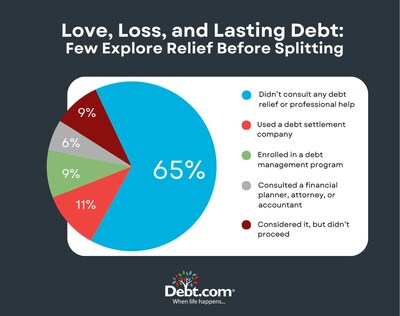
Despite the growing financial strain, nearly two-thirds of respondents admitted they never sought professional help before filing for divorce. That includes financial planners, nonprofit credit counseling agencies, or debt settlement companies.

Financial Infidelity Is Widespread

Financial secrecy also played a major role. More than one-third of respondents said they or their spouse hid credit card debt during their marriage. Gen Z again led the way, with over half admitting to hiding debt. And for the first time, the survey asked whether hiding credit card debt should be grounds for divorce—38% said yes.

“Credit card debt has quietly become one of the leading homewreckers in America,” Dvorkin added. “It’s not just the balances, it’s the secrecy, the stress, and the silence. Until couples treat debt like the life-changing issue it is, we’ll keep seeing love lost to late fees.”

The emotional toll of financial dishonesty is clear. Nearly 70% of respondents agreed that hiding credit card debt constitutes “financial infidelity.” Yet despite these strong feelings, most couples didn’t seek help. Only a small fraction enrolled in debt management programs or consulted financial professionals.

Divorce Takes A Toll

The aftermath of divorce often brought more financial hardship. Over half of respondents said they took on new debt after their split, with 26% taking on five-figure balances over $10,000. Many also saw their credit scores drop—some by more than 50 points.

Income changes were common as well. Nearly one-third said their household income decreased by more than 25% within a year of their divorce. Others saw increases, but the financial instability was widespread.

When asked whether they recovered faster emotionally or financially, 27% said they handled the financial aspect more quickly. Still, a 20% reported they’re still recovering—either emotionally or financially.

Debt.com’s survey paints a sobering picture: credit card debt isn’t just a financial issue—it’s a relationship killer. And while the numbers continue to rise, the lack of professional intervention suggests many couples are struggling in silence.

About Debt.com

Debt.com is a trusted source for consumers seeking help with credit card debt, student loans, tax debt, credit repair, and more. By connecting people with vetted financial professionals and educational tools, Debt.com empowers Americans to make smart money decisions and regain control of their finances.

Cision View original content to download multimedia:https://www.prnewswire.com/news-releases/debtcom-survey-reveals-credit-card-debt-driving-more-divorces-than-ever-302570240.html

SOURCE Debt.com

Total Round Reaches 17.8 Million USD to Accelerate R&D and Global Expansion

OKINAWA, Japan, Sept. 30, 2025 /PRNewswire/ — Japan-based deep tech startup EF Polymer K.K. (Founder & CEO: Narayan Lal Gurjar, “EF Polymer”), developer of 100% bio-based super absorbent polymers, today announced that it has completed the second close of its Series B financing round through a third-party allotment. In this second close, investors from diverse industries participated, bringing the total amount raised to 17.8 million USD  combined with the first close. This underscores the strong support for EF Polymer’s mission to scale sustainable solutions worldwide.

Business Progress

Sales Milestone:

  • EF Polymer has achieved cumulative global sales of 500 tons, upcycling more than 5,000 tons of agricultural residues into sustainable products. Demonstration projects are actively underway in drought-affected regions such as France, Spain, Italy, and Portugal.

Diversification Beyond Agriculture:

  • In addition to agricultural use, EF Polymer’s bio-based polymers are being applied in cosmetics, personal care, cooling packs (“Cy-Cool”), and absorbent sheets.

Certifications & Recognition:

  • EF Polymer’s India plant (Rajasthan) has obtained ISO 14001:2015, ISO 9001:2015, and ISO 45001:2018 certifications.
  • Organic certification “OMRI” obtained for the U.S. market.
  • CEO Narayan Lal Gurjar selected for Forbes Japan 30 Under 30.
  • Named a “THRIVE Rising Star” and listed in the 2025 Top 50 AgTech by THRIVE.

R&D Focus Areas

  • Diversification of raw materials beyond orange and banana peels
  • Establishing sustainable and circular production processes
  • Development of new agricultural products by combining EF Polymer with other solutions
  • Strengthening multi-site global production capabilities
  • Expanding applications beyond agriculture

Series B Round Investors
Through this financing, EF Polymer aims to further accelerate and deepen its research and development (R&D), while strengthening our global business development capabilities to drive the next stage of growth.

Participating Investors (in no particular order):
Impact Capital I Limited Partnership / AgVenture Lab / Amami Okinawa Investment Limited Partnership (Kagoshima Development Co., Ltd.) / EMA Enterprise Co., Ltd. / Hokuyo SDGs Promotion No. 3 Investment Limited Partnership (Hokkaido Kyoso Partners Co., Ltd.) / Japan Green Investment Corp. for Carbon Neutrality / Kyoritsu Holdings Corporation / Melissa Estate International Co., Ltd. / OLtV Opportunity Fund / Soken Chemical & Engineering Co., Ltd. / SVG Ventures Sunrise Agri Fund GP, LLC / Okinawa Development Finance Corporation / TOPPAN Holdings Inc. / Toyoda Gosei Co., Ltd.

Narayan Lal Gurjar, Founder & CEO of EF Polymer, commented:
“Our mission is to tackle water scarcity and environmental challenges while improving the livelihoods of farmers and communities. With the support of partners who share our vision, this Series B financing will further accelerate our efforts toward building a sustainable future.”

Business Synergies with Investors

EF Polymer will also collaborate with corporate investors to create business synergies:

  • SVG Ventures: Supporting global tomato production with Kagome through stable supply of processing tomatoes.
  • Soken Chemical: Co-developing absorbent sheets and launching applications in cosmetics and agriculture.
  • TOPPAN Holdings: Developing soil regeneration technologies and collaborating on next-generation manufacturing.

About EF Polymer
EF Polymer is a deep-tech startup born in India and nurtured in Japan. By upcycling agricultural residues such as orange and banana peels into 100% bio-based super absorbent polymers, EF Polymer provides sustainable solutions for agriculture and beyond. The company also promotes applications in cosmetics, personal care products, and ice-packs, helping industries achieve green transformation (GX). Through its technology, EF Polymer strives to solve global environmental challenges, particularly water scarcity.
https://efpolymer.com/

CONTACT:

Nakao: kyoji.nakao@efpolymer.com / +81(0)50-3628-8676
Maekawa: kai.maekawa@efpolymer.com / +81(0)70-2210-5880 

Cision View original content to download multimedia:https://www.prnewswire.com/news-releases/ef-polymer-completes-series-b-second-close-302570559.html

SOURCE EF Polymer K.K.

LanzaJet received a $13M award from the UK Department for Transport – the largest allocation this cycle – to support next phase of development for LanzaJet’s sustainable aviation fuel project in Teesside, United Kingdom

TEESSIDE, United Kingdom, Sept. 30, 2025 /PRNewswire/ — LanzaJet, Inc., a leading next-gen fuels technology company and producer of sustainable fuels, has been awarded more than $13 million (£10 million) from the UK Department for Transport’s Advanced Fuels Fund (AFF) to accelerate development of Project Speedbird, a major sustainable aviation fuel (SAF) biorefinery in Teesside, United Kingdom being developed primarily for LanzaJet investor and SAF customer British Airways. 

The award will support the next phase of work on Project Speedbird as it progresses into Front-End Engineering Design (FEED), marking a key milestone in the creation of one of the UK’s first commercial-scale ethanol-to-SAF production facilities using waste-based feedstocks. Among the projects selected in this round of the AFF, Speedbird received the largest award, underscoring LanzaJet’s advancement in the SAF industry, the maturity of the project, and the UK’s commitment to moving beyond pilots toward industrial deployment.

Project Speedbird is set to transform the aviation sector by producing SAF from low-carbon ethanol using LanzaJet’s patented and fully integrated Alcohol-to-Jet (ATJ) technology. The LanzaJet solution incorporates Technip Energies’ Hummingbird® ethanol-to-ethylene technology, which Project Speedbird has licensed, and which is deployed at commercial demonstration scale for the first time at LanzaJet’s Freedom Pines Fuels facility in Georgia, USA.

Once Project Speedbird is operational, the facility is expected to produce over 30 million gallons (approximately 90 kilotons) of sustainable fuels from low-carbon ethanol each year, significantly reducing lifecycle greenhouse gas emissions compared to traditional fossil jet fuel. 

“We’ve maintained a long-held belief that creating a new industry requires partnership across the public and private sectors. We’re proud to collaborate with the UK Department for Transport to advance Project Speedbird as a leading project catalyzing SAF development in the UK,” said Jimmy Samartzis, Chief Executive Officer at LanzaJet. “This support demonstrates confidence in LanzaJet as a leading SAF company, in our ATJ technology, and in the critical role of ethanol-to-SAF in delivering economic growth, creating jobs, and decarbonizing air travel. Project Speedbird is vital to building a national SAF industry in the UK and to unlocking opportunity and innovation in the region. We thank the UK Department for Transport for its leadership and vision in accelerating the transition to net-zero aviation.” 

The project aligns with the UK Government’s SAF mandate, which requires 10% of jet fuel used in the UK to come from sustainable sources by 2030.

Located in the heart of Teesside, the LanzaJet plant will also deliver significant regional benefits – creating hundreds of jobs, boosting the local economy, and contributing to the region’s position as a clean energy hub. By anchoring the project in Teesside, LanzaJet is helping to build out a broader ecosystem for sustainable fuels, one that connects local feedstock providers, renewable energy producers, and storage and distribution partners. In doing so, the project supports the UK’s broader net-zero strategy and the Government’s ambition for the country to become a global SAF leader. 

With this latest milestone, LanzaJet continues to lead the scale-up of sustainable fuels globally as it combines technological innovation, operating experience, and deep partnerships to decarbonize aviation at pace. 

About LanzaJet 
LanzaJet is a leading alternative fuels technology provider with patented ethanol-based alcohol-to-jet (ATJ) technology. LanzaJet is creating an opportunity for future generations by accelerating the production and deployment of Sustainable Aviation Fuel (SAF) and other alternative fuel technologies critical to transform the global economy. Last year, LanzaJet was named a TIME100 Most Influential Company, a Rising Star Company of the Year by S&P Global, one of MIT’s 15 Climate Tech Companies to Watch in 2024, and the Platts Global Energy Award winner for Rising Star Company of the Year 2024. Further information is available at https://www.lanzajet.com/.

Cision View original content to download multimedia:https://www.prnewswire.com/news-releases/lanzajets-project-speedbird-advances-in-the-uk-marking-a-significant-milestone-for-ethanol-to-jet-302569953.html

SOURCE LanzaJet, Inc.

DUBAI, UAE, Sept. 30, 2025 /PRNewswire/ — Vici Energy, an integrated energy company, today released its inaugural Sustainability Report 2025, outlining its sustainability framework and ESG commitments to decarbonize energy logistics and empower local communities.

The report highlights Vici Energy’s actionable targets, including reducing leased fleet emissions, a 15% expansion of certified biofuel trading by 2026, and STEM education programs for students in its operating regions. The company’s approach balances the urgent need for energy access in emerging economies with long-term sustainability imperatives.

Gordon Mackie, Director of Trading and Trade Finance at Vici Energy, commented: “This report demonstrates how we’re addressing global energy needs while creating tangible benefits in the communities where we operate. By integrating sustainability into every facet of our operations, from optimizing maritime logistics to investing in future talent, we are creating value for our stakeholders. Our approach is rooted in pragmatism: meeting today’s energy challenges while laying the groundwork for a lower-carbon future. Partnerships, innovation, and accountability will remain central to this mission.”

The report underscores Vici Energy’s 2024 commitment to the United Nations Global Compact (UNGC) and its alignment with key Sustainable Development Goals (SDGs).

Read the full report on the Vici Energy website:
https://shorturl.at/R3D98

About Vici Energy

Vici Energy is a privately owned, integrated energy company engaged in the exploration, development, trading, and delivery of energy products. With a focus on emerging markets, Vici Energy leverages local expertise to drive economic growth and create long-term value for partners and communities where it operates.

For more information, please visit https://www.vicienergy.com/

Photo – https://mma.prnewswire.com/media/2780914/Vici_Energy_Report.jpg

Cision View original content to download multimedia:https://www.prnewswire.com/news-releases/vici-energy-launches-inaugural-sustainability-report-committing-to-decarbonization-and-community-empowerment-302565851.html

SOURCE Vici Energy


Fashion Designer activists unite during the United Nations General Assembly to spotlight the need to scale up diverse fashion brands supporting the Sustainable Development Goals

NEW YORK, Sept. 29, 2025 /PRNewswire/ — Redress, the Asia-focused NGO accelerating circular fashion together with the United Nations Fashion and Lifestyle Network (UNFLN), which plays a central role in advancing sustainable development by connecting industry stakeholders, media, governments, and United Nations entities, co-organised a high impact delegation and panel discussion of pioneering fashion designer activists, representing India, the Philippines and USA, within the SDG Media Zone at the United Nations General Assembly. With the mainstream global fashion industry generally failing to adopt adequate sustainable and ethical responses to fashion’s polluting and harmful ways, as sustainability takes a backseat and industry executives prioritise other opportunities[1], the delegation called for support of established ethical and responsible fashion and lifestyle brands that already work to achieve multiple UN Sustainable Development Goals (SDGs) in often far-reaching, developing world supply chains.

Fashion activists on the designer-led industry panel discussion, Damini Mittai (India), Jann Christian Lim Bungcaras (Philippines) and Isabella Li Kostrzewa (USA), discussed their works that are focused on key global fashion themes, including intersectional environmental justice, cultural identity, social inequality, gender inequality, overconsumption and textile waste colonialism.

“Fashion must be more than just creativity and commerce,” said Dr. Christina Dean, Founder of Redress. “Fashion needs more of an ethical heart and soul to address our planetary challenges. There are countless inspiring brands globally making more than just clothes; they are making positive impacts at various Sustainable Development Goals. From consumers to investors, we must spotlight and empower these businesses to give them a rightful seat at the global fashion table.”

Building momentum together: The United Nations Fashion and Lifestyle Network welcomes Redress’ Alumni designers

This delegation and event collaboration signified Redress as a member of the United Nations Fashion and Lifestyle Network, the organisation that enables collaboration between industries and the United Nations system, accelerates innovation and knowledge sharing, and elevates the contributions of members driving positive impact worldwide that have significant global traction.

“As the United Nations Secretary-General reminded us on the International Day of Zero Waste, fashion must make good sense for both people and planet,” said Kerry Bannigan, Co-Founder of the United Nations Fashion and Lifestyle Network and President of the Board, PVBLIC Foundation. “Fashion significantly influences numerous aspects of society, from employment and gender equality to innovation and cultural expression. The choices we make in this sector today profoundly affect the world we live in tomorrow.”

Redress’ global network of ethical fashion designers, who are Alumni of the world’s largest sustainable fashion design competition, the Redress Design Award, were outreached and supported in joining the UNFLN. The goal was to bring more fashion advocates, particularly those from Asia, into the UNFLN’s global network and to encourage industry stakeholders to demonstrate solutions and scale their impact. Through convenings, education and advocacy, Redress and UNFLN will continue to highlight sustainable practices and empower businesses to lead change.

Spotlighting Asia – and bringing more Asian designers into the network – is critical 

Asia is pivotal in achieving fashion’s global sustainability efforts. Asia accounts for some 60% of global exports of garments and textiles[2], with approximately 60 million workers being employed in Asia’s garment manufacturing[3]. Asia is also hit hardest by climate change, with the region heating up faster than the global average[4]. Asia-focused Redress’ Alumni designers primarily come from Asia.

Damini Mittai, Founder and Designer, Koaka Collective, India, said “My work with marginalised female rural communities in India aims to foster sustainable livelihoods through skills-building and collective action, working against gender equality and the injustice of climate change.”

Jann Christian Lim Bungcaras, Founder, Creative Director and Designer, Jann Bungcaras Fashion House, Philippines, said “The Philippines is awash with a modern textile waste colonialisation, from post consumer to industry waste, and as a developing country, we should not be seen as a dumping ground for waste.”

Isabella Li Kostrzewa, Artist, Isboko, USA, saidHere in my own country of USA, we have a gluttony of fashion overconsumption and we urgently need to inspire fashion consumers toward healthier fashion choices.”

Redress Alumni designers who have joined the UNFLN are: Damini Mittai (India), Jann Bungcaras (Philippines), Isabella Li Kostrzewa (USA), Aashita Jain (India), Ruyin Tian (China), Aarushi Kilawat (India), Ruwanthi Gajadeera (Sri Lanka); and from around the world Lívia Aguiar de Castro (Brazil), Louise Boase (Australia), Rachel Clowes (UK), Rose Brown (UK), Magdalena Malbran (Argentina), and Silvia Acién Parrilla (Spain).

Together, they represent a growing movement of ethical and responsible businesses showing that sustainable fashion can scale beyond individual projects into systemic industry transformation.


[1] McKinsey & Company & Business of Fashion, The State of Fashion 2025


[2] World Trade Organisation, World Trade Statistical Review 2023


[3] Labour Force Surveys, 2022


[4] According to the United Nations and the World Meteorological Organization (WMO), Asia is hit hardest by climate change, with the region heating up faster than the global average.

Media Assets 

High-resolution images are available here.
Link to the three designers’ bios here.

About Redress:

Redress (www.redress.com.hk) is a Hong Kong-based, Asia-focused environmental NGO with a mission to accelerate the change to a circular fashion industry by educating and empowering designers and consumers so as to reduce clothing’s negative environmental impacts.

One of their programmes, The Redress Design Award (www.redressdesignaward.com) is the world’s leading sustainable fashion design competition that educates and empowers emerging fashion designers about circular design techniques to reduce fashion’s negative environmental impacts. Organised by Redress since 2011, the competition partners with academic institutions globally and attracts designer applicants from over 50 countries and regions to win prizes that connect them with global-leading fashion businesses to accelerate the change to a circular fashion industry. Through this, the Redress Alumni Network unites 330+ rising and established fashion voices from across the world, spanning brand founders to visionary educators. 

About the UN Fashion and Lifestyle Network

The United Nations Fashion and Lifestyle Network (unfashionlifestyle.org), an online platform hosted by the United Nations (UN), plays a key role in advancing sustainable development  by connecting industry stakeholders, media, governments, and UN entities. The Network enables collaboration between industries and the UN system, accelerates innovation and knowledge sharing, and elevates the contributions of members driving positive impact worldwide. The United Nations Fashion and Lifestyle Network is a collaborative initiative of the United Nations Office for Partnerships, the Fashion Impact Fund, and the United Nations Department of Economic and Social Affairs. The United Nations Industrial Development Organization (UNIDO) is a supporting partner of the Network.

Special thanks to leading global garment manufacturer TAL Apparel who generously supported the Redress Alumni delegation’s trip to New York. Founded in 1947, TAL has established itself as a leading global garment manufacturer with a strong commitment to innovation, sustainability, and customer satisfaction. A trusted partner for fashion brands worldwide, TAL is proudly leading the transition to a sustainable future.


Cision View original content to download multimedia:https://www.prnewswire.com/news-releases/redress-x-united-nations-fashion-and-lifestyle-network-global-call-for-fashion-to-deliver-on-the-sdgs-302570287.html

SOURCE Redress

  • The U.S. softwood lumber industry is a critical manufacturing industry essential to the national economic strength and the industrial resilience of the United States
  • Canada’s unfair trade in softwood lumber continues to be extremely harmful to U.S. producers and workers
  • Section 232 tariffs on softwood lumber product imports from around the world will facilitate a reliable supply of softwood lumber products made in the USA

WASHINGTON, Sept. 29, 2025 /PRNewswire/ — The U.S. Lumber Coalition today welcomes the imposition of Section 232 tariffs on imports of softwood lumber products into the United States, and applauds President Trump for taking this necessary additional trade law enforcement action.

The harmful trade practices of Canadian softwood lumber producers, combined with ongoing unfair subsidies provided by the Canadian Government, have been thoroughly documented in the antidumping and countervailing duty proceedings on softwood lumber imports from Canada. Those trade cases offset unfair trade at the border, but have not fully addressed Canada’s massive excess capacity, which is currently the root cause of Canada’s unfair trading. The U.S. Lumber Coalition is hopeful that President Trump’s Section 232 tariffs will help right size the Canadian softwood lumber industry and allow the U.S. industry to grow to its natural size to fully supply the U.S. housing market with lumber made in the USA. 

“The U.S. Lumber Coalition greatly appreciates President Trump’s and the Commerce Department’s commitment to the U.S. wood products industry and welcomes Section 232 tariffs on imports of softwood lumber products into the United States,” stated Andrew Miller, Chairman and Owner of Stimson Lumber Co.

“We fully agree with President Trump that the wood products industry, and specifically the U.S. softwood lumber industry, is a critical manufacturing industry essential to the national economic strength, and the industrial resilience of the United States,” added Miller. “The time has come for the domestic industry to be able to operate on a level playing field and not be suppressed by predatory imports.” 

“Canada’s excess capacity since 2016 has increased from 2.8 to almost 8 billion board feet – that excess capacity is now the primary driver of Canada’s dumping behavior that is forcing U.S. softwood lumber producers to operate at unhealthy and unsustainably low capacity utilization rates,” said Zoltan van Heyningen, Executive Director of the U.S. Lumber Coalition, adding that “it is outrageous that the National Association of Homebuilders continues to advocate for the importation of unfairly traded Canadian lumber imports that is harming U.S. workers, U.S. companies, and their communities.”

“The United States is the main outlet for Canada’s excess capacity and Canada continues to engage in aggressive dumping practices. This behavior is extremely harmful to U.S. producers and workers,” added van Heyningen. 

There is also evidence that, while imports of softwood lumber products from Canada have declined following the imposition of the antidumping and countervailing duties, the volume of imports from Europe and other sources has increased over the last several years. The U.S. Lumber Coalition has documented numerous subsidy programs provided by foreign governments, such as in Germany and Sweden, that contribute to the disruptive nature of those softwood lumber imports. 

“The Section 232 tariffs on softwood lumber products imported into the United States from around the world will facilitate the development of the domestic softwood lumber industry, which will strengthen our domestic supply of softwood lumber products,” concluded van Heyningen.

U.S. lumber community voices on President Trump’s trade law enforcement and the positive impacts on U.S. manufacturing: https://vimeo.com/1086817309?fl=pl&fe=ti

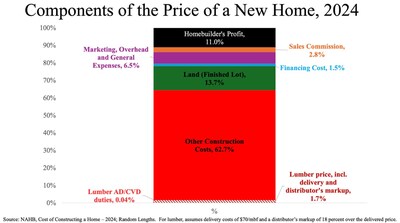
Enforcing the U.S. trade laws helps increase the U.S. supply of lumber to build American homes, all without impacting the cost of a new home, as demonstrated by data from the National Association of Home Builders (NAHB) and Fastmarkets Random Lengths.

About the U.S. Lumber Coalition

The U.S. Lumber Coalition is an alliance of large and small softwood lumber producers from around the country, joined by their employees and woodland owners, working to address Canada’s unfair lumber trade practices. Our goal is to serve as the voice of the American lumber community and effectively address Canada’s unfair softwood lumber trade practices. The Coalition supports the full enforcement of the U.S. trade laws to allow the U.S. industry to invest and grow to its natural size without being impaired by unfairly traded imports. Continued full enforcement of the U.S. trade laws will strengthen domestic supply lines by maximizing long-term domestic production and lumber availability produced by U.S. workers to build U.S. homes. For more information, please visit the Coalition’s website at www.uslumbercoalition.org.

CONTACT: Zoltan van Heyningen
zoltan@uslumbercoalition.org | 202-805-9133

Cision View original content to download multimedia:https://www.prnewswire.com/news-releases/us-lumber-coalition-applauds-president-trumps-targeted-tariffs-on-imports-of-softwood-lumber-products-into-the-united-states-302570246.html

SOURCE The U.S. Lumber Coalition

IRMO, S.C., Sept. 29, 2025 /PRNewswire/ — ProLift Garage Doors of Lake Murray is proud to announce its continued support of Centerville Elementary School as a Platinum Sponsor for the 2025–2026 school year. This partnership provides critical resources that help ensure every student and family can participate in school activities, regardless of financial barriers.

Through this sponsorship, ProLift Garage Doors helps Centerville Elementary:

  • Provide free entry to most school events for students and their families, including the annual Fall Festival, Fun Run, and Field Day.
  • Cover essential overhead costs so programs can be accessible to all.
  • Distribute free t-shirts to every student and staff member, creating a strong sense of unity and belonging within the school community.

“Supporting Centerville Elementary is about much more than a logo on a banner—it’s about helping every child feel included and supported,” said Kyle Crisci, owner of ProLift Garage Doors of Lake Murray. “We’re proud to play a role in making these programs possible and giving students and families opportunities to come together as a community.”

This marks another milestone in ProLift’s long-standing tradition of investing in local education. In addition to Centerville Elementary, the company has proudly sponsored River Springs Elementary at the Platinum level for the past four years.

Centerville Elementary is a Title I school, receiving federal funding to support students who are economically disadvantaged and may be at risk of academic challenges. Community sponsorships like ProLift’s provide additional resources that directly impact students’ experiences and success.

“We believe no child should miss out on school events or feel left out because of financial barriers. Providing this kind of support ensures every student has the chance to participate, connect, and thrive—and that’s something we’re deeply proud to invest in.”

About ProLift Garage Doors of Lake Murray

ProLift Garage Doors of Lake Murray is a locally owned business providing expert residential garage door repair, installation, and maintenance services. Committed to both customer satisfaction and community engagement, ProLift is proud to support local schools, youth programs, and initiatives that strengthen the communities around Lake Murray.

Media Contact:

For press and interview inquiries, please reach out to nathan@proliftdoors.com.


Cision View original content to download multimedia:https://www.prnewswire.com/news-releases/prolift-garage-doors-of-lake-murray-strengthens-commitment-to-local-education-with-platinum-sponsorship-of-centerville-elementary-302568036.html

SOURCE ProLift Garage Doors

MEXICO CITY, Sept. 29, 2025 /PRNewswire/ — FIBRA Prologis (BMV: FIBRAPL 14), a leading owner and operator of Class-A logistics real estate in Mexico, will host a webcast and conference call with senior management to discuss third quarter results, current market conditions and future outlook on Wednesday, October 29, at 9:00 a.m. Mexico Time.

To access a live broadcast of the call, dial +1 888 596 4144 (toll-free from the United States and Canada), 800 269 4416 (toll-free from Mexico) or +1 646 968 2525 from all other countries or and enter conference code 4603995. A live webcast can be accessed at www.fibraprologis.com in the Investor Relations section October 29.

A telephonic replay will be available October 29 – November 5 at +1 800 770 2030 from the U.S. and Canada or at +1 647 362 9199 from all other countries using conference code 4603995. The replay will be posted in the Investor Relations section of the FIBRA Prologis website.

ABOUT FIBRA PROLOGIS

FIBRA Prologis is a leading owner and operator of Class-A industrial real estate in Mexico. As of June 30, 2025, the company’s portfolio comprised 507 Investment Properties, totaling 87.0 million square feet (8.1 million square meters). This includes 345 logistics and manufacturing facilities across 6 industrial core markets in Mexico, comprising 65.5 million square feet (6.1 million square meters) of Gross Leasing Area (GLA) and 162 buildings with 21.5 million square feet (1.9 million square meters) of non-strategic assets in other markets.

FORWARD-LOOKING STATEMENTS

The statements in this release that are not historical facts are forward-looking statements. These forward-looking statements are based on current expectations, estimates and projections about the industry and markets in which FIBRA Prologis operates, management’s beliefs and assumptions made by management.  Such statements involve uncertainties that could significantly impact FIBRA Prologis financial results. Words such as “expects,” “anticipates,” “intends,” “plans,” “believes,” “seeks,” “estimates,” variations of such words and similar expressions are intended to identify such forward-looking statements, which generally are not historical in nature.  All statements that address operating performance, events or developments that we expect or anticipate will occur in the future — including statements relating to rent and occupancy growth, acquisition activity, development activity, disposition activity, general conditions in the geographic areas where we operate, our debt and financial position, are forward-looking statements. These statements are not guarantees of future performance and involve certain risks, uncertainties and assumptions that are difficult to predict. Although we believe the expectations reflected in any forward-looking statements are based on reasonable assumptions, we can give no assurance that our expectations will be attained and therefore, actual outcomes and results may differ materially from what is expressed or forecasted in such forward-looking statements. Some of the factors that may affect outcomes and results include, but are not limited to: (i) national, international, regional and local economic climates, (ii) changes in financial markets, interest rates and foreign currency exchange rates, (iii) increased or unanticipated competition for our properties, (iv) risks associated with acquisitions, dispositions and development of properties, (v) maintenance of real estate investment trust (“FIBRA”) status and tax structuring, (vi) availability of financing and capital, the levels of debt that we maintain and our credit ratings, (vii) risks related to our investments (viii) environmental uncertainties, including risks of natural disasters, (ix) risks related to the coronavirus pandemic, and (x) those additional factors discussed in reports filed with the “Comisión Nacional Bancaria y de Valores” and  the Mexican Stock Exchange by FIBRA Prologis under the heading “Risk Factors.” FIBRA Prologis undertakes no duty to update any forward-looking statements appearing in this release.

Non-Solicitation – Any securities discussed herein or in the accompanying presentations, if any, have not been registered under the Securities Act of 1933 or the securities laws of any state and may not be offered or sold in the United States absent registration or an applicable exemption from the registration requirements under the Securities Act and any applicable state securities laws. Any such announcement does not constitute an offer to sell or the solicitation of an offer to buy the securities discussed herein or in the presentations, if and as applicable.

Cision View original content to download multimedia:https://www.prnewswire.com/news-releases/fibra-prologis-to-host-third-quarter-2025-earnings-conference-call-october-29-302570129.html

SOURCE FIBRA Prologis

International Maritime Organization’s Net-Zero Framework May Offer Long-Term Solution for U.S. Farmers Through Biofuel Demand

ST. LOUIS, Sept. 29, 2025 /PRNewswire/ — Rural America is under mounting financial pressure as commodity prices for corn and soybeans have fallen 40-50% from recent highs, while production costs remain elevated. A recent National Corn Growers Association survey shows that nearly half of U.S. farmers believe the nation is on the brink of a farm crisis.1 For many, 2025 marks the third consecutive year of negative profitability, threatening both food security and the stability of local economies.

Industry leaders stress that short-term fixes will not be enough. Instead, new and durable demand markets are required to restore profitability for America’s farmers. A potential breakthrough may come this October, when the International Maritime Organization (IMO) is expected to finalize its Net-Zero Framework, requiring large ocean-going vessels to cut greenhouse gas (GHG) emissions beginning in 2027.2

This policy will accelerate demand for biofuels; renewable fuels made from plant material, animal waste, and agricultural residues.3 By 2030, biofuel demand for maritime use could grow by up to 25 million metric tons; one-third of global demand.4

“Biofuels represent more than just cleaner energy. They represent a lifeline for U.S. farmers,” said Ben Kruger, senior vice president, Roeslein Renewables. “By leveraging our agricultural waste and renewable resources, we can stabilize rural communities while helping the shipping industry decarbonize.”

Among the most promising fuels are:

  • BioLNG: Produced from manure, crop residues, and food waste, BioLNG is compatible with existing LNG infrastructure and can even achieve negative lifecycle emissions. With over 1 billion tons of agricultural waste generated annually, the U.S. is uniquely positioned to lead in BioLNG production.5

  • Biodiesel: Derived from animal fats, oilseeds, and used cooking oil, biodiesel offers a near drop-in replacement for marine diesel with minimal retrofitting. Increased demand could equal up to twice the size of Iowa’s annual soybean crop, generating new markets for farmers across multiple feedstocks.

Together, BioLNG and biodiesel could help U.S. agriculture supply flexible, scalable, and sustainable fuel solutions for maritime shipping. Projections show these markets could generate $100-200 billion in new farm revenues by 2050, reducing dependence on ad hoc government assistance and strengthening rural economies.

To seize this opportunity, U.S. leadership will be critical. Key actions include:

  • Coordinating USDA, DOE, EPA, and Treasury programs to support renewable maritime fuels.
  • Fast-tracking renewable fuel production and blending infrastructure.
  • Streamlining permitting and credit verification for small and mid-sized farms.
  • Establishing maritime fuel corridors linking inland feedstock to coastal ports.

“The IMO will reward early movers,” Bryan Sievers, director of government relations, Roeslein Renewables, emphasized. “The U.S. must act now to ensure farmers are not left behind. As the world’s ships sail toward net-zero, it’s time for American agriculture to chart its own course; powered by innovation, infrastructure, and resources we can no longer afford to waste.”

To learn more about Roeslein Renewables, please visit https://roeslein.com/renewables/.

About Roeslein Renewables

Roeslein Renewables (RR) is a leader in alternative energy and conservation solutions, dedicated to transforming waste into valuable resources while fostering sustainable development in rural and agricultural communities. At Roeslein, we believe our innovative capabilities can generate the kind of renewable natural gas that diminishes greenhouse gases, generates renewable fuels, and creates a more balanced and beneficial future for all life on earth. Combining our team of curious, confident experts with cutting-edge energy technology, our renewable energy products and initiatives can help revitalize economic growth, regenerate agriculture, restore nature, and return hope to the next generation.

Contact:
Adam Voight
Manager, Global Marketing
AVoight@Roeslein.com

1 Once-in-a-generation economic crisis in rural America means many farmers could face last year | Fortune. (September 20, 2025).
2 The IMO Net-Zero Framework – FAQs. (2025).
3 Biofuel Basics | Department of Energy. (2025).
4 Maritime Forecast to 2050 by DNV (2025).
5 Food loss and waste account for 8-10% of annual global greenhouse gas emissions; cost USD 1 trillion annually | UNFCCC. (2024).

Cision View original content to download multimedia:https://www.prnewswire.com/news-releases/rural-america-faces-mounting-farm-crisis–roeslein-renewables-says-global-maritime-shift-could-unlock-200-billion-in-new-agricultural-revenues-302570078.html

SOURCE Roeslein Renewables

Privacy Overview

This website uses cookies so that we can provide you with the best user experience possible. Cookie information is stored in your browser and performs functions such as recognising you when you return to our website and helping our team to understand which sections of the website you find most interesting and useful.