
Author: sHq_LoGiNz
CHARLOTTE, N.C., July 16, 2026 /3BL/ – National nonprofit CodePath today announced a $2 million philanthropic investment from Wells Fargo and the Wells Fargo Foundation to accelerate the number of local college students who are prepared to participate in Charlotte’s growing technology economy.
“We believe Charlotte can be a national example of how to prepare students for the future of work,” said Michael Ellison, Co-Founder and CEO of CodePath, which delivers industry-aligned programs at more than 700 U.S. colleges across the country. “Together with Wells Fargo, this philanthropic investment will unlock pathways to economic mobility for students and their families while strengthening the region’s tech ecosystem.”
In the span of just five years, Charlotte’s tech sector has grown nearly twenty percent – far outpacing national averages. Some of the largest tech companies including Apple, Microsoft and IBM, in the U.S. have opened hubs in the city.
“Preparing the next generation for the future of work is essential to helping our communities and our economy grow,” said Bonnie Wallace, Head of Financial Health Philanthropy at Wells Fargo. “Through our support of CodePath and local universities, we are expanding access to high-quality training and career pathways so more students can build in-demand skills and participate in Charlotte’s rapidly growing technology economy.”
Designed to meet the growing need for tech talent in the region, the new collaboration will embed CodePath’s courses, career services, and interview preparation in the computing programs at University of North Carolina at Charlotte (UNC Charlotte) and HBCU Johnson C. Smith University (JCSU). Participating students will build in-demand technical skills including AI, software engineering, cybersecurity, and mobile development to propel them into employment opportunities in the city’s fastest-growing industries. In addition, the program will build direct hiring pipelines with top Charlotte employers. The courses will serve an initial cohort of 300 students, with the aim of serving up to 2,000 students each year by 2028.
“Integrating CodePath’s industry-aligned courses directly into our curriculum will give JCSU computing students the technical foundation, hands on professional skills, and employer connections needed to launch successful tech careers in the AI era,” said Patrick M. Martin, Ph.D., Provost, Chief Academic and Research Officer at Johnson C. Smith University. “This partnership strengthens our commitment to economic mobility and positions JCSU as a leader in developing AI-ready talent for Charlotte’s, North Carolina’s and the nation’s innovation economy.”
“This philanthropic support ensures that all UNC Charlotte students have access to CodePath’s exceptional classes and services, allowing our College to continue offering technical interview prep and iOS development courses as part of our degree programs,” said Bojan Cukic, professor and dean of UNC Charlotte’s College of Computing and Informatics. “This direct investment in our computer science, data science and AI curricula and career readiness services will bring the opportunity to our students to master industry-aligned skills needed to compete and succeed in the rapidly evolving technology workforce.”
###
About CodePath
CodePath is a nonprofit dedicated to reprogramming higher education to create the first AI-native generation of engineers, CTOs, and founders. It delivers industry-vetted courses and career support centered on the needs of first-generation and low-income students. Students train with senior engineers, intern at top companies, and rise together to become the tech leaders of tomorrow. CodePath serves over 30,000 students at more than 700 colleges and universities across the country. Visit www.codepath.org for more.
Companies operating across global value chains face an increasingly complex regulatory landscape. Cascale’s new Global Legislative Overview Map provides an interactive, region-by-region view of 21 key human rights and environmental due diligence and sustainability reporting frameworks across Europe, the Americas, and Asia-Pacific.
Developed as a companion to the 2026 Global Due Diligence and Sustainability Reporting Legislation Report, the map helps users understand where major regulatory developments are taking shape and how expectations differ across markets.
Key Takeaways
- Explore 21 key due diligence and sustainability reporting frameworks in an interactive global map.
- View developments across Europe, the Americas, and Asia-Pacific.
- Use the map to understand where regulatory activity is taking place and how requirements vary by jurisdiction.
- Access the accompanying report for detailed legislative analysis and the Higg Index overlap assessment.
- The map will be updated periodically as relevant legislation evolves.
What Does the Global Legislative Overview Map Cover?
The map visualizes legislation related to corporate sustainability reporting and human rights and environmental due diligence. Users can explore the frameworks by region and review high-level information about their scope, requirements, and status.
It is intended to provide an accessible starting point for companies monitoring regulatory developments across multiple markets. The map can also support internal discussions among sustainability, legal, compliance, sourcing, public affairs, and leadership teams.
How Does the Map Relate to the Report?
The initial version of the map is based on the legislative analysis included in Cascale’s 2026 Global Due Diligence and Sustainability Reporting Legislation Report, published earlier this year. The report provides more detailed information on each legislative framework, including:
- Scope and applicability
- Key requirements for companies
- Implementation status and timelines
- Relevance to Cascale’s strategic pillars and workstreams
- Where the Higg Index frameworks may support readiness efforts related to data, governance, and performance measurement
How Does Cascale Support Members Navigating Policy Change?
The Global Legislative Overview Map is publicly available as part of Cascale’s commitment to strengthening industry understanding of sustainability policy.
Corporate and Affiliate Members receive access to additional policy insights and engagement opportunities designed to help them navigate regulatory developments, including:
- Member-exclusive policy webinars and briefings
- Email newsletters and legislative updates
- Regional reports and policy deep dives
- Discussions, resources, and expert insights through the Policy & Public Affairs Knowledge Hub on Cascale Connect
- Opportunities to contribute industry perspectives to Cascale’s public affairs and advocacy work
Through these resources, Cascale helps members interpret policy developments, make more informed business decisions, and engage with peers navigating similar challenges.
In a feed full of competing headlines, the featured image is often what decides whether your story gets a second look at all. Readers scroll fast, and a strong image is what stops the scroll — before a single word of your headline even registers.
It’s the first impression, and it happens in a fraction of a second
Social feeds, search results, and content aggregators are crowded places. A compelling featured image cuts through that noise instantly, giving your story a fighting chance to be noticed before a reader moves on to the next thing.
It sets the tone before anyone reads a word
The image a reader sees first shapes how they interpret everything that follows. A sharp, well-chosen featured image signals credibility and professionalism; a mismatched or low-quality one can undercut a story before it’s been given a chance. In that sense, the featured image isn’t decoration — it’s part of how your brand introduces itself.
It directly influences whether people click
Featured images are consistently one of the biggest levers on click-through rate. The right image doesn’t just look good — it gives a reader a reason to click, previewing what the story is about and why it’s worth their time.
That’s what makes getting this right worth the attention: a story’s featured image isn’t a finishing touch, it’s often the deciding factor in whether the story gets read at all.
WASHINGTON, July 16, 2026 /3BL/ – The International WELL Building Institute (IWBI), the Brown University Pandemic Center and Air Club released today Advancing Healthy Indoor Air: Five Leading Policy Models from Around the World, a new report highlighting a rapidly expanding wave of indoor air quality (IAQ) policy innovation across the globe. Drawing lessons from nearly 160 policies spanning 40 countries, the report identifies five leading policy models that governments are using to improve indoor air quality and offers practical guidance for policymakers seeking to strengthen public health, resilience and economic performance.
“We’re entering a new era of indoor air quality policy,” said Skandan Ananthasekar, lead author and Visiting Fellow at Brown University Pandemic Center. “We are seeing governments around the world increasingly focus on how to accelerate improvements in indoor air quality, exploring new policy approaches that can deliver better health outcomes. This report represents an important step forward in understanding the policy landscape and identifying leading models, while also providing a roadmap for policymakers looking to advance policies in their countries.”
The report synthesizes findings from a comparative analysis of a global indoor air policy database, which includes 158 adopted IAQ policies across 40 countries, including more than 50 that were enacted or amended within the past five years. The report highlights five leading policy models pioneered by eight governments, demonstrating how they are adapting IAQ policy to fit their own institutional structures, political environments and public health priorities while making a significant contribution to a growing body of international policy best practice.
“Policy is a critical driver in any movement,” said Jason Hartke, Executive Vice President of Global Advocacy, IWBI. “Around the world, policymakers are embracing indoor air quality as a public health imperative, adopting innovative policy approaches precisely because they recognize their potential to drive healthier buildings, healthier people and stronger economies. This report is all about highlighting what’s working and how we can accelerate progress through sound public policies.”
Drawing from the full database, the report identifies five leading policies models that governments have pioneered to advance healthy indoor air:
- High-Priority Sectors – focuses on investments in schools, healthcare facilities, childcare and other priority settings. Exemplar: City of Boston, United Kingdom
- Transparency – expanding opportunities for IAQ monitoring, public disclosure and other programs to make indoor air more visible. Exemplar: Belgium
- Integrating Health into Building Performance – Integrating health and indoor air quality within new or existing building performance policies. Exemplar: European Union, United Arab Emirates
- National Coordination – Establishing coordinated national strategies that align relevant government agencies and programs. Exemplar: Finland
- Dedicated Indoor Air Quality Law with Enforcement – Adopting IAQ requirements supported by monitoring and enforcement mechanisms. Exemplar: South Korea, Taiwan
“The global momentum for healthy indoor air has never been stronger,” said Georgia Lagoudas, Co-Founder of Air Club and Senior Fellow at the Brown University Pandemic Center. “Today, a multitude of countries are driving policy innovation that is helping make healthy indoor air both achievable and scalable. We hope this report will empower policymakers from around the world to learn from these models and inspire action in their own jurisdictions.”
The report builds on the growing international movement to elevate indoor air quality as a public health priority and a fundamental human right. Through the Global Commission on Healthy Indoor Air and the Global Pledge for Healthy Indoor Air, IWBI, Brown Pandemic Center and Air Club are working to bring governments and organizations together around a shared vision of healthier indoor environments. This report serves as another important contribution to that collective effort, and to the shared belief that everyone, everywhere deserves access to healthy indoor air.
About the International WELL Building Institute
The International WELL Building Institute (IWBI) is a public benefit corporation and the global authority for transforming health and well-being in buildings, organizations and communities. In pursuit of its public-health mission, IWBI mobilizes its community through the development and administration of the WELL Building Standard (WELL), WELL for residential, WELL Community Standard, its WELL ratings and management of the WELL AP credential. IWBI also translates research into practice, develops educational resources and advocates for policies that promote people-first places for everyone, everywhere. More information on WELL can be found here. Media contact: media@wellcertified.com
International WELL Building Institute, IWBI, the WELL Building Standard, WELL v2, WELL Certified, WELL AP, WELL EP, WELL Score, The WELL Conference, We Are WELL, the WELL Community Standard, WELL Health-Safety Rated, WELL Performance Rated, WELL Equity Rated, WELL Equity, WELL Coworking Rated, WELL Residence, Works with WELL, WELL and others, and their related logos are trademarks or certification marks of International WELL Building Institute pbc in the United States and other countries.
About the Brown University Pandemic Center
The Pandemic Center at Brown University’s School of Public Health works to prevent, reduce vulnerabilities, and increase resilience to pandemics, other biological emergencies, and the harms they pose to health, peace, security, and prosperity.
About Air Club
Air Club is a global coalition of indoor air quality champions working to make indoor air healthy. Air Club launched the Global Pledge for Healthy Indoor Air, which calls on governments and organizations to prioritize this crucial issue.
View original content here.
Originally published on STEM Next
Before they got involved in STEM Next’s Opportunity AI pilot project in the fall, educators said they weren’t sure where to start with using AI in their programs, much less teaching kids how to use it responsibly. Now, they’re testing activities with students, exploring how to integrate career-connected AI learning in their programs, and sharing what works with other educators across their states.
This is an early look at what it takes to scale human-centered AI learning through afterschool.
With leadership support from partners including Qualcomm and Arconic Foundation, STEM Next launched the Opportunity AI pilot project in fall 2025 with afterschool network leaders and educators in Montana, Ohio, Pennsylvania and West Virginia with a goal to make AI learning practical, accessible, and scalable through afterschool and summer programs.
Click here to read more on STEM Next
Welcome to the BIER Workstream Feature Series, a new content series that provides members, partners, and industry stakeholders with a closer look at the collaborative initiatives, technical expertise, and practical resources that advance environmental sustainability across the beverage sector.
Each feature will highlight one of BIER’s active workstreams, exploring the challenges being addressed, the value being delivered to members, and the role collective action plays in supporting industry-wide progress. Through these conversations, readers will gain greater visibility into the work happening behind the scenes and the collaborative efforts that help transform shared challenges into practical solutions.
This month, we are highlighting BIER’s Water, Energy, and Emissions Benchmarking Study, one of the coalition’s longest-running initiatives. For nearly two decades, benchmarking has helped participating companies better understand operational performance, identify opportunities for improvement, and gain insight into environmental sustainability trends across the beverage sector. The study provides BIER members with normalized data and analysis that can support performance evaluation, goal setting, and continuous improvement efforts.
To learn more, we spoke with Eileen Lo, Senior Manager and BIER’s Benchmarking Workstream Lead.
What is the purpose of this workstream?
The Benchmarking Study provides participating members with a better understanding of environmental performance across the beverage sector by collecting and analyzing facility-level data related to water use, energy consumption, and Scope 1 and Scope 2 greenhouse gas emissions.
The study allows participating companies to benchmark their performance against aggregated industry data[1] and gain insights into operational trends, efficiency opportunities, and sustainability performance across different beverage facility types.
What key issue is it addressing?
The beverage industry continues to face rising expectations for improved resource efficiency, climate action, environmental reporting, and operational performance.
The Benchmarking Study helps address a fundamental challenge facing many organizations: understanding how performance compares across the broader industry and identifying opportunities for improvement using credible, comparable data.
By providing meaningful benchmarking data, the study supports informed decision-making and helps companies better understand environmental performance trends across water, energy, and emissions metrics.
Why does this work matter to members and the industry?
As shared by our members, one of the most valuable aspects of the Benchmarking Study is that it enables them to understand how their facilities compare to overall industry performance.
The reports help members benchmark themselves against industry averages, evaluate progress toward sustainability goals, and identify opportunities for improvement.
The study also provides historical trend data, allowing participants to compare current performance against previous reporting periods. This helps companies better understand whether implemented programs are driving measurable sustainability improvements and identify efficiency factors that may influence performance over time.
Beyond individual companies, the study contributes to sustainability evaluation for the broader industry by providing aggregated insights that support shared learning and continuous improvement across the beverage sector.
How has the workstream evolved over time?
Originally, the Benchmarking Study focused primarily on water performance.
As climate-related discussions and expectations increased, members expressed interest in expanding the study to include energy and greenhouse gas emissions metrics. As a result, the benchmark evolved into the Water, Energy, and Emissions Benchmarking Study.
The study has also expanded its analytical capabilities. In addition to examining performance across facility types such as breweries, wineries, distilleries, and bottling facilities, BIER has conducted best-in-class analyses to better understand the technologies, tactics, and operational practices associated with top-performing facilities.
Members are increasingly interested not only in performance data but also in understanding the operational strategies and best practices that support improved efficiency and sustainability outcomes.
What is a current focus area or challenge?
The Benchmarking Team continues to improve the Benchmarking Study, working with participants to enhance data quality and evaluate opportunities to incorporate additional metrics that are meaningful to BIER members. Additionally, the Benchmarking Team strives to encourage submission of supplemental data specific to each facility type, which will help to identify process and product-related efficiency drivers for sustainability performance.
Overall, the Team is focused on continuously improving the report, building on the Study’s foundation to provide deeper insights and greater value for the beverage sector.
What is one insight or takeaway people may not realize?
The highly collaborative nature of the benchmarking process cannot be overstated. The study extends beyond participating companies and includes collaboration with industry associations and other stakeholders, helping create a broader platform for knowledge sharing and collective progress.
“The realization that so many large companies, that are competitors, can collaborate on these sustainability initiatives, is encouraging and impressive,” shares Eileen, the Benchmarking Workstream Lead.
Through working on this study, long-standing members often help newer participants understand BIER’s history and purpose, reinforcing the idea that the work is designed to benefit the broader beverage sector rather than any single organization.
How does this work support BIER’s broader mission and 2030 direction?
The Benchmarking Study reflects BIER’s longstanding commitment to advancing environmental sustainability through collaboration, scientific rigor, and practical implementation.
By providing members with credible, comparable performance data and facilitating shared learning across companies, the workstream supports BIER’s mission of helping beverage companies address shared environmental challenges collectively.
The study also aligns with the goals by strengthening collective action, supporting industry-wide learning, and providing practical tools and resources that help members make informed decisions on water stewardship, climate action, and operational performance.
Looking Ahead
As environmental sustainability expectations continue to evolve, access to credible data, practical insights, and collaborative learning opportunities remains increasingly important.
The Water, Energy, and Emissions Benchmarking Study demonstrates how BIER members work together to transform shared data into industry insight, helping support informed decision-making and measurable progress across the beverage sector.
Stay tuned for future editions of the BIER Workstream Feature Series as we continue exploring the people, projects, and collaborative initiatives advancing environmental sustainability across the beverage industry.
[1] Industry data referred in this article represents data contributed by participants of the BIER Benchmarking Study, which is not representative of the entire global beverage industry.
 The Beverage Industry Environmental Roundtable (BIER) is a technical coalition of leading global beverage companies working together to advance environmental sustainability within the beverage sector.
BIER is facilitated by Antea Group.
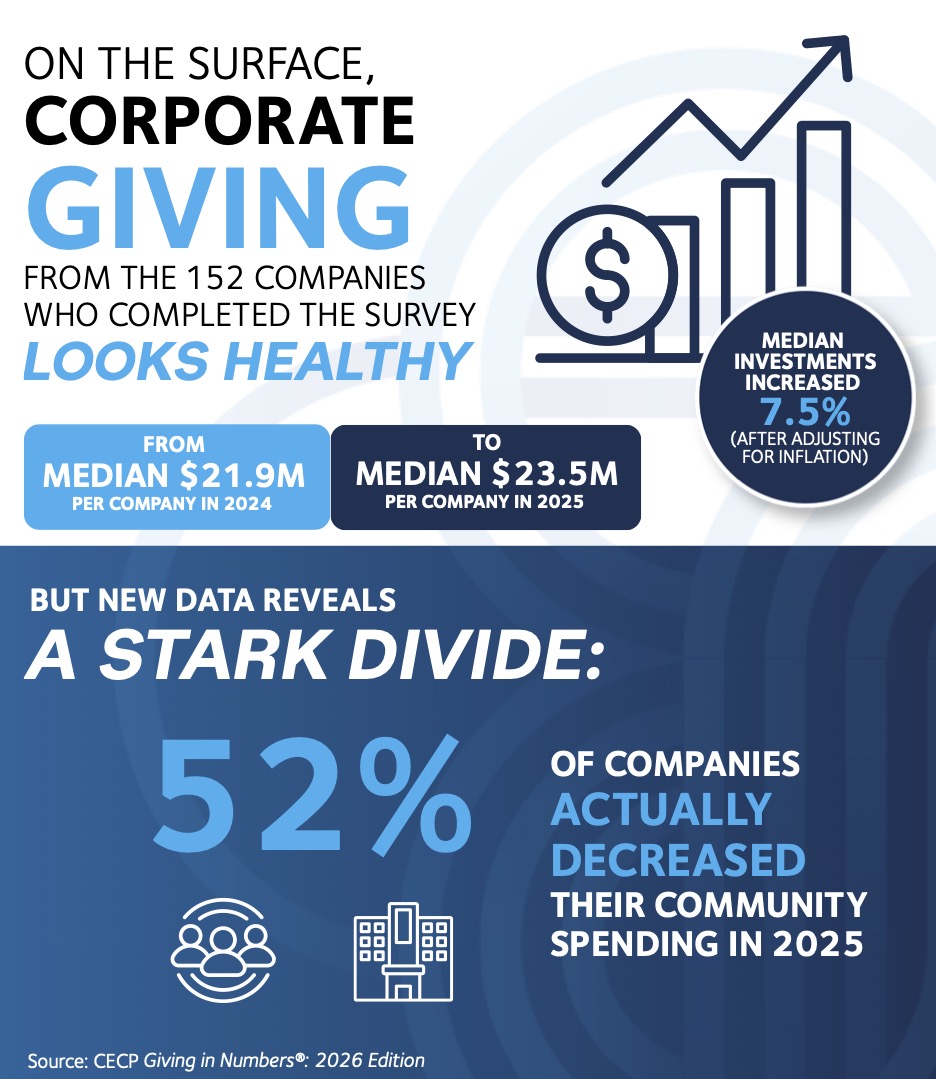
NEW YORK, July 16, 2026 /3BL/ – New data from Chief Executives for Corporate Purpose®(CECP)’s Giving in Numbers® survey shows a corporate giving landscape that’s more divided than it first appears. While median Total Community Investments increased from $21.9M in 2024 to $23.5M in 2025 in a matched set of companies, more than half of companies cut back on giving in 2025. Overall, total giving across all companies stayed relatively flat. The takeaway is that a smaller group of companies increased their investments enough to pull the overall numbers up, masking the fact that pullbacks were the more common story on the ground.
Now in its 25th year, CECP in partnership with companies, has built the largest and most comprehensive historical dataset on corporate social investment trends, drawing on participation from more than 650 multi-billion-dollar companies and representing over $519 billion in giving over the life of the survey.
For the first time, companies with $500M to $1.5B in revenue can take part through a dedicated mid-market tier with benchmarking built for their scale. CECP is also welcoming GroundSwell as a new Innovation Partner, joining Benevity, YourCause from Blackbaud, and Bonterra. Companies on any of these four platforms can use built-in Giving in Numbers reports to pull their survey responses directly from the platforms, cutting out manual data pulls.
“The headline number tells you giving went up, but that’s not really the story,” said Kate Stobbe, Director, Corporate Insights & Research, CECP. “What we’re actually seeing is a widening gap between companies that are leaning into their community investments and companies that are pulling back. The median only rose because the increases from one group were large enough to outweigh the decreases from another. Companies need to look past the topline number to understand where they actually stand.”
Three key takeaways from among the 139 companies that reported Total Community Investments (TCI — Direct Cash, Foundation Cash, and Non-Cash giving) in both 2024 and 2025:
- The median company’s TCI climbed from $21.9 million to $23.5 million, a 7.5% increase after adjusting for inflation.
- The top quartile told a similar story, up 10.6% (from $60.6 million to $67.0 million). But those gains weren’t shared broadly.
- Total giving across all survey participants was essentially flat, down 0.2%, and 52% of companies spent less in 2025 than the year before.
Companies over $500M in revenue can still participate in this year’s survey; see the survey here and email insights@cecp.co for more information. The full Giving in Numbers report will be available in October 2026.
CECP Media Contact
Katie Leasor
kleasor@cecp.co
###
About Chief Executives for Corporate Purpose (CECP)
Chief Executives for Corporate Purpose® (CECP) is the only nonpartisan business counsel and network dedicated to driving measurable returns on purpose. We promote responsible purpose-driven business as it increases customer loyalty, builds employee engagement, improves brand trust, attracts top talent, connects with strategic investors, and contributes to the bottom line.
More than 200 of the world’s leading companies seek to improve their return on purpose through access to CECP’s solutions in research and insights, strategy and benchmarking, and convening and communications. With our companies, we harness the power of purpose for business, stakeholders, and society.
For more information, visit http://cecp.co.