HONG KONG, Dec. 21, 2025 /PRNewswire/ — On 19 December 2025, the TVB ESG Awards 2025 Presentation Ceremony, hosted by Television Broadcasts Limited (“TVB”), was held at the Hong Kong Convention and Exhibition Center. Fosun International was honored with the highest accolade, the “Outstanding ESG Award”, as well as awards for “Best in ESG Practices” and “Best in ESG Report”.

Mr. Wong Wai Lun, Michael, GBS, JP, Deputy Financial Secretary of the Government of the Hong Kong Special Administrative Region (SAR), Mr. Siu Sai Wo, General Manager (Business Operations) of TVB and Dr. Lawrence Cheung Chi-chong, Chief Technology Officer of Hong Kong Productivity Council served as officiating guests at the awards ceremony and jointly presented the “Outstanding ESG Award” to Fosun International.

TVB pointed out that Fosun International’s recognition with the “Outstanding ESG Award”, “Best in ESG Practices” and “Best in ESG Report” is well-deserved. After more than 30 years of development, Fosun has developed into a large global company with operations spanning healthcare, tourism, consumption, and insurance. With a robust global industrial ecosystem, Fosun operates responsibly in over 40 countries and regions, actively contributing to public welfare and creating sustainable value worldwide.

TVB highlighted that the awards recognize Fosun International’s outstanding performance in environmental, social, and governance (ESG) and sustainability, while affirming its excellent achievements in ESG over the past year. Each award is presented to the top three scorers in their respective categories, with organizations excelling in both “ESG Practices” and “ESG Report” eligible for the highest accolade, the “Outstanding ESG Award”.

In addition to Fosun International, other recipients of TVB’s highest accolade, the “Outstanding ESG Award”, are all organizations that have demonstrated excellence in ESG. These include government statutory bodies, major public utilities, and well-known companies such as the Airport Authority Hong Kong, MTR Corporation, Schneider Electric, China State Construction Development Holdings Limited, and Riskory Consultancy Limited.

Ms. Angel Sze, Company Secretary and Head of ESG Management Committee of Fosun International, accepted the “Outstanding ESG Award” on behalf of the company and subsequently joined representatives from other award-winning organizations in a panel discussion to share Fosun International’s ESG practices and achievements.

Driven by innovation, committed to social contribution

During the discussion, Angel Sze remarked, “Fosun remains committed to innovation-driven development and globalization. Since its establishment, Fosun has stayed true to its original aspiration of ‘Contribution to Society’, striving to create positive societal impact through its operations. Taking our Health segment as an example, we target original innovation to address unmet clinical needs. By continuously strengthening our independent R&D and innovation capabilities, we strive to deliver higher-quality, more accessible, and more affordable medicines and services to patients.”

Fosun adheres to an innovation-driven strategy, and the anticancer drugs developed by its Health segment have widely benefited cancer patients. Among them, HANSIZHUANG, an innovative anti-PD-1 monoclonal antibody independently developed by Fosun, is the world’s first anti-PD-1 monoclonal antibody approved for the first-line treatment of small cell lung cancer (SCLC). To date, it has been approved for marketing in nearly 40 countries and regions, including China, the European Union, the United Kingdom, Singapore, and India.

Since the beginning of this year, Fosun has achieved multiple breakthroughs in the field of innovative drugs. HLX43, a PD-L1-targeting antibody-drug conjugate (ADC), is undergoing clinical studies for solid tumors such as non-small cell lung cancer and thymic carcinoma in countries including China, the United States, and Australia. Currently, no PD-L1 ADC has been approved globally, positioning HLX43 as a potential highly effective and safe broad-spectrum anticancer drug.

On 7 December, the National Healthcare Security Administration (NHSA) and the Ministry of Human Resources and Social Security (MOHRSS) released the 2025 national medical insurance drug list, which includes multiple marketed products from Fosun Pharma. Moreover, the highly anticipated inaugural edition of the commercial insurance innovative drug list was unveiled, featuring Fosun Pharma’s CAR-T cell therapy Yi Kai Da (ejilunsai injection). The successful inclusion of innovative drugs underscores national support for pharmaceutical innovation and paves the way for market promotion and patient access.

Fosun’s innovation capabilities have also received high recognition from global pharmaceutical companies. On 9 December, Fosun Pharma announced that its subsidiary had entered into a license agreement with Pfizer, granting Pfizer exclusive worldwide license for the development, use, manufacturing, and commercialization of oral small-molecule glucagon-like peptide-1 receptor (GLP-1R) agonists, including YP05002, and any products containing such oral small molecule GLP-1R agonists as an active ingredient.

At the same time, Fosun actively integrates global resources to accelerate the introduction of cutting-edge medical technologies in China, enhancing the accessibility and affordability of medical technologies. By the end of September 2025, over 480 Da Vinci surgical systems had been installed in more than 370 hospitals across the Chinese mainland, Hong Kong SAR, and Macau SAR, collectively serving over 810,000 patients.

Centering on “Health” as a global public issue, Fosun launched the Rural Doctors Program in 2017. Since its launch, the Program has supported 25,000 rural doctors and benefited 3 million rural families. It was honored as one of the United Nations Global Compact’s “20 Cases of Private Sector’s Sustainable Development in China for 20 Years”, earning international recognition as a model for empowering rural healthcare.

Actively responding to climate change and attaching great importance to biodiversity conservation

With climate change being one of the most severe long-term risks, Fosun recognizes the importance of global cooperation to tackle this challenge. Fosun remains committed to advancing China’s “dual carbon” goals by promoting carbon neutrality and energy conservation and emission reduction. In 2021, Fosun made a commitment to society – “strive to peak carbon emissions by 2028 and achieve carbon neutrality by 2050”. Fosun has formulated strategies for climate change mitigation and adaptation to align with the 1.5°C temperature control target set in the Paris Agreement.

The Group also actively encourages its member companies to carry out climate actions. In 2024, the Bund Finance Center (BFC), the Group’s main office location in Shanghai and a landmark in Shanghai, was successfully included in Shanghai’s first batch of carbon peaking and carbon neutrality pilot demonstration projects, becoming the only large-scale commercial complex exceeding 200,000 square meters on the list.

In 2024, Fidelidade, Fosun’s insurance company in Portugal, established the Impact Center For Climate Change (ICCC), a knowledge center dedicated to climate change research. Through collaborations with external entities, including universities, research centers, and public institutions, it provides scientific insights on the impacts of climate change on society, particularly in the insurance industry.

In addition to actively addressing climate change, Fosun also places great importance on biodiversity conservation. Since 2018, the Lost Chambers Aquarium at Atlantis Sanya, a subsidiary of Fosun Tourism Group (FTG), has been dedicated to rescuing and rehabilitating sea turtles in Hainan Province and its surrounding waters. As of 2024, the aquarium had rescued 24 sea turtles and held 6 sea turtle release events since its opening, returning 10 rehabilitated turtles to the ocean.

On 28 November, FTG hosted “Fosun Holiday Horizon 2026” at Atlantis Sanya, where it signed a partnership agreement with the Nanjing Institute of Environmental Sciences (NIES) of the Ministry of Ecology and Environment (MEE). The two parties will incorporate biodiversity conservation and habitat creation into Club Med resorts, jointly developing China’s first “biodiversity resort” centered on the concept of “harmonious coexistence between humans and nature”.

Empowering a sustainable future through globalization and innovation

Looking ahead, Fosun will remain focused on its core businesses, step up innovation efforts, and firmly advance its globalization strategy, creating greater value for shareholders, employees and society. At the same time, Fosun will continue to closely follow global sustainability trends, continuously refine its ESG management, actively respond to national strategies, ensure information security, promote technology innovation, implement “dual carbon” goals, participate in public welfare undertakings, and protect employees’ rights and interests. Leveraging the resources and advantages of its global industrial ecosystem, Fosun endeavors to make a greater impact on sustainable development and continuously contribute to a better world.

Cision View original content:https://www.prnewswire.com/news-releases/fosun-international-honored-with-tvbs-highest-accolade-outstanding-esg-award-302647603.html

SOURCE Fosun

Originally published by GoDaddy’s Small Business Research Lab

From Resiliency to Resolve: The State of Small Businesses

Small businesses have always been resilient. This year we are seeing something else too. Entrepreneurs are moving forward with intention and conviction. They are not just adapting, but they are committed, and staying present.

Over 70% of small business owners are confident they will achieve their definition of success in their lifetime. With AI reshaping how they grow, the outsized local economic impact is scaling faster than ever. Below is a 2025 wrap-up report on their outlook, plans to hire, and where you can find them online and nationally.

Introduction

For over six years, the GoDaddy Small Business Research Lab (formerly Venture Forward) has reported annually on digital businesses with typically fewer than 10 employees. Our research has captured the growth in number of jobs they create, their aspirations as well as challenges, and how patterns have shifted across the country and where they are taking root and thriving. We invite you to explore the key findings, customize the interactive map, download the charts, and share this with anyone supporting or owning a small business.

Report Sections

  • Small business growth by location and industry
  • Updated economic impact
  • Customer stories
  • Key entrepreneur insights

Microbusinesses Are Growing

Resilience has been a defining trait of small businesses, and in 2025, resolve stands out just as strongly.

In Australia, small and microbusinesses continue to expand in number and influence all over the country. Last year’s report highlighted the steady rise of entrepreneurs even in more remote areas – and this year, that momentum persists. Many of the entrepreneurs represented here are running relatively young businesses, often less than a decade old, and their ability to operate without a physical storefront has given them the flexibility to adapt quickly and seize new opportunities. These patterns align with survey insights from over 1,200 small business owners this year, and their steadfast focus, navigation of financial challenges, and positive business impact from using AI.

The chart below is a ranking of provinces by the highest microbusiness counts.

Strong activity is led by more populated areas, entrepreneurship is also accelerating fast in some more remote areas. Density shows how many microbusinesses exist per 100 people. It gives us a clearer way to compare large and small Statistical Area Level 4s (SA4s).

Top 10 Statistical Area Level 4s (SA4) By Microbusiness Count

SA4 Name

Active

Microbusinesses

Q3 ’25

1 year

Microbusiness

Count % Growth

Microbusiness

Density

Q3 ’25

Sydney – City and Inner South

44,768

149%

13.2

Sydney – Eastern Suburbs

37,923

219%

14.4

Melbourne – Inner

31,412

23%

4.9

Gold Coast

22,334

34%

3.4

Melbourne – South East

17,517

33%

2.0

Melbourne – West

17,156

39%

1.9

Brisbane Inner City

16,810

30%

5.5

Sydney – Parramatta

16,200

38%

3.3

Melbourne – Inner South

14,496

34%

3.4

Sydney – North Sydney and Hornsby

13,999

31%

3.3

Source: GoDaddy Small Business Research Lab 2025

Each year, the GoDaddy Small Business Research Lab reports on changes in e-commerce activity, including revenue, order volume, or number of sellers, based on data self-reported by website owners. The findings surface notable shifts in demand and participation, highlighting which products and services are drawing more suppliers, such as Marketing and Photography in 2025. These rankings show which industries saw the biggest year-over-year growth in entrepreneurs selling online.

Top 5 Ecommerce Industries in 2025 
Ranked by growth in entrepreneurs

  • Rank #1: Marketing: +100%
  • Rank #2: Public Space: +88%
  • Rank #3: Photography: +45%
  • Rank #4: Media: +44%
  • Rank #4: Religion: +43%

Customer Stories

Corrin Elliott & Roxanne Coutts
Barkery Deluxe Dog Treats, BARKERYDELUXEDOGTREATS.COM

Corrin and Roxane began Barkery Deluxe Dog Treats as a weekend hobby — just two busy mums baking all-natural dog treats in their kitchens. Their first market stall was a surprising hit, and soon they expanded into pop-ups and wholesale to vet clinics and cafés across Melbourne. As demand grew, they scaled up: moving production into a proper facility, obtaining a food-safety licence, and launching an online store. When retail shut down during the lockdowns, their website kept orders flowing — and saved the business. What began as a small side hustle turned into a thriving, nationwide brand known for quality, natural treats made with care.

Emma McLeavy
Jo + Co Hampers & Floral Design, joandcohampers.com.au

After more than a decade as a commercial banker helping other small businesses, Emma McLeavy decided to pursue her own passion. While on maternity leave, she launched Jo + Co Hampers & Floral Design — a bespoke hamper service filled with local produce, artisanal goods, and carefully chosen floral gifts. She built the website herself, and from her home she now balances packaging, family life, and building the business. What started as a side-hustle evolved into a growing venture. Emma plans to expand into floristry, firmly believing that “if you’re passionate about something, you just have to go for it.”

Key Entrepreneur Insights

Since 2019, GoDaddy’s Small Business ResearchLab has surveyed over 60,000 global microbusiness owners with a GoDaddy domain and active website and over 3,000 in the UK in the last two years. Their answers give us a real view of how people are navigating changing conditions, and often offer an early signal of what’s ahead. Their responses cut through broader noise and provide a clearer, bottom-up read on the grassroots economy.​​

The below chart captures their outlook for their business revenue compared to the national economy over the second half of 2025.

Positive outlook for my business vs. the economy


Business 

Economy

Nov ’23

71%

25%

Jul ‘24

68%

30%

Jul ’25

64%

32%

Source: GoDaddy Small Business Research Lab Australia National Survey. July 2025 (N-= 2,256)​

Microbusinesses in Australia are, by design, small. 86% have fewer than ten employees, and over a quarter are run by solo entrepreneurs. Many owners are still building toward full-time operations, with 34% saying their business is their main source of income, 35% using it as supplemental income, and 31% reporting that it currently generates no income, which may be due to the recent start of the business.​

Over half are first-time founders, and about 1 in 4 currently own more than one business. 38% previously sold a business at a profit or broke-even. This shows how strongly entrepreneurial ambition is continuing in Australia, with people experimenting, launching, and growing multiple ideas even in a shifting economic landscape. This is a community that is both resilient and resolute.

Microbusinesses are small

  • 93%: Microbusinesses with fewer than 10 employees
  • 56% are solo entrepreneurs

Microbusinesses generate income

  • 29%: Main
  • 40%: Supplemental
  • 32%: No Income

About 1 in 4 currently own more than one business

61% are first-time small business owners.

Source: GoDaddy Small Business Research Lab National AU Survey, July 2025; n=~1,200+

While broader economic conversations leaned toward caution in 2025, micro-and small business owners delivered a quieter, more telling signal: they believe in their path and they’re planning for growth. Australian microbusiness owners continue to show a grounded and moderate outlook for their financial turnover in the second half of 2025. After 62% had a steady or profitable first half of the year. 50% anticipate an increase, and 26% expect no change.

Expectations for financial turnover increase in 2025 have been mostly positive

  • 26%: No Change
  • 50%: Positive

First half of 2025 was steady or profitable for most small businesses in Australia

Monthly revenue change Jan-July

  • 24%: Lower
  • 38%: No Change
  • 24%: Higher

Their ambition, hard work and independence has made them successful, but recent economic concerns have made them more self-aware, cost-sensitive and income-driven having started their ventures using their personal savings. 51% of entrepreneurs cited having enough money to pay rent, wages, advertising, etc. as the primary cause of stress from their business, and that is on top of the fact that 71% of entrepreneurs fund their small business from personal savings when first starting out. Less than half (41%) of microbusiness owners would say they have a work-life balance.

Under these financial pressures and with the goal of optimizing time and stress, they are turning more to AI to do more content creation and summaries as well as strategy for marketing or operations.

Overall, AI adoption has accelerated. Over one-third (46%) now use AI for their business, and small business owners say AI delivers value in several key areas:​

  • 73%: Writing content for me​
  • 65%: Summarizing information or text​
  • 56%: Generating recommendations for marketing or operations​

And when it comes to what brings these entrepreneurs the most joy, it’s predominantly creating their own source of income (26%), followed by connecting with customers (16%). They also have strong conviction in the return on investment of having a venture, with 1 in 4 believing their small business is the best way to fund their future and retirement, above stocks and retirement funds.

Al use has a positive impact on small businesses

62% of entrepreneurs report a positive impact from Al on their business

Financial and time pressures top the list as causes of stress for entrepreneurs

  • 51%: Financial stress/limited cash
  • 41%: Work-Life balance (not enough time)
  • 24%: Competition from other businesses
  • 23%: Customer issues
  • 17%: Technology/Equipment
  • 11%: Vendors/Partnerships stress
  • 8%: Employee issues

25%: 1 in 4 believe income from their small business is the most lucrative way to fund their future and retirement

The main source of capital when starting a small business in Australia

  • 71%: Personal savings
  • 8%: No capital needed
  • 4%: Loan from friends and/or familyNo capital needed
  • 4%: Loan from bank/credit union
  • 3%: Equity investors
  • 1%: Online startup campaign or crowdfunding

Source: GoDaddy Small Business Research Lab National AU Survey, July 2025; n=~1,200+

As far as connecting with customers, their approach to online presence reflects another interesting trend. 42% point to their website as the main place where customers can buy from them, followed by 26% on social media and 20% in a storefront or office.​

​For those who don’t sell on their website, an online presence still plays a central role: 65% view it as critical for marketing and credibility, and 42% rely on it for customer communications. And despite the reach a website can provide, many operate with a strong local focus. Many say their customers are based within their state or even suburb, offering meaningful proximity to the people they serve and, in some cases, insulating them from certain global pressures.

Online presence leads as far as where small businesses conduct business and services

  • 42%: Website
  • 26%: Social Media
  • 20%: Storefront and Office

What entrepreneurs use their website for the most

  • 65%: Marketing & Credibility
  • 44%: Sales Orders
  • 42%: Communications
  • 31%: Sales Orders
  • 23%: Bookings
  • 8%: Operations

Source: GoDaddy Small Business Research Lab National AU Survey, July 2025; n=~1,200+

Microbusinesses are focused locally

  • 4 out of 10 say most of their customers live within their suburb or state.
  • 83% of small business owners serve only domestic customers.

About GoDaddy Small Business Research Lab

A research initiative launched in 2018 that quantifies the growth and economic impact of over 25 million global online microbusinesses, and provides a unique view into the attitudes, demographics, and needs of these entrepreneurs.

To explore our research further, specifically all the reports since 2020, we’ve also introduced a CustomGPT experience through ChatGPT at research.godaddy/gpt that allows for deeper analysis and discovery.​

Landmark Project Across Four Governorates to Boost Power Plant Output by 50%, Easing Chronic Electricity Shortages

SHANGHAI, Dec. 19, 2025 /PRNewswire/ — Shanghai Electric has broken ground on the Euphrates Combined Cycle Expansion Project in Iraq. As the project’s contractor, Shanghai Electric is upgrading power plants across four Iraqi governorates by transforming simple-cycle units into combined-cycle systems. The expansion will add a total capacity of 625 megawatts (MW) and is designed to boost overall plant efficiency by approximately 50%, generating an additional 5 billion kilowatt-hprojours (kWh) of electricity annually without increasing fuel consumption. This initiative is poised to significantly alleviate the country’s persistent electricity shortages.

“The pressing need for energy security and development in Iraq is clear. We are honored that our efficient combined-cycle technology is recognized as instrumental in modernizing this critical infrastructure,” said a spokesperson for Shanghai Electric. “This project exemplifies our commitment to supporting the energy security and green development of Belt and Road countries through technological innovation.”

Iraq, a major Middle Eastern oil producer, has faced severe power shortages for over three decades. Most of its power plants rely on natural gas, yet domestic gas development lags, creating a heavy dependence on imports. This power deficit has become a persistent challenge to people’s livelihoods and a bottleneck for national reconstruction and economic growth.

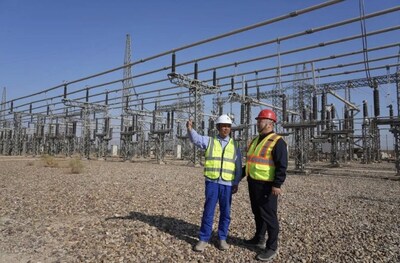
The Shanghai Electric-contracted expansion project along the Euphrates River broke ground early this year and covers the Iraqi governorates of Najaf, Karbala, Babylon, and Al-Qadisiyyah, with all upgrades centered on advanced combined-cycle technology. Core equipment has now arrived on site, and construction is advancing through the collaboration of Chinese and Iraqi teams. Since its commencement, the project has drawn considerable attention from the Iraqi government and public.

Iraqi Minister of Electricity Ziad Ali Fadel has praised the project’s strategic importance, stating, “This initiative is highly significant for improving Iraq’s power supply and optimizing its electricity infrastructure. Once operational, it will effectively reduce Iraq’s reliance on imported natural gas and lower its fuel costs for power generation.”

At the power plant in Najaf, the upgrade utilizes high-temperature exhaust from existing gas turbines as a heat source. The exhaust is directed through heat recovery steam generators to produce high-pressure steam, which then drives a new steam turbine to create additional electricity. This combined-cycle process increases output and efficiency without extra fuel and reduces the thermal pollution from the original units.

Naseem Ayad, the Iraqi project manager at the Najaf site, said, “Chinese equipment and power technology help us reuse high-temperature exhaust, boosting generation capacity while reducing thermal pollution. This project sets a benchmark for power plant upgrades in Iraq and reflects local hopes for more reliable electricity and better living conditions.”

At the Karbala site, core equipment such as heat recovery steam generators and direct air-cooled condensers have been delivered. This project phase marks one of Iraq’s first combined-cycle expansions to fully utilize Chinese equipment and standards, with core systems designed and manufactured in China. This will effectively drive the overseas deployment of Chinese equipment and enhance the recognition of Chinese standards in Iraq.

Upon completion, the project is expected to improve local livelihoods, support post-war reconstruction, and lay a robust energy foundation for Iraq’s industrial recovery and economic growth.

Shanghai Electric remains dedicated to supporting sustainable development in Belt and Road regions and worldwide through advanced, efficient, and eco-friendly energy technologies.

For more information, please visit https://www.shanghai-electric.com/group_en/.


Cision View original content to download multimedia:https://www.prnewswire.com/news-releases/shanghai-electric-powers-up-iraqs-energy-future-with-major-625mw-efficiency-upgrade-302647425.html

SOURCE Shanghai Electric