Company program will support school systems with funding and charging infrastructure and will test vehicle-to-grid (V2G) technology

WILLIAMSPORT, Md., Feb. 4, 2026 /PRNewswire/ — Potomac Edison, a subsidiary of FirstEnergy Corp. (NYSE: FE), has been granted approval from the Maryland Public Service Commission to launch a pilot program that will help local school systems shift to cleaner, zero-emission school buses. The program is designed to make the move to electric buses easier and more affordable, bringing quieter rides for students, cleaner air for neighborhoods and long-term savings for school districts.

Supporting Maryland’s Clean Transportation Goals  
Maryland’s Climate Solutions Now Act of 2022 requires public school systems to purchase or contract only zero-emission vehicles moving forward. Potomac Edison’s pilot program helps school districts meet this requirement by removing some of the biggest financial hurdles.  The company will cover the cost difference – typically about $250,000 – between diesel and electric buses along with the cost of charging equipment and the electrical upgrades needed for installation.

Jim Myers, FirstEnergy’s President of West Virginia and Maryland: “Maryland’s public schools are taking important steps toward cleaner, healthier transportation for students, and this program is designed to help make that transition more practical and affordable. We’re reducing upfront costs and offering hands-on support to help school systems integrate electric buses smoothly. At the same time, we’re exploring how these buses can support grid reliability through innovative technology – a promising opportunity that could benefit customers across the counties we serve.”

Program Highlights
The $11.1 million program will launch in early 2026 and includes:

  • Incentives for up to 28 electric school buses in Potomac Edison’s Maryland service territory.
  • Full technical and administrative support to help school systems identify charging locations, install necessary equipment and train personnel on vehicle operation and charging.
  • Access to vehicle-to-grid (V2G) technology, allowing Potomac Edison to test how stored energy in bus batteries can flow back to the grid when buses aren’t in use – potentially supporting grid reliability during emergencies.

The program will run for five years or until funds have been exhausted.

Potomac Edison serves about 285,000 customers in all or parts of Allegany, Carroll, Frederick, Garrett, Howard, Montgomery and Washington counties in Maryland. Follow Potomac Edison at www.potomacedison.com, on X @PotomacEdison, and on Facebook at facebook.com/PotomacEdison.

FirstEnergy is dedicated to integrity, safety, reliability and operational excellence. Its electric distribution companies form one of the nation’s largest investor-owned electric systems, serving more than six million customers in Ohio, Pennsylvania, New Jersey, West Virginia, Maryland and New York. The company’s transmission subsidiaries operate approximately 24,000 miles of transmission lines that connect the Midwest and Mid-Atlantic regions. Follow FirstEnergy online at www.firstenergycorp.com and on X @FirstEnergyCorp.

Cision View original content to download multimedia:https://www.prnewswire.com/news-releases/potomac-edison-pilot-program-to-help-maryland-schools-transition-to-clean-electric-buses-302679138.html

SOURCE FirstEnergy Corp.

ST. PAUL, Minn., February 4, 2026 /3BL/ – Antea Group USA, a leading global environmental consulting firm, is proud to announce a strategic partnership with Gridify, a premier digital infrastructure firm that specializes in making the procurement of renewable energy credits (RECs) faster, more transparent, and scalable. This alliance enhances Antea Group’s ability to help clients achieve their renewable energy goals by simplifying the complex process of sourcing and retiring high-quality RECs.

Streamlining REC Procurement through Digital Innovation

Through this partnership, Antea Group leverages Gridify’s technology to transform how organizations access clean energy markets. The Gridify platform streamlines the procurement process through a four-step digital workflow:

  • Request Entry: Antea Group identifies client needs—such as specific fuel types, locations, or budget targets—and enters them directly into the platform.
  • Instant Quote Comparison: The platform provides access to over 150 vetted clean energy suppliers, allowing for immediate price transparency and the ability to compare multiple competitive offers in one place.
  • Simplified Selection: Once the best fit is identified, quotes are shared with clients via a one-click review process.
  • End-to-End Management: Gridify automates the remaining hurdles, including standardized contracting and secure, simplified payment processing.

This centralized transaction hub provides clients with a secure portal to access all contracts, invoices, and retirement certificates, eliminating the administrative burden typically associated with REC purchases.

Strengthening Climate Advisory and Decarbonization Services

The partnership with Gridify significantly bolsters Antea Group’s Greenhouse Gas (GHG) and Climate Change Advisory services. By integrating direct REC procurement into the broader decarbonization journey, Antea Group provides a more comprehensive suite of tools for clients to meet their sustainability commitments.

Key benefits to Antea Group’s climate change advisory services include:

  • Enhanced Target Setting: The ability to secure vetted RECs supports clients in establishing and meeting Science-Based or other emission reduction targets based on accurate company benchmarking.
  • Actionable Decarbonization Planning: RECs serve as an implementable element of a client’s decarbonization roadmap, providing a clear path to reduce GHG emissions alongside operational changes and capital investments.
  • Robust Annual Reporting: The Gridify platform ensures that RECs are properly retired in tracking systems, providing the necessary documentation for voluntary and required disclosures.
  • Verified Quality and Integrity: Gridify reviews all suppliers for registry certifications and track records of delivery, ensuring that credits meet high standards for additionality, verification, and transparency.

“Our partnership with Gridify allows us to offer our clients a more transparent and efficient way to manage their renewable energy purchases,” said Dr. Susan Lewis, Climate and Carbon Accounting Services Lead at Antea Group USA. “By removing the administrative challenges of REC procurement, we can focus on helping our clients accelerate their decarbonization plans and reach their climate targets with greater confidence.”

For more information on Antea Group’s climate change and carbon management services, please visit Antea Group Climate Services. To learn more about the Gridify platform, visit Gridify.ai.

About Antea Group

Antea Group is an international environmental consulting firm that specializes in full-service solutions in the fields of environment, infrastructure, urban planning, and water. By combining strategic thinking and multidisciplinary perspectives with technical expertise and pragmatic action, we do more than effectively solve client challenges; we deliver sustainable results for a better future.

About Gridify

Gridify is a digital infrastructure firm focused on building transparent clean energy markets where every organization can power its impact with integrity. With over 1 TWh of RECs procured to date and a network of 150+ vetted suppliers, Gridify simplifies the clean energy transaction process for consultants and their clients worldwide.

"2026 BEST PLACES I WORK" logo

A winning start to 2026 

We’re kicking off the new year with some great news: Built In has recognized Northern Trust across multiple 2026 Built In Best lists!

We’re honored to be named among the very best places to work in several of our key hubs:

  • Best Large Places to Work – Chicago
  • Best Places to Work – Chicago
  • Best Large Places to Work – San Francisco
  • Best Places to Work – Los Angeles
  • Best Large Places to Work – Boston
  • Best Places to Work – Boston
  • Best Large Places to Work – Los Angeles

These wins reflect the passion, talent, and dedication of every person on our teams who make our offices an incredible place to grow, innovate, and thrive

ATLANTA, Feb. 4, 2026 /PRNewswire/ — Novelis Inc. will report its earnings for the third quarter of fiscal year 2026 on Wednesday, February 11, 2026. Following the release, Steve Fisher, President and Chief Executive Officer, and Dev Ahuja, Chief Financial Officer, will discuss the results via a live conference call for investors at 7:00 a.m. EST/5:30 p.m. IST the same day. The conference call will also be webcast live via the Novelis website, with presentation materials available online at https://investors.novelis.com/.

The webcast can be accessed at:
https://event.choruscall.com/mediaframe/webcast.html?webcastid=EgugP4UQ 

To participate by telephone, participants are requested to register at: 
https://services.incommconferencing.com/DiamondPassRegistration/register?confirmationNumber=13758269&linkSecurityString=1ea08ffd35 

Upon registering you will receive the dial-in info and a unique PIN to join the call as well as an email confirmation with the details.

Following the meeting, the webcast will be available for replay at https://investors.novelis.com/. 

About Novelis

Novelis Inc. is driven by its purpose of shaping a sustainable world together. We are a global leader in the production of innovative aluminum products and solutions and the world’s largest recycler of aluminum. Our ambition is to be the leading provider of low-carbon, sustainable aluminum solutions and to achieve a fully circular economy by partnering with our suppliers, as well as our customers in the aerospace, automotive, beverage can and specialties industries throughout North America, Europe, Asia and South America. Novelis had net sales of $17.1 billion in fiscal year 2025. Novelis is a subsidiary of Hindalco Industries Limited, an industry leader in aluminum and copper, and the metals flagship company of the Aditya Birla Group, a multinational conglomerate based in Mumbai. For more information, visit novelis.com.

Cision View original content to download multimedia:https://www.prnewswire.com/news-releases/novelis-to-host-third-quarter-fiscal-year-2026-earnings-conference-call-on-february-11-302679072.html

SOURCE Novelis Inc.

Originally published on Guiding Stars Health & Nutrition News

by Kitty Broihier

I always find the topic of meal planning to be polarizing. You’re either a fan who finds it valuable or it’s your idea of monotonous drudgery. But I’m here to say there’s more than one way to meal plan. I’m sharing a simple process that relies on one well-planned grocery shopping trip and a handful of cook-once, eat-twice recipes. Follow the map and you’ll be set up for a week’s worth of balanced, Guiding Stars-earning meals.

Step 1: Look at the Week Ahead

This is one of my top tips for making sure you don’t end up ordering pizza or getting take-out (again). The idea here is to take away some of the burden of feeding yourself well by pre-planning the biggest or most complicated meal of the day ahead of time. For many of us, that meal is dinner, but if that’s not true for you, plan for whichever meal is typically the most time-consuming or difficult to prepare. And if you have social obligations or evening activities that include dinner out, you’ll have fewer main meals to plan and prep.

Step 2: Take an Inventory

Check your refrigerator and make a note of any foods that need to be used this week. While you’re there, start a grocery list and add any staple items that need replenishing. Do the same with your pantry staples, then move on to your freezer. What do you have on hand for frozen veggies, and protein items like meat, fish, and poultry? Get an idea of what you have to work with so you don’t over-buy while shopping.

Step 3: Choose What to Make: Focus on Double-Duty Recipes

One way to make a full week of meals feel easy is to cook foods that work in multiple meals. This saves time and effort, and decreases food waste. (And if you get the ingredients on sale, you’ll save money too.) For example, say you notice that you have a good supply of frozen chicken breasts on hand. So you decide to make a sheet-pan meal using chicken breasts as the protein along with a couple of vegetables. Not sure which veggies to cook? Look for another recipe (check the Guiding Stars recipe collection online) that could use leftover cooked chicken breast and pre-roasted vegetables. Perhaps something like this easy Chicken Mushroom Skillet (swap the frozen veggies for the pre-cooked ones from your sheet-pan meal).

The idea is not to necessarily follow every recipe to the letter, rather to let them inspire you and provide a framework from which to create multiple easy meals. Focus on these kinds of recipes to help make it happen (click on the links below for Guiding Stars-earning recipes):

Once you’ve got a few basic meals and ideas for the leftover ingredients, give your plan the once-over. Be sure to have extra veggies and fruit on hand to round out the meals with more fiber and nutrients.

Step 4: Cross-Check Your Meal Plan With the Store Sales

This step is optional, but one that I always employ because it saves me money. Once I have a basic idea for several meals to make during the week, I check the store flyer for sales on the primary ingredients I need. You can also start your meal selection process the other way around. First see what’s on sale, and then choose the meals you plan to make based on those items. And stock up on sale items that you tend to use often and keep well. (For me that’s ground turkey, quinoa, and canned beans.) Other multi-purpose staple items to consider purchasing if you find a good sale include:

  • Pasta, rice, and other grains
  • Lentils and beans
  • Fruits and vegetables of all kinds
  • Eggs, milk, and yogurt

As always, you can compare the nutrient density of many foods and beverages by checking their Guiding Stars. You’ll find them on the shelf tags, store signage, and store-brand packaging at participating grocery stores. 

Step 5: Make Your Final Grocery List

If you already started a grocery list when taking your inventory, you’re nearly done. All you need to add are those items you’re missing from the recipes you’ve chosen to prepare for the week. Check the recipes and finalize your list (don’t forget any crucial spices). Then feel good about using a list! For one, you’ll be less likely to forget things. And when you shop with a list, you make fewer impulse purchases—better for your health and your wallet.

About Guiding Stars

Guiding Stars is an objective, evidence-based, nutrition guidance program that evaluates foods and beverages to make nutritious choices simple. Products that meet transparent nutrition criteria earn a 1, 2, or 3 star rating for good, better, and best nutrition. Guiding Stars can be found in more than 2,000 grocery stores and through the Guiding Stars Food Finder app.

Image: Chippy Chili – 2 Guiding Stars

What You Need to Know

Biodiversity risk is more nuanced and complex than many investors think. For instance, there’s a widespread belief that deforestation poses the biggest nature-related risk for most portfolios. But when we applied our proprietary biodiversity risk-assessment framework for a client, we found that water risk—not deforestation—was the portfolio’s biggest exposure. Our analysis of the MSCI AWCI Index using the same framework shows water risk is elevated for many companies, highlighting just how important it is to assess biodiversity risk accurately.

16%

35%

14%

of the MSCI ACWI is exposed to the highest level of biodiversity risk

the share of MSCI ACWI for which water risk is high or very high

the share of MSCI ACWI for which deforestation risk is high or very high

Authors

Sara Rosner| Director—Responsible Investing Research
David Hutchins, FIA| Portfolio Manager—Multi-Asset Solutions
Henry Smith, CFA| Investment Strategist—Multi-Asset Solutions

The importance of biodiversity as a nature-related risk in investors’ portfolios has become better understood in the past few years. Investors are beginning to appreciate how complex and nuanced biodiversity risk can be. For example, there’s a widespread assumption that deforestation is the biggest biodiversity risk in many portfolios. That’s understandable, given media attention around the topic, and because large-scale deforestation contributes to climate change, which can have a material impact on investments across the globe.

But such assumptions can fall short of reality. We recently analyzed the biodiversity risks in the equity allocations of a large UK pensions provider1 and found that water stress, not deforestation, was the biggest risk (Display).
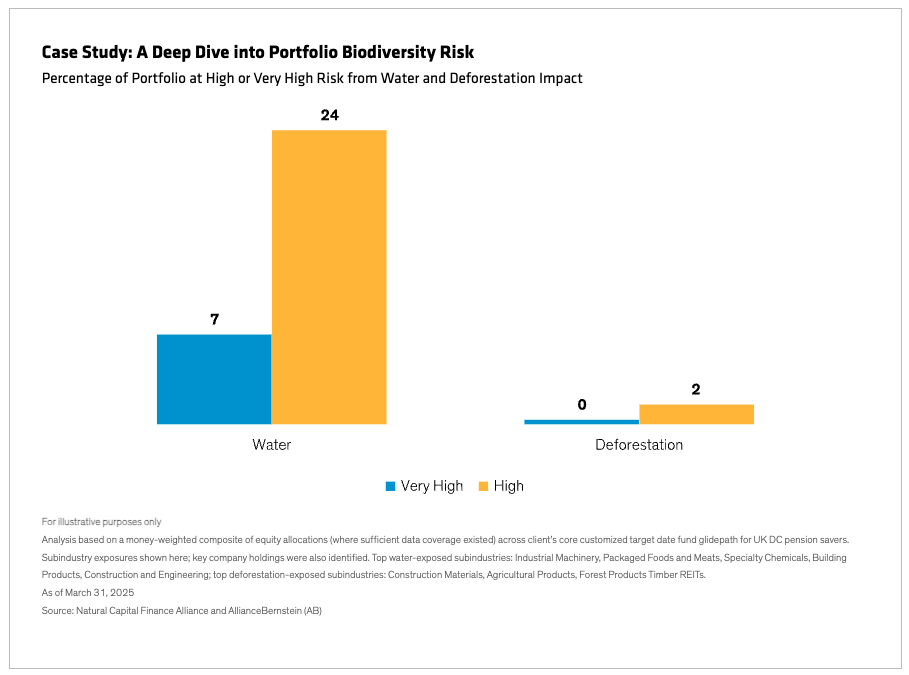
Graph - Case Study: A Deep Dive into Portfolio Biodiversity Risk

This may seem surprising, given that the impacts of water stress tend to be localized and not so obviously global as those of deforestation and its links to climate.

But this particular client is not an outlier. Our analysis of the ENCORE2 industry biodiversity-risk database shows that the proportion of the MSCI ACWI Index for which water-related risk is high or very high is 35%—not very different from the client’s 31%. (The index also has a bigger exposure to high or very high deforestation risk—about 14%.) The insight underscores how important it is for investors and investment managers to analyze and identify their nature-related exposures correctly.

To that end, we have developed a proprietary risk-assessment framework that can identify nature-risk exposures across portfolios at the sub-industry level. In turn, this enables analysts to assess and engage with the potentially high-risk companies identified. We believe the framework may help reduce portfolio risk and unlock better returns.

Mapping Portfolio Biodiversity Risks

According to the Taskforce on Nature-related Financial Disclosures, nature-related risks are potential threats to an organization arising from dependency and impact on nature—the organization’s own, and those of society too. Dependency and impact are, respectively, physical and transition risks.

For example, fisheries that rely on water quality to sustain their fish stocks have a high dependency on nature, as they are exposed to the physical risk that water quality might deteriorate. Mining companies and property developers have a high impact on nature; as laws, regulations and trade practices change (transition) to reflect society’s growing awareness of biodiversity risk, they may become exposed to legal, reputational, market and other risks.

Using dependency, impact and related risks as a framework, we draw on the ENCORE database to map biodiversity risk exposure at the GICS3 subindustries level (Display).
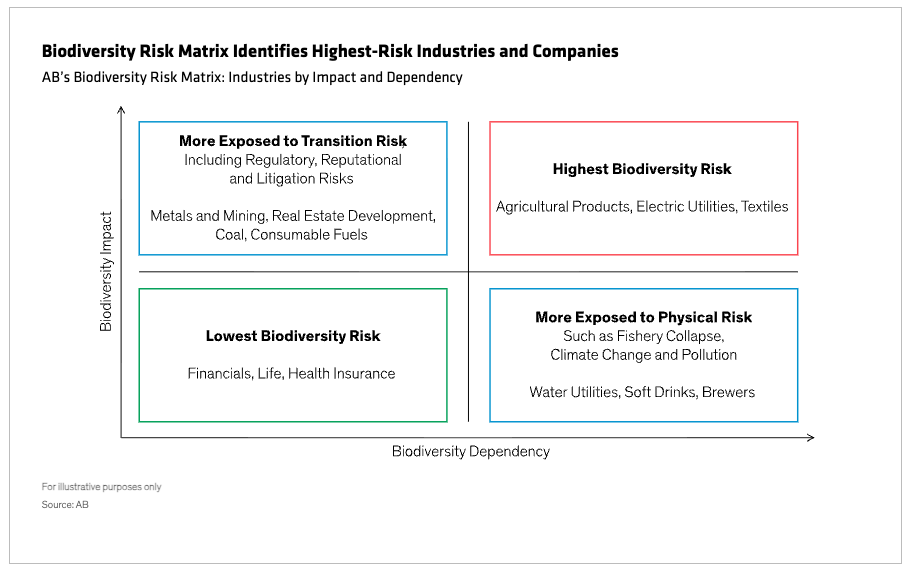
Biodiversity Risk Matrix Identifies Highest-Risk Industries and Companies

The industries that fall in the upper right quadrant have both high dependency and impact and, therefore, the most nature-related risk. Our analysis shows that 15.7% of MSCI ACWI falls into this quadrant. For the equity portfolio in our client case study, the proportion is significantly lower, at nearly 10% (Display).
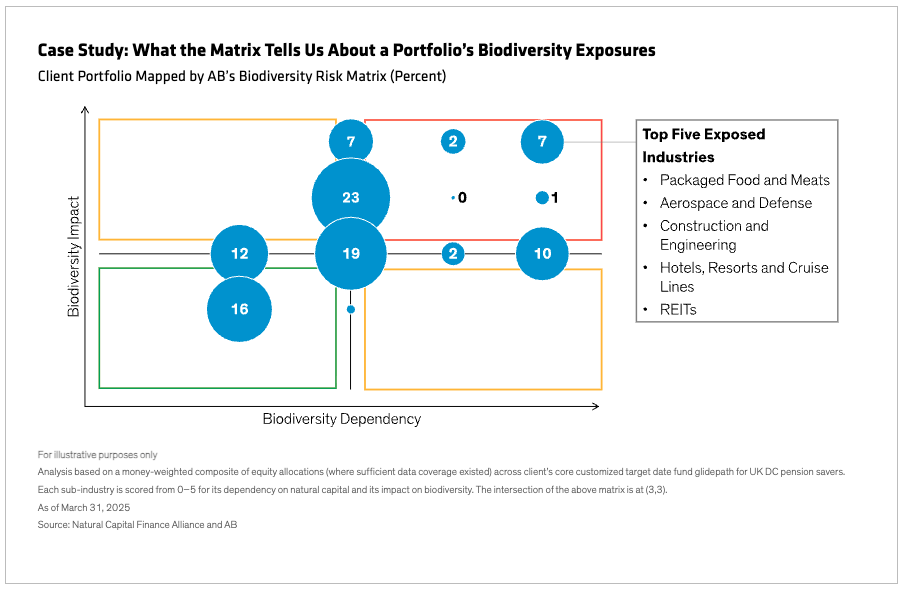
Graph - Case Study: What the Matrix Tells Us About a Portfolio's Biodiversity Exposures

Understanding how dependency and impact risks are distributed across industries in a portfolio is a vital first step, but it’s also important to dive deeper to understand the risks at the issuer level. The ENCORE database lists risks individually and classifies them according to whether they are dependencies or impacts. Using this information, we can apply the framework to identify specific risks across a portfolio. This was how we discovered the extent to which the case-study portfolio’s biodiversity risks were dominated by water-related exposures (Display).
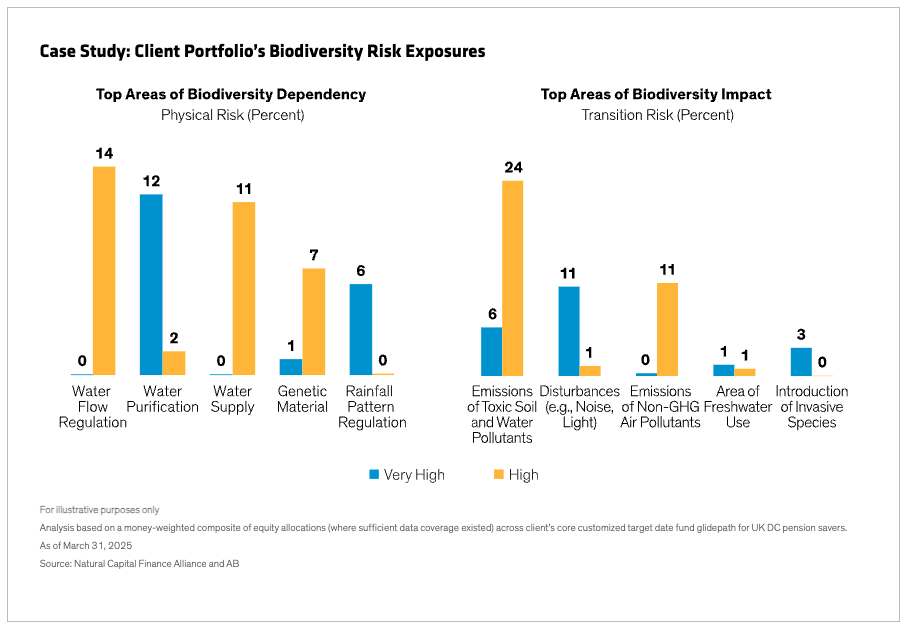
Graph - Case Study: Client Portfolio's Biodiversity Risk Exposures

Most of these exposures fell in the dependencies category, but two of the top five impact exposures were also water-related—area of freshwater use, and emissions of toxic soil and water pollutants. This level of information is potentially helpful in deciding where to focus efforts to mitigate the portfolio’s biodiversity risks.

Having established which industries in a portfolio have the highest nature risk, we can identify individual holdings within those industries that we may wish to target for further research to understand which biodiversity risks are most material for them.

Company Engagements: Consistency and Comparability

For active portfolios managed by AB, this level of research may also lead us to engage4 directly with issuers to better understand their exposures and, if appropriate, work with them to help mitigate risks. We decide which issuers to engage with on a case-by-case basis, according to whether engagement is in clients’ best interests. When undertaking an engagement for clients whose strategy is implemented mostly with third-party funds, we partner with appointed managers to ensure that biodiversity is a priority for them. The engagement process may require multiple meetings over time to monitor issuers’ progress in achieving their risk-reduction goals.

We have engaged on biodiversity risk with issuers in various client portfolios. These issuers include, for example, Linde, a UK-based supplier of industrial gases; US water-treatment company Ecolab; and Swiss processed foods group Nestlé (Display).
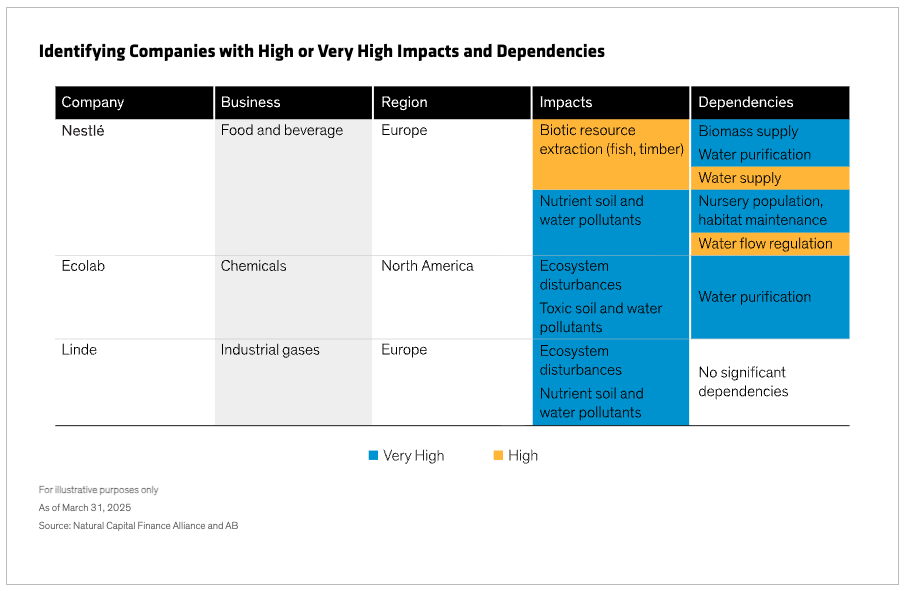
Identifying Companies with High or Very High Impacts and Dependencies

All fall in the top-right quadrant of the risk matrix. Linde ranks high for impact and moderate for dependency; Ecolab also ranks high for impact but higher than Linde for dependency. Nestlé ranks highest of the three on both counts. Below, we use Linde and Ecolab to illustrate how we engage on water-related risks and Nestlé on deforestation-related risks.

The process begins with defining the objective of the engagement. In the case of Linde, we wanted to know the water-risk implications of its hydrogen production—especially its move to producing green hydrogen. Traditional hydrogen production uses steam methane reforming, in which steam reacts with methane to produce hydrogen. Green hydrogen, which is powered by renewables, uses an electric current to split water into hydrogen and oxygen. Both processes are water intensive.

When engaging with Linde, we noted that it had reported considerable water savings, but its steam consumption had increased. The company explained that this had been possible because of a move to closed-loop production processes in which steam is fed back into the production cycle. It planned to use a similar technique to conserve water when producing green hydrogen. We asked Linde to consider introducing a company-wide water-usage target, and it said it planned to do so soon.

With Ecolab, we wanted an update on its effort to help customers conserve water and how it might be affected by plans to service water-hungry AI data centers. While the company had made considerable progress with conservation (226 billion gallons out of a 300 billion target), it noted that further gains were being complicated by increased water demand. But the expansion of data centers and utilities to power them was also creating opportunities for new efficiencies in energy and water supply, and the company was looking for commercial water-solution opportunities across the AI value chain.

Our engagement with Nestlé on deforestation illustrates some of the challenges of risk mitigation and the value of monitoring progress. In 2010, the company aimed to eliminate deforestation from five key supply chains—palm oil, soy, meat, paper and sugar—by 2022. It progressed well except for palm oil, which is sourced from high-risk countries: deforestation in the chain had fallen only 70% by 2020. We tracked progress, and in 2021 the company, aided by satellite and field monitoring, had eliminated deforestation across 90% of the chain. Its next goal was to be deforestation-free in all supply chains by the end of 2025.

Not Just Risks, but Opportunities, Too

Biodiversity exposures are material risks for many portfolios and need to be addressed appropriately, in our view. Our framework—supported by specialist, third-party industry data—can show how these exposures are distributed across portfolios and identify issuers with high nature-related risks. Combined with fundamental research and, where appropriate, issuer engagement and stewardship, it can lead to a deep understanding of issuer- and portfolio-level risks and the actions needed to mitigate them.

But it’s not just about risk: it’s about opportunity, too. For example, our engagement with Linde improved our understanding of how green hydrogen—an important step in the move to a low-carbon economy—could be produced in a way that conserves water usage. And Ecolab helped us understand how the growth in AI data centers might lead to enhanced water and energy efficiencies and related commercial opportunities.

As part of a broad-based active investment strategy, the framework, in our view, can not only identify and mitigate nature-related risks in portfolios, but it may help unlock better returns, too.

1 The analysis applied the framework to the client firm’s default investment offering for UK defined contribution (DC) pension savers to illustrate how the framework can surface biodiversity-related risks and highlight potential areas for deeper review. The results are provided for illustrative purposes only and are not intended as investment advice.

2 The Exploring Natural Capital Opportunities, Risks and Exposure (ENCORE) database is maintained by Global Canopy, the UN Environment Programme Finance Initiative and UN Environment Programme World Conservation Monitoring Centre.

3 Global Industry Classification Standard. Among the Standard’s various categories, the category “subindustries” provides the most granular classification of industries.

4 AB engages issuers where it believes the engagement is in the best interest of its clients.

The authors would like to thank Max Lulavy, Responsible Investing Research Analyst at AB, for his contributions to this article.
 

The views expressed herein do not constitute research, investment advice or trade recommendations, do not necessarily represent the views of all AB portfolio-management teams and are subject to change over time.

References to specific securities discussed are for illustrative purposes only and should not to be considered recommendations by AllianceBernstein L.P. It should not be assumed that investments in the securities mentioned have necessarily been or will necessarily be profitable.

The “target date” shown in a fund’s name refers to the approximate year when a pension scheme member expects to retire and begin withdrawing from his or her account. Target date funds gradually adjust their asset allocation, lowering risk as a member nears retirement. Investments in target date funds are not guaranteed against loss of principal at any time, and account values can be more or less than the original amount invested—including at the time of the fund’s target date. Also, investing in target date funds does not guarantee sufficient income in retirement.

MSCI makes no express or implied warranties or representations, and shall have no liability whatsoever with respect to any MSCI data contained herein.

The MSCI data may not be further redistributed or used as a basis for other indices or any securities or financial products. This report is not approved, reviewed or produced by MSCI.

Learn more about AB’s approach to responsibility here.