BEIJING, Aug. 14, 2025 /PRNewswire/ —

Editor’s Note:

August 15 marks the National Ecology Day. During an inspection tour to Yucun village, Anji county in East China’s Zhejiang Province on August 15, 2005, Xi Jinping, then secretary of the Zhejiang Provincial Committee of the Communist Party of China (CPC), for the first time put forward the concept of “lucid waters and lush mountains are invaluable assets.” 

Since the 18th CPC National Congress, ecological civilization has been placed in the country’s “five-sphere” integrated plan. The concept has become the core philosophy and action framework for China’s eco-civilization construction, ushering in a new chapter for China’s ecological civilization. Guided by this philosophy, the country has achieved historic, transformative, and comprehensive changes in ecological and environmental protection, which has become a distinctive feature of the historic accomplishments and transformations in the cause of the Party and the country.

The book series of Xi Jinping: The Governance of China includes several important speeches on ecological construction. Chinese President Xi’s directive on China’s first National Ecology Day in 2023 is included in Volume V of the book series. President Xi said “I hope our whole society acts now to promote and apply the concept that lucid waters and lush mountains are invaluable assets. Through solid and sustained efforts, we will make a greater contribution to building a clean and beautiful world.”

In the 10th installment of the special series “Decoding the Book of Xi Jinping: The Governance of China,” the Global Times, along with People’s Daily Overseas Edition, explores the theme: China’s innovative approach in ecological conservation and its global impact. We continue to invite Chinese and foreign scholars, translators of Xi’s works, practitioners with firsthand experience, and international readers to discuss how the concept of “lucid waters and lush mountains are invaluable assets” and relevant practices contribute to sustainable development, global ecological governance and building a community with a shared future for humanity.

In the 10th article of the “Translators’ Voices” column, Global Times (GT) reporter Wang Wenwen interviewed Dr. Khosraw Ubaidy (Ubaidy), who was a member of the editorial committee of translators of the Dari edition of the book series Xi Jinping: The Governance of China.

GT: The newly published volume V of the book series Xi Jinping: The Governance of China included Xi’s directives on the first National Ecology Day in 2023, in which he expressed hope that the whole society acts now to promote and apply the concept that lucid waters and lush mountains are invaluable assets. The concept has become a guiding principle for China’s ecological civilization construction, clarifying the relationship between economic development and environmental protection. From your perspective, what specific policies has China implemented to balance ecological protection and economic growth? How can this guiding principle and these specific policies provide lessons for global sustainable development?

Ubaidy: China’s famous saying, “lucid waters and lush mountains are invaluable assets,” isn’t just a concept – it presents a fundamental shift in how development should work. Instead of sacrificing nature for short-term economic gains, China has developed policies that treat the environment as invaluable assets. Take the “ecological red lines” program, which protects nearly a third of the country’s land from destructive development. Or consider China’s substantial investments in solar and wind power, demonstrating that cutting emissions doesn’t mean sacrificing growth. Even heavy industries now face strict pollution controls, while rural areas profit from eco-tourism and organic farming, turning untouched landscapes into sustainable sources of income.

What’s revolutionary here is the mind-set: economic progress and environmental health aren’t enemies – they’re partners. China’s approach shows that developing countries can leapfrog non-clean phases of growth entirely. For Global South nations, this is a game-changer. Why repeat the mistakes of coal-dependent 20th-century development when today’s tech allows cleaner paths? China’s model proves that protecting forests, rivers, and farmland isn’t anti-growth – it’s the only growth that lasts. The lesson? True prosperity isn’t just GDP numbers; it’s breathable air, drinkable water, and stable climates. As climate disasters escalate, this isn’t just China’s strategy – it’s the world’s necessary future.

GT: In his speech at a national conference on ecological and environmental protection in 2023, Xi emphasized that the Party’s overall leadership must be upheld and strengthened. The five volumes of the book series Xi Jinping: The Governance of China provide elaboration on ecological civilization. How do you view the leadership role of the CPC Central Committee with Comrade Xi Jinping at its core, in the construction of China’s ecological civilization?

Ubaidy: Viewed from a governance and philosophical perspective, the leadership of the CPC Central Committee with Comrade Xi Jinping at its core frames ecological civilization not merely as an environmental policy, but as a developmental paradigm that binds ecological, economic, social, and political objectives into a single continuum. President Xi’s leadership, as articulated in the book on Xi Jinping Thought on Ecological Civilization and echoed in Xi Jinping: The Governance of China, elevates top-level design, long-term planning, and cross‑sector coordination to ensure that ecological goals become systemically embedded in law, finance, industry, and regional development.

GT: China has put forward a new development philosophy of innovative, coordinated, green and open development for all, incorporating the “dual carbon” goals (peak carbon and carbon neutrality) into its national strategy. How do these top-level designs reflect the core of China’s high-quality development and ecological civilization construction?

Ubaidy: China’s new development philosophy, alongside its “dual carbon” goals, has redefined economic and social priorities by embedding sustainability into the core of growth. Innovation now drives high-value sectors like AI and renewables, reducing reliance on low-end manufacturing, while coordinated development bridges regional disparities through strategic infrastructure and supply chain integration. Green transformation enforces strict ecological accountability, scaling renewable energy (solar/wind capacity surpassing 1,200 GW) and penalizing high-pollution industries, reflecting a shift from GDP-centric growth to “ecological civilization.” Openness, under the dual-circulation model, strengthens domestic demand while positioning China as a leader in global green tech, evidenced by its dominance in EVs and battery production. The “dual carbon” targets act as structural discipline, accelerating coal phase-outs and carbon trading to align growth with decarbonization. This top-down redesign synthesizes Marxist dialectics with ecological modernity, shaping development as a sustainable recalibration of China’s civilizational trajectory where economic vigor and environmental stewardship are inextricably linked.

GT: In 2013, Xi mentioned in his congratulatory message to the Eco Forum Annual Global Conference Guiyang that leave to future generations a working and living environment with a blue sky, green fields and clean water. In his inspection tour at the Qinling Mountains in Niubeiliang National Nature Reserve in northwest China’s Shaanxi Province in 2020, Xi said that ecological conservation and environmental protection are contemporary causes that will benefit many generations to come. What is your understanding of this long-term perspective?

Ubaidy: China’s long-term ecological governance philosophy centers on ecological civilization – a holistic, value-driven framework that ties development to the health of the natural world. This treats nature not as a mere resource but as a common inheritance and a bedrock of social justice and human well-being, embodying intergenerational responsibility and harmony between people and the environment.

Practically, it rests on a systematic governance architecture: the integrated plan, cross-department coordination, ecological red lines, and market-based tools like carbon trading, all aimed at achieving carbon peaking by 2030 and carbon neutrality by 2060. It fuses green finance, clean technology, and public participation to mobilize both markets and communities. The approach seeks to stabilize ecosystems, improve living environments, and sustain inclusive growth, building resilience in the face of climate and ecological risks.

In sum, China’s ecological governance combines a dignified, future-oriented philosophy with a robust, multi-level institutional toolkit, pursuing sustainable prosperity while honoring the planet’s finite boundaries.

GT: President Xi proposed the concepts of “strengthening biodiversity conservation” and “building a community of all life on the Earth,” and called on all countries to work together to address challenges such as biodiversity loss and ecosystem degradation. How do you evaluate this approach to transforming ecological values into international action? In the current international political climate, how can China cooperate with more countries in the ecological field?

Ubaidy: Xi’s proposals ground biodiversity protection in a universal ethic of stewardship and interdependence, turning ecological values into international norms that unite diverse publics around shared stakes rather than ideological lines. The idea of a “community of all life” echoes cosmopolitan duties and intergenerational justice: Today’s choices shape tomorrow’s life support systems.

To translate values into action, China can leverage multiple channels: strengthen global governance by embedding biodiversity in multilateral frameworks, align targets with the Sustainable Development Goals, and establish clear, science-based metrics; promote openness and cooperation through joint research, technology transfer, capacity building, and open data sharing; mobilize finance and incentives via green finance, biodiversity focused investments, debt relief for biodiversity projects, and mechanisms that invite private-sector participation; and engage civil society and culture through education, media, and science to sustain public support. To broaden buy-in, China can lead by example, honor diverse responsibilities, invite inclusive dialogue, and offer win-win partnerships that deliver concrete biodiversity gains while advancing development and energy transition.


Cision View original content:https://www.prnewswire.com/news-releases/translators-voices-two-mountains-concept-presents-a-fundamental-shift-in-how-development-should-work-global-times-302530348.html

SOURCE Global Times

To achieve net-zero carbon by 2050, Saint-Gobain North America must reach key milestones by 2030. In our latest episode of Journey to 2030, learn more about how Saint-Gobain is transforming the way people think about construction by creating circularity in our production.  

By diverting vinyl siding from landfills, our CertainTeed team is giving it new life!

About Journey to 2030

With approximately 37% of CO2 emissions coming from the built environment, we have a responsibility as the leader of light and sustainable construction to move towards net-zero carbon by 2050. But before we can get there, Saint-Gobain has milestones we’re trying to achieve by 2030. 

Join us on our Journey to 2030 and watch the entire video series on YouTube.

About Saint-Gobain

Worldwide leader in light and sustainable construction, Saint-Gobain designs, manufactures and distributes materials and services for the construction and industrial markets. Its integrated solutions for the renovation of public and private buildings, light construction and the decarbonization of construction and industry are developed through a continuous innovation process and provide sustainability and performance. The Group, celebrating its 360th anniversary in 2025, remains more committed than ever to its purpose “MAKING THE WORLD A BETTER HOME”.

€46.6 billion in sales in 2024
More than 161,000 employees, locations in 80 countries
Committed to achieving net zero carbon emissions by 2050

When disaster strikes, preparedness often takes center stage, but what happens after the crisis passes? Recovering from a disruptive event is more than restoring power or reopening your doors. It’s about caring for your people, rebuilding operations, and creating lasting resilience for the future.

In our recent webinar, “Disaster Recovery & Resilience: What to Do After the Crisis,” Antea Group experts Alizabeth Aramowicz Smith, Environment, Health & Safety Practice Leader; Tracy Taszarek, Senior Consultant; and John Ruksenas, Senior Manager; led a powerful discussion exploring recovery strategies through the lens of Human and Organizational Performance (HOP), business continuity planning, and trauma-informed leadership.

Below are four essential takeaways to help your organization not only recover but grow stronger after a crisis.

Find the full webinar here: Watch On-Demand


1. Rethink Investigations with HOP Principles

In the wake of disaster, organizations are under pressure to respond quickly, especially when incidents involve injuries or operational breakdowns. Traditional investigation tools like the Five Whys often miss the bigger picture, leading to oversimplified conclusions and misplaced blame.

Human and Organizational Performance (HOP) reframes how we investigate. It encourages us to understand why an employee made a decision based on their environment and pressures, rather than assuming they failed to follow procedure.

An example discussed during the webinar shared how HOP-enabled interviews, conducted after a tornado, revealed critical system failures that would have been missed by traditional approaches. By prioritizing psychological safety and empathy, an organization can learn more, respond better, and strengthen its safety systems.

Key takeaway: In times of crisis, shift your focus from blaming individuals to learning from the event to improve the system. Train your teams in HOP principles before an event occurs.


2. Activate Your Business Continuity Plan—Early

Statistics show that 40% of businesses without a continuity plan never reopen after a disaster. A well-designed Business Continuity Plan (BCP) is your roadmap to recovery, and it must be more than a static document.

Using the tornado example scenario mentioned earlier, here are some steps leaders should take immediately following an event: gather updates from the scene, assess employee safety and infrastructure, coordinate emergency communications, and identify critical functions that must be restored first (e.g., payroll, IT, procurement).

Common pitfalls include failing to escalate quickly, not testing plans, or struggling with outdated contact lists and contractual agreements. Proactive planning, prepared with regular walkthroughs, desktop simulations, and role-play exercises, helps mitigate these gaps.

Key takeaway: Act quickly and don’t wait to activate your BCP. Regularly test it through integrated emergency drills and full recovery simulations. The more you train, whether through desktop or role-play, the more confident and capable your response will be.


3. Turn Recovery into Continuous Improvement

Recovery is not the final step; it’s the beginning of building back better. Every incident, no matter how severe, is a learning opportunity.

Post-disaster debriefs should include more than logistics. They must evaluate what worked, what didn’t, and what needs to change. This includes reassessing your maximum tolerable outages, reviewing contractor performance, validating contact info, and refining communications strategies.

One of the most overlooked reasons recovery plans fail? They’re never tested under pressure. Exercises like scenario-based simulations and post-exercise reviews give your teams the chance to build muscle memory—so they know how to respond when it really counts.

Key takeaway: Don’t file away your recovery plan once the crisis passes. Update it based on rea l-world lessons and stress-test it regularly to build resilience over time.


4. Make Compassionate Recovery Part of Your Safety Culture

After a disaster, one of the most powerful things a leader can do is acknowledge the emotional toll on employees. A serious injury, or the loss of a colleague, can leave teams grieving, disoriented, and fearful.

A trauma-informed recovery approach prioritizes people. It includes access to grief counseling or Employee Assistance Programs (EAP), compassionate communication from leadership, flexible time-off policies, and thoughtful reintegration of staff into operations. It also means pausing—not pushing—when employees need space to process.

A leadership team’s empathetic response to a tragic employee fatality, such as bringing in counselors, delaying the restart of operations, and holding a remembrance event, can have a profound and lasting impact on workforce trust and morale. These actions show employees that their well-being is a priority, helping to strengthen safety culture and build long-term resilience.

Key takeaway: How you respond in the aftermath of a crisis will define your safety culture. A human-centered approach builds not just recovery but long-term loyalty and resilience.


Frequently Asked Questions

Q: How can we build HOP principles into recovery exercises?

A: Integrate emotional scenarios into your desktop or live simulations, such as an injury or structural damage, so teams can practice asking better, more empathetic questions and avoid falling back into blame-based patterns.

Q: What makes a good debrief after a crisis?

A: Look beyond whether the “plan” was followed. Review if vendors met expectations, if communication tools worked, and if decisions were made quickly enough. In today’s hybrid work environment, evaluating your communication plan is critical—were messages timely, accurate, and received by the right people to enable decision-making? Also focus on key metrics like restoration time, data loss, and leadership response to truly gauge effectiveness.

Q: How can I ensure our business continuity plan will actually work?

A: Test it. Start with a simple walkthrough, then evolve into full scenario simulations. Review contracts, contact details, and access to backup locations or systems. Ensure your leaders know how and when to activate the plan.


Looking Ahead

True disaster recovery goes beyond patching holes. It’s about rebuilding with purpose and listening to your employees, testing your systems, and learning with humility. By integrating HOP principles, activating and updating your continuity plans, and leading with compassion, your organization can emerge from crisis not just operational, but stronger, safer, and more united than ever.


Need help building a resilient recovery plan or training your leaders in HOP? Reach out today! We’re here to support your people and your process.

DELRAY BEACH, Fla., Aug. 14, 2025 /PRNewswire/ — The global environmental remediation market is projected to grow from USD 141.87 billion in 2025 to USD 210.56 billion by 2030, at a CAGR of 8.2% according to a new report by MarketsandMarkets™. The environmental remediation market is expanding as advanced technologies like bioremediation, nanoremediation, and chemical treatments enable more effective and sustainable cleanup of contaminated sites. There is an increasing focus on developing environmentally friendly industries that prioritize pollution control and ecological balance. This shift toward sustainable industrial practices is driving strong demand for innovative remediation solutions worldwide. Key players such as CLEAN HARBORS, INC. (US), WSP (Canada), AECOM (US), Jacobs Solutions Inc. (US), and Tetra Tech, Inc. (US) continue to innovate, positioning the market for substantial growth in the coming years.

MarketsandMarkets Logo

Download PDF Brochure: https://www.marketsandmarkets.com/pdfdownloadNew.asp?id=93290334

Browse in-depth TOC on “Environmental Remediation Market

223 – Tables
60 – Figures
268 – Pages

Environmental Remediation Market Scope:

Report Coverage

Details

Market Revenue in 2025

$ 141.87 billion

Estimated Value by 2030

$ 210.56 billion

Growth Rate

Poised to grow at a CAGR of 8.2%

Market Size Available for

2021–2030

Forecast Period

2025–2030

Forecast Units

Value (USD Million/Billion)

Report Coverage

Revenue Forecast, Competitive Landscape, Growth Factors, and Trends

Segments Covered

By Type of Contaminant, Environmental Medium, Site Type, Technology, Application, and Region

Geographies Covered

North America, Europe, Asia Pacific, and Rest of World

Key Market Challenge

Inconsistencies in government regulations in many countries

Key Market Opportunities

Development of advanced remediation technologies

Key Market Drivers

Rapid population growth and industrialization in developing countries


By technology, the bioremediation segment is expected to hold the largest market share and grow at a high rate till 2030

Bioremediation holds the largest share of the environmental remediation market and is expected to grow rapidly because of its sustainable, cost-effective, and environmentally friendly approach to cleaning contaminated sites. This technology uses naturally occurring or engineered microorganisms to break down hazardous pollutants such as hydrocarbons, pesticides, and heavy metals in soil and groundwater. It is particularly appealing for large-scale remediation projects in both developed and developing areas where reducing ecological impact and costs is a priority. Increasing regulatory support for green technologies and rising focus on low-impact remediation solutions further drive demand for bioremediation. Its versatility across different site types—industrial, agricultural, oil & gas, and landfills—contributes to its widespread use. With ongoing advancements in microbial formulations and in-situ treatment methods, bioremediation is poised to stay a leading and rapidly growing segment in the remediation technology field.

The private site type will hold the largest market share during the forecast period

The private site segment holds the largest share of the environmental remediation market, fueled by significant involvement from industries, commercial real estate developers, and private landowners. Manufacturing facilities, oil & gas refineries, chemical plants, and other industrial operations are often situated on privately owned lands that have experienced long-term contamination. With rising regulatory enforcement, environmental liability risks, and an increased focus on ESG compliance, private companies are prioritizing site remediation to avoid legal penalties and protect their reputation. Additionally, the surge in brownfield redevelopment projects by private real estate firms is increasing demand for soil and groundwater remediation to ready contaminated land for commercial use. The availability of private capital, collaborations with environmental consulting firms, and a strong emphasis on operational sustainability ensure ongoing investment in remediation activities on private properties.

Inquiry Before Buying: https://www.marketsandmarkets.com/Enquiry_Before_BuyingNew.asp?id=93290334

The North American market is projected to grow at a significant rate till 2030

North America leads the global environmental remediation industry, mainly due to its well-established regulations and strong policies. The US EPA enforces cleanup efforts via programs like Superfund and Brownfields, requiring contaminated sites to be cleaned before redevelopment. The region’s history of heavy industry, mining, and oil & gas activities has led to significant contamination, supporting steady demand for remediation. Leading US and Canadian environmental firms promote innovation and advanced technologies. It hosts major corporations like AECOM, Clean Harbors, Tetra Tech, and Jacobs Solutions. North America’s mature, regulated market is driven by strict laws, legacy contamination, and public awareness. Many industrial, mining, and chemical sites remain focal points, utilizing technologies like pump-and-treat, soil vapor extraction, in-situ bioremediation, and oxidation.

Key Players

Key companies operating in the environmental remediation companies include CLEAN HARBORS, INC. (US), WSP (Canada), AECOM (US), Jacobs Solutions Inc. (US), and Tetra Tech, Inc. (US).

Get 10% Free Customization on this Report: https://www.marketsandmarkets.com/requestCustomizationNew.asp?id=93290334

Browse Adjacent Market: Semiconductor and Electronics Market Research Reports &Consulting

See More Latest Semiconductor Reports:

Control Valve Market by Material (Stainless Steel, Cast Iron, Cryogenic, Alloy Based), Actuators (Pneumatic, Electrical, Hydraulic), Size, Rotary Valves (Ball, Butterfly, Plug), Linear Valves (Globe, Diaphragm), Industry – Global Forecast to 2030

Containerized Battery Energy Storage System (BESS) Market by Battery Type (Lithium-ion, Advanced Lead-acid, Sodium-based Batteries), Capacity (<1,000 kWh, 1,000-5,000 kWh, >5,000 kWh), Container Size (10 Feet, 20 Feet, 40 Feet) – Global Forecast to 2030

About MarketsandMarkets™

MarketsandMarkets™ has been recognized as one of America’s Best Management Consulting Firms by Forbes, as per their recent report.

MarketsandMarkets™ is a blue ocean alternative in growth consulting and program management, leveraging a man-machine offering to drive supernormal growth for progressive organizations in the B2B space. With the widest lens on emerging technologies, we are proficient in co-creating supernormal growth for clients across the globe.

Today, 80% of Fortune 2000 companies rely on MarketsandMarkets, and 90 of the top 100 companies in each sector trust us to accelerate their revenue growth. With a global clientele of over 13,000 organizations, we help businesses thrive in a disruptive ecosystem.

The B2B economy is witnessing the emergence of $25 trillion in new revenue streams that are replacing existing ones within this decade. We work with clients on growth programs, helping them monetize this $25 trillion opportunity through our service lines – TAM Expansion, Go-to-Market (GTM) Strategy to Execution, Market Share Gain, Account Enablement, and Thought Leadership Marketing.

Built on the ‘GIVE Growth’ principle, we collaborate with several Forbes Global 2000 B2B companies to keep them future-ready. Our insights and strategies are powered by industry experts, cutting-edge AI, and our Market Intelligence Cloud, KnowledgeStore™, which integrates research and provides ecosystem-wide visibility into revenue shifts.

To find out more, visit www.MarketsandMarkets™.com or follow us on TwitterLinkedIn and Facebook.

Contact:
Mr. Rohan Salgarkar

MarketsandMarkets™ INC.
1615 South Congress Ave.
Suite 103, Delray Beach, FL 33445
USA: +1-888-600-6441
Email: sales@marketsandmarkets.com
Visit Our Web Site: https://www.marketsandmarkets.com/
Research Insight: https://www.marketsandmarkets.com/ResearchInsight/environmental-remediation-market.asp
Content Source: https://www.marketsandmarkets.com/PressReleases/environmental-remediation.asp

Logo: https://mma.prnewswire.com/media/1868219/MarketsandMarkets_Logo.jpg


Cision View original content:https://www.prnewswire.com/news-releases/environmental-remediation-market-worth-210-56-billion-by-2030—exclusive-report-by-marketsandmarkets-302529844.html

SOURCE MarketsandMarkets

At Covia, we are committed to meeting or exceeding environmental compliance requirements by creating environmental awareness, proactively managing environmental risks, promoting more efficient use of resources, encouraging wildlife and habitat conservation, maintaining strong stakeholder relationships, and responsibly managing the land under our care.

We strive to be good neighbors by:

  • Protecting air quality
  • Improving waste management
  • Reducing noise pollution, vibration, and light
  • Limiting road congestion
  • Implementing Community Action Plans
  • Protecting indigenous communities

Our dedication to environmental responsibility is more than a promise—it’s reflected in the tangible actions we take across our operations. For example:

Reducing Dust Emissions at Lampazos, Mexico Plant

To proactively tackle the persistent issue of dust emissions when filling large flexible intermediate bulk containers in our industrial mineral operations, we installed a sealing sleeve at the discharge point at our Lampazos site. This sealing sleeve effectively secures the neck of the bulk bag under pressure, significantly reducing dust emissions and enhancing the safety and cleanliness of the work environment.

Improving Waste Management at Canoitas, Mexico Plant

This past year, we implemented a hopper system, a versatile steel dumpster used in conjunction with a forklift, in our warehouse in Canoitas, Mexico. This system allows us to group four types of waste through a smart management plan and has led to a significant reduction in waste volumes, smoother waste-storage operations, savings on containers, lower transportation and disposal costs, and a reduction of safety risks.

For more information on our approach to environmental stewardship, please see our Responsible Operations Statement.

This year marks 30 years of corporate responsibility reporting for AMD – a milestone that reflects our continued commitment toward fostering deep collaboration across technology and the semiconductor industry that drives real, measurable impact on the economy, the environment and human potential. In partnership with our customers, developers and partners, we are advancing open standards, accelerating product energy efficiency and expanding access to high-performance computing and AI.

AMD has a long legacy of purpose-driven innovation, developing high-performance and adaptive computing products that help solve the world’s most important challenges. No area of high-performance computing is more important today than AI. The next wave of AI breakthroughs holds tremendous promise, from advancing scientific discovery and accelerating medical research to transforming how we work and live. But these advances bring new demands on global energy systems, challenging the pace of responsible innovation. At AMD, we are committed to enabling AI in a responsible and ethical manner. Through energy-efficient innovation, transparent practices and a dedication to sustainability, we support a more resilient future for both society and the planet.

In 2025, we exceeded our 30×25 AI energy efficiency goal, achieving a 38x improvement in node-level energy efficiency for AI training and high-performance computing since 2020. This amounts to a 97% reduction in energy use for the same performance. To build on that progress, we set a new energy efficiency target aiming to achieve 20x rack-scale efficiency improvement by 2030. Achieving our goal means that by 2030, a typical AI model that needs over 275 racks to train in 2025 could be trained using less than one fully utilized rack.

Beyond our products, we continue to focus on the environmental impacts of our operations, and in 2024 we achieved a 28% reduction in our operational (Scope 1 and 2) greenhouse gas (GHG) emissions compared to 2020. We continue to make progress on renewable energy, with about half of AMD’s global electricity coming from renewable sources in 2024.

Through the AMD University Program and STEM education initiatives, we have donated technology to more than 800 institutions in 2024. To date, these efforts have benefited more than 84 million people, empowering students and researchers to advance science, accelerate AI research and expand teaching and training initiatives.

We are investing in our workforce to support employee growth and foster an environment where the best minds can do their best work and make the largest impact. In 2024, we expanded our global AMD Mentoring Programs, including dedicated programs for technical and non-engineering talent, career development and members of Employee Resource Groups. Our mentorship programs continue to drive significant engagement and skills development. You can read more about our progress and priorities throughout this report.

As our company grows and our impact on the world expands, we see meaningful opportunities for high-performance computing and AI to improve everyday life and contribute to solving global challenges. AMD remains committed to delivering computing solutions that are open, efficient and thoughtfully designed to support a more sustainable and connected world.

Dr. Lisa Su,
AMD Chair and CEO 

Originally published in AMD 2024-25 Corporate Responsibility Report.

AMSTERDAM, HONG KONG, and OAKLAND, Calif., August 14, 2025 /3BL/ – Cascale and Worldly have released the “Navigating Forest, Land, and Agriculture (FLAG) Emissions” report to offer a standardized method for estimating FLAG emissions for the apparel and footwear industry. The report uses data from Cascale’s Higg Index tools, exclusively available on Worldly, as well as guidance for companies to assess the relevance of FLAG emissions to their organizations.

FLAG emissions, which include land use change (LUC), land management emissions, and biogenic removals, represented 22 percent of all global emissions in 2019. However, because of ongoing data and methodological challenges, these emissions have often been partially excluded from corporate greenhouse gas (GHG) inventories. With regulatory momentum shifting, the Science-Based Targets initiative (SBTi) now requires companies with more than 20 percent of emissions from FLAG sources to set separate reduction targets. In parallel, finalized GHG Protocol guidance on FLAG emissions is expected by Q4 2025.

While tools like Cascale’s Higg Materials Sustainability Index (Higg MSI) already include many FLAG-related impacts, they currently do not include land use change data — an essential input for full FLAG reporting standards. In addition, land management emissions are often aggregated together with non-FLAG GHG emissions in the Higg MSI, while they must be separated to calculate a FLAG baseline.

Recognizing this gap and need for industry guidance, Cascale and Worldly conducted exploratory research to identify and evaluate key calculation methodologies and considerations specific to the sector. The outcome is a foundational framework designed to help companies take initial steps in FLAG emission estimations using consistent, sector-relevant methods.

“Accurately measuring and reporting FLAG emissions remains a significant challenge for many organizations,” said Joël Mertens, Director of Higg Product Tools at Cascale. “Data quality, availability, and alignment with evolving standards continue to be major hurdles. This framework offers a critical starting point for companies, enabling more consistent and harmonized reporting across the industry.”

“This report provides a robust methodology that enables Higg MSI users to calculate a credible FLAG emissions baseline,” said Paula Bernstein, Associate Director of Sustainability Science at Worldly. “Establishing this baseline is key to meeting emerging climate disclosure requirements. As FLAG data and standards evolve, we’ll continue collaborating with Cascale and the industry to refine methodologies and shape best practices that drive supply-chain decarbonization.”

The FLAG Emissions report can be accessed through Cascale’s website. Further discussion and member input on the guidance will take place during Cascale’s Annual Meeting and Worldly’s Customer Forum, both planned for September 2025.


ABOUT CASCALE

Cascale is the global nonprofit alliance empowering collaboration to drive equitable and restorative business practices in the consumer goods industry. Formerly known as the Sustainable Apparel Coalition, Cascale owns and develops the Higg Index, which is exclusively available on Worldly, the most comprehensive sustainability data and insights platform. Cascale unites over 300 retailers, brands, manufacturers, governments, academics, and NGO/nonprofit affiliates around the globe through one singular vision: To catalyze impact at scale and give back more than we take to the planet and its people. LinkedIn | X | Instagram | Facebook | YouTube

ABOUT WORLDLY

Worldly is the leading sustainability data and analytics platform for the consumer goods industry, empowering brands, retailers, and suppliers to turn primary data into strategic business action. Trusted by a network of over 40,000 global customers across apparel, footwear, home furnishings, outdoor sporting goods, and more, Worldly provides deep visibility into environmental and social impact—from carbon and water to chemicals and labor—at the product, facility, and value chain level.


Built on industry-leading standards including Cascale’s Higg Index tools, exclusively available on Worldly, and connected with partners like ZDHC and Bluesign, Worldly transforms raw data into actionable intelligence that helps companies reduce risk, boost operational efficiency, meet evolving compliance and regulatory requirements, and accelerate measurable impact. With the largest global network of engaged manufacturers and the most comprehensive library of materials and product impact data, Worldly enables businesses to lead with transparency, resilience, and accountability. www.worldly.io

Nasdaq

In June 2025, TIME and Statista named Nasdaq the #8 most sustainable company in the world—and the #1 in the United States—on their annual list of the World’s Most Sustainable Companies. This distinction is not only a testament to Nasdaq’s long-standing commitment to sustainable business practices and sustainability reporting excellence, but also a compelling case study in how sustainability technology can drive measurable impact when embedded across an enterprise.

Third-Party Recognition, First-Hand Results

The TIME ranking evaluated more than 5,000 companies across 30 countries using over 20 key performance indicators, including emissions intensity, sustainability reporting practices, and board diversity. Nasdaq’s placement at the top of the U.S. list reflects the strength of its sustainability strategy and the operational rigor behind it.

“At Nasdaq, we are powering resilient growth through a sustainability strategy rooted in our core purpose—to empower economic opportunity—and guided by our vision to be the trusted fabric of the world’s financial system. Internally, we solidify our own business resilience and deliver long-term value to our stakeholders by managing our climate-related risks and advancing sustainable business practices across our entire organization. Externally, we support our clients’ resilient growth objectives as they navigate the evolving sustainability ecosystem by providing them with relevant insights and a growing suite of innovative sustainability and climate-related solutions.” 

-Nina Eisenman, Vice President of Corporate Sustainability Strategy & Reporting, Nasdaq

A Case Study in Using Nasdaq Sustainability Solutions—Internally

Nasdaq’s own sustainability reporting team played a pivotal role in achieving this recognition. Their work was powered by the same tools Nasdaq offers to clients: Nasdaq Metrio and Nasdaq Sustainable Lens®. These platforms enabled the team to:

  • Centralize ESG data across business units and geographies, ensuring consistency and auditability.
  • Align with evolving global standards, including CSRD, IFRS S1/S2, and CDP.
  • Benchmark performance against peers using real-time analytics and AI-driven insights.
  • Produce transparent, investor-grade disclosures that meet the expectations of regulators, raters, and stakeholders.

“Sustainable Lens was indispensable for both our CSRD preparation and voluntary reporting. Its benchmarking and research capabilities amplified our team’s ability to efficiently analyze peer reports and quickly respond to leadership requests, making a heavy lift manageable for our small team. Centralizing our climate data in Nasdaq Metrio has streamlined our reporting process and ensures we’re well-prepared for upcoming regulatory requirements.” 

-Nina Eisenman, Vice President of Corporate Sustainability Strategy & Reporting, Nasdaq

These tools weren’t just helpful—they were foundational. They allowed our teams to move from compliance to leadership, from reporting to storytelling, from ambition to insights and impact.

Key Takeaways for Sustainability Leaders

Whether you’re a sustainability officer at a mid-sized enterprise or global firm, Nasdaq’s experience offers valuable insights for sustainability professionals seeking to elevate their own sustainability and climate programs:

1. Technology Enables Scale and Precision

Manual processes are no longer sufficient in a regulatory environment that demands speed, accuracy, and traceability. Nasdaq’s internal use of its own platforms demonstrates how automation and AI can streamline workflows and reduce reporting burdens.

2. Cross-Functional Collaboration Is Essential

Nasdaq’s sustainability success was not confined to a single team. It was the result of coordinated efforts across corporate sustainability, legal, finance, investor relations, marketing, and operations. Technology served as a unifying layer, enabling shared visibility and accountability. Additionally, Nasdaq’s Sustainability & Climate Advisory team proved invaluable in ensuring that climate strategies aligned with both business goals and regulatory requirements.

3. Transparency Builds Trust

By using Nasdaq Sustainability Solutions to produce high-quality, transparent disclosures, the company strengthened its relationships with investors, customers, employees, and the broader market. This transparency was a key factor in earning recognition from TIME and Statista.

“The Sustainability & Climate Advisory team provided critical support in reviewing our TCFD report, giving us the confidence that our disclosures meet regulatory standards before board approval.” 

-Nina Eisenman, Vice President of Corporate Sustainability Strategy & Reporting, Nasdaq

From Platform to Proof Point

Nasdaq’s recognition as the most sustainable company in the U.S. is more than an accolade—it is a validation of the tools and strategies it brings to market. The same solutions that helped Nasdaq achieve this milestone are available to organizations seeking to lead in sustainability.

Ready to Lead Like Nasdaq?

To explore how Nasdaq Sustainability Solutions can support your sustainability and climate reporting goals, visit our website or contact us to schedule a consultation.

Originally published on August 11, 2025 on LinkedIn.

We’re happy to have been able to support Surplus to Supper on their mission with surplus from our recent Foodie Expo being redistributed and transformed into meals for the community. 

William Wan, Site Manager at Surplus to Supper said “We are incredibly grateful to Brakes for their generosity at the recent Foodie Event at Sandown Park! At Surplus to Supper, our mission is to rescue quality surplus food and redistribute it to those in need, and events like this are absolutely vital to our work. 

“The volume and variety of food we were able to collect was truly impressive, and it all went a long way in supporting our numerous charities, families and individuals across our Spelthorne Community. Thank you, Brakes, for helping us fight food waste and food poverty!”

About Sysco

Sysco is the global leader in selling, marketing and distributing food products to restaurants, healthcare and educational facilities, lodging establishments and other customers who prepare meals away from home. Its family of products also includes equipment and supplies for the foodservice and hospitality industries. With more than 76,000 colleagues, the company operates 340 distribution facilities worldwide and serves approximately 730,000 customer locations. For fiscal year 2024 that ended June 29, 2024, the company generated sales of more than $78 billion. Information about our Sustainability program, including Sysco’s 2023 Sustainability Report and 2023 Diversity, Equity & Inclusion Report, can be found at www.sysco.com.

 For more information, visit www.sysco.com or connect with Sysco on Facebook at www.facebook.com/SyscoFoods. For important news and information regarding Sysco, visit the Investor Relations section of the company’s Internet home page at investors.sysco.com, which Sysco plans to use as a primary channel for publishing key information to its investors, some of which may contain material and previously non-public information. In addition, investors should continue to review our news releases and filings with the SEC. It is possible that the information we disclose through any of these channels of distribution could be deemed to be material information.

View original content here.

Total transactions, median price, and dollar volume all increased

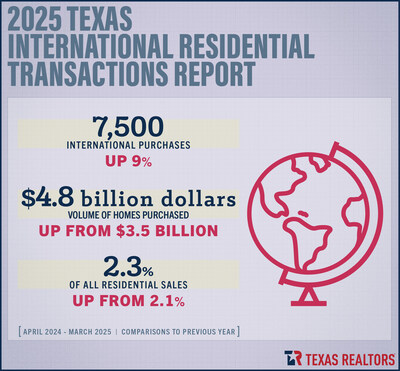
AUSTIN, Texas, Aug. 14, 2025 /PRNewswire/ — The number of residential properties sold in Texas to international buyers increased nearly 9% over the prior year, according to the 2025 Texas International Residential Transactions Report released by Texas Realtors. Approximately 7,500 buyers from other countries purchased Texas residential properties from April 2024 to March 2025, topping $4.8 billion in total dollar volume. That represents a $1.3 billion-dollar increase from the previous reporting period.

Despite the increase in activity, the number of sales falls far short of the high mark of 34,135 Texas home purchases by international buyers in 2017.

Median price is higher for purchases by international buyers
The $420,800 median price of homes purchased by international buyers was up 12% from last year and is $82,300 higher than the median for all Texas homes sold during the same time. International homebuying activity accounted for 2.3% of the total number of residential transactions, a slight increase from 2.1% a year ago.

Mexico remains the top country of origin
Thirty percent of all international buyers of Texas houses came from Mexico, followed by Canada and China (each at 8%), India (7%), and Nigeria (6%).

Texas was the top state in the U.S. for homebuyers from Mexico, accounting for 40% of all purchases, according to the National Association of Realtors 2025 International Transactions in U.S. Residential Real Estate. The next closest state, California, had 17% of all purchases by Mexican buyers.

Texas ranks third among U.S. states
Florida led all states in international activity, with 21% of U.S. residential purchases by international buyers, followed by California (15%), Texas (10%), New York (7%), and Arizona (5%).

Future purchase activity may be affected by new law
Beginning September 1, 2025, Texas law will restrict some property purchases and leases for people and entities from certain countries deemed to be a national security threat (currently China, Iran, North Korea, and Russia). Exceptions to the law include U.S. citizens and lawful permanent residents.

Realtors are professionals who can help all buyers
Texas clearly has much to offer homebuyers from all over the globe,” said Christy Gessler, chairman of Texas Realtors. “A Texas Realtor is the best resource to assist an international client, with extensive market knowledge and guidance to help them with any type of real estate transaction.”

About the Texas International Residential Transactions Report
This study was conducted by the National Association of REALTORS® for Texas REALTORS®. Information about international residential real estate transactions of Texas REALTORS® members pertain to the period April 2024–March 2025. The period is referenced in the report as “2025,” while the prior survey period is referred to as “2024.”

About Texas REALTORS®
With more than 140,000 members, Texas REALTORS® is a professional membership organization that represents all aspects of real estate in Texas. We are the advocates for REALTORS® and private property rights in Texas. Visit texasrealestate.com to learn more. 

About National Association of REALTORS®
The National Association of REALTORS® (NAR) is America’s largest trade association, representing more than 1.5 million members involved in all aspects of the real estate industry. The term REALTOR® is a registered collective membership mark that identifies a real estate professional who is a member of the National Association of REALTORS® and subscribes to its strict Code of Ethics.

CONTACT
David Gibbs
Hahn Agency
david.gibbs@hahn.agency

Cision View original content to download multimedia:https://www.prnewswire.com/news-releases/international-homebuying-activity-in-texas-is-up-302529519.html

SOURCE Texas Realtors

Privacy Overview

This website uses cookies so that we can provide you with the best user experience possible. Cookie information is stored in your browser and performs functions such as recognising you when you return to our website and helping our team to understand which sections of the website you find most interesting and useful.