
Author: sHq_LoGiNz
CHARLOTTE, N.C., July 17, 2026 /3BL/ – Discovery Education today announced that its Digital Citizenship Initiative has been named a 2026 CODiE Award Winner in the category Best Digital Citizenship Solution, presented by the Software & Information Industry Association (SIIA). The recognition follows the Initiative’s selection as one of five Discovery Education solutions named 2026 CODiE Award finalists earlier this year.
Now in its 40th year, the CODiE Awards are the technology industry’s most established peer-reviewed recognition program, celebrating excellence and innovation in education technology. Selected from 228 finalists across 75 categories, winners are determined through a rigorous evaluation process conducted by independent industry experts who assess each solution for innovation, functionality, market impact, and overall value.
“Students are growing up in a world shaped by rapid innovation, and they need the digital fluency and critical thinking to navigate it safely and confidently,” said Catherine Dunlop, Senior Vice President of Corporate Partnerships at Discovery Education. “Through the Digital Citizenship Initiative, we partner with leading industry experts to give educators free resources that turn today’s digital challenges into practical classroom learning. This CODiE Award affirms the importance of that work and the commitment of educators preparing students to participate responsibly in our digital world.”
Launched in February 2025, the Digital Citizenship Initiative gives educators and students the tools and knowledge to participate responsibly in today’s digital world. Grounded in Discovery Education’s research report, From Risks to Resilience: Why Digital Citizenship Matters in K-12 Education, the Initiative translates documented student challenges — including misinformation, cyberbullying, privacy risks, and emerging AI technologies — into structured, classroom-ready learning experiences delivered at no cost to schools.
“The 2026 CODiE Award winners represent some of the most innovative and impactful solutions in the industry,” said Jennifer Baranowski, President of the CODiE Awards. “These organizations are solving meaningful challenges, delivering measurable outcomes, and helping shape the future of technology.”
The CODiE Award win for Best Digital Citizenship Solution marks one of five finalist nominations Discovery Education received in the 2026 program. Discovery Education Experience, DreamBox Math, Science Techbook, and Sandbox Immersive Learning were also all honored as finalists. Together, the recognition underscores the breadth of Discovery Education’s portfolio and its focus on delivering practical, classroom-ready solutions across core instruction, supplemental learning, home education, and immersive experiences.
Announcement At-a-Glance
- Discovery Education’s Digital Citizenship Initiative won the 2026 CODiE Award for Best Digital Citizenship Solution, one of five Discovery Education solutions honored as 2026 CODiE Award finalists.
- Developed in partnership with Verizon, Norton, IBM, the Family Online Safety Institute, and #HalfTheStory.
- Launched in February 2025, the free curriculum addresses AI fluency, digital safety, online identity management, and media literacy at no cost to schools. Content includes lessons, educator guides, and an engaging video series, updated quarterly.
- First-year impact: Since its launch in 2025, the Initiative has reached nearly 1,000,000 students, with more than half of participating schools identified as Title I, and educators reporting stronger student engagement and awareness of digital behaviors.
To learn more about the Digital Citizenship Initiative, visit digitalcitizenship.discoveryeducation.com.
A complete list of 2026 CODiE Award winners is available at codieawards.com/winners.
About Discovery Education
Discovery Education is a global education technology leader whose innovative solutions empower educators and progress student learning. Discovery Education’s solutions have served more than 100 million students globally, supporting effective teaching and learning in 45% of U.S. K-12 schools and in 100+ countries and territories. The company’s portfolio includes award-winning core and supplemental curriculum, high-quality standards-aligned content, and AI-enabled teaching and learning tools. Solutions span math, science, literacy, social studies, and career-connected learning, including instructionally aligned content developed through one-of-a-kind partnerships with industry leaders to bring real-world relevance into every lesson. Learn more at www.DiscoveryEducation.com.
About the CODiE Awards
The CODiE Awards are the technology industry’s most established peer-reviewed recognition program. Since 1986, the CODiE Awards have recognized the companies and products transforming the way the world learns, works, and communicates. The awards span five tracks covering startup technology, developer and AI tools, digital transformation platforms, education technology, and industry-specific solutions. For more information, visit codieawards.com.
Media Contact
Ali Koper
Discovery Education
akoper@discoveryed.com
Originally published in GoDaddy’s 2025 Global Stakeholder Impact Report
By valuing individuality, we grow together.
At GoDaddy, we are committed to attracting, motivating, and retaining qualified talent from around the world. We work to create a diverse, inclusive, and equitable workplace where employees can learn, grow, and succeed. We believe a workforce that reflects the communities we serve strengthens our ability to experiment and innovate. The unique perspectives and experiences of our employees help us to better serve entrepreneurs globally.
Accountability and transparency are essential to this approach. Our Diversity, Equity, Inclusion, and Belonging Steering Committee, composed of senior leaders, plays a key role in fostering an inclusive employee and customer experience by providing feedback and direction as needed. We also support accountability through transparent public disclosures on workforce representation and pay parity.
Our People-Centered Strategy in Action
We put our people-centered strategy into practice through inclusive programs and policies across the employee experience. These efforts are designed to support employees individually and empower teams to deliver strong business outcomes.
We also integrate people-centered priorities into how we operate across our business. This includes a thoughtful approach to partnerships, investments, policies, and communications, supporting consistency between how we work internally and how we show up for our customers.
To better serve entrepreneurs, we seek to understand the diverse needs of the customers we support and use that insight to inform the enhancements we make to our solutions and tools as well as how and what we build in the future. By connecting employee experience to customer experience, we equip our teams to help entrepreneurs succeed.
Representation Matters
We believe representation matters because it helps us attract and retain the best talent and brings a wider range of perspectives into how we build and innovate. By reflecting the communities around us, we strengthen collaboration, creativity, and long-term performance.
Board Composition
Our business and long-term value creation are supported by our purpose to make opportunity more inclusive for all by serving a diverse customer base. In support of this purpose, our Board, in conjunction with the Nominating and Governance Committee, seeks qualified individuals to serve as directors who bring a broad mix of experience, skills, knowledge, personal and professional backgrounds, age, tenure, and diversity to the Board. For more information on our Board please review our 2026 Proxy Statement on our Investor Relations Governance page or the Frameworks & Metrics section in the Appendix.
Global Gender Diversity4
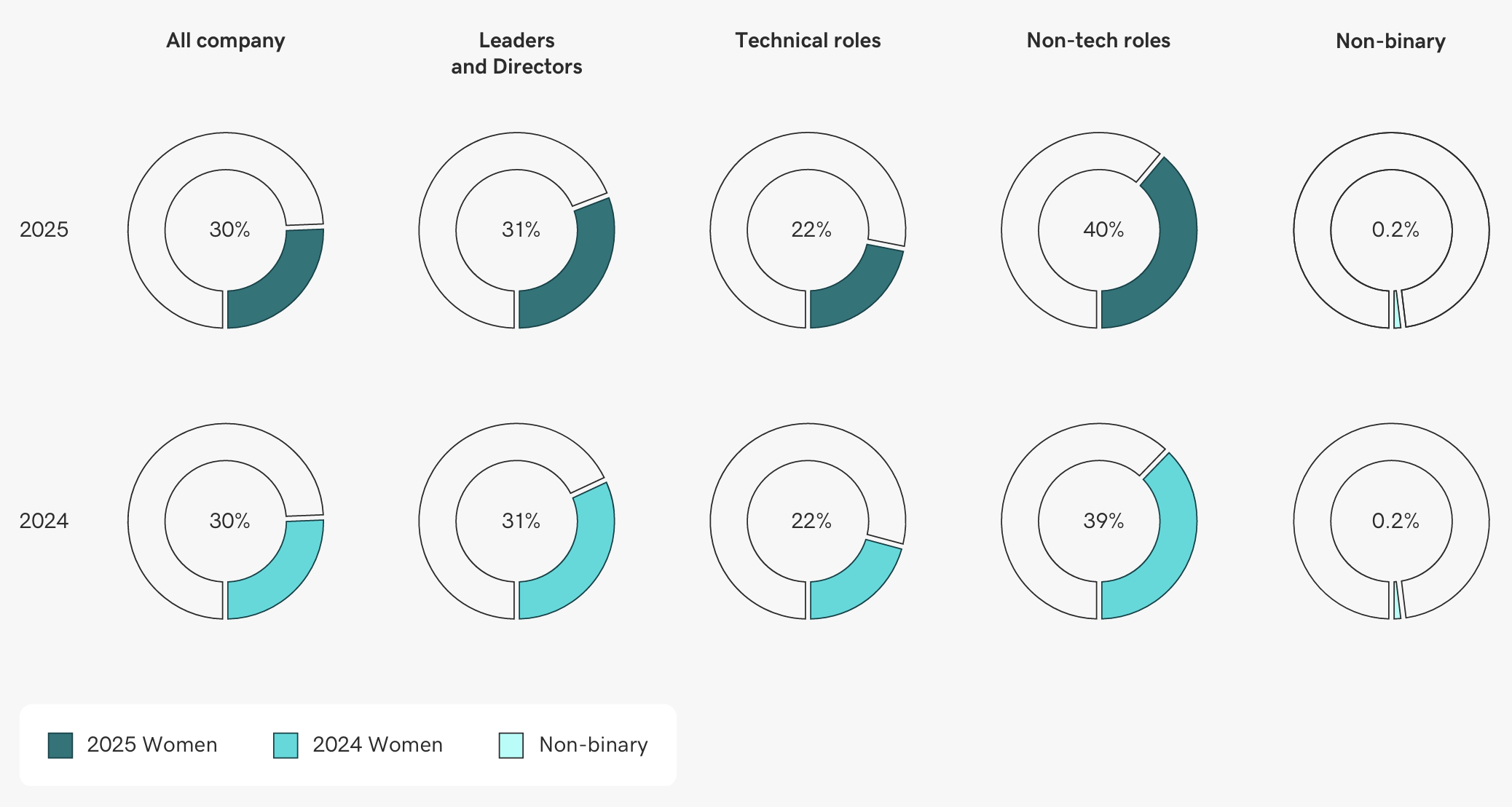
As illustrated below, women continue to represent approximately 30% of GoDaddy’s global workforce, while non-binary employees continue to represent 0.2%.
U.S. Racial & Ethnic Diversity5
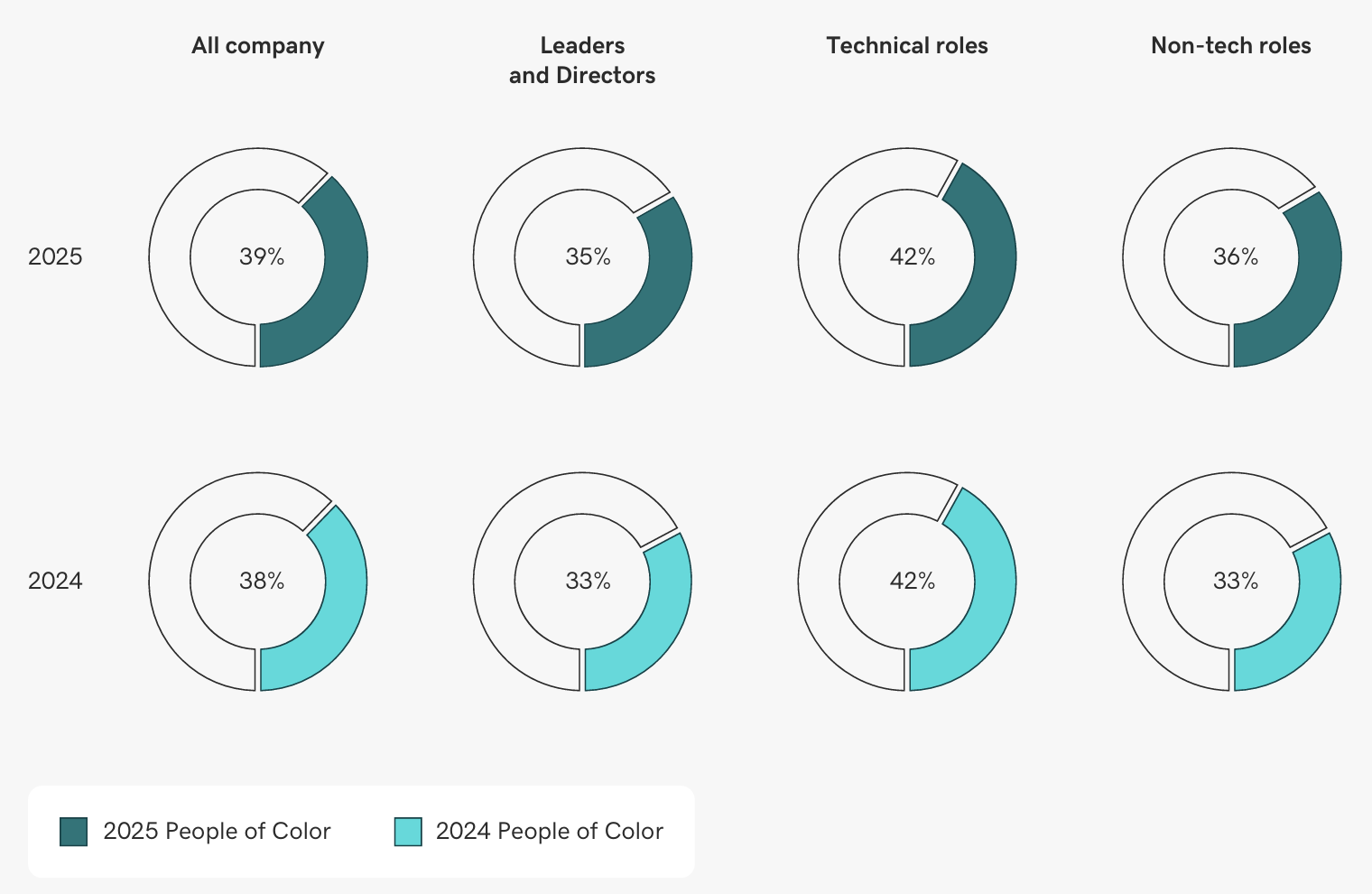
Employees of color represent 39% of GoDaddy’s U.S. workforce.
A Closer Look at U.S. Racial & Ethnic Diversity6
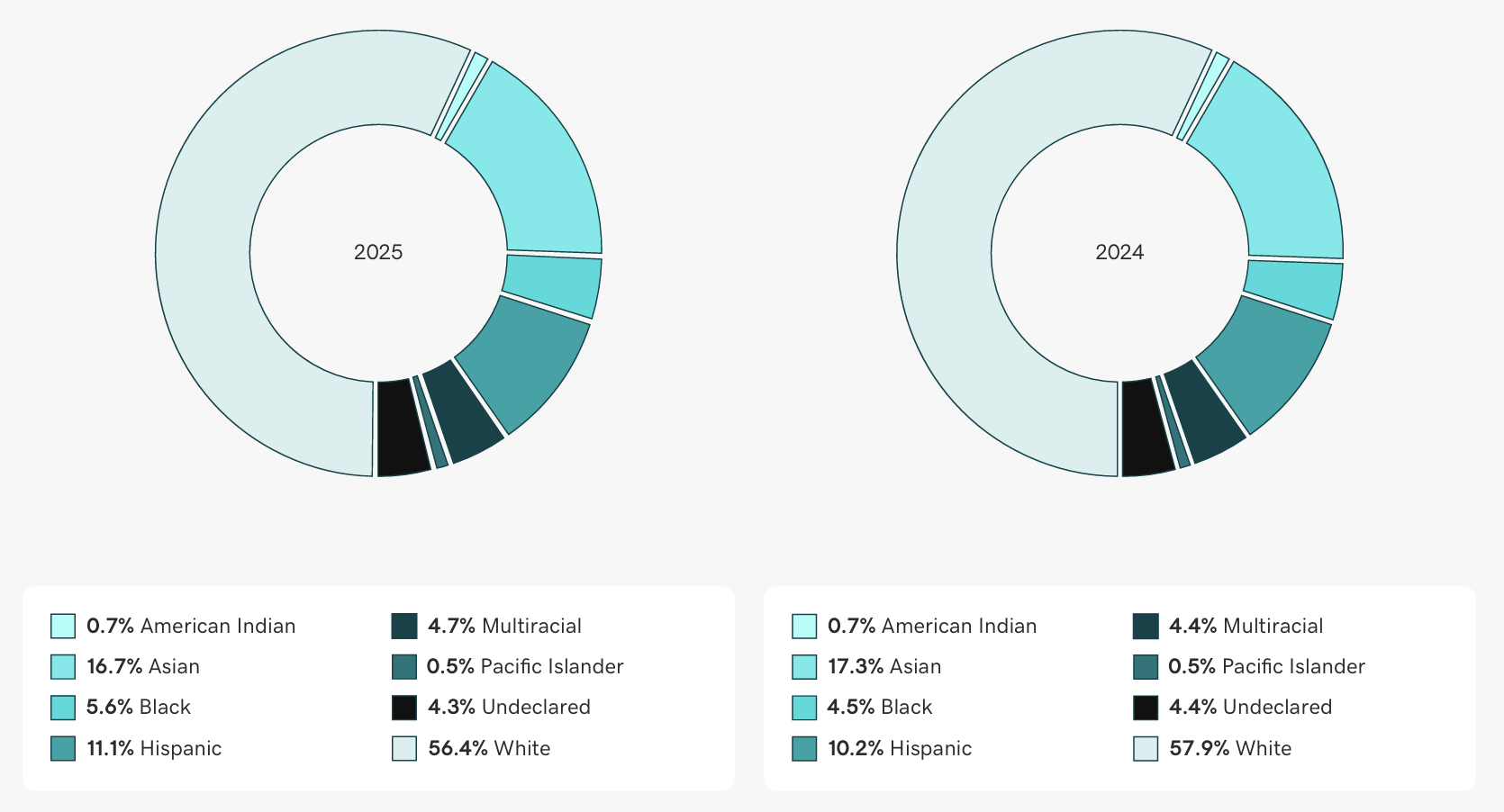
Employees who identify as Hispanic and Black increased by approximately one point each, while all other groups remained within a couple of tenths of percentage points year-over-year.
We recognize that ethnicity and race are distinct, and we continue to assess our data collection efforts against frameworks and guidelines from government reporting agencies and best practices. For more details on our workforce diversity, please refer to the Frameworks & Metrics section.
Pay Parity
Our compensation programs and practices are designed to pay our employees fairly based on the type of work they perform and their overall performance of such work. In 2015, we were among the first companies to publish pay parity results. We are proud to mark 11 years of sharing our gender pay data and nine years of U.S. race and ethnicity pay data. Our goal is to achieve $1.00-to-$1.00 pay parity after controlling for legitimate compensable factors, including role level, individual performance, tenure, location, and the timing of variable compensation such as bonuses and equity grants. We consider pay parity achieved when differences remain within a few cents on either side of the dollar.
Pay parity is not a one-time exercise, but an ongoing and rigorous process. We continue to partner with an independent third-party expert to conduct a multivariate regression analysis. This approach supports the use of established methods and standards and informs our ongoing analysis and mitigations. This also allows us to continue to provide transparency and accountability to current and prospective employees through publicly reported pay parity data. In addition, as pay equity frameworks and legislation evolve, we are better able to monitor our programs and compliance as needed.
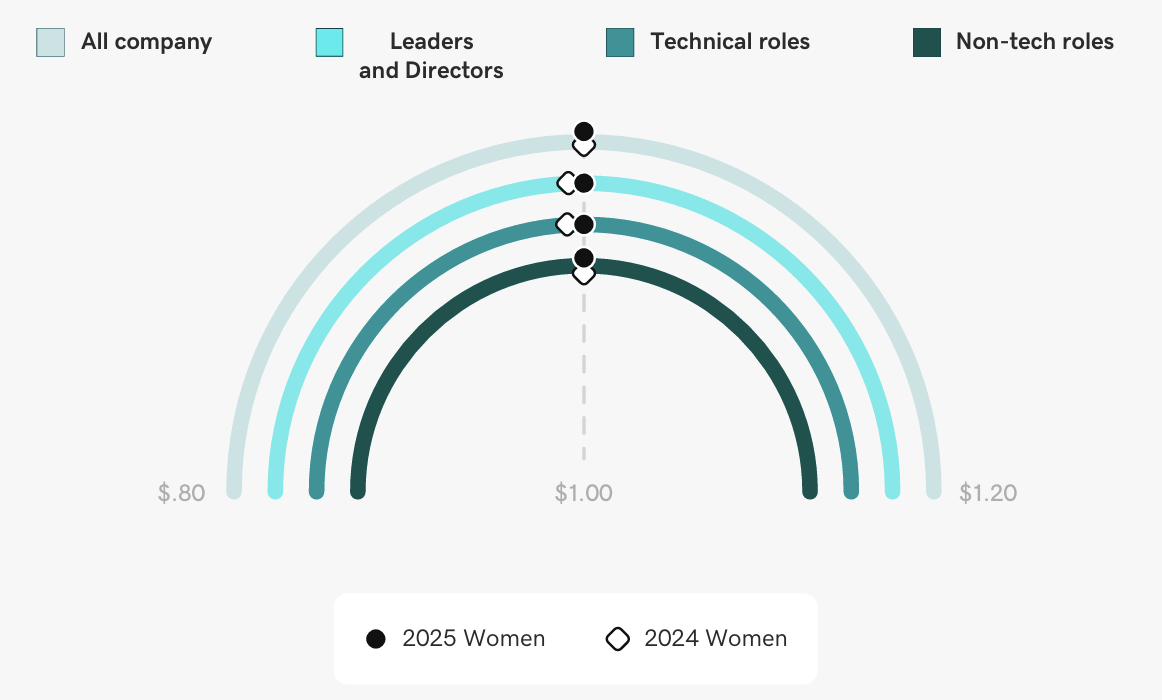
Gender Compensation Data7,8
As illustrated to the right, GoDaddy-wide, we continue to maintain global gender pay parity, paying employees fairly and equitably regardless of their gender. This commitment spans all career levels globally, as we believe true equity involves everyone.
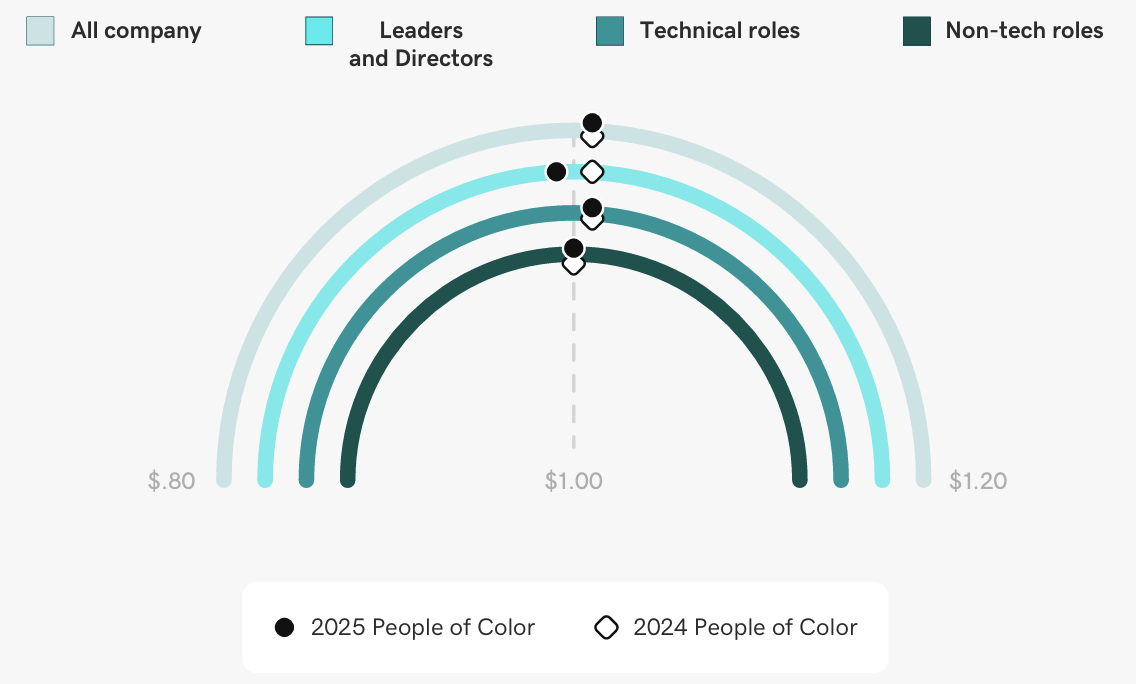
U.S. Race & Ethnicity Compensation Data9
We aim to pay employees fairly and equitably regardless of race and ethnicity. This data shows that people of color have comparable pay relative to white employees when performing comparable work.
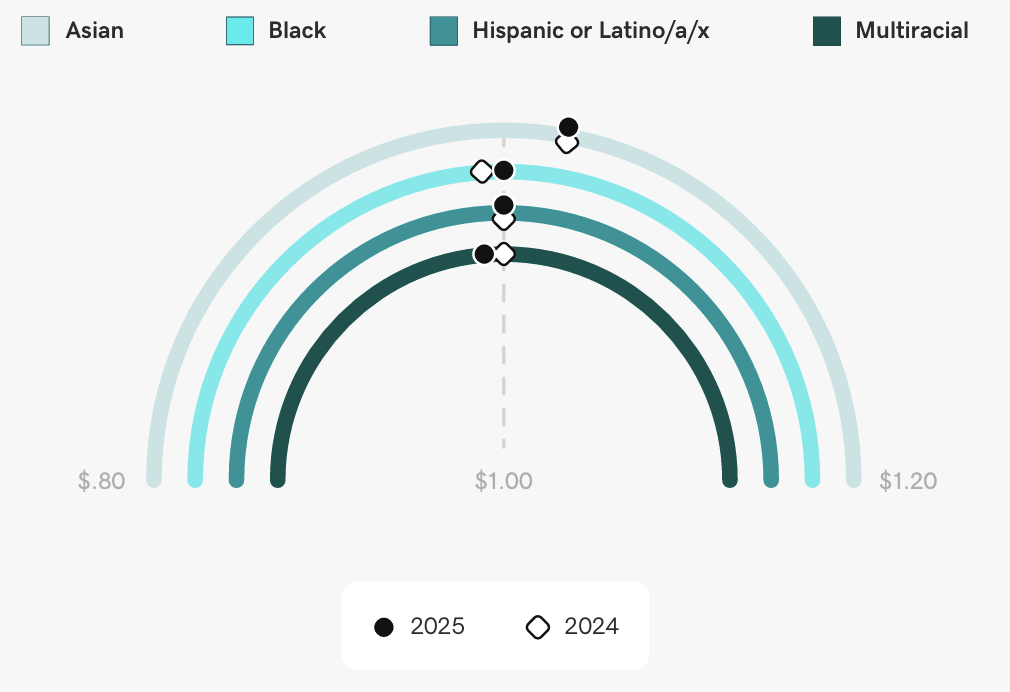
A Closer Look at Compensation Data — U.S. Race & Ethnicity10
4 Categories are not mutually exclusive.
5 Categories are not mutually exclusive.
7 Categories are not mutually exclusive.
8 While we continue to track the data for non-binary employees, the sample size is too small to report.
9 Categories are not mutually exclusive.
10 While we continue to track the data for American Indians and Pacific Islanders, the sample size is too small to report.
Learn more about GoDaddy’s 2025 Global Stakeholder Impact Report.
About this Report
The GoDaddy 2025 Global Stakeholder Impact Report details our progress toward our corporate sustainability goals, strategies, and initiatives in support of our overarching purpose and values. Unless otherwise noted, this report reflects our corporate sustainability performance across our global operations covering the fiscal year period from January 1 to December 31, 2025. To demonstrate our commitment to transparent communication regarding our sustainability progress, we routinely share updates through our website and our annual reporting. We welcome your questions, comments, and feedback on this report by contacting ESG@GoDaddy.com.
This report references the Global Reporting Initiative Standards, includes select Sustainability Accounting Standards Board metrics for the Internet Media and Services sector, and the Task Force on Climate Related Financial Disclosures. We also disclose our contributions and progress toward priority UN SDGs. For additional information on how we align with these frameworks and key indicators demonstrating our sustainability performance, please refer to the Frameworks & Metrics section.
About GoDaddy
GoDaddy, the world’s largest domain name registrar, helps millions of entrepreneurs globally start, grow, and scale their businesses. People come to GoDaddy to name their idea, build a website and logo, sell their products and services and accept payments. GoDaddy Airo®, the company’s AI-powered experience, makes growing a small business faster and easier by helping them to get their idea online in minutes, drive traffic and boost sales. GoDaddy’s expert guides are available 24/7 to provide assistance. To learn more about the company, visit www.GoDaddy.com.
by Gabriele Ballero, public affairs manager at Cascale
Greenwashing faces a real opponent in the form of European legislators. With consumers increasingly looking for more sustainable products, the way companies communicate environmental performance has been top of the EU policy watchlist for some time.
Alongside relevant country-specific legislation, Cascale’s public affairs team has been following both the Empowering Consumers for the Green Transition Directive (ECGT) and the Green Claims Directive quite closely. While the two are related, they serve different purposes. The ECGT restricts certain misleading or vague environmental claims made to consumers, while the Green Claims Directive was intended to introduce detailed rules on how environmental claims should be substantiated and verified.
Yet while this year ECGT moves to implementation, after the Commission announced its intention to withdraw the proposal, the Green Claims Directive is still stuck in Council. There is currently no clear timeline for whether, or in what form, it may move forward. Even so, companies can take several practical steps now to strengthen readiness.
Actions to Take Now
Don’t delay action. Entering into force September 27, 2026, ECGT will introduce new restrictions on misleading environmental claims. Their immediate priority will be to map all existing environmental and climate claims that companies doing business in the EU have made to consumers.
Brands should convene colleagues across marketing, legal, and product teams to flag any high-risk wording, and vet all packaging, advertising, websites, labels, and product descriptions to ensure compliance with the new rules.
Broad, generic environmental claims without appropriate substantiation will become significantly more restricted under the ECGT. Companies should steer clear of vague claims like “climate neutral,” “carbon positive,” “zero impact,”or “environmentally friendly.” In line with other generalizations, a company cannot market an entire product as “made with recycled material” if only one aspect (such as packaging) contains recycled material. Where recycled-content claims are intended for consumer-facing communications, companies should obtain clear information from suppliers on the scope and percentage of recycled content.
Companies should also exercise caution when making comparative environmental claims. Comparing products based on environmental or social characteristics or circularity aspects such as durability, reparability, or recyclability is increasingly common, but could mislead consumers if comparisons are unclear, incomplete, or not properly substantiated.
Manufacturers should ensure they have appropriate technical evidence supporting recycled-content claims, durability testing, environmental performance claims, and warranty terms. Retailers, traders or resellers are generally responsible for passing on information received from producers, although they are not expected to actively verify or seek information that has not been provided.
Ultimately, the ECGT is not a product disclosure framework — it is a consumer protection and marketing law. Its objective is to ensure that consumers receive accurate and reliable information when making purchasing decisions.
Your 3-month ECGT Readiness Checklist:
- Assemble a cross-functional task force: Convene marketing, legal, and product design teams to flag high-risk environmental or climate claims on all packaging, ads, and digital touchpoints before September 27, 2026.
- Eliminate vague generalizations: Completely phase out sweeping claims like “climate neutral,” “biodegradable,” or “eco-friendly” unless they can be robustly substantiated.
- Secure supplier percentages: Where consumer-facing recycled-content claims are planned, obtain exact, audited percentages and scopes from suppliers.
- Establish technical substantiation: Ensure manufacturers have verifiable durability testing, recyclability metrics, and warranty data ready.
What’s Next for Substantiation
The ECGT represents a sharp shift in how companies communicate environmental performance to consumers. While it introduces broad restrictions on misleading environmental claims, it leaves an important question unanswered: how those claims should be substantiated. That was the role envisaged for the proposed Green Claims Directive, though its future remains uncertain.
In light of this regulatory gap, standardized methodologies and credible sustainability data become increasingly valuable. Tools such as the Higg Index can support companies in strengthening the data, governance and measurement systems that increasingly underpin environmental claims. The adoption of the Apparel & Footwear PEFCR also demonstrates continued EU efforts to promote greater methodological consistency in measuring product environmental performance.
Regardless of the future of the Green Claims Directive, the direction is clear: companies should expect increasing scrutiny of environmental claims and continue strengthening the governance, data, and substantiation processes that support consumer-facing communications.
Cascale Corporate and Affiliate Members can continue exploring these developments during the EU Policy Briefing for Cascale Members on July 20. The member-only session will cover key EU policy updates across corporate sustainability reporting, product sustainability, human rights and due diligence, circularity, and consumer information — including how these developments may affect internal planning, data needs, supplier engagement, and value chain readiness.
Interested in accessing member briefings, expert insights, and opportunities to engage with peers across the consumer goods industry? Learn more about Cascale membership.
Disclaimer: This information is provided for informational purposes only, and should not be construed as legal advice on any subject matter.
Gabriele Ballero is Cascale’s manager of public affairs.
KeyBank and the Buffalo Sabres brought together community spirit, philanthropy, and hometown pride on July 16 during a special Give 716 Celebration at KeyBank’s Northtown Branch in Amherst, NY.
Give 716, the annual online giving event led by the Buffalo Bills Foundation and Buffalo Sabres Foundation, has become a powerful platform for connecting residents with the nonprofit organizations that serve local communities. The initiative helps nonprofits raise critical funding while generating awareness for missions that address a wide range of community needs.
Supporting the Organizations That Strengthen Western New York
The event highlighted the power of collective giving in Western New York and encouraged residents to support the nonprofit organizations that strengthen communities across the region. Sabres legends Rob Ray and Derek Roy joined fans alongside Sabretooth for an afternoon that celebrated both local generosity and Buffalo hockey.
As part of the celebration, the first 50 attendees who showed proof of a donation of $71.60 or more to Give 716 received a Rasmus Dahlin jersey, motivating participants to support causes that matter throughout Western New York.
KeyBank is proud to support Give 716 alongside the Buffalo Sabres as part of its ongoing commitment to investing in the people, neighborhoods, and organizations that help Western New York thrive.
“Give 716 is a great example of what makes Western New York special,” said Chiwuike Owunwanne, KeyBank Corporate Responsibility Officer in Buffalo. “When businesses, sports teams, nonprofits, and residents come together around a common purpose, the impact is significant. Every donation helps strengthen our region and the communities we call home.”
A Partnership Built Around Community
KeyBank’s relationship with the Buffalo Sabres extends far beyond hockey. Together, the organizations have partnered on initiatives such as Give 716 and HocKey Assists that celebrate community pride, support local nonprofits, and create opportunities for residents across Western New York.
Community investment is a cornerstone of KeyBank’s corporate responsibility efforts. KeyBank works alongside nonprofit organizations, civic leaders, and community partners across the communities it serves to help create economic opportunity, advance neighborhood revitalization, and support programs that improve quality of life.
News Summary
- LG Electronics’ just-released 2025-26 Sustainability Report highlights that the company’s Scope 1 and Scope 2 emissions in 2025 fell below the company’s 2030 target level, while its waste recycling rate reached 97.3 percent.
- Reinforcing its global ESG leadership, LG is ranked in the S&P Global’s CSA “Top 1%” for the third consecutive year while also earning recognition in other trusted assessments.
- LG expanded accessibility across its products and services with solutions including the LG Comfort Kit, accessible kiosks and LG Easy TV.
- The company strengthened Responsible AI governance, introducing a new Responsible AI section in the report detailing accountability and transparency across AI development and use.
SEOUL, South Korea, July 17, 2026 /3BL/ – Global ESG management leader LG Electronics has released the LG 2025-26 Sustainability Report, which highlights the company’s ongoing worldwide efforts to realize its vision for A Better Life for All.
The newly issued report outlines LG’s key ESG (environmental, social and governance) initiatives for stakeholders around the world and reveals that in 2025 the company surpassed its 2030 targets for both greenhouse gas (GHG) emissions reductions and waste recycling rate.
EMISSIONS
In 2025, LG’s Scope 1 (direct) and Scope 2 (indirect) emissions across all domestic and overseas business sites totaled 842,000 tons of CO₂ equivalent (tCO₂eq) – a figure significantly lower than the company’s 2030 target of 878,000 tCO₂eq. This achievement reflects the success of LG’s organization-wide efforts to reduce GHG emissions by 54.6 percent by 2030 (from 2017 levels). Key initiatives include the adoption of energy-efficient equipment and the transition to renewable electricity.
LG also exceeded its 2030 target for reducing emissions intensity during the use stage of seven major product categories. In 2025, the company reduced carbon emissions per unit during the use stage of its seven major categories by 22.5 percent compared to 2020. The target, a 20 percent reduction in per-unit GHG emissions from product use by 2030 – using 2020 as a baseline – was previously validated by the Science Based Targets initiative (SBTi). LG is the first South Korean home appliance manufacturer to receive SBTi validation for such a target.
CIRCULARITY
In addition to its GHG reduction targets, LG has exceeded its resource circularity goals. The company recorded a waste recycling rate of 97.3 percent across all domestic and overseas business sites in 2025 – surpassing its 2030 goal of 95 percent.
The company maintained Zero Waste to Landfill (ZWTL) certification across all domestic operations, with all five domestic production sites achieving the highest Platinum rating. LG collected 640,000 tons of used electronics from 91 locations across 56 countries in 2025, bringing its cumulative total of e-waste recovery to over 5.65 million tons since 2006.
ACCESSIBILITY
Along with the effectiveness of LG’s environmentally-focused programs, the 2025-26 Sustainability Report demonstrates the company’s continued drive to enhance the accessibility of its products and services.
Key offerings include the LG Comfort Kit, designed to make home appliances easier to use regardless of age, gender or disability; accessibility initiatives such as the broader application of braille and tactile guides, as well as kiosks equipped with sign-language avatars at service locations; and the LG Easy TV, specifically engineered for seniors. LG also provides a range of inclusive services, including sign language consultations for the hearing impaired, and dedicated consultation services for senior customers.
GOVERNANCE
To strengthen board independence and governance transparency, LG has separated the roles of CEO and board chairperson. Earlier this year, the company further reinforced oversight by appointing an independent director as board chairperson.
The new sustainability report also features a newly-introduced section on Responsible AI, outlining the company’s AI Ethics Principles and governance framework in response to the growing adoption of AI technologies. Going forward, the company plans to continuously bolster its governance framework to ensure accountability and transparency across the development and use of AI.
RECOGNITION
A global ESG leader, LG has again been recognized by the world’s premier ESG rating agencies. The company has now been included in the Dow Jones Best-in-Class World Index (DJBIC World) for 14 consecutive years and has ranked in the “Top 1%” of S&P Global’s Corporate Sustainability Assessment (CSA) for three years in a row.
LG also earned an “AA” rating from Morgan Stanley Capital International (MSCI) this year, one level higher than it achieved the previous year. Additionally, the company has received its second consecutive “Platinum” rating from EcoVadis, a distinction reserved for the top one percent of companies in their industry category.
LG has published its annual sustainability report since 2006. The full 2025-26 report is available on LG’s global website.
* Greenhouse gas emissions generated over a product’s average lifetime, expressed on a per-unit basis.
# # #
About LG Electronics Inc.
LG Electronics is a global innovator in technology and consumer electronics with a presence in almost every country and an international workforce of more than 75,000. LG’s four Companies – Home Appliance Solution, Media Entertainment Solution, Vehicle Solution and Eco Solution – combined for global revenue of over KRW 89 trillion in 2025. LG is a leading manufacturer of consumer and commercial products ranging from TVs, home appliances, air solutions, monitors, automotive components and solutions, and its premium LG SIGNATURE and intelligent LG ThinQ brands are familiar names world over. Visit www.LG.com/global/newsroom/ for the latest news.
About LG Electronics USA
LG Electronics USA Inc., based in Englewood Cliffs, N.J., is the North American subsidiary of LG Electronics Inc., a smart life solutions company with annual global revenues of more than $60 billion. In the United States, LG sells a wide range of innovative home appliances, home entertainment products, commercial displays, air conditioning systems and vehicle components. LG is an 11-time ENERGY STAR® Partner of the Year and was named to the 2026 Forbes Accessibility 200 list. www.LG.com.
Media Contact:
LG Electronics North America
John I. Taylor
+1 202 719 3490
john.taylor@lge.com
Whirlpool Corporation has once again been recognized for its long-standing commitment to corporate responsibility, earning a position on the Dow Jones Best-in-Class Indices (formerly DJSI). This year marks the company’s fourth consecutive year on the World Index and its 19th appearance on the North America Index.
In addition to its inclusion in the Dow Jones indices, Whirlpool Corporation has been featured in the 2026 S&P Global Sustainability Yearbook. The company placed among the top 10% of more than 9,200 companies evaluated worldwide, a testament to transparency and commitment to corporate responsibility.
“We are proud that our focus on innovation seamlessly integrates sustainability into how we design, how we manufacture, and how products perform and improve life at home.”
“Being recognized for leadership in sustainability and our continued inclusion in these indices validates and reinforces our deep commitment to environmental stewardship,” said Beat Stocker, senior director of global sustainability at Whirlpool Corporation. “We are proud that our focus on innovation seamlessly integrates sustainability into how we design, how we manufacture, and how products perform and improve life at home.”
For more information on Whirlpool Corporation’s sustainability progress and most recent achievements, visit the Corporate Responsibility Resource Center or view the latest Corporate Responsibility reports.
About Whirlpool Corporation
Whirlpool Corporation (NYSE: WHR) is a leading home appliance company, in constant pursuit of improving life at home. As the only major U.S.-based manufacturer of kitchen and laundry appliances, the company is driving meaningful innovation to meet the evolving needs of consumers through its iconic brand portfolio, including Whirlpool, KitchenAid, JennAir, Maytag, Amana, Brastemp, Consul, and InSinkErator. In 2025, the company reported approximately $16 billion in annual net sales – close to 90% of which were in the Americas -41,000 employees, and 35 manufacturing and technology research centers. Additional information about the company can be found at WhirlpoolCorp.com.
View original content here.
WASHINGTON, July 17, 2026 /3BL/ – The Congressional App Challenge and Qualcomm Incorporated today announced Engineering the Future: Educator Arduino Scholarship, a new national initiative to expand access to physical computing tools for middle and high school students participating in the Congressional App Challenge. Through the program, educators across the country can apply for sets of Arduino® UNO™ Q boards, enabling students to build hands-on, hardware-enabled projects that connect software to real-world applications, from environmental monitoring and health tracking to assistive technology and community-based solutions.
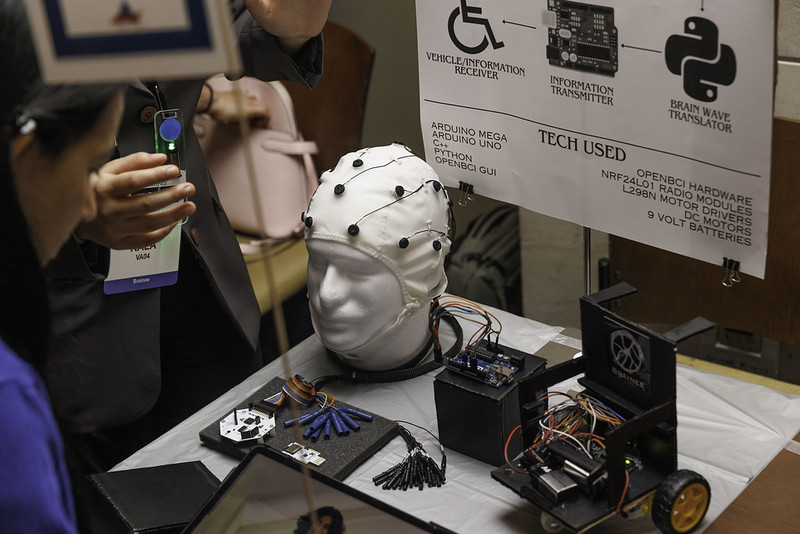
Qualcomm Technologies, Inc. acquired Arduino in October 2025 to empower students, educators, and developers by facilitating access to its unmatched portfolio of edge technologies and products. The Arduino UNO Q is a newly released board that helps enable students to bring code into the physical world. This is done by connecting software to sensors, lights, motors, and other components, supporting interactive projects that help students design, test, and iterate real systems while learning core hardware and coding skills.
Many students participating in the Challenge have strong ideas and technical ability but limited access to hardware. This scholarship is designed to address that gap by placing tools directly in student hands where educators can guide them from concept through working prototypes. The scholarship prioritizes under-resourced and rural schools, expanding access to opportunities that allow students to build, test, and iterate on real systems using Edge AI. Arduino boards are also heavily used in industries such as automotive, aerospace and IOT to help prototype and commercialize products, providing the foundation for students to gain highly valuable skills that directly transfer into industry.
The program is delivered in collaboration with the Congressional App Challenge, the official coding competition of the U.S. House of Representatives, and the largest high school coding competition in the country. Each year, the Challenge engages nearly 14,000 students across all 50 states, and all Arduino UNO Q boards awarded through this scholarship will support students or teams preparing to submit an app, ensuring the tools are tied directly to real projects and outcomes.
“Students don’t just want to code, they want to build things that work in the real world,” said Joe Alessi, Program Director of the Congressional App Challenge. “What we see every year is that when students have access to tools like Arduino, the quality and ambition of their projects change completely. This partnership collaboration with Qualcomm gives more students that opportunity and brings hardware into classrooms that otherwise wouldn’t have it.”
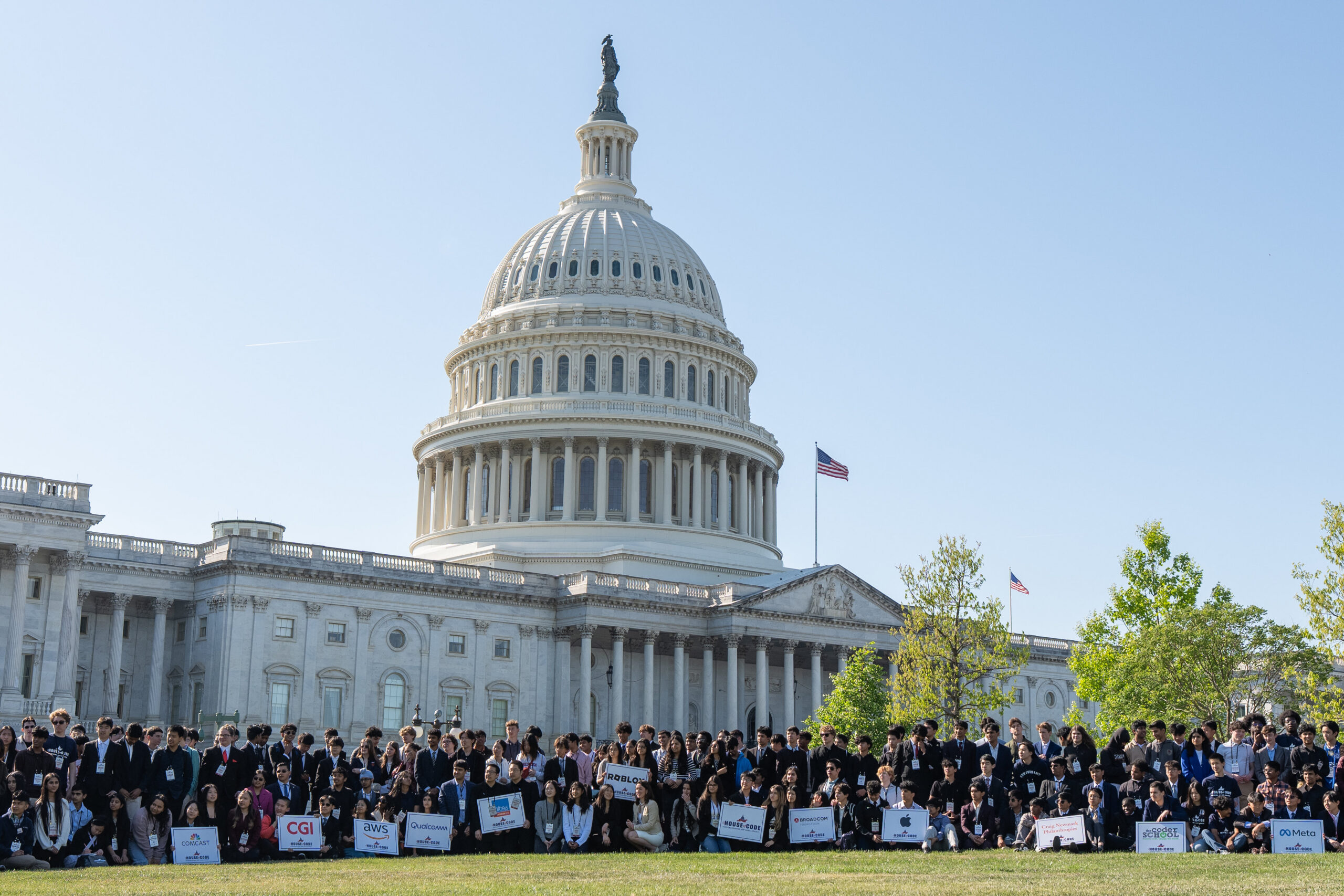
Members of Congress will have the opportunity to recognize participating schools and educators in their districts, highlight student projects that incorporate both software and hardware, and engage directly with classrooms through visits and local events, strengthening the connection between local innovation and national priorities around technology and workforce development.
As part of the initiative, select Congressional App Challenge alumni will share examples of how they have used Arduino boards in their own projects, from dorm-room automation and smart plant monitors to assistive tools and sensor-based systems, offering practical examples that show what is possible with accessible hardware and giving students a clear starting point for their own ideas. Throughout the academic year, Qualcomm and the Congressional App Challenge will also highlight participating classrooms through local and regional media, school visits, and short video features focused on what students are building and how they are approaching real-world problems.

Applications for the Educator Arduino Scholarship are open now, supporting a new generation of builders preparing to define the next era of U.S. innovation. The program addresses a growing need as more student projects incorporate real-world data, sensors, and AI-enabled features, while many classrooms still lack access to the hardware required to support that work. Awardees will be notified in August, and Arduino UNO Q boards will be distributed shortly thereafter. Students supported through this program will be preparing submissions for the 2026 Congressional App Challenge, with a submission deadline of October 26, 2026 at 12:00 PM ET.
Educators can learn more about the scholarship and apply below!
Qualcomm branded products are products of Qualcomm Technologies, Inc. and/or its subsidiaries. Arduino and UNO are trademarks or registered trademarks of Arduino S.r.l.