
Month: June 2026
Key Points
- Several Marathon Petroleum refineries set themselves apart from industry peers at this year’s American Fuel & Petrochemical Manufacturers (AFPM) Safety Awards.
- The Detroit, Michigan, refinery became a back-to-back winner of the Distinguished Safety Award, AFPM’s most prestigious honor.
- MPC refineries in Mandan, North Dakota, and St. Paul Park, Minnesota, received AFPM’s second highest award, while six other company facilities were also recognized for their safety performance in 2025.
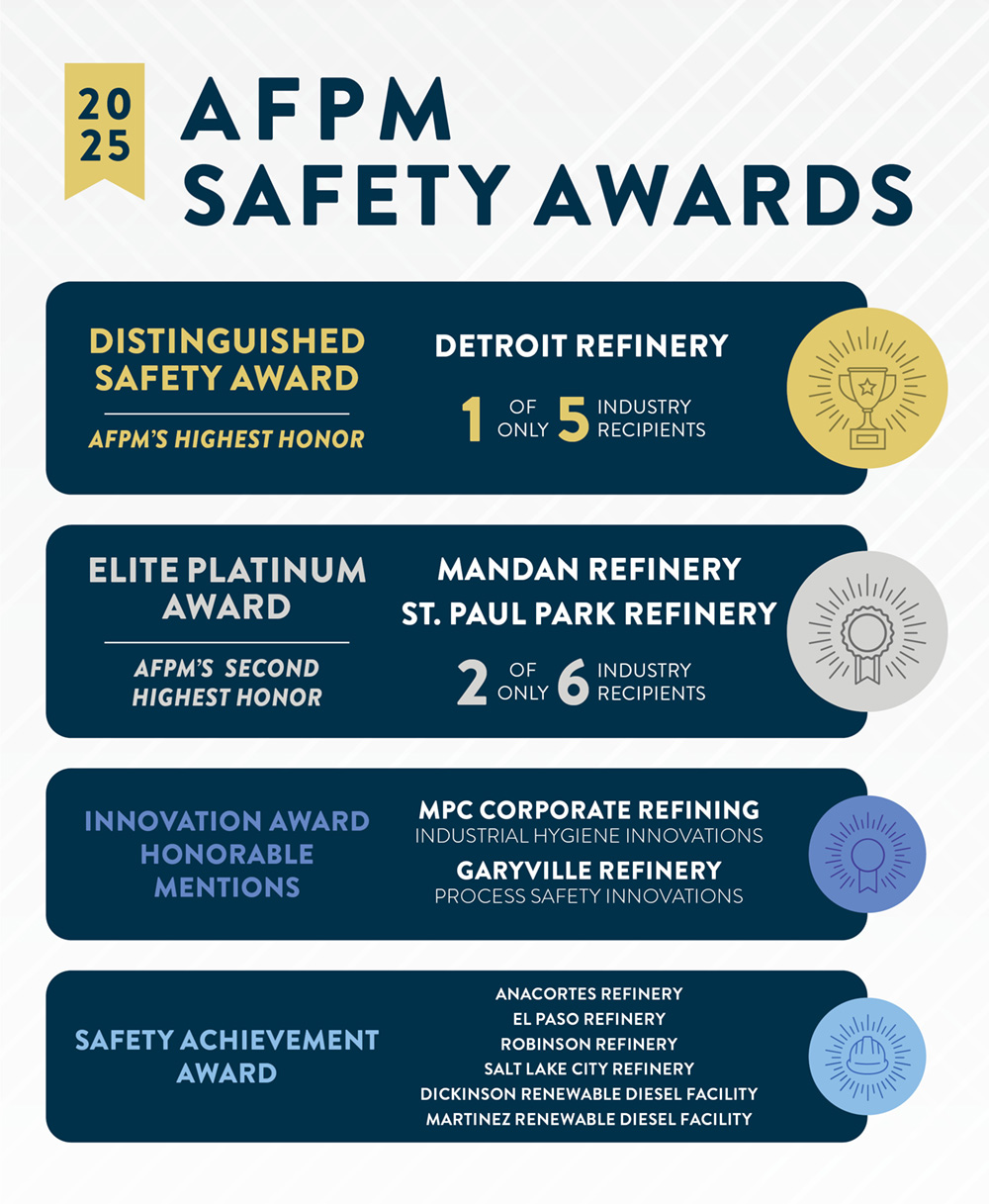
The American Fuel & Petrochemical Manufacturers (AFPM) refers to winners of its Distinguished Safety Award (DSA) as the industry’s best of the best. For the third year in a row, Marathon Petroleum Corporation (MPC) is represented in this exclusive group. The company’s Detroit, Michigan, refinery received the DSA at this year’s AFPM Safety Awards for its 2025 performance.
“We encourage employees to challenge the status quo and ask, ‘Is there a better way?’, before beginning any task,” Detroit Personal Safety Manager Eric Sponaugle said. “Our focus on supporting frontline employees, from leadership being engaged at all levels to additional training for upskilling, promotes speaking up if something doesn’t feel right.”
“Experienced employees played a critical role in shaping new team members, fostering a sustainable safety culture rooted in ownership, accountability, and peer support.”
Detroit’s award was its second consecutive DSA, making it one of only seven back-to-back winners of AFPM’s highest honor in the last 35 years. The refinery was one of five winners from a pool of 11 DSA finalists that also included MPC’s refineries in Mandan, North Dakota, and St. Paul Park, Minnesota.
A selection committee examined the safety performance records of DSA finalists and interviewed site teams in person before choosing the winners. As finalists that were not selected, the Mandan and St. Paul Park refineries earned AFPM’s second highest honor, the Elite Platinum Award.
“This award created a strong sense of pride across the site and reinforces the behaviors that have driven our success,” said Mandan Personal Safety Manager Cullen Rosine. “It also motivates our team to stay focused on the daily commitment to safety that made it possible.”
 The DSA recognizes a sustained, exemplary level of safety performance. Among other award criteria were no workplace-related fatalities for the previous five consecutive years; no days-away injuries associated with life-critical tasks in 2025; and no community evacuations or shelter-in-place events in 2025.
“This journey was defined by a strong emphasis on mentorship and intentional culture development,” St. Paul Park Personal Safety Manager Michael Roache said. “Experienced employees played a critical role in shaping new team members, fostering a sustainable safety culture rooted in ownership, accountability and peer support.”

MPC also received other AFPM accolades:
- Innovation Award Honorable Mentions – The Garyville, Louisiana, refinery was recognized for process safety innovations, and MPC Corporate Refining was acknowledged for industrial hygiene innovations.
- Safety Achievement Award for maintaining high safety standards – Recipients were MPC’s refineries in Anacortes, Washington; El Paso, Texas; Robinson, Illinois; and Salt Lake City, Utah; as well as the company’s renewable diesel facilities in Dickinson, North Dakota, and Martinez, California.
In the past three years, MPC has received 26 AFPM safety awards, including six DSAs. Last year, the Detroit, Kenai, Alaska, and El Paso refineries earned the DSA. Two years ago, the Canton, Ohio, and Robinson refineries received the honor.
by Erlinda Lee
In the age of artificial intelligence, geopolitical instability, and tariff turbulence, sustainability has never been more challenging to get right. The rules are changing. As sustainability expectations grow and regulations evolve, the industry does not need more disconnected systems. It needs greater alignment around credible approaches, shared measurement, and common expectations.
Cascale’s origins are all about collective action. Today, we help organizations reduce duplication, improve efficiency, navigate regulatory complexity, and make more informed business decisions through common measurement, shared tools, pre-competitive industry collaboration, and shared progress on climate action and decent work.
By bringing companies together around credible frameworks and practical solutions, we help members spend less time navigating fragmentation and more time driving measurable progress across their value chains.
Our 2026 offerings address every level of sustainability ambition while giving a clear sense of ownership, flexibility, pricing transparency, and stronger alignment.
In this upcoming blog series, we’ll walk through some of these pathways in greater depth. For now, here’s what prospective members need to know.
How You Can Join Us
- At any level of sustainability knowledge, Cascale membership enables scaled industry ambitions.
- Members now have greater flexibility in how they access tools, services, and community support, with clearer choices and pricing transparency.
- With a focus on measurement, the new Associate membership offering helps members build a credible baseline and reduce duplication.
- Refined Corporate membership helps members align with the industry and accelerate progress at scale.
- Affiliate membership remains unchanged for the upcoming member cycle.
At a glance, there are three unique sustainability offerings, which were shaped in consultation with 110 Cascale members. Affiliate membership remains a dedicated pathway for nonprofit, academic, public-sector, and other non-corporate organizations to contribute expertise, perspective, and partnership to Cascale’s mission. Associate membership is designed for organizations primarily focused on measurement, reporting, and building a credible sustainability baseline.
Corporate membership is designed for organizations ready to go further — beyond measurement — and actively engage with the industry to help shape shared priorities and drive collective progress, while strengthening owned sustainability performance and business resilience. Across all pathways, Cascale membership brings the industry together to set shared priorities and turn alignment into measurable progress.
Like-minded Community
No matter what stage you are at in your sustainability journey, Cascale membership offers a like-minded community and a place to pre-competitively scale impact. Cascale’s role in stewarding and governing the Higg Index framework and methodology remains, as does our commitment to member guidance, value, pricing transparency, and community. That’s why we went straight to the source when redesigning these offerings (thank you to all who supported this transformation).
These new plans further emphasize member and prospective member needs, so that together we can drive systems change in consumer goods. You don’t have to do it alone. By working through common frameworks and pre-competitive collaboration, you can help reduce duplication, strengthen consistency, and move the industry from fragmented action toward shared progress.
Guidance Along the Way
For anyone curious about Cascale – no matter your sustainability ambition – we encourage you to get in touch. And for members, the May member webinar (available now on Cascale Connect) captured all of the updates, including unchanged Affiliate plans, new Associate offerings, and refined Corporate membership. As Jeremy Lardeau (our newly appointed senior vice president, industry activation and growth) shared in the webinar: many members will actually see reduced pricing this year.
That’s a reflection of the renewed flexibility, transparency, and differentiated offerings we committed to delivering to our members.
Whether organizations are establishing foundational sustainability practices or helping shape industry-wide solutions, the goal remains the same: enabling meaningful progress through shared action. No single company can transform the consumer goods industry alone, which is why Cascale membership has become an imperative.
New to Cascale? Fill Out the Become a Member Form
Erlinda Lee is Senior Director, Member Development at Cascale