
Month: June 2026
Originally published on GoDaddy Resource Library
Tell us a little bit about yourself and your career journey to date.
I’ve been at GoDaddy for 16 years, and my career has grown and changed quite a bit along the way.
I began my career in marketing and PR at smaller organizations, and early on I also gained hands‑on experience as a trainer and executive assistant. Those experiences shaped how I think about communication, people, and how work really gets done.
When I joined GoDaddy, I spent 12 years in marketing and brand, working across creative, events, sponsorships, customer marketing, and with our Web Pro community. I had the opportunity to work on several “Big Game” campaigns, meet many of our celebrity partners, and be part of some really memorable events. But the moments that stayed with me the most were the ones spent with our small business customers. Hearing their stories and seeing the impact of their work firsthand was always the most meaningful part.
A few years ago, my path took an unexpected turn when my role was eliminated during a restructuring. Not long after, I was given the opportunity to step into a Chief of Staff role in People Operations. It was completely new to me and pushed me outside of my comfort zone, but it opened a door I didn’t know I needed.
I’ve now spent nearly four years in People Operations and it feels like everything has come together. I’m able to bring my background in brand, project management, and creative problem-solving together with a focus on people and impact. It feels like home.
One thing that’s stayed consistent is that I’ve never been driven by title or how quickly I could move up. What’s mattered most is doing good work with good people, and I’ve been fortunate to find that at GoDaddy.

What was the turning point that most accelerated your career?
The biggest turning point was saying yes to the Chief of Staff role, even though I didn’t feel ready.
I had spent my career in marketing and was stepping into a completely new space. I had a lot of self-doubt, but I also had people around me who believed I could do it. Over time, I started to believe it too.
That experience taught me that growth comes from stepping into something new and figuring it out along the way. It also reinforced that you can lead with both your head and your heart and still drive real impact.
How do you decide which initiatives deserve focus when everything feels important?
When everything feels important, I come back to impact. I ask what will truly move the business forward and where our effort will make the biggest difference.
Not everything can be a priority, and that’s okay. Being clear about what we’re not doing is just as important as what we are. That clarity helps teams stay focused and do their best work.

What’s the most surprising insight you’ve uncovered through experimentation?
You don’t have to do something big to learn something big.
Some of the most valuable insights come from small changes. For me, experimentation is really about creative problem-solving. It’s about staying curious, trying something, and learning from it. Over time, those small learnings add up and lead to better decisions.
How does GoDaddy’s culture or values show up in the way you approach work?
GoDaddy’s culture shows up in the way we’re encouraged to take ownership, try new things, and keep learning.
I also feel a responsibility to help carry that forward. It matters to me that GoDaddy continues to be a place where people feel valued, supported, and encouraged, even when we have different perspectives. That sense of belonging is part of what makes this place special.
What do you enjoy doing outside of work?
Outside of work, I enjoy spending time with the people closest to me. My husband and I have been married for 26 years, and we have two daughters who are both in college.
As empty nesters, we’re finding new ways to spend our time, mostly through travel and shared experiences. Right now, we’re planning a trip to France and Northern Germany this fall with my parents to visit our ancestral home and meet extended family. It’s a special way to stay connected to where we come from while creating new memories together.

Are you enjoying this series and want to know more about life at GoDaddy? Check out our GoDaddy Life social pages! Follow us to meet our team, learn more about our culture (Teams, ERGs, Locations), careers, and so much more. You’re more than just your day job, so come propel your career with us.
Teresa Dos, Ed.D., has built a career defined by disciplined leadership, mission impact, and a relentless drive to advance the U.S. Army’s digital enterprise. With more than 20 years of experience guiding large‑scale programs across government and industry, her influence continues to shape some of the Army’s most consequential modernization efforts.
As deputy for CACI’s NC4SI program, Dos helps manage and lead cross-functional teams of subject matter experts supporting the HQDA G-6, the Army’s senior military office responsible for all command, control, communications, cyber operations, and network matters. Their work is critical to executing the Army’s Unified Network Plan (AUNP) 2.0 — a comprehensive, data- and security-driven modernization effort.
“Our team provides the highly specialized expertise that the government requires to modernize AUNP and enable multi-domain operations,” Dos said. “As a trusted partner, we ensure the Army maintains decision dominance on the battlefield.”
The team’s proven clarity and execution were put to the test during the longest government furlough in U.S. history: 45 days. While federal operations paused, Dos’s teams ensured the Army’s network readiness remained uninterrupted, seamlessly sustaining essential functions without a single degradation to the mission.
“By delivering this level of enterprise-scale innovation and reliability, we embody CACI’s commitment to being ‘Ever Vigilant,’” she said.
Another defining moment in Dos’s career was serving as a system architect and lead during the Army 365 implementation — the largest organizational Software as a Service (SaaS) cloud migration in history. Together, Dos and her team led working groups of more than 200 experts across the Department of War (DoW) and private industry to establish performance standards and centralized reporting.
The outcome was historic: for this massive effort, the team was honored with the CACI Champions Exceptional Performance Award and became the first contracting team ever to be recognized by name for the DoW Chief Information Officer (CIO) Award for Cyber & IT Excellence.
“My greatest pride lies in the historic achievements of our team,” said Dos. “As a lasting testament to this unprecedented achievement, our team’s photos, names, and accomplishments are prominently displayed on the DoW CIO’s corridor wall within the Pentagon.”
For Dos, success is deeply tied to partnership. Working alongside Program Manager Deon Young, she has helped build an agile, high‑performing team that consistently exceeds expectations — including earning an “Exceptional” Contractor Performance Assessment Report rating, the highest possible distinction.
“My leadership approach is rooted in enablement, mentorship, and accountability,” Dos said. “By empowering our people to grow, lead, and elevate one another, I help ensure we execute our shared vision for the program while supporting Deon’s focus on higher-level strategic growth.”
Dos invests the same energy in upskilling her team as she does in her own journey of continuous learning. She leverages CACI’s EdAssist program, CACI Virtual University (CVU), and an expansive catalog of professional certification pathways — resources that supported her graduate and doctoral studies, funded her executive education at Harvard Business School, and equipped her to earn Information Technology Infrastructure Library (ITIL) and Project Manager Professional (PMP) credentials.
“Being surrounded by a collaborative culture and strong leaders within CACI equips me with the advanced frameworks and support system I need to mentor the next generation of leaders,” she said. “This environment empowers me to challenge the status quo, drive meaningful change, and effectively serve as a catalyst for innovation.”
Dos’s transformational leadership has earned her prestigious industry recognitions over the years. This past April, LeadForward selected Dos to receive its 2026 Game Changer Award for her ability to inspire change and demonstrate comfort in breaking traditional molds to drive positive outcomes.
As she continues to lead with vision and purpose, her influence extends well beyond any single achievement. Her work, her impact, and her example continue to advance CACI’s legacy and inspire what’s possible for tomorrow.
CACI offers its employees the autonomy and resources they need to thrive. Explore boundless opportunities to serve your country, grow your skills, and expand your horizons with CACI.
About CACI
CACI International Inc (NYSE: CACI) is a national security company with 27,000 talented employees who are Ever Vigilant in expanding the limits of national security. We ensure our customers’ success by delivering differentiated technology and distinctive expertise to accelerate innovation, drive speed and efficiency, and rapidly anticipate and eliminate threats. Our culture drives our success and earns us recognition as a Fortune World’s Most Admired Company. We are members of the Fortune 500™, the Russell 1000 Index, and the S&P MidCap 400 Index. For more information, visit us at caci.com.
Corporate Communications and Media:
Lauren Presti
Executive Director, External Communications
(703) 434-5037, lauren.presti@caci.com
BONN, Germany, June 16, 2026 /3BL/ – A new digital system designed to help coffee and cocoa cooperatives manage, analyze and securely share geolocation data in preparation for growing due diligence requirements, including the European Union Deforestation Regulation (EUDR), was launched by Fairtrade today.
The EUDR requires companies to ensure their products are deforestation free before entering the European market. Geolocation data of every plot that supplies seven products coming into the EU, including coffee and cocoa, is required for importers’ due diligence obligations under the regulation. It is scheduled to take effect December 30, 2026 for large and medium operators and June 30, 2027, for micro and small enterprises.
The new system, Plot Insights, is a major step towards secure, consent-based geolocation data management. Most importantly, it enables cooperatives to retain ownership and control over their data. It also streamlines data sharing with trade partners. Plot Insights is available free of charge for Fairtrade certified cooperatives.
“Farmers are having to adopt new digital tools and map farm plots, which is an expensive burden, in order to continue to be viable suppliers to the European market,” said Brenda Marina Huerta García, Senior Advisor, Climate & Environment, Fairtrade International. “With Plot Insights, Fairtrade coffee and cocoa cooperatives have a free platform to check their geolocation data quality, receive deforestation risk analysis from Satelligence, and share data with their buyers, all built with cooperatives’ businesses in mind and to support our environmental goals towards deforestation.”
Through Plot Insights, cooperatives can upload geolocation data to receive immediate feedback and visualization on any data errors, provided by nature tech firm Satelligence. Fairtrade and Satelligence have partnered to support certified organizations in monitoring deforestation risk, providing them with data on deforestation alerts in and around cocoa and coffee plots and identifying plots located within or near protected areas, since 2023. Satelligence analysis is now embedded in Plot Insights, which makes it significantly more accessible and tangible for cooperatives.
With their deforestation risk analysis, cooperatives can take the additional steps required by Fairtrade Standards, including developing a risk mitigation plan. This includes following up on deforestation alerts or planning education and ongoing monitoring for plots that are near protected areas.
Starting in October, Plot Insights will also enable cooperatives to share geolocation data with European exporters and importers. This function will be part of Fairtrade’s sales transaction platform, Fairtrace. Cooperatives will be able to select plots and attach the relevant geolocation data – automatically converted into a format aligned with EU requirements – to a sales contract created between the cooperative, exporter and importer. The importer can download and use the data as part of their due diligence process and attach it to the due diligence statement required for import.
Fairtrade’s three regional producer networks – Fairtrade Africa, Network of Asia & Pacific Producers (NAPP), and Latin American and Caribbean Coordinator of Small Producers and Fair Trade Workers (CLAC) – are currently supporting more than 800 Fairtrade certified coffee and cocoa cooperatives in adopting Plot Insights and preparing for EUDR implementation at the end of this year.
Plot Insights is hosted within Unify, a new centralized location for the Fairtrade digital ecosystem that brings various individual systems into one place with a single point of entry. Fairtrade certified cooperatives are the first stakeholders to gain access to Unify, with additional systems and functionalities expected to be introduced over the coming year. Fairtrade plans to expand access to certified traders, retailers, and brands sourcing Fairtrade products and ingredients.
###
About Fairtrade America
Fairtrade America works to rebalance trade, making it a system rooted in partnership and mutual respect rather than exploitation. It’s about businesses, shoppers, farmers and workers all working together so we can all experience the benefits of trade. Fairtrade America is the U.S. branch of Fairtrade International, the original and global leader in fair trade certification with more than 30 years of experience working for fair trading practices in more than 60 countries across the globe. A non-profit 501(c)3 organization, Fairtrade America is part of the world’s largest and most recognized fair trade certification program —part of a global movement for change. Learn more at fairtrade.net, and by connecting with Fairtrade America on Facebook, Instagram and LinkedIn.
Media Contact
Liz Davis, ldavis@fairtradeamerica.org | +1 202-930-4349
Many nonprofits know they need to embrace AI, and most are already feeling the pressure to move faster than their resources allow. AI is advancing at a speed that’s hard for them to keep pace with, let alone adopt responsibly. For mission-driven organizations with lean teams and limited resources, the question isn’t just how to implement AI. It’s how to do it ethically and in ways that support the long-term wellbeing of the communities they serve.
At Cisco, we believe that technological expertise, deployed with purpose, is one of the most powerful resources we can offer our nonprofit partners. Beyond financial investment and access to technology, what many nonprofits need is direct access to people who understand this AI moment deeply and can help them translate that knowledge into practice.
That conviction shaped our first annual Tech for Social Good Hackathon. In early 2026, more than 160 Cisco experts volunteered to form 27 teams and spent one week building AI-powered solutions for seven Cisco and Cisco Foundation nonprofit partners working across climate resilience and economic opportunity. Each team started with an actual problem statement submitted by the nonprofit organization and a mandate to solve the problem responsibly.
Inside the build to develop ethical AI solutions for nonprofit partners
Across all 27 teams, the most effective solutions shared something in common: they were built by volunteers who thought as much about the people implementing the tools as the problems the tools were solving. As Venkata Naga Rajesh Badveti, a Cisco engineer who designed a workflow solution for Generation’s curriculum development team, which creates lessons for thousands of learners worldwide, put it: “AI is a multiplier, not a standalone solution. It works best when it amplifies human expertise rather than replacing it.”
That mindset extended to how teams thought about the communities their solutions would ultimately serve. Sathwik Kothapalli worked with Farmers for Forests on an AI tool to automate the verification of handwritten documents in multiple regional languages, a prerequisite for farmers joining the nonprofit’s reforestation program in India. His team built for speed without sacrificing accuracy, embedding human review at every step with a clear-eyed understanding of what was at stake for each person in the process. “Knowing that a farmer in rural Maharashtra could get verified faster and join a reforestation program sooner because of code I wrote made this the most meaningful project of my career,” Sathwik shared.
“The Tech for Social Good Hackathon reminded me that the skills we hone and develop every day at Cisco can be genuinely life-changing for communities that have never had access to them.”
– Sathwik Kothapalli, Cisco engineer
Abhishek Kumar, who helped build a donor prospect platform for Opportunity International, brought both hands-on engineering depth and the systems-level thinking that comes from managing technical teams. “These are the kinds of operational bottlenecks I help my own teams solve every day, and seeing that same pattern at a nonprofit reinforced how transferable our skills really are.” More than the technical output, though, he saw the Hackathon as a symbol of what partnership with Cisco looks like: “An event like the Hackathon signals that we see our partners as organizations with real operational challenges that deserve the same caliber of engineering we bring to our customers.”
“Financial contributions and corporate donations matter, but building a working AI solution that a nonprofit can actually deploy — that’s a fundamentally different kind of partnership.”
– Abhishek Kumar, Cisco engineer
For Cisco volunteers, the experience was meaningful. They deepened their AI expertise, collaborated across teams, and saw immediate impact from their work, all of which strengthened both individual skill and organizational culture.
Deployable tools, lasting impact
The feedback from participating organizations was equally consistent: the volunteers came ready to listen and offer tailored solutions, and left their partners energized about what else was possible. “You not only found great one-stop-shop solutions for multiple issues we’re trying to solve,” says Maja Cimpric, Digital Product Lead at Generation. “This entire experience is also triggering great follow-up conversations on our team about our workflows and other potential for automations, which we are confident will lead to more exciting projects down the road.”
That pattern, a solution that solves the problem and reframes what’s possible, showed up across organizations. Jennifer Wolford, Operation Hope‘s Chief Innovation Officer, reflected: “Working with Cisco’s team made it clear how quickly the right technical expertise can turn ideas into real, usable solutions that improve how we serve our clients. That kind of collaboration is what allows us to adopt emerging technology in a way that actually scales impact.”
For some nonprofits, the Hackathon represented something more fundamental: a chance to move past the manual, resource-intensive ways of working that have historically limited their reach. Jessica White, Director of Data Analytics and Systems Integrations at Opportunity International, described it in concrete terms: “They took a process that was previously inconsistent and hard to scale and turned it into something actionable. That shift from manual effort to strategic action has real potential to increase fundraising and expand our impact for the clients we serve.”
The case for skills-based volunteering as a social impact strategy
Cisco has long invested in its nonprofit partners by providing funding and technology, but skills-based volunteering, at this level of rigor and technical depth, represents something additive: an opportunity for the kind of engaged, purposeful expertise that helps organizations build real AI capability from the inside out.
“As we are living and evolving in the AI era, we at Cisco have a unique opportunity to make an immediate impact with nonprofits through our state-of-the-art technology,” said Tim Barnes, Cisco engineer who worked with NESsT. “Imagine if we did this for all of society’s challenges? We could streamline and upgrade nonprofit operations, freeing funds for them to lengthen reach, widen scope, and enable them to better help those in need.”
The Tech for Social Good program will keep growing. We are bringing more volunteers and partners into this model — our next cohort will expand into Crisis Response and Education sectors — because the results suggest it’s worth scaling. In a moment when AI fluency is becoming a prerequisite for nonprofit effectiveness, this is one more way Cisco can help close the gap.
View original content here.
Fire safety is evolving rapidly alongside changes in infrastructure, energy systems, and building design. Across industries and regions organizations are facing new challenges tied to electrification, energy transition, adaptive reuse, and increasingly complex facilities. At a recent Inogen Alliance meeting in Bath, UK, fire safety experts from the Netherlands and India shared regional insights into how these risks are changing and why businesses must move beyond compliance toward a more strategic approach to fire safety and resilience.
Fire Safety Risks Are Changing with the Built Environment
Modern buildings are no longer static environments. Facilities are being repurposed, expanded, retrofitted, and equipped with new technologies at a rapid pace. According to René’s perspective from the Netherlands, many organizations underestimate how these operational and structural changes can affect fire safety performance over time.
Changes in building occupancy, compartmentation, equipment layout, and intended use can introduce new hazards that original fire protection systems were never designed to address. In many cases, fire safety strategies that were compliant during construction may no longer align with current operational realities.
Testing, inspection, and maintenance programs are also becoming increasingly important. Fire protection systems that are not properly maintained may fail when they are needed most, creating operational, financial, and safety consequences.
As organizations continue modernizing facilities, fire safety can no longer be treated as a one-time compliance exercise. It requires continuous evaluation as facilities, technologies, and business operations evolve.
Energy Transition Is Introducing New Fire Safety Challenges
The global energy transition is accelerating adoption of technologies that carry unique fire protection considerations. Solar photovoltaic systems, battery energy storage systems (BESS), EV charging infrastructure, and alternative fuels are increasingly common across commercial and industrial facilities.
While these technologies support decarbonization goals, they also introduce new risks, electrical hazards, and suppression challenges that many existing facilities were not originally designed to manage.
René highlighted several emerging concerns organizations are facing across Europe, including:
- Droughts that reduce freshwater availability
- Flooding and sea-level rise that damage infrastructure
- Water pollution that affects both input water and discharge compliance
- Infrastructure strain in areas with outdated or failing water systems
- Large rooftop solar arrays on commercial and industrial buildings
- Battery storage systems located inside or adjacent to facilities
- Increasing use of electric vehicle charging infrastructure
- Hydrogen and ammonia developments associated with future fuel strategies
- Evolving regulations tied to hazardous materials and suppression systems
The transition away from PFAS-containing firefighting foams is also becoming a major issue globally. Many facilities still rely on foam suppression systems that may no longer comply with emerging regulations. Replacing or transitioning these systems can be technically complex and operationally disruptive, particularly for high-hazard facilities.
Organizations are increasingly recognizing that fire safety planning must evolve alongside sustainability and energy transition initiatives rather than being addressed afterward.
Data Centers Require a Different Level of Fire Protection Strategy
Environments such as data centers present another layer of complexity. These facilities require fire protection systems capable of minimizing both safety risks and operational downtime.
According to René, suppression systems in data centers are often designed around continuity and resilience, with specialized systems intended to control incidents while maintaining operations wherever possible.
At the same time, electrical safety concerns are increasing as power demands continue to grow. High-voltage environments, battery systems, and continuously operating infrastructure create unique operational and emergency response challenges.
Fire safety in these facilities also depends heavily on collaboration during the design phase. Developers, operators, engineers, contractors, and fire safety professionals must align early on issues such as:
- Suppression strategy
- Compartmentation
- Emergency response planning
- Electrical safety controls
- Redundancy and resilience requirements
- Maintenance access and operational continuity
Without this coordination upfront, organizations may face costly redesigns, operational risks, or long-term limitations after construction is complete.
India’s Rapid Development Is Driving New Fire Safety Pressures
Ramesh shared that many fire safety challenges in India stem from gaps during the design and planning stages of projects. While regulations continue evolving, rapid development and urbanization are creating increasingly complex environments that require more proactive fire safety integration.
Mixed-use buildings, high-rise developments, commercial complexes, and industrial facilities are becoming more common, often combining multiple occupancy types and risk profiles within a single structure.
At the same time, India’s rapid adoption of electric mobility is creating new concerns around EV charging infrastructure, particularly in basement parking areas of existing buildings that were not originally designed for these hazards.
Ramesh also noted that many organizations historically outsourced fire safety responsibilities entirely to installers or contractors, sometimes creating conflicts between system design, installation, permitting, and long-term operational performance. However, this is beginning to change as organizations increasingly seek independent fire safety expertise and third-party reviews.
Another important shift is the growing role of fire safety in investment decisions, acquisitions, and due diligence processes. Retrofitting fire protection systems after construction can be extremely expensive and operationally disruptive, making early identification of gaps increasingly important for investors and property owners.
In many cases, fire safety is now being evaluated not only as a compliance issue, but also as a business continuity, financial, and reputational risk.
Compliance Alone Is No Longer Enough
Across both regional perspectives, one message remained consistent: compliance alone is no longer sufficient.
Regulations are becoming more stringent globally, but organizations that focus only on meeting minimum requirements may still face significant operational and financial exposure. Fire safety is increasingly tied to:
- Operational resilience
- Asset protection
- Insurance and insurability
- Business continuity
- ESG and sustainability initiatives
- Investment and transaction risk
- License to operate
Organizations are also facing increasing scrutiny from regulators, insurers, investors, and stakeholders regarding how fire risks are identified, managed, and maintained over time.
As facilities become more technologically advanced and interconnected, fire safety strategies must become more integrated, proactive, and adaptable as well.
A Global Perspective on Emerging Fire Safety Risks
While fire safety challenges vary across regions, the underlying trends are increasingly global. Electrification, energy transition, adaptive reuse, evolving regulations, and operational complexity are reshaping how organizations approach risk management worldwide.
The discussions shared by experts from the Netherlands and India highlighted the importance of combining local regulatory knowledge with broader global experience to help organizations navigate these evolving risks effectively.
As infrastructure and technologies continue changing, organizations that integrate fire safety earlier during planning, design, operations, and long-term asset management — will be better positioned to improve resilience, reduce disruption, and protect both people and business continuity.
Learn more about Inogen Alliance’s global fire safety capabilities and how our experts support organizations across industries and regions: Inogen Alliance Fire Safety Services
Inogen Alliance
Inogen Alliance is a global network made up of over 70 of independent local businesses and over 6,000 consultants around the world who can help make your project a success. Our Associates collaborate closely to serve multinational corporations, government agencies, and nonprofit organizations, and we share knowledge and industry experience to provide the highest quality service to our clients. If you want to learn more about how you can work with Inogen Alliance, you can explore our Associates or Contact Us. Watch for more News & Blog updates, listen to our podcast and follow us on LinkedIn.
With support from KeyBank and other community partners, The WorkPlace has re-launched its upgraded American Job Center Career Coach, bringing job training, career services, and employment resources directly into neighborhoods across Connecticut.
Designed to meet people where they are, the mobile unit serves as a fully equipped classroom on wheels, helping remove common barriers such as transportation and access to technology.
“Expanding access to workforce training and career opportunities is essential to helping people and communities thrive,” said Matt Hummel, Connecticut and Massachusetts Market President, KeyBank. “The American Job Center Career Coach brings critical services directly into neighborhoods, making it easier for individuals to build in-demand skills while connecting employers with local talent. We’re proud to support this innovative approach that strengthens the workforce and creates more pathways to opportunity.”
The newly upgraded Career Coach features modern computer workstations and enhanced technology, enabling job seekers to search for employment, build resumes, enroll in training programs, and participate in workshops. Staffed by workforce professionals, the mobile center offers the same services available at American Job Centers in Bridgeport, Ansonia, Derby, and Stamford.
Serving a 20-town region in southwestern Connecticut, the Career Coach travels to community hubs, schools, libraries, and local events, ensuring residents can access services close to home. Visitors are welcomed by knowledgeable staff and can use 10 computer workstations to explore job opportunities or register for training. The unit also includes a private interview room, an ADA-compliant lift and workstation, and an onboard lavatory to support an inclusive experience for all.
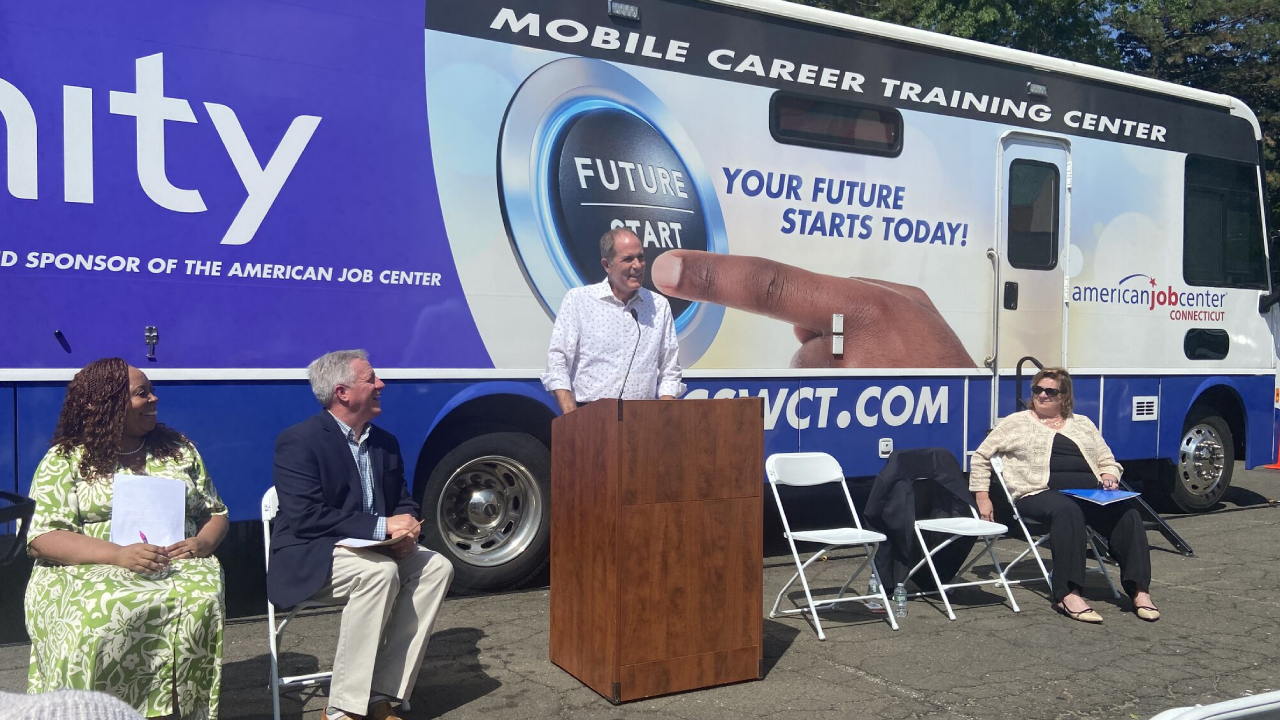
“With the support of the Connecticut Department of Labor, along with outstanding corporate partners, we are excited to announce that the upgraded American Job Center Career Coach is ready to hit the road,” said Joe Carbone, president and CEO of The WorkPlace. “Economic growth depends on a qualified workforce, and this vehicle helps us to meet employer demand for skilled, adaptable workers.”
In addition to serving job seekers, the Career Coach provides direct value to local businesses. Employers can use the mobile unit to recruit talent, host training sessions, and upskill their workforce onsite.
Comcast also provided support for the mobile Career Coach.
“We’re delighted to partner with The WorkPlace to bring its mobile Career Coach across Connecticut, helping more residents connect to workforce opportunities,” said Carolyne Hannan, Senior Vice President of Comcast’s New England Region. “Through this partnership, we’re helping connect people to the skills, resources and opportunities they need to build their future.”
American Job Centers are a collaboration of state, regional, and local organizations dedicated to supporting both job seekers and businesses. In southwestern Connecticut, primary partners include the Connecticut Department of Labor; The WorkPlace, the region’s Workforce Development Board; and Career Resources, Inc., which operates the Job Centers.
By bringing workforce resources directly into neighborhoods, the American Job Center Career Coach reflects a community-first approach—one that helps break down barriers, expand access, and create pathways to opportunity.
A full schedule of Career Coach locations is available at www.ajcswct.com or by calling (203) 953-3275. The unit is also available to serve neighborhood groups, schools, faith-based organizations, job fairs, and employers seeking specialized training.
Through collaboration and continued investment, partners like KeyBank and The WorkPlace are helping build stronger, more connected communities—one stop at a time.
Kenvue released its 2025 Healthy Lives Mission Report today, the Company’s third annual report, with an update on its sustainability strategy, goals, and commitments. With its Healthy Lives Mission designed to put the extraordinary power of everyday care into action, the consumer health company reported progress across its focus on healthy people, healthy planet, and healthy products.
Through targeted efforts across product innovation, packaging solutions, public health and environmental stewardship, Kenvue reported disciplined progress across its commitments, including:
- $50.0M of in-kind donations and $3.4M of cash contributions provided across the year, helping restore the dignity of everyday care for vulnerable and displaced people around the world.
- 450,000 students and 18,000 teachers educated on sun safety and skin cancer prevention.
- 41% reduction in Scopes 1 and 2GHG emissions from a 2020 base year, putting the company well on track to meet a 2030 goal of 42% reduction, aligned with its Climate Transition Plan, released this year as part of its annual report.
- 76% electricity now sourced from renewable sources across global Kenvue operations, on its way to meet a goal of 100% by 2030.
- Continued reduction of virgin plastics by 33% from a 2020 base year, exceeding its goal of reducing 25% by 2025.
- 600+ product developers trained on the Sustainable Innovation Profiler, a patent-pending product sustainability assessment tool released in 2025, which helps measure and improve product performance for social and environmental factors.
As a dedicated consumer health company, Kenvue is people-centered and science-backed: improving quality of life today while ensuring a healthier, more resilient world for generations to come. Learn more here.
+++
Media Contact
Aman Singh
ASing030@kenvue.com
This article was originally published on Trellis.net
Key Takeaways:
- Chris Reeves’ official title is director of scientific communications.
- He was a working forester for 12 years before moving to the corporate world in 2017.
- Ikea and Kimberly-Clark also employ foresters, but the practice is still rare among consumer products companies.
When Procter & Gamble adopted an ambitious new pulp and paper pledge in early 2021, it hired a forester to convince suppliers to get on board.
Officially, Chris Reeves is director of scientific communications for P&G’s family care business, which makes Charmin toilet paper, Bounty paper towels and Puffs facial tissues.
That title downplays his master’s degree in forestry and 12 years of experience managing Kentucky forests, but Reeves spends at least one-third of his time among the trees with land owners or in meetings with the Society of American Foresters and nonprofits with big forestry practices.
“Every day is different,” he said. “It’s making sure policies are adhered to. It’s offering education on the ground.”
P&G tries to make field visits to all pulp suppliers once every two years to offer technical advice and advocate for independent audits of their forest management practices.
In particular, Reeves is responsible for helping suppliers see value in becoming certified by the Forest Stewardship Council (FSC), a nonprofit that promotes strict environmental and social standards for timber and paper. P&G has pledged to buy all of its wood pulp from FSC-recognized sources by 2030; so far, it’s at 86 percent.
Reeves also visits with employees and retail partners and fields questions from investors. One of his biggest challenges is translating sophisticated concepts into messaging that’s more appropriate for consumers and P&G’s vast marketing organization.
Uncommon role
P&G has hired environmental scientists for decades and some paper products companies, such as Domtar, employ foresters and forestry engineers to manage responsible harvesting and replanting practices.
Reeves’ first corporate job was for IKEA, where he was responsible for wood purchasing processes. P&G rival Kimberly-Clark, which has pledged to be “natural forest free” after 2030, also employs foresters.
Still, it’s uncommon for consumer products companies to hire foresters who can work directly with suppliers and nudge them toward more sustainable forest management practices, sometimes with contract incentives or preferred supplier status.
“This is a new thing in that world,” said Sarah Billig, president of FSC’s U.S. operation. “P&G is ahead of the curve, but as brands and retailers dive into nature-based goals they have to dive more into their supply chain. We are seeing more companies engage in this sort of expertise. They need to get folks that can get down to the ground level.”
Foresters understand how to talk to local communities about both the economic and ecological value of forests, said Billig, who previously worked for a lumber company in Northern California. Many spend at least half of their time in community forums and cultivating knowledge of Indigenous forest management practices, she said.
“One of the most important things they do is push the value of better forest management,” Billig said.