GENEVA, March 16, 2026 /3BL/ – The Tire Industry Project (TIP), in partnership with UL Environment, announces updated Product Category Rules (PCR) for tires, improving the framework for measuring environmental performance and enabling transparent reporting across the industry.

A PCR is a guideline for manufacturers of a given type of product to conduct lifecycle assessments (LCAs) and produce Environmental Product Declarations (EPDs), ensuring comparable environmental reporting for their products. Effective for the next five years, the revised PCR incorporates new science-based data, including more precise accounting for greenhouse gas emissions. It better aligns with current manufacturing conditions, such as the use of renewable electricity in tire manufacturing facilities, and with the latest vehicle-related factors such as improved fuel efficiency and emerging fuel types. It also requires consistent reporting when new materials are introduced, improving product comparability and making it easier to track sustainability progress.

The updated PCR has been independently adopted by TIP’s 10 member companies, which represent 60% of global tire manufacturing capacity, significantly increasing the likelihood of broader voluntary adoption across the industry.

Last updated in 2022, this fourth version of the PCR is the result of a collaborative effort of the major tire manufacturers. By standardizing methods used to calculate a tire’s lifecycle footprint—from raw materials and manufacturing through to use and end of life—the PCR ensures that EPDs are comparable. This in turn supports more sustainable procurement decisions and helps drive continuous improvement in environmental performance across the tire value chain.

What’s new in the PCR

  • Revised carbon footprint calculations: Introduces updated methodology for renewable materials, including the treatment of biogenic carbon.
  • Broader applicability: Expands category coverage to all tire types, including off-road and specialty tires.
  • Enhanced regional precision: Includes region-specific data for ELT management, vehicle efficiency, fuel mixes and payload factors, which will enable LCAs and EPDs to better reflect local market conditions.
  • Clearer methodology: Applies a structured hierarchy to calculate impacts for manufacturing processes that produce multiple products (e.g., tires and saleable rubber scraps), which improves consistency and comparability.
  • Aligned impact indicators: Aligns environmental impact indicators and methodologies with the European Commission’s Environmental Footprint 3.1, a widely recognized standard.
  • Updated, more accurate datasets: Features updated datasets for raw materials as well as refined background emission factors, which improves overall data quality.

“The updated PCR reflects years of collaboration and investment to advance sustainability across the tire value chain,” said Dr Larisa Kryachkova, Executive Director at TIP. “Our goal is to strengthen environmental reporting. With a common methodology, we support better industry-wide decision-making, turning ambition into positive environmental action.”

The PCR has been developed and published in close partnership with UL Solutions, a globally recognized and independent safety science company. Ranee Valles, Director and General Manager, Product Sustainability at UL Solutions said, “Transparent, standardized reporting enables manufacturers, regulators, fleet operators and consumers to make informed choices about the products they use or supply. Our collaboration with TIP reflects a shared commitment to credible, science-driven solutions, and we’re grateful for TIP’s leadership in advancing scientific rigor and industry alignment on environmental reporting.”

Learn more about the latest PCR here.

– ENDS –

About TIP

Formed in 2005, the Tire Industry Project (TIP) is a voluntary CEO-driven initiative with a mission to anticipate, understand and address global environmental, social and governance (ESG) issues relevant to the tire industry and its value chain.​

TIP acts by commissioning independent research of the highest standards, collaborating on sectoral solutions and engaging with external stakeholders. ​

TIP is part of the World Business Council for Sustainable Development (WBCSD), bringing together 10 leading tire companies that represent more than 60% of the world’s tire manufacturing capacity. ​

In 2025, TIP marked its 20th anniversary—a milestone that reflects its long-term commitment to advancing scientific knowledge and fostering collective industry action to improve sustainability across the tire value chain.​

For more information, visit The Tire Industry Project.
Originally published by Mastercard
By Laxita Gautam, Contributor

The aromatic lychee orchards of northern India, the mustard fields that flow through Rajasthan like golden rivers, and the vast sunflower farms in Karnataka all have one thing in common. Actually, billions: bees.

Insect pollination services, where beekeepers rent out their hives to farmers, contribute $22.5 billion to the Indian agricultural economy annually. But despite powering greater crop yields, biodiversity and climate resilience, the beekeeping sector remains an underseen and underserved sector, far from reaching its full potential.

A few years ago, Monika Shukla, a former banking technologist turned social entrepreneur, was working with rural communities across India on market-driven, sustainable solutions that could improve livelihoods, particularly for women. She and her team met hundreds of small-scale beekeepers in more than a dozen states and realized that beekeeping, if supported by scientific training, fair markets and better tools and tech, could become an even more powerful driver of income, crop productivity, biodiversity and climate resilience in rural and tribal areas. In fact, Prime Minister Narendra Modi in 2020 launched what he calls a “sweet revolution,” a mission to promote and develop scientific beekeeping and quality honey and beehive products.

“It’s about looking at a system in its entirety and fixing the infrastructure, so that effort actually compounds into livelihoods, income stability and anti-fragility,” Shukla says. Beekeeping has low barriers to entry and doesn’t require a lot of land, so it’s often introduced as a livelihood opportunity for women, small landholders and landless farmers, but, she says, support often drops after the initial training.

So, in 2023, she founded Buzzworthy Ventures (also known as the Humble Bee), equipping thousands of small-scale beekeepers with scientific training, guaranteed buy-back and market access, and better equipment to improve hive management and honey quality and strengthen crop pollination. That includes the introduction of BeeKind, a mobile platform that uses AI-powered insights and predictive analysis to offer guidance on hive health and productivity, a pollination calendar, climate resilience advice and more.

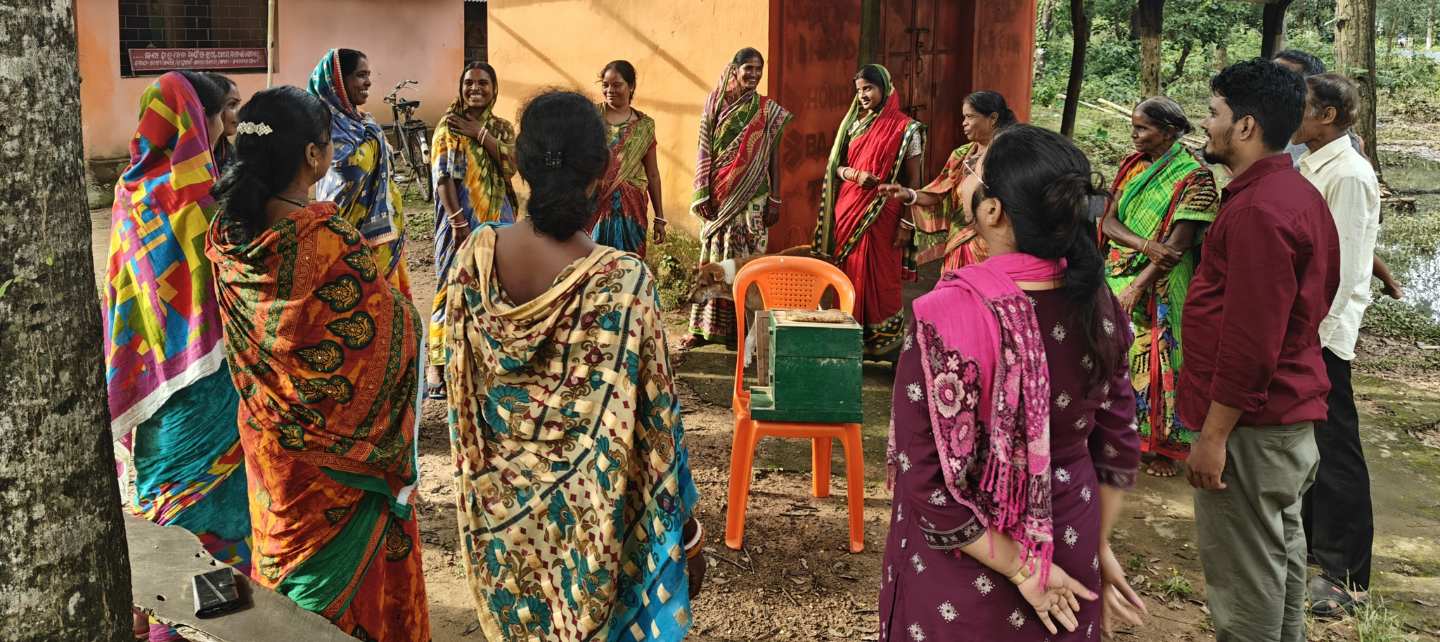
Group of women speaking to each other while standing in a circle around a beehive

It was developed with insights from the rural beekeeping communities to avoid the “false confidence” created by solutions designed without that level of input, Shukla says. “If literacy, language or gender dynamics aren’t included in the design, the very people the solution claims to help stop using it.”

For example, one of the biggest challenges the team identified was that beekeepers, particularly women, don’t have the time, skills or access to smartphones to be able to use apps reliably. The solution wasn’t more features, but more people.

The initiative supports clusters of beekeepers with a BeeMitra, a trained on-ground facilitator who often comes from the same community and helps beekeepers with diagnostics, yield-tracking, hive health tracking, migration management and more. The team created FieldView, a mirror application of BeeKind, for the BeeMitras and field facilitators to use on behalf of the beekeepers, allowing them constant access to BeeKind support without having to learn all the functionalities or own a smartphone. The app data is captured passively via images, calls, voice inputs and site visits. The AI-generated insights are then communicated via short voice-based alerts in local languages.

“We are building participation into the system itself,” Shukla says of this “human in the loop” model of AI. “Field coordinators and lead women beekeepers regularly flag when AI recommendations don’t match field conditions, and that feedback feeds directly into model refinement.”

That philosophy has not gone unnoticed. Buzzworthy Ventures became one of five winners of the Artificial Intelligence to Accelerate Inclusion (AI2AI) Challenge, launched in 2024 by Mastercard Center for Inclusive Growth and data.org to recognize AI solutions that advance inclusion and economic empowerment. “When AI learns from people, it has the potential to amplify impact and scalability many times over,” says Uyi Stewart, the vice president for Inclusive Innovation & Analytics at the Center.

Humble Bee will be using its prize money to evolve the in-app chatbot into an agentic system with memory, context and routing that can offer support in eight different local languages. It has also introduced an image bot that offers hive health insights based on the images that beekeepers upload.

“Scaling for us doesn’t mean removing humans from the loop,” Shukla says. “It means using AI to amplify field knowledge, not replace it.”

BeeKind has helped deploy 6,000 hives across eight ecological zones, generating employment for about 1,800 women beekeepers, a number that continues to grow.

In the future, the Humble Bee team is planning to introduce a pollination-as-a-service module to bridge the gap between farmers seeking pollination services and the beekeepers. They’re also working toward digitizing income cycles for the beekeepers by adding honey passbooks to the app, which creates a digital transaction history that can help them get better access to credit and insurance. Shukla also expects to add features such as dynamic migration data and deeper climate risk signals, and come up with a gender-adaptive climate resilience fund to support the beekeepers.

“One lesson we have learned is that AI adoption in rural contexts is less about algorithms and more about relationships,” she says. “When communities feel seen and heard in the design, technology becomes a tool they trust — not something they tolerate. That’s the lens through which we continue to build BeeKind.”

AI for good
The Mastercard Center for Inclusive Growth will be participating in the India AI Impact Summit this week in New Delhi. Learn more about Mastercard’s AI for good and responsible AI work by following the Center on LinkedIn.  

Continue reading here.
Follow along Mastercard’s journey to connect and power an inclusive, digital economy that benefits everyone, everywhere.
 

AMSTERDAM, HONG KONG, OAKLAND, Calif., March 17, 2026 /3BL/ – Cascale today announced the publication of its APAC Policy Priorities Paper, developed by the Asia-Pacific (APAC) Policy Member Expert Team (MET) to identify key regional sustainability challenges and provide practical, aligned recommendations for policymakers and industry stakeholders across Asia-Pacific.

As the primary hub for global apparel and footwear manufacturing, the APAC region plays a critical role in delivering credible progress on climate and decent work. The paper outlines a unified industry perspective on how governments, manufacturers, brands, and multi-stakeholder initiatives can work together to strengthen policy coherence, reduce duplicative reporting burdens, and accelerate measurable impact across complex value chains.

With sustainability regulations emerging unevenly across jurisdictions — including new climate disclosure requirements, greenhouse gas inventory obligations, and evolving labor frameworks — companies across the region are navigating increasing complexity. The APAC Policy Priorities Paper calls for greater alignment to:

  • Better align national approaches with internationally recognized standards, while respecting national objectives.
  • Enable mutual recognition of credible assessments to reduce duplicative audits.
  • Promote interoperable data and reporting systems that strengthen compliance and enforcement efficiency
  • Deploy targeted incentives that accelerate decarbonization, including measures accessible to small and medium-sized enterprises (SMEs)
  • Strengthen policy attention to region-specific decent work realities, including responsible purchasing practices

The paper was co-developed by Cascale and members of its APAC Policy MET, representing manufacturers, service providers, affiliates, industry associations, and multi-stakeholder initiatives. Insights were informed by discussions at the “Aligning APAC Policy Priorities” workshop during Cascale’s Annual Meeting 2025 in Hong Kong, as well as continued input from APAC Policy MET members and ongoing member engagement activities, including regional roundtables and virtual events.

“The APAC region sits at the heart of global apparel and footwear production,” said Howard Kwong, senior manager of public affairs (APAC), Cascale. “For sustainability policy to be effective, it must reflect the operational realities of manufacturers while remaining aligned with international standards. Our members are signaling that policy ambition must be matched with practical implementation pathways.”

“Policy alignment is essential to unlocking real progress across supply chains,” said Nguyen Thi Minh Thuy, senior program manager, Textile & Manufacturing Program, IDH. “When governments and industry collaborate on consistent frameworks and credible measurement, we can reduce duplication, improve transparency, and accelerate climate and decent work outcomes in a way that works for the region.”

“Manufacturers in Asia are ready to take action, but fragmented requirements across multiple initiatives continue to increase costs and operational complexity,” said Shein Han, Director of Compliance & Sustainability at GG International Manufacturing. “Improving interoperability between tools and reporting systems will enable factories to focus their efforts where they matter most—driving better performance while strengthening support for workers.”

By bringing together diverse industry perspectives, the APAC Policy MET reinforces Cascale’s commitment to credible methodologies and tools, aligned standards, and collective action. The paper supports Cascale’s broader strategy to strengthen foundational measurement systems, combat climate change, and advance decent work through coordinated public affairs and industry engagement.

Cascale members are invited to join the “APAC Policy Priorities: Industry-Led Insights and Recommendations” webinar on April 2; click here to register on Cascale Connect.

Cascale will carry this work forward through ongoing regional engagement in 2026, including in-person dialogue with members and stakeholders to support practical implementation and coordinated policy engagement.

Media Contact: Forster Communications, cascaleforster@forster.co.uk


ABOUT CASCALE

Cascale is the global nonprofit alliance empowering collaboration to combat climate change and support decent work in the consumer goods industry. Formerly known as the Sustainable Apparel Coalition, Cascale stewards and governs the Higg Index frameworks, modules, and methodologies, while Worldly delivers the technology platform through which they are implemented globally. Cascale also recently acquired the Better Buying and Sustainable Furnishings Council tools. Cascale unites over 300 retailers, brands, manufacturers, governments, academics, and NGO/nonprofit affiliates around the globe through one singular vision: To catalyze impact at scale and give back more than we take to the planet and its people.

LinkedIn | Instagram | Facebook | YouTube

By the American Red Cross

The place you call home looks different after a disaster strikes. Streets empty and buried in debris, power lines down and an eerie silence. Through it all, the American Red Cross is there to offer care and comfort to communities and families with the help of partners like Lenovo.

The Red Cross responds to more than 65,000 disasters across the country each year—that’s a response every 8 minutes on average. The organization relies on the generosity of donors and power of volunteers to provide compassionate care—including hot meals, safe shelter and emotional support—to families in times of need.

Disaster Responder Program members like Lenovo donate in advance of disasters and are instrumental to relief efforts. With the support of these forward-thinking partners, the Red Cross stands ready to respond day and night, from coast to coast. As disasters become more frequent and intense, the organization also uses technology to fulfill its lifesaving mission, including to help stock warehouses, maintain vehicles, train volunteers, and so much more.

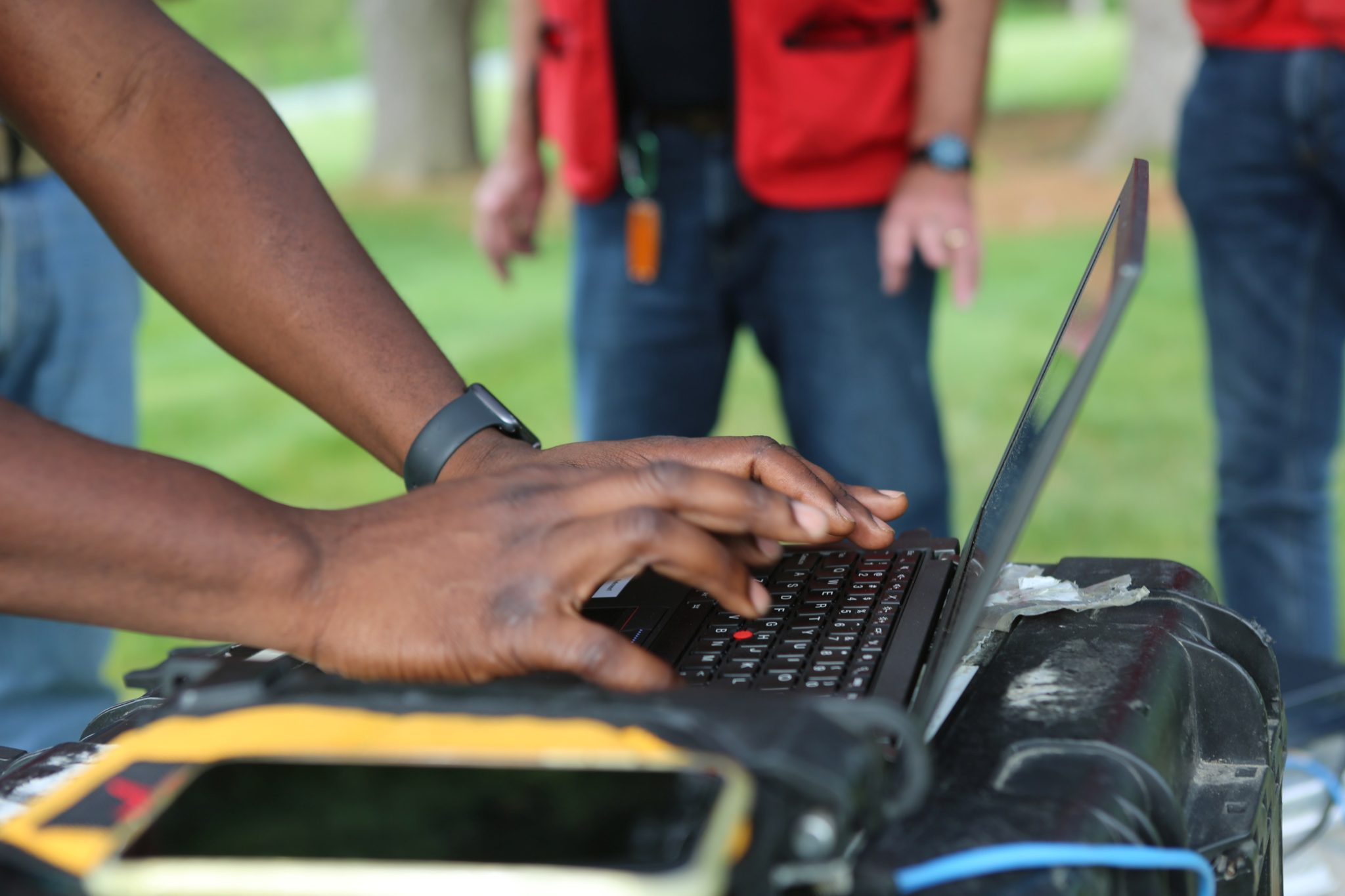
typing on a laptop outside

“Increasing severe weather events mean that families are relying on the Red Cross now more than ever,” said Anne McKeough, chief development officer at the American Red Cross. “We are so thankful for Disaster Responder members like Lenovo for their forward-thinking commitment that powers our preparedness and relief efforts, ensuring we can immediately provide help and hope to those facing their darkest day.”

Both Lenovo and the American Red Cross share a commitment to providing help to those affected by disasters—including using technology to connect families in times of need. By providing items like laptops and internet connection, Lenovo helps ensure Red Cross volunteers have the tools to establish and maintain communication not only during disaster response operations, but during daily mission delivery—providing comfort and care for those who need it most.

The road to recovery looks different after every disaster, and the Red Cross is grateful to work with partners like Lenovo. While the organizations may have different missions, they are united through a common goal of helping people in times of need. Lenovo is proud to support the Red Cross and is an example of how companies can help power humanitarian work based on their strengths.

From the moment disaster strikes through the months and years of rebuilding, the Red Cross remains with communities in need. Partners like Lenovo provide critical support to advance help and hope in the wake of crises.

The Invisible Logistics Behind the Digital Economy

Artificial intelligence, cloud computing, and digital services are driving an unprecedented expansion of global data centers. Industry forecasts suggest investments in data center infrastructure could exceed $1 trillion over the next five years, transforming communities and industries alike.

But behind the racks of servers powering today’s digital economy lies something rarely discussed: the highly specialized logistics required to build, maintain, and operate these facilities.

Unlike traditional freight, data center equipment is sensitive, high-value, and often mission-critical. A delayed or mishandled shipment can impact uptime, disrupt services, and trigger costly operational risks.

That’s why logistics providers are playing an increasingly strategic role — managing everything from equipment assembly and inventory control to secure transport and on-site delivery.

DP World is helping meet this demand by delivering end-to-end logistics solutions tailored to the unique requirements of hyperscale data centers, from precision rack assembly to global spare-parts distribution.

DP World Case Study: Secure Server Rack Configuration

One of DP World’s most advanced data center logistics solutions supports a global technology company requiring high-spec server rack configuration and deployment.

The Challenge: Precision, Cleanliness and Global Integration

The customer required a secure facility capable of assembling server racks to strict server-grade standards, while integrating with its global rack configuration network.

Key requirements included:

  • A contamination-free environment meeting strict cleanliness standards
  • Custom rack builds tailored to client specifications
  • Integration with the customer’s global data center deployment model

This level of precision demanded more than traditional logistics — it required controlled manufacturing-style operations combined with supply chain execution.

DP World’s Solution: Cleanroom Rack Assembly and Secure Logistics

DP World designed and delivered a secure, cleanroom-enabled rack configuration solution built to meet the customer’s most stringent technical and security requirements.

Key capabilities included:

  • Cleanroom Rack Assembly: A purpose-built cleanroom facility was constructed with positive air pressure systems to prevent contamination during configuration.
  • End-to-End Rack Build Process: DP World delivered a full assembly workflow including:
    • Inbound component management
    • Rack kitting and cabling
    • Quality control and validation
    • Secure packaging and shipping
  • 24/7 Secure Operations: The facility operates as a restricted-access environment with continuous monitoring, protecting high-value technology equipment throughout the process.

The Impact: A Global Benchmark for Rack Configuration

The operation quickly became the global benchmark for the customer’s rack configuration program, demonstrating how specialized logistics can support complex technology infrastructure.

Key results included:

  • 75 custom server racks configured per week
  • 1,000–1,500 racks built and shipped annually
  • The operational model replicated across additional global locations

By combining cleanroom manufacturing conditions with integrated logistics, DP World enabled the customer to scale operations while maintaining strict quality and security standards.

DP World Case Study: Managing Data Center Spare Parts at Global Scale

Maintaining uptime across hyperscale data centers also requires a sophisticated logistics model to manage thousands of components across multiple regions.

DP World partnered with a Fortune 100 technology company to transform its spare-parts logistics network into a single, integrated supply chain ecosystem.

The Challenge: Fragmented Inventory and Limited Visibility

The company was managing:

  • 5,000+ unique part numbers
  • Equipment distributed across data centers in the U.S. and Europe
  • More than $2 billion in inventory

However, inventory and fulfillment were fragmented across multiple providers, limiting visibility and creating inconsistent service levels.

During equipment failures, teams often relied on reactive expediting, increasing costs while still risking downtime.

DP World’s Solution: Integrated Data Center Logistics

DP World implemented a comprehensive operating model designed to improve visibility, control, and responsiveness. Key components included:

  • Integrated Inventory Management: A centralized logistics environment unified thousands of SKUs, delivering full visibility across the global spare-parts network and tighter control over high-value inventory.
  • Precision Fulfillment and Re-Supply:
    • Data center-specific kitting and order fulfillment
    • Coordinated last-mile delivery to critical facilities
    • Integrated repair and reverse logistics
    • For mission-critical parts, hypercare delivery protocols were introduced, including serialized tracking, restricted-access handling, and documented room-level placement.
  • Multi-Regional Operations: Dedicated facilities in the United States and Europe enabled the company to expand across regions while maintaining standardized processes and consistent service levels.

DP World also provided in-plant logistics support at partner manufacturing sites, integrating production flows into the broader logistics network.

The Impact: Greater Control and Reduced Risk

The transformation delivered measurable operational improvements:

  • 5,000+ SKUs integrated into a single logistics ecosystem
  • $2B+ in inventory managed with full visibility
  • Expanded operations across multiple regions
  • Reduced emergency shipments and improved response times

Most importantly, the new model strengthened chain-of-custody integrity for high-value technology components, reducing damage exposure and operational risk.

Supporting the Infrastructure Powering the Digital World

As global demand for computing power accelerates, logistics is becoming a critical enabler of the digital economy.

From precision rack assembly to global spare-parts management, data center supply chains require a level of coordination, security, and reliability far beyond traditional freight.

By combining secure handling environments, contract logistics expertise, and integrated supply chain orchestration, DP World is helping technology companies build and maintain the infrastructure powering the modern world.

Because when uptime matters, logistics becomes mission-critical.

Learn more about DP World’s Data Center Logistics Solutions.

Southwire announced on March 10 that it has been named one of Newsweek’s “Greatest Workplaces for Women” for the second year in a row, reinforcing the company’s ongoing commitment to building an inclusive workplace where all team members can grow and thrive.

The recognition was shared during Southwire’s Women’s Day event, held at the University of West Georgia, where the company gathered to celebrate Women’s History Month, honor the contributions of women throughout the organization and recognize progress and opportunity across the manufacturing industry. 

I personally am very optimistic for the future. When you look at the number of role models who refused to accept status quo and pushed the boundaries over the last 20 years and the overflowing ambition in current generation of female professionals and leaders, I am very confident that soon every day will become women’s day in this industry,” said Ganesh Ramaswamy, Southwire’s president and CEO. 

Newsweek announced the “America’s Greatest Workplaces for Women 2026” rankings in February, recognizing companies that foster strong and supportive environments for women. 

The recognition is not application-based but instead determined through an independent, data-driven study that analyzed feedback from more than 89,000 women employees and 1.1 million company reviews. The recognition also factors in more than 37 million data points across 120 key workplace performance indicators related to areas such as leadership representation, workplace equity and employee satisfaction. 

“This recognition belongs to our team members. It reflects that at Southwire, success is not defined by what we achieve, but by how we show up for one another and how we do the work together every day,” said Cara Herzog, VP, Inclusion & Interim Strategic Talent. “Behind every metric is a human story. It is a leader who listened, a team member who spoke up, a moment where people leaned in and inclusion moved from intention to action. That is what this recognition represents, and it is something our entire organization should be proud of.” 

A companywide livestream connected people across various Southwire locations, resulting in 900-plus Southwire team members, customers and nonprofit partners registering to join the event either virtually or in person. 

This year’s Women’s History Month theme, “Leading Change: Women Shaping a Sustainable Future,” guided the conversations during the event as team members, representatives from UWG, Atlanta Braves, the American Heart Association and many more explored topics centered on development, wellbeing and continuous learning.

The event also featured sessions covering a range of subjects, including leadership development, women’s health, customer engagement and financial wellness. Each discussion was designed to equip team members with practical insights while fostering open dialogue about the role women play in shaping a more sustainable future for Southwire and the communities it serves.

Events like this help people feel included. It gives us a space for networking and a space for being a part of something bigger. Southwire is much more than a wire and cable company. We’re making a difference,” said Krystle Wright, Manager of Pricing and Internal Engagement and Giving Back subcommittee chair for Women’s Network. 

Designed to inspire and engage, raise awareness and drive long-term impact, the event highlighted Southwire’s continued commitment to inclusion and its essential connection to the company’s long-term sustainability strategy.

As a certified sustainable event, the program also reflected Southwire’s dedication to operating responsibly while investing in its people.

Newsweek’s recognition underscores Southwire’s ongoing efforts to cultivate a workplace culture where everyone has the opportunity to lead, grow and make an impact.

To learn more about Southwire’s inclusion initiatives, visit https://southwire.com/inclusion. 

Akvile Treciokaite

  • Practice Area: Environment, Health and Safety
  • Area of Expertise: Environment, Health and Safety
  • About Me in 140 Characters: I am someone who loves to keep growing, both at work and in life. Outside of work I am always keen to try new hobbies such as dancing, travel to new places and challenge myself in new ways.
  • Favourite Thing about Being an EHS Practitioner: My favourite thing about being an EHS Practitioner is that I am constantly learning and making a real impact on how people work. I enjoy problem solving, working on various different projects and tapping in to various operational challenges.

What’s your favorite part of your job?

My favourite part of working as part of EHS Team is the variety. No two days are ever the same – there is a new set of challenges to tackle with every project and opportunities to problem solve. I enjoy constant change, it opens an opportunity for learning, adapting and finding tailored solutions. 

If someone at a party asks what you do, how to you respond?

I respond by telling them that I keep people safe. I develop safe working procedures and practical solutions in areas where people might get hurt.

What surprises people about your job? far?

What usually surprises people about my job is just how broad EHS really is within the business. It is not just about safety goggles and hard hats – it covers everything from environmental impact, sustainability, health and wellbeing to workplace systems and compliance. One day I might be working on reducing waste or energy use and another on ergonomics or mental health. EHS touches every part of the business.


Just for Fun… 

What was your first job?

My first job was within the hospitality sector in a small restaurant. That is where I first learned about health and safety in a practical way. For example, I had to check fridges temperatures for food storage and record it every single day and learn about safe working practices such as manual handling. At the time it felt like part of of the job, however looking back, it was my first introduction to EHS principles in everyday work.

If you had one month off, where would you go or what would you do?

I would like to travel around Southeast Asia. There is such a mix of culture, adventure and stunning scenery – it would be an amazing experience. 

Is there something unique that people might not know about you?

I really enjoy gardening such as growing plants and vegetables.