"2026 BEST PLACES I WORK" logo

A winning start to 2026 

We’re kicking off the new year with some great news: Built In has recognized Northern Trust across multiple 2026 Built In Best lists!

We’re honored to be named among the very best places to work in several of our key hubs:

  • Best Large Places to Work – Chicago
  • Best Places to Work – Chicago
  • Best Large Places to Work – San Francisco
  • Best Places to Work – Los Angeles
  • Best Large Places to Work – Boston
  • Best Places to Work – Boston
  • Best Large Places to Work – Los Angeles

These wins reflect the passion, talent, and dedication of every person on our teams who make our offices an incredible place to grow, innovate, and thrive

ATLANTA, Feb. 4, 2026 /PRNewswire/ — Novelis Inc. will report its earnings for the third quarter of fiscal year 2026 on Wednesday, February 11, 2026. Following the release, Steve Fisher, President and Chief Executive Officer, and Dev Ahuja, Chief Financial Officer, will discuss the results via a live conference call for investors at 7:00 a.m. EST/5:30 p.m. IST the same day. The conference call will also be webcast live via the Novelis website, with presentation materials available online at https://investors.novelis.com/.

The webcast can be accessed at:
https://event.choruscall.com/mediaframe/webcast.html?webcastid=EgugP4UQ 

To participate by telephone, participants are requested to register at: 
https://services.incommconferencing.com/DiamondPassRegistration/register?confirmationNumber=13758269&linkSecurityString=1ea08ffd35 

Upon registering you will receive the dial-in info and a unique PIN to join the call as well as an email confirmation with the details.

Following the meeting, the webcast will be available for replay at https://investors.novelis.com/

About Novelis

Novelis Inc. is driven by its purpose of shaping a sustainable world together. We are a global leader in the production of innovative aluminum products and solutions and the world’s largest recycler of aluminum. Our ambition is to be the leading provider of low-carbon, sustainable aluminum solutions and to achieve a fully circular economy by partnering with our suppliers, as well as our customers in the aerospace, automotive, beverage can and specialties industries throughout North America, Europe, Asia and South America. Novelis had net sales of $17.1 billion in fiscal year 2025. Novelis is a subsidiary of Hindalco Industries Limited, an industry leader in aluminum and copper, and the metals flagship company of the Aditya Birla Group, a multinational conglomerate based in Mumbai. For more information, visit novelis.com.

Cision View original content to download multimedia:https://www.prnewswire.com/news-releases/novelis-to-host-third-quarter-fiscal-year-2026-earnings-conference-call-on-february-11-302679072.html

SOURCE Novelis Inc.

ATLANTA, Feb. 4, 2026 /PRNewswire/ — Novelis Inc. will report its earnings for the third quarter of fiscal year 2026 on Wednesday, February 11, 2026. Following the release, Steve Fisher, President and Chief Executive Officer, and Dev Ahuja, Chief Financial Officer, will discuss the results via a live conference call for investors at 7:00 a.m. EST/5:30 p.m. IST the same day. The conference call will also be webcast live via the Novelis website, with presentation materials available online at https://investors.novelis.com/.

The webcast can be accessed at:
https://event.choruscall.com/mediaframe/webcast.html?webcastid=EgugP4UQ 

To participate by telephone, participants are requested to register at: 
https://services.incommconferencing.com/DiamondPassRegistration/register?confirmationNumber=13758269&linkSecurityString=1ea08ffd35 

Upon registering you will receive the dial-in info and a unique PIN to join the call as well as an email confirmation with the details.

Following the meeting, the webcast will be available for replay at https://investors.novelis.com/

About Novelis

Novelis Inc. is driven by its purpose of shaping a sustainable world together. We are a global leader in the production of innovative aluminum products and solutions and the world’s largest recycler of aluminum. Our ambition is to be the leading provider of low-carbon, sustainable aluminum solutions and to achieve a fully circular economy by partnering with our suppliers, as well as our customers in the aerospace, automotive, beverage can and specialties industries throughout North America, Europe, Asia and South America. Novelis had net sales of $17.1 billion in fiscal year 2025. Novelis is a subsidiary of Hindalco Industries Limited, an industry leader in aluminum and copper, and the metals flagship company of the Aditya Birla Group, a multinational conglomerate based in Mumbai. For more information, visit novelis.com.

Cision View original content to download multimedia:https://www.prnewswire.com/news-releases/novelis-to-host-third-quarter-fiscal-year-2026-earnings-conference-call-on-february-11-302679072.html

SOURCE Novelis Inc.

Originally published on Guiding Stars Health & Nutrition News

by Kitty Broihier

I always find the topic of meal planning to be polarizing. You’re either a fan who finds it valuable or it’s your idea of monotonous drudgery. But I’m here to say there’s more than one way to meal plan. I’m sharing a simple process that relies on one well-planned grocery shopping trip and a handful of cook-once, eat-twice recipes. Follow the map and you’ll be set up for a week’s worth of balanced, Guiding Stars-earning meals.

Step 1: Look at the Week Ahead

This is one of my top tips for making sure you don’t end up ordering pizza or getting take-out (again). The idea here is to take away some of the burden of feeding yourself well by pre-planning the biggest or most complicated meal of the day ahead of time. For many of us, that meal is dinner, but if that’s not true for you, plan for whichever meal is typically the most time-consuming or difficult to prepare. And if you have social obligations or evening activities that include dinner out, you’ll have fewer main meals to plan and prep.

Step 2: Take an Inventory

Check your refrigerator and make a note of any foods that need to be used this week. While you’re there, start a grocery list and add any staple items that need replenishing. Do the same with your pantry staples, then move on to your freezer. What do you have on hand for frozen veggies, and protein items like meat, fish, and poultry? Get an idea of what you have to work with so you don’t over-buy while shopping.

Step 3: Choose What to Make: Focus on Double-Duty Recipes

One way to make a full week of meals feel easy is to cook foods that work in multiple meals. This saves time and effort, and decreases food waste. (And if you get the ingredients on sale, you’ll save money too.) For example, say you notice that you have a good supply of frozen chicken breasts on hand. So you decide to make a sheet-pan meal using chicken breasts as the protein along with a couple of vegetables. Not sure which veggies to cook? Look for another recipe (check the Guiding Stars recipe collection online) that could use leftover cooked chicken breast and pre-roasted vegetables. Perhaps something like this easy Chicken Mushroom Skillet (swap the frozen veggies for the pre-cooked ones from your sheet-pan meal).

The idea is not to necessarily follow every recipe to the letter, rather to let them inspire you and provide a framework from which to create multiple easy meals. Focus on these kinds of recipes to help make it happen (click on the links below for Guiding Stars-earning recipes):

Once you’ve got a few basic meals and ideas for the leftover ingredients, give your plan the once-over. Be sure to have extra veggies and fruit on hand to round out the meals with more fiber and nutrients.

Step 4: Cross-Check Your Meal Plan With the Store Sales

This step is optional, but one that I always employ because it saves me money. Once I have a basic idea for several meals to make during the week, I check the store flyer for sales on the primary ingredients I need. You can also start your meal selection process the other way around. First see what’s on sale, and then choose the meals you plan to make based on those items. And stock up on sale items that you tend to use often and keep well. (For me that’s ground turkey, quinoa, and canned beans.) Other multi-purpose staple items to consider purchasing if you find a good sale include:

  • Pasta, rice, and other grains
  • Lentils and beans
  • Fruits and vegetables of all kinds
  • Eggs, milk, and yogurt

As always, you can compare the nutrient density of many foods and beverages by checking their Guiding Stars. You’ll find them on the shelf tags, store signage, and store-brand packaging at participating grocery stores

Step 5: Make Your Final Grocery List

If you already started a grocery list when taking your inventory, you’re nearly done. All you need to add are those items you’re missing from the recipes you’ve chosen to prepare for the week. Check the recipes and finalize your list (don’t forget any crucial spices). Then feel good about using a list! For one, you’ll be less likely to forget things. And when you shop with a list, you make fewer impulse purchases—better for your health and your wallet.

About Guiding Stars

Guiding Stars is an objective, evidence-based, nutrition guidance program that evaluates foods and beverages to make nutritious choices simple. Products that meet transparent nutrition criteria earn a 1, 2, or 3 star rating for good, better, and best nutrition. Guiding Stars can be found in more than 2,000 grocery stores and through the Guiding Stars Food Finder app.

Image: Chippy Chili – 2 Guiding Stars

Originally published on Guiding Stars Health & Nutrition News

by Kitty Broihier

I always find the topic of meal planning to be polarizing. You’re either a fan who finds it valuable or it’s your idea of monotonous drudgery. But I’m here to say there’s more than one way to meal plan. I’m sharing a simple process that relies on one well-planned grocery shopping trip and a handful of cook-once, eat-twice recipes. Follow the map and you’ll be set up for a week’s worth of balanced, Guiding Stars-earning meals.

Step 1: Look at the Week Ahead

This is one of my top tips for making sure you don’t end up ordering pizza or getting take-out (again). The idea here is to take away some of the burden of feeding yourself well by pre-planning the biggest or most complicated meal of the day ahead of time. For many of us, that meal is dinner, but if that’s not true for you, plan for whichever meal is typically the most time-consuming or difficult to prepare. And if you have social obligations or evening activities that include dinner out, you’ll have fewer main meals to plan and prep.

Step 2: Take an Inventory

Check your refrigerator and make a note of any foods that need to be used this week. While you’re there, start a grocery list and add any staple items that need replenishing. Do the same with your pantry staples, then move on to your freezer. What do you have on hand for frozen veggies, and protein items like meat, fish, and poultry? Get an idea of what you have to work with so you don’t over-buy while shopping.

Step 3: Choose What to Make: Focus on Double-Duty Recipes

One way to make a full week of meals feel easy is to cook foods that work in multiple meals. This saves time and effort, and decreases food waste. (And if you get the ingredients on sale, you’ll save money too.) For example, say you notice that you have a good supply of frozen chicken breasts on hand. So you decide to make a sheet-pan meal using chicken breasts as the protein along with a couple of vegetables. Not sure which veggies to cook? Look for another recipe (check the Guiding Stars recipe collection online) that could use leftover cooked chicken breast and pre-roasted vegetables. Perhaps something like this easy Chicken Mushroom Skillet (swap the frozen veggies for the pre-cooked ones from your sheet-pan meal).

The idea is not to necessarily follow every recipe to the letter, rather to let them inspire you and provide a framework from which to create multiple easy meals. Focus on these kinds of recipes to help make it happen (click on the links below for Guiding Stars-earning recipes):

Once you’ve got a few basic meals and ideas for the leftover ingredients, give your plan the once-over. Be sure to have extra veggies and fruit on hand to round out the meals with more fiber and nutrients.

Step 4: Cross-Check Your Meal Plan With the Store Sales

This step is optional, but one that I always employ because it saves me money. Once I have a basic idea for several meals to make during the week, I check the store flyer for sales on the primary ingredients I need. You can also start your meal selection process the other way around. First see what’s on sale, and then choose the meals you plan to make based on those items. And stock up on sale items that you tend to use often and keep well. (For me that’s ground turkey, quinoa, and canned beans.) Other multi-purpose staple items to consider purchasing if you find a good sale include:

  • Pasta, rice, and other grains
  • Lentils and beans
  • Fruits and vegetables of all kinds
  • Eggs, milk, and yogurt

As always, you can compare the nutrient density of many foods and beverages by checking their Guiding Stars. You’ll find them on the shelf tags, store signage, and store-brand packaging at participating grocery stores

Step 5: Make Your Final Grocery List

If you already started a grocery list when taking your inventory, you’re nearly done. All you need to add are those items you’re missing from the recipes you’ve chosen to prepare for the week. Check the recipes and finalize your list (don’t forget any crucial spices). Then feel good about using a list! For one, you’ll be less likely to forget things. And when you shop with a list, you make fewer impulse purchases—better for your health and your wallet.

About Guiding Stars

Guiding Stars is an objective, evidence-based, nutrition guidance program that evaluates foods and beverages to make nutritious choices simple. Products that meet transparent nutrition criteria earn a 1, 2, or 3 star rating for good, better, and best nutrition. Guiding Stars can be found in more than 2,000 grocery stores and through the Guiding Stars Food Finder app.

Image: Chippy Chili – 2 Guiding Stars

What You Need to Know

Biodiversity risk is more nuanced and complex than many investors think. For instance, there’s a widespread belief that deforestation poses the biggest nature-related risk for most portfolios. But when we applied our proprietary biodiversity risk-assessment framework for a client, we found that water risk—not deforestation—was the portfolio’s biggest exposure. Our analysis of the MSCI AWCI Index using the same framework shows water risk is elevated for many companies, highlighting just how important it is to assess biodiversity risk accurately.

16%

35%

14%

of the MSCI ACWI is exposed to the highest level of biodiversity risk

the share of MSCI ACWI for which water risk is high or very high

the share of MSCI ACWI for which deforestation risk is high or very high

Authors

Sara Rosner| Director—Responsible Investing Research
David Hutchins, FIA| Portfolio Manager—Multi-Asset Solutions
Henry Smith, CFA| Investment Strategist—Multi-Asset Solutions

The importance of biodiversity as a nature-related risk in investors’ portfolios has become better understood in the past few years. Investors are beginning to appreciate how complex and nuanced biodiversity risk can be. For example, there’s a widespread assumption that deforestation is the biggest biodiversity risk in many portfolios. That’s understandable, given media attention around the topic, and because large-scale deforestation contributes to climate change, which can have a material impact on investments across the globe.

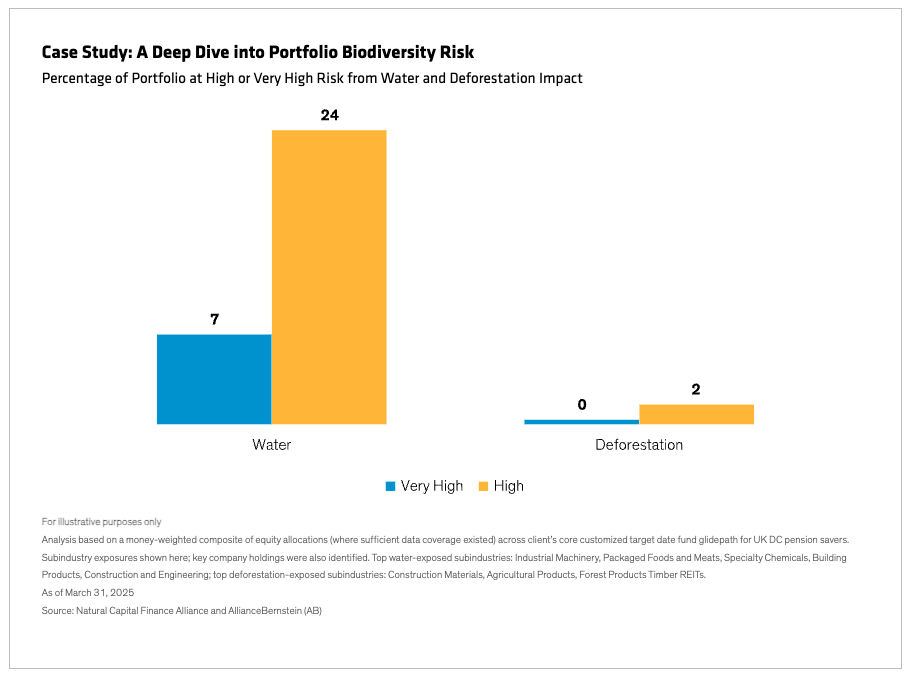
But such assumptions can fall short of reality. We recently analyzed the biodiversity risks in the equity allocations of a large UK pensions provider1 and found that water stress, not deforestation, was the biggest risk (Display).
Graph - Case Study: A Deep Dive into Portfolio Biodiversity Risk

This may seem surprising, given that the impacts of water stress tend to be localized and not so obviously global as those of deforestation and its links to climate.

But this particular client is not an outlier. Our analysis of the ENCORE2 industry biodiversity-risk database shows that the proportion of the MSCI ACWI Index for which water-related risk is high or very high is 35%—not very different from the client’s 31%. (The index also has a bigger exposure to high or very high deforestation risk—about 14%.) The insight underscores how important it is for investors and investment managers to analyze and identify their nature-related exposures correctly.

To that end, we have developed a proprietary risk-assessment framework that can identify nature-risk exposures across portfolios at the sub-industry level. In turn, this enables analysts to assess and engage with the potentially high-risk companies identified. We believe the framework may help reduce portfolio risk and unlock better returns.

Mapping Portfolio Biodiversity Risks

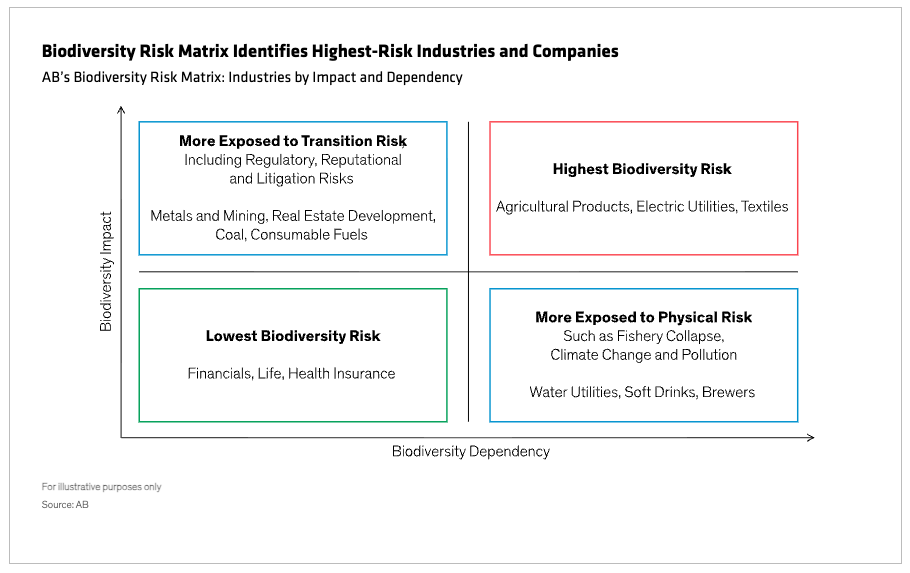
According to the Taskforce on Nature-related Financial Disclosures, nature-related risks are potential threats to an organization arising from dependency and impact on nature—the organization’s own, and those of society too. Dependency and impact are, respectively, physical and transition risks.

For example, fisheries that rely on water quality to sustain their fish stocks have a high dependency on nature, as they are exposed to the physical risk that water quality might deteriorate. Mining companies and property developers have a high impact on nature; as laws, regulations and trade practices change (transition) to reflect society’s growing awareness of biodiversity risk, they may become exposed to legal, reputational, market and other risks.

Using dependency, impact and related risks as a framework, we draw on the ENCORE database to map biodiversity risk exposure at the GICS3 subindustries level (Display).
Biodiversity Risk Matrix Identifies Highest-Risk Industries and Companies

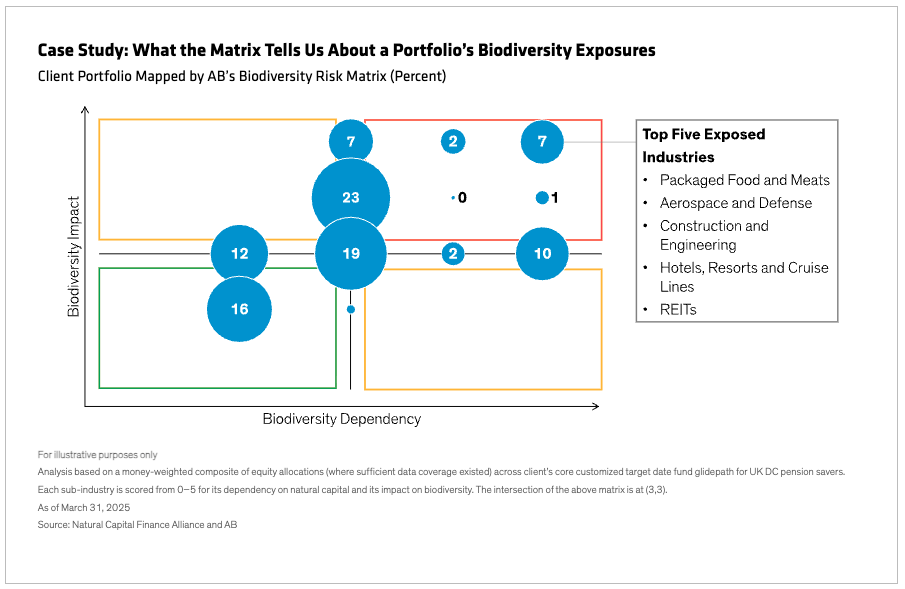
The industries that fall in the upper right quadrant have both high dependency and impact and, therefore, the most nature-related risk. Our analysis shows that 15.7% of MSCI ACWI falls into this quadrant. For the equity portfolio in our client case study, the proportion is significantly lower, at nearly 10% (Display).
Graph - Case Study: What the Matrix Tells Us About a Portfolio's Biodiversity Exposures

Understanding how dependency and impact risks are distributed across industries in a portfolio is a vital first step, but it’s also important to dive deeper to understand the risks at the issuer level. The ENCORE database lists risks individually and classifies them according to whether they are dependencies or impacts. Using this information, we can apply the framework to identify specific risks across a portfolio. This was how we discovered the extent to which the case-study portfolio’s biodiversity risks were dominated by water-related exposures (Display).
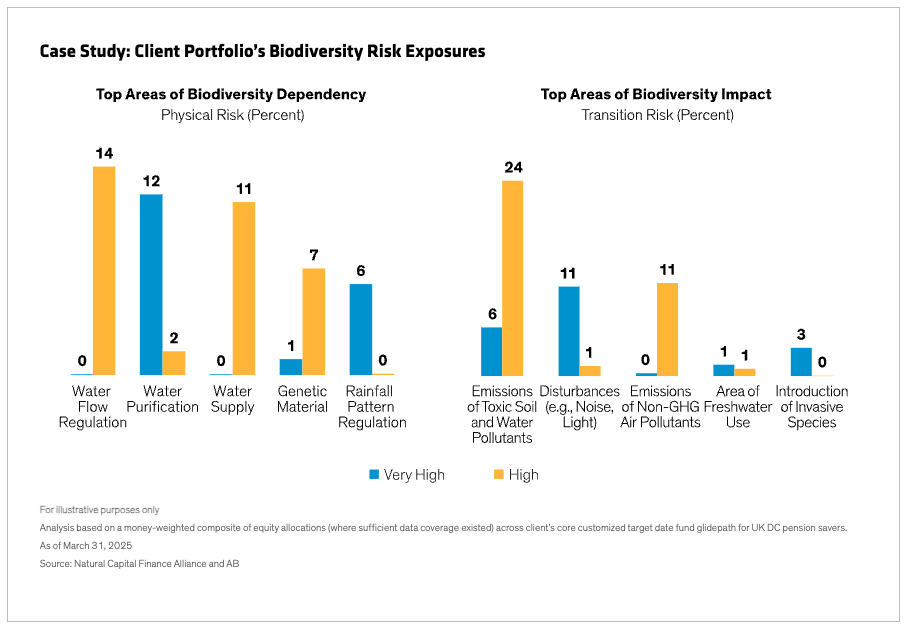
Graph - Case Study: Client Portfolio's Biodiversity Risk Exposures

Most of these exposures fell in the dependencies category, but two of the top five impact exposures were also water-related—area of freshwater use, and emissions of toxic soil and water pollutants. This level of information is potentially helpful in deciding where to focus efforts to mitigate the portfolio’s biodiversity risks.

Having established which industries in a portfolio have the highest nature risk, we can identify individual holdings within those industries that we may wish to target for further research to understand which biodiversity risks are most material for them.

Company Engagements: Consistency and Comparability

For active portfolios managed by AB, this level of research may also lead us to engage4 directly with issuers to better understand their exposures and, if appropriate, work with them to help mitigate risks. We decide which issuers to engage with on a case-by-case basis, according to whether engagement is in clients’ best interests. When undertaking an engagement for clients whose strategy is implemented mostly with third-party funds, we partner with appointed managers to ensure that biodiversity is a priority for them. The engagement process may require multiple meetings over time to monitor issuers’ progress in achieving their risk-reduction goals.

We have engaged on biodiversity risk with issuers in various client portfolios. These issuers include, for example, Linde, a UK-based supplier of industrial gases; US water-treatment company Ecolab; and Swiss processed foods group Nestlé (Display).
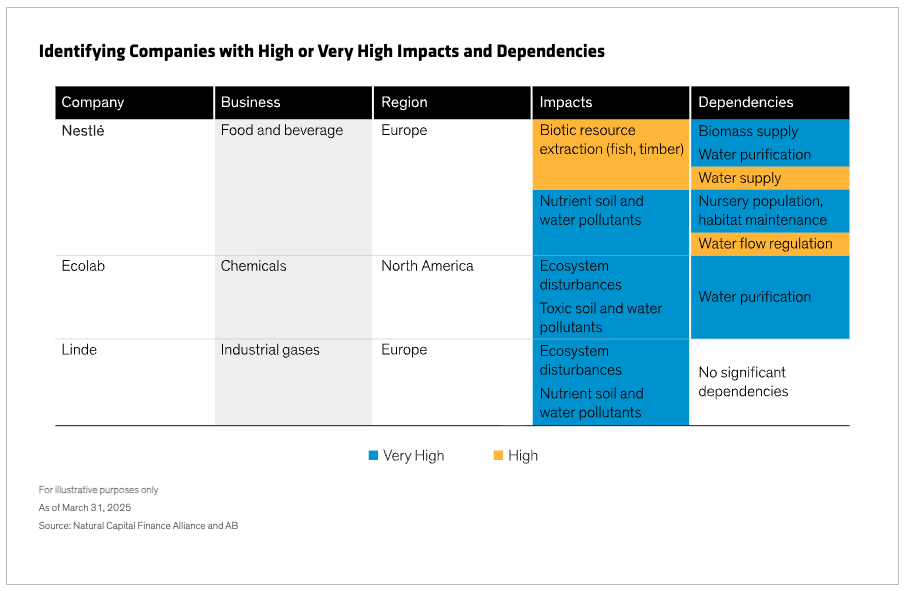
Identifying Companies with High or Very High Impacts and Dependencies

All fall in the top-right quadrant of the risk matrix. Linde ranks high for impact and moderate for dependency; Ecolab also ranks high for impact but higher than Linde for dependency. Nestlé ranks highest of the three on both counts. Below, we use Linde and Ecolab to illustrate how we engage on water-related risks and Nestlé on deforestation-related risks.

The process begins with defining the objective of the engagement. In the case of Linde, we wanted to know the water-risk implications of its hydrogen production—especially its move to producing green hydrogen. Traditional hydrogen production uses steam methane reforming, in which steam reacts with methane to produce hydrogen. Green hydrogen, which is powered by renewables, uses an electric current to split water into hydrogen and oxygen. Both processes are water intensive.

When engaging with Linde, we noted that it had reported considerable water savings, but its steam consumption had increased. The company explained that this had been possible because of a move to closed-loop production processes in which steam is fed back into the production cycle. It planned to use a similar technique to conserve water when producing green hydrogen. We asked Linde to consider introducing a company-wide water-usage target, and it said it planned to do so soon.

With Ecolab, we wanted an update on its effort to help customers conserve water and how it might be affected by plans to service water-hungry AI data centers. While the company had made considerable progress with conservation (226 billion gallons out of a 300 billion target), it noted that further gains were being complicated by increased water demand. But the expansion of data centers and utilities to power them was also creating opportunities for new efficiencies in energy and water supply, and the company was looking for commercial water-solution opportunities across the AI value chain.

Our engagement with Nestlé on deforestation illustrates some of the challenges of risk mitigation and the value of monitoring progress. In 2010, the company aimed to eliminate deforestation from five key supply chains—palm oil, soy, meat, paper and sugar—by 2022. It progressed well except for palm oil, which is sourced from high-risk countries: deforestation in the chain had fallen only 70% by 2020. We tracked progress, and in 2021 the company, aided by satellite and field monitoring, had eliminated deforestation across 90% of the chain. Its next goal was to be deforestation-free in all supply chains by the end of 2025.

Not Just Risks, but Opportunities, Too

Biodiversity exposures are material risks for many portfolios and need to be addressed appropriately, in our view. Our framework—supported by specialist, third-party industry data—can show how these exposures are distributed across portfolios and identify issuers with high nature-related risks. Combined with fundamental research and, where appropriate, issuer engagement and stewardship, it can lead to a deep understanding of issuer- and portfolio-level risks and the actions needed to mitigate them.

But it’s not just about risk: it’s about opportunity, too. For example, our engagement with Linde improved our understanding of how green hydrogen—an important step in the move to a low-carbon economy—could be produced in a way that conserves water usage. And Ecolab helped us understand how the growth in AI data centers might lead to enhanced water and energy efficiencies and related commercial opportunities.

As part of a broad-based active investment strategy, the framework, in our view, can not only identify and mitigate nature-related risks in portfolios, but it may help unlock better returns, too.

1 The analysis applied the framework to the client firm’s default investment offering for UK defined contribution (DC) pension savers to illustrate how the framework can surface biodiversity-related risks and highlight potential areas for deeper review. The results are provided for illustrative purposes only and are not intended as investment advice.

2 The Exploring Natural Capital Opportunities, Risks and Exposure (ENCORE) database is maintained by Global Canopy, the UN Environment Programme Finance Initiative and UN Environment Programme World Conservation Monitoring Centre.

3 Global Industry Classification Standard. Among the Standard’s various categories, the category “subindustries” provides the most granular classification of industries.

4 AB engages issuers where it believes the engagement is in the best interest of its clients.

The authors would like to thank Max Lulavy, Responsible Investing Research Analyst at AB, for his contributions to this article.
 

The views expressed herein do not constitute research, investment advice or trade recommendations, do not necessarily represent the views of all AB portfolio-management teams and are subject to change over time.

References to specific securities discussed are for illustrative purposes only and should not to be considered recommendations by AllianceBernstein L.P. It should not be assumed that investments in the securities mentioned have necessarily been or will necessarily be profitable.

The “target date” shown in a fund’s name refers to the approximate year when a pension scheme member expects to retire and begin withdrawing from his or her account. Target date funds gradually adjust their asset allocation, lowering risk as a member nears retirement. Investments in target date funds are not guaranteed against loss of principal at any time, and account values can be more or less than the original amount invested—including at the time of the fund’s target date. Also, investing in target date funds does not guarantee sufficient income in retirement.

MSCI makes no express or implied warranties or representations, and shall have no liability whatsoever with respect to any MSCI data contained herein.

The MSCI data may not be further redistributed or used as a basis for other indices or any securities or financial products. This report is not approved, reviewed or produced by MSCI.

Learn more about AB’s approach to responsibility here.

What You Need to Know

Biodiversity risk is more nuanced and complex than many investors think. For instance, there’s a widespread belief that deforestation poses the biggest nature-related risk for most portfolios. But when we applied our proprietary biodiversity risk-assessment framework for a client, we found that water risk—not deforestation—was the portfolio’s biggest exposure. Our analysis of the MSCI AWCI Index using the same framework shows water risk is elevated for many companies, highlighting just how important it is to assess biodiversity risk accurately.

16%

35%

14%

of the MSCI ACWI is exposed to the highest level of biodiversity risk

the share of MSCI ACWI for which water risk is high or very high

the share of MSCI ACWI for which deforestation risk is high or very high

Authors

Sara Rosner| Director—Responsible Investing Research
David Hutchins, FIA| Portfolio Manager—Multi-Asset Solutions
Henry Smith, CFA| Investment Strategist—Multi-Asset Solutions

The importance of biodiversity as a nature-related risk in investors’ portfolios has become better understood in the past few years. Investors are beginning to appreciate how complex and nuanced biodiversity risk can be. For example, there’s a widespread assumption that deforestation is the biggest biodiversity risk in many portfolios. That’s understandable, given media attention around the topic, and because large-scale deforestation contributes to climate change, which can have a material impact on investments across the globe.

But such assumptions can fall short of reality. We recently analyzed the biodiversity risks in the equity allocations of a large UK pensions provider1 and found that water stress, not deforestation, was the biggest risk (Display).

Graph - Case Study: A Deep Dive into Portfolio Biodiversity Risk

This may seem surprising, given that the impacts of water stress tend to be localized and not so obviously global as those of deforestation and its links to climate.

But this particular client is not an outlier. Our analysis of the ENCORE2 industry biodiversity-risk database shows that the proportion of the MSCI ACWI Index for which water-related risk is high or very high is 35%—not very different from the client’s 31%. (The index also has a bigger exposure to high or very high deforestation risk—about 14%.) The insight underscores how important it is for investors and investment managers to analyze and identify their nature-related exposures correctly.

To that end, we have developed a proprietary risk-assessment framework that can identify nature-risk exposures across portfolios at the sub-industry level. In turn, this enables analysts to assess and engage with the potentially high-risk companies identified. We believe the framework may help reduce portfolio risk and unlock better returns.

Mapping Portfolio Biodiversity Risks

According to the Taskforce on Nature-related Financial Disclosures, nature-related risks are potential threats to an organization arising from dependency and impact on nature—the organization’s own, and those of society too. Dependency and impact are, respectively, physical and transition risks.

For example, fisheries that rely on water quality to sustain their fish stocks have a high dependency on nature, as they are exposed to the physical risk that water quality might deteriorate. Mining companies and property developers have a high impact on nature; as laws, regulations and trade practices change (transition) to reflect society’s growing awareness of biodiversity risk, they may become exposed to legal, reputational, market and other risks.

Using dependency, impact and related risks as a framework, we draw on the ENCORE database to map biodiversity risk exposure at the GICS3 subindustries level (Display).

Biodiversity Risk Matrix Identifies Highest-Risk Industries and Companies

The industries that fall in the upper right quadrant have both high dependency and impact and, therefore, the most nature-related risk. Our analysis shows that 15.7% of MSCI ACWI falls into this quadrant. For the equity portfolio in our client case study, the proportion is significantly lower, at nearly 10% (Display).

Graph - Case Study: What the Matrix Tells Us About a Portfolio's Biodiversity Exposures

Understanding how dependency and impact risks are distributed across industries in a portfolio is a vital first step, but it’s also important to dive deeper to understand the risks at the issuer level. The ENCORE database lists risks individually and classifies them according to whether they are dependencies or impacts. Using this information, we can apply the framework to identify specific risks across a portfolio. This was how we discovered the extent to which the case-study portfolio’s biodiversity risks were dominated by water-related exposures (Display).

Graph - Case Study: Client Portfolio's Biodiversity Risk Exposures

Most of these exposures fell in the dependencies category, but two of the top five impact exposures were also water-related—area of freshwater use, and emissions of toxic soil and water pollutants. This level of information is potentially helpful in deciding where to focus efforts to mitigate the portfolio’s biodiversity risks.

Having established which industries in a portfolio have the highest nature risk, we can identify individual holdings within those industries that we may wish to target for further research to understand which biodiversity risks are most material for them.

Company Engagements: Consistency and Comparability

For active portfolios managed by AB, this level of research may also lead us to engage4 directly with issuers to better understand their exposures and, if appropriate, work with them to help mitigate risks. We decide which issuers to engage with on a case-by-case basis, according to whether engagement is in clients’ best interests. When undertaking an engagement for clients whose strategy is implemented mostly with third-party funds, we partner with appointed managers to ensure that biodiversity is a priority for them. The engagement process may require multiple meetings over time to monitor issuers’ progress in achieving their risk-reduction goals.

We have engaged on biodiversity risk with issuers in various client portfolios. These issuers include, for example, Linde, a UK-based supplier of industrial gases; US water-treatment company Ecolab; and Swiss processed foods group Nestlé (Display).

Identifying Companies with High or Very High Impacts and Dependencies

All fall in the top-right quadrant of the risk matrix. Linde ranks high for impact and moderate for dependency; Ecolab also ranks high for impact but higher than Linde for dependency. Nestlé ranks highest of the three on both counts. Below, we use Linde and Ecolab to illustrate how we engage on water-related risks and Nestlé on deforestation-related risks.

The process begins with defining the objective of the engagement. In the case of Linde, we wanted to know the water-risk implications of its hydrogen production—especially its move to producing green hydrogen. Traditional hydrogen production uses steam methane reforming, in which steam reacts with methane to produce hydrogen. Green hydrogen, which is powered by renewables, uses an electric current to split water into hydrogen and oxygen. Both processes are water intensive.

When engaging with Linde, we noted that it had reported considerable water savings, but its steam consumption had increased. The company explained that this had been possible because of a move to closed-loop production processes in which steam is fed back into the production cycle. It planned to use a similar technique to conserve water when producing green hydrogen. We asked Linde to consider introducing a company-wide water-usage target, and it said it planned to do so soon.

With Ecolab, we wanted an update on its effort to help customers conserve water and how it might be affected by plans to service water-hungry AI data centers. While the company had made considerable progress with conservation (226 billion gallons out of a 300 billion target), it noted that further gains were being complicated by increased water demand. But the expansion of data centers and utilities to power them was also creating opportunities for new efficiencies in energy and water supply, and the company was looking for commercial water-solution opportunities across the AI value chain.

Our engagement with Nestlé on deforestation illustrates some of the challenges of risk mitigation and the value of monitoring progress. In 2010, the company aimed to eliminate deforestation from five key supply chains—palm oil, soy, meat, paper and sugar—by 2022. It progressed well except for palm oil, which is sourced from high-risk countries: deforestation in the chain had fallen only 70% by 2020. We tracked progress, and in 2021 the company, aided by satellite and field monitoring, had eliminated deforestation across 90% of the chain. Its next goal was to be deforestation-free in all supply chains by the end of 2025.

Not Just Risks, but Opportunities, Too

Biodiversity exposures are material risks for many portfolios and need to be addressed appropriately, in our view. Our framework—supported by specialist, third-party industry data—can show how these exposures are distributed across portfolios and identify issuers with high nature-related risks. Combined with fundamental research and, where appropriate, issuer engagement and stewardship, it can lead to a deep understanding of issuer- and portfolio-level risks and the actions needed to mitigate them.

But it’s not just about risk: it’s about opportunity, too. For example, our engagement with Linde improved our understanding of how green hydrogen—an important step in the move to a low-carbon economy—could be produced in a way that conserves water usage. And Ecolab helped us understand how the growth in AI data centers might lead to enhanced water and energy efficiencies and related commercial opportunities.

As part of a broad-based active investment strategy, the framework, in our view, can not only identify and mitigate nature-related risks in portfolios, but it may help unlock better returns, too.

1 The analysis applied the framework to the client firm’s default investment offering for UK defined contribution (DC) pension savers to illustrate how the framework can surface biodiversity-related risks and highlight potential areas for deeper review. The results are provided for illustrative purposes only and are not intended as investment advice.

2 The Exploring Natural Capital Opportunities, Risks and Exposure (ENCORE) database is maintained by Global Canopy, the UN Environment Programme Finance Initiative and UN Environment Programme World Conservation Monitoring Centre.

3 Global Industry Classification Standard. Among the Standard’s various categories, the category “subindustries” provides the most granular classification of industries.

4 AB engages issuers where it believes the engagement is in the best interest of its clients.

The authors would like to thank Max Lulavy, Responsible Investing Research Analyst at AB, for his contributions to this article.
 

The views expressed herein do not constitute research, investment advice or trade recommendations, do not necessarily represent the views of all AB portfolio-management teams and are subject to change over time.

References to specific securities discussed are for illustrative purposes only and should not to be considered recommendations by AllianceBernstein L.P. It should not be assumed that investments in the securities mentioned have necessarily been or will necessarily be profitable.

The “target date” shown in a fund’s name refers to the approximate year when a pension scheme member expects to retire and begin withdrawing from his or her account. Target date funds gradually adjust their asset allocation, lowering risk as a member nears retirement. Investments in target date funds are not guaranteed against loss of principal at any time, and account values can be more or less than the original amount invested—including at the time of the fund’s target date. Also, investing in target date funds does not guarantee sufficient income in retirement.

MSCI makes no express or implied warranties or representations, and shall have no liability whatsoever with respect to any MSCI data contained herein.

The MSCI data may not be further redistributed or used as a basis for other indices or any securities or financial products. This report is not approved, reviewed or produced by MSCI.

Learn more about AB’s approach to responsibility here.

AMSTERDAM, HONG KONG, OAKLAND, Calif., February 4, 2026 /3BL/ – Cascale and Worldly today released Navigating Global Water Regulation: Implications for the Textile and Consumer Goods Sector, examining how intensifying water scarcity and tightening regulation are reshaping the operating environment for the apparel, textile, and wider consumer goods sector.

The analysis maps evolving water policy across key production regions in Asia, the European Union, and the United States. It connects regulatory developments to operational, financial, and reputational risks, and outlines how companies can strengthen resilience as water becomes a strategic business concern alongside climate and supply chain due diligence.

With the global apparel and textile industry consuming an estimated 93 billion cubic meters of water annually and contributing roughly 20 percent of global industrial wastewater, water regulation is accelerating in regions already facing acute stress. Governments are responding with stricter controls on water use, wastewater discharge, and pollution, particularly in major manufacturing hubs.

The report highlights significant regulatory momentum in China and Vietnam, continued but uneven enforcement across other Asian production countries, expanding disclosure requirements in the European Union, and regulatory uncertainty in the United States. Together, these trends underscore the need for companies to elevate water risk from a site-level issue to a governance and strategy priority.

“Preserving our planet’s freshwater supplies is a top priority — water is life. Across the globe, legislators are responding by introducing new regulations, and water is quickly becoming a defining constraint on how and where the industry can operate,” said Elisabeth von Reitzenstein, senior director of policy and public affairs at Cascale. “This analysis is designed to help companies move beyond reacting to individual laws and instead understand the bigger picture. When water risk is integrated into sourcing, governance, and performance management, it becomes possible to protect both business continuity and local communities.”

The report also outlines practical actions companies can take now, including mapping facilities in water-stressed basins, validating wastewater compliance, strengthening supplier data collection, and embedding water considerations into sourcing and contingency planning. These steps are increasingly critical as regulation shifts from focusing on efficiency alone toward source sustainability and foundational environmental performance.

“Water policy provides essential direction for where supply chain action matters most,” said JR Siegel, vice president of sustainability at Worldly. “Leading companies rely on Worldly’s standardized, decision-grade data to prioritize action at the facility level—strengthening risk management, investment decisions, and supply chain resilience ahead of disruption.”

Key Takeaways

  • Water regulation is accelerating globally. Governments are strengthening controls on water use, wastewater discharge, and pollution, particularly in water-stressed production regions.
  • Risk exposure is uneven but growing. Major apparel and textile hubs in Asia face tightening regulation and enforcement, while EU disclosure requirements expand and U.S. policy remains uncertain.
  • Water is now a strategic business issue. Companies are moving from treating water as a site-level concern to integrating it into governance, sourcing, and risk management decisions.
  • Data and standardization matter. Visibility into water use, wastewater management, and basin-level risk is essential to manage compliance, protect operations, and maintain credibility.
  • Early action builds resilience. Companies that invest now in efficient, compliant, and transparent water management are better positioned as scarcity and regulation intensify.

The publication reflects Cascale and Worldly’s shared commitment to supporting the industry with credible, actionable insight. Cascale’s Higg Index tools, developed in collaboration with Worldly, in addition to Worldly’s comprehensive data and analytics platform, help connect evolving regulation to measurable performance improvement at scale.

As water scarcity intensifies and enforcement strengthens across regions, the report concludes that the cost of inaction — from production disruptions to reputational damage — is likely to exceed the investment required today. Proactive, verifiable water management is increasingly a strategic imperative for long-term resilience in the consumer goods industry.

ABOUT CASCALE

Cascale is the global nonprofit alliance empowering collaboration to drive equitable and restorative business practices in the consumer goods industry. Formerly known as the Sustainable Apparel Coalition, Cascale owns and develops the Higg Index, which is exclusively available on Worldly, the most comprehensive sustainability data and insights platform. Cascale unites over 300 retailers, brands, manufacturers, governments, academics, and NGO/nonprofit affiliates around the globe through one singular vision: To catalyze impact at scale and give back more than we take to the planet and its people.

LinkedIn | Instagram | Facebook | YouTube

ABOUT WORLDLY

Worldly is the leading sustainability and supply chain intelligence platform for the consumer goods industry. The company empowers brands, retailers, and manufacturers to turn verified primary data into insight and action across complex global supply chains.

Trusted by a network of more than 40,000 companies across apparel, footwear, home furnishings, and sporting goods, Worldly provides visibility into environmental and social performance, including carbon, water, chemicals, and labor, at the product, facility, and value-chain levels.

Built on industry-recognized standards, including Cascale’s Higg Index, Worldly translates raw data into actionable intelligence that helps organizations reduce risk, meet evolving regulatory requirements, and drive measurable progress over time.

www.worldly.io

AMSTERDAM, HONG KONG, OAKLAND, Calif., February 4, 2026 /3BL/ – Cascale and Worldly today released Navigating Global Water Regulation: Implications for the Textile and Consumer Goods Sector, examining how intensifying water scarcity and tightening regulation are reshaping the operating environment for the apparel, textile, and wider consumer goods sector.

The analysis maps evolving water policy across key production regions in Asia, the European Union, and the United States. It connects regulatory developments to operational, financial, and reputational risks, and outlines how companies can strengthen resilience as water becomes a strategic business concern alongside climate and supply chain due diligence.

With the global apparel and textile industry consuming an estimated 93 billion cubic meters of water annually and contributing roughly 20 percent of global industrial wastewater, water regulation is accelerating in regions already facing acute stress. Governments are responding with stricter controls on water use, wastewater discharge, and pollution, particularly in major manufacturing hubs.

The report highlights significant regulatory momentum in China and Vietnam, continued but uneven enforcement across other Asian production countries, expanding disclosure requirements in the European Union, and regulatory uncertainty in the United States. Together, these trends underscore the need for companies to elevate water risk from a site-level issue to a governance and strategy priority.

“Preserving our planet’s freshwater supplies is a top priority — water is life. Across the globe, legislators are responding by introducing new regulations, and water is quickly becoming a defining constraint on how and where the industry can operate,” said Elisabeth von Reitzenstein, senior director of policy and public affairs at Cascale. “This analysis is designed to help companies move beyond reacting to individual laws and instead understand the bigger picture. When water risk is integrated into sourcing, governance, and performance management, it becomes possible to protect both business continuity and local communities.”

The report also outlines practical actions companies can take now, including mapping facilities in water-stressed basins, validating wastewater compliance, strengthening supplier data collection, and embedding water considerations into sourcing and contingency planning. These steps are increasingly critical as regulation shifts from focusing on efficiency alone toward source sustainability and foundational environmental performance.

“Water policy provides essential direction for where supply chain action matters most,” said JR Siegel, vice president of sustainability at Worldly. “Leading companies rely on Worldly’s standardized, decision-grade data to prioritize action at the facility level—strengthening risk management, investment decisions, and supply chain resilience ahead of disruption.”

Key Takeaways

  • Water regulation is accelerating globally. Governments are strengthening controls on water use, wastewater discharge, and pollution, particularly in water-stressed production regions.
  • Risk exposure is uneven but growing. Major apparel and textile hubs in Asia face tightening regulation and enforcement, while EU disclosure requirements expand and U.S. policy remains uncertain.
  • Water is now a strategic business issue. Companies are moving from treating water as a site-level concern to integrating it into governance, sourcing, and risk management decisions.
  • Data and standardization matter. Visibility into water use, wastewater management, and basin-level risk is essential to manage compliance, protect operations, and maintain credibility.
  • Early action builds resilience. Companies that invest now in efficient, compliant, and transparent water management are better positioned as scarcity and regulation intensify.

The publication reflects Cascale and Worldly’s shared commitment to supporting the industry with credible, actionable insight. Cascale’s Higg Index tools, developed in collaboration with Worldly, in addition to Worldly’s comprehensive data and analytics platform, help connect evolving regulation to measurable performance improvement at scale.

As water scarcity intensifies and enforcement strengthens across regions, the report concludes that the cost of inaction — from production disruptions to reputational damage — is likely to exceed the investment required today. Proactive, verifiable water management is increasingly a strategic imperative for long-term resilience in the consumer goods industry.

ABOUT CASCALE

Cascale is the global nonprofit alliance empowering collaboration to drive equitable and restorative business practices in the consumer goods industry. Formerly known as the Sustainable Apparel Coalition, Cascale owns and develops the Higg Index, which is exclusively available on Worldly, the most comprehensive sustainability data and insights platform. Cascale unites over 300 retailers, brands, manufacturers, governments, academics, and NGO/nonprofit affiliates around the globe through one singular vision: To catalyze impact at scale and give back more than we take to the planet and its people.

LinkedIn | Instagram | Facebook | YouTube

ABOUT WORLDLY

Worldly is the leading sustainability and supply chain intelligence platform for the consumer goods industry. The company empowers brands, retailers, and manufacturers to turn verified primary data into insight and action across complex global supply chains.

Trusted by a network of more than 40,000 companies across apparel, footwear, home furnishings, and sporting goods, Worldly provides visibility into environmental and social performance, including carbon, water, chemicals, and labor, at the product, facility, and value-chain levels.

Built on industry-recognized standards, including Cascale’s Higg Index, Worldly translates raw data into actionable intelligence that helps organizations reduce risk, meet evolving regulatory requirements, and drive measurable progress over time.

www.worldly.io

Four Acclaimed Bourbon Producers Collaborate on a One-of-a-Kind Barrel Benefiting Veterans During America’s 250th Anniversary Year

LOUISVILLE, Ky., Feb. 4, 2026 /PRNewswire/ — The inaugural Kentucky Bourbon Country Auction & Celebration (KBCA) has announced a landmark auction lot titled “United We Stand,” a special military barrel created through an unprecedented collaboration among four acclaimed American whiskey producers with deep ties to veteran and military philanthropy.

J. Mattingly 1845, Heritage Distilling, Four Branches Bourbon and Pursuit Spirits each donated a barrel for the project. From those individual contributions, Ryan Cecil, Master Blender for Pursuit Spirits, carefully selected and blended the finest elements to create a singular expression known as the United We Stand barrel.

Coinciding with the United States’ 250th anniversary, the barrel will be auctioned during the inaugural KBCA event on Presidents’ Day Weekend, Feb. 14, 2026, with proceeds benefiting the Bob Woodruff Foundation, supporting veterans and their families.

“This barrel represents everything the KBCA stands for: unity, craftsmanship and purpose,” said Andrew Varga, founder of KBCA. “Four respected producers, each with their own identity and legacy, have come together in service of something bigger than themselves. In America’s 250th anniversary year, this collaboration honors our nation’s origins, our military’s shared sacrifice, and the idea that we are strongest when we stand together.”

In addition to the auctioned barrel, each participating distiller will release 100 individual bottles featuring a commemorative label honoring the collaboration and America’s milestone anniversary.

Collectively, J. Mattingly 1845, Heritage Distilling and Four Branches Bourbon have donated millions of dollars over many years to more than 50 military and veteran-focused organizations, including the Bob Woodruff Foundation, Folds of Honor, Disabled American Veterans, Navy SEAL Foundation and the Green Beret Foundation.

The United We Stand barrel joins a lineup of previously announced KBCA lots, including exclusive single-barrel selection experiences and historic bourbon releases. For the auction catalogue and ticket information, visit www.KYBCA.com and follow KBCA on Instagram, YouTube and LinkedIn.

The KBCA will take place Feb. 13–15, 2026, in Louisville, Ky and consists of various bourbon-related events. For those who cannot attend the auction in person, there is a virtual option at the following link: KBCA Virtual Viewing Link

Media Contact:
Amy Preske
Booze PR
502-608-6502
408697@email4pr.com

Cision View original content to download multimedia:https://www.prnewswire.com/news-releases/the-kentucky-bourbon-country-auction-announces-united-we-stand-military-barrel-auction-lot-honoring-service-and-unity-302678690.html

SOURCE KY Bourbon Country Auction

Privacy Overview

This website uses cookies so that we can provide you with the best user experience possible. Cookie information is stored in your browser and performs functions such as recognising you when you return to our website and helping our team to understand which sections of the website you find most interesting and useful.