PHILADELPHIA, Feb. 25, 2026 /PRNewswire/ — February 25, 2026 marks one year since KJ, an infant born with severe carbamoyl phosphate synthetase 1 (CPS1) deficiency, became the world’s first person to receive a personalized CRISPR-based gene editing therapy. The therapy was developed by physician-scientists at Children’s Hospital of Philadelphia (CHOP) and Penn Medicine, and in May 2025, CHOP shared that the treatment – created specifically for KJ’s rare disease – was administered safely. Since that time, KJ has achieved meaningful clinical improvements, such as walking and talking, as he continues to grow and thrive.
“It’s amazing to see KJ hit these milestones,” said Rebecca Ahrens-Nicklas, MD, PhD, director of CHOP’s Gene Therapy for Inherited Metabolic Disorders Frontier Program, which focuses on inborn errors of metabolism. “While this treatment isn’t a cure, after three infusions from February through April 2025, KJ has tolerated it well with no serious side effects. He’s able to handle more dietary protein, requires less nitrogen-scavenging medication, and we’re seeing better control of ammonia levels during colds and similar childhood illnesses. He will continue to be monitored closely to track long-term outcomes.”

A milestone born of decades of research and teamwork, CHOP has long integrated specialty clinical care with research to meet children’s most urgent needs. KJ’s personalized gene therapy, a base editor delivered via lipid nanoparticles to correct his CPS1 variant in the liver, evolved from years of preclinical work, collaboration between CHOP and Penn, and the NIH-funded Somatic Cell Genome Editing Consortium. Currently, CHOP supports more than 80 faculty advancing cell and gene therapy across more than 20 programs and 45 active pediatric clinical trials.

“We’re just beginning to unlock gene editing’s potential in pediatrics and beyond,” said Kiran Musunuru, MD, PhD, MPH, ML, MRA, Co-Director of the Orphan Disease Center (ODC), a partnership between CHOP and Penn Medicine, who also co-led KJ’s team with Dr. Ahrens-Nicklas. “We aim to responsibly develop and scale these approaches, so more children can lead healthy lives, and to invest in hands-on training so best practices reach all communities. We’re also working on designing umbrella clinical trials that move us beyond one-patient treatments, accelerating access to scalable, adaptable therapies.”

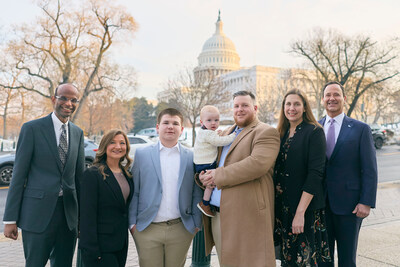
Earlier this month, the Muldoon’s traveled with KJ to Washington, DC, alongside Ahrens-Nicklas and Musunuru, to share KJ’s story with lawmakers. CHOP hosted educational briefing events in collaboration with the Rare Disease Congressional Caucus and the Personalized Medicine Caucus, highlighting the need for sustained federal funding for pediatric research and policies that expand access to personalized gene therapies.

“As KJ’s parents, we want to put a human face on rare diseases,” said Kyle Muldoon.

“Watching KJ grow and thrive is nothing short of a miracle – we want every child and family facing a rare condition to have that same chance,” added Nicole Muldoon. “Lawmakers can make that possible by investing in research, expanding access to care, and ensuring innovative therapies reach patients now.”

Looking ahead, CHOP researchers are pursuing causes and treatments for hard-to-treat metabolic disorders through CHOP’s Gene Therapy for Inherited Metabolic Disorders (GTIMD) Program. They are studying conditions such as urea cycle disorders, organic acidemias, fatty acid oxidation defects, and phenylketonuria. KJ’s case is also spurring discussions about new approval models for personalized therapies, and a New England Journal of Medicine editorial highlighted the lessons it offers the rare-disease community.

On Monday, February 23, Drs. Ahrens-Nicklas and Musunuru joined the FDA in announcing a new “plausible mechanism” framework for individualized therapies to speed approvals for rare diseases where large, randomized trials aren’t possible. Under the pathway, all variant-specific versions of a gene editor would be treated as one drug, simplifying review. For example, a single trial could enroll people with any of seven urea cycle disorders (from seven different genes) that the same editor can fix, and positive results in as few as 5-10 patients, rather than hundreds, could be enough for FDA approval of the overall platform.

“We’re committed to ensuring access for all children, and that means working together to develop a clear roadmap,” said Ahrens-Nicklas. “Through full transparency in our science and regulatory interactions, we aim to empower more teams to develop safe, effective therapies and extend these advances across other pediatric rare diseases.”

About Children’s Hospital of Philadelphia:
A non-profit, charitable organization, Children’s Hospital of Philadelphia was founded in 1855 as the nation’s first pediatric hospital. Through its long-standing commitment to providing exceptional patient care, training new generations of pediatric healthcare professionals, and pioneering major research initiatives, the hospital has fostered many discoveries that have benefited children worldwide. Its pediatric research program is among the largest in the country. The institution has a well-established history of providing advanced pediatric care close to home through its CHOP Care Network, which includes more than 50 primary care practices, specialty care and surgical centers, urgent care centers, and community hospital alliances throughout Pennsylvania and New Jersey. CHOP also operates the Middleman Family Pavilion and its dedicated pediatric emergency department in King of Prussia, the Behavioral Health and Crisis Center (including a 24/7 Crisis Response Center) and the Center for Advanced Behavioral Healthcare, a mental health outpatient facility. Its unique family-centered care and public service programs have brought Children’s Hospital of Philadelphia recognition as a leading advocate for children and adolescents. For more information, visit https://www.chop.edu. 

Contact: Ashley Moore
Children’s Hospital of Philadelphia
(267) 426-6067
moorea1@chop.edu

Cision View original content to download multimedia:https://www.prnewswire.com/news-releases/childrens-hospital-of-philadelphia-marks-one-year-anniversary-of-worlds-first-personalized-crispr-gene-therapy-for-child-with-rare-genetic-disease-302696376.html

SOURCE Children’s Hospital of Philadelphia

State and industry leaders gather to reflect on early results, highlighting long-term benefits of Illinois’ newest recycling program

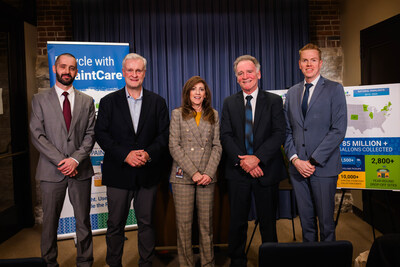
SPRINGFIELD, Ill., Feb. 24, 2026 /PRNewswire/ — Today, elected officials and paint industry leaders gathered at the Illinois State Capitol for a press conference highlighting the early progress of the new statewide architectural paint recycling program. Operated by PaintCare, a nonprofit organization created by the American Coatings Association (ACA), the program helps households and businesses recycle leftover paint, stain, and varnish in a convenient and responsible way. Just two months after its December 1, 2025 launch, the program is already seeing strong participation across the state with a growing network of more than 340 drop-off site community partners.

PaintCare’s paint recycling program was made possible under the paint stewardship law that was passed with bipartisan support by the Illinois General Assembly and signed into law by Governor JB Pritzker in 2023. This morning’s press conference featured remarks from notable supporters of the legislation including Illinois State Senator Linda Holmes, who served as the bill’s Chief Senate Sponsor. Illinois EPA Director James Jennings, American Coatings Association President and CEO, Michael W. Johnson and PaintCare IL Program Manager, Ross Dudzik, also offered insights into the program’s successes to date, including the collection of an estimated 60,000 gallons of leftover paint during the first two months of the program.

Attendees of the conference included key advocates for the program including Walter Willis, Executive Director of the Solid Waste Agency of Lake County, and Heather Presutti, VP of Operations for paint recycler GDB Paint & Coatings, among others. Scott Cassel of the Product Stewardship Institute was not able to attend, but a statement provided by Cassel was read by Walter Willis.

Illinois State Senator Linda Holmes said, “This program is a tremendous win for Illinois families, businesses and our environment. For years, residents have been asking for a simpler, more responsible way to dispose of old paint, and I’m proud to have sponsored legislation that directly responds to that need. This program will provide more collection sites than in the past; I believe more convenient access, as additional drop-off sites join the system, will be an incentive to families and business owners to safely dispose of leftover paint and free up space in their homes and businesses.”

Illinois State Representative Natalie Manley said, “Today’s event reflects how impactful policy can be when it’s designed to work in the real world. Looking at the incredible collection numbers and partnerships to date, it’s clear that the paint stewardship legislation is already making a strong impact here in our state.”

PaintCare estimates its new Illinois program will manage nearly one million gallons of leftover paint in its first year with the help of its local drop-off site partners and communitywide events. The program has already signed on 345 partners, with more onboarding planned according to Michael W. Johnson, President and CEO of the American Coatings Association. The drop-off sites primarily consist of paint and hardware retail stores, but also facilities owned by local government and nonprofit organizations. These entities participate voluntarily collecting leftover paint during regular business hours to provide households and businesses a convenient, year-round recycling option.

“The remarkable turnout and enthusiastic support from local leaders today confirmed what we already knew—Illinois was more than ready for this program,” said Johnson. “The collection numbers speak for themselves and serve as a strong indicator that the program is working, scaling effectively and meeting a significant need in communities statewide. The success is the direct result of focused leadership and unprecedented collaboration across policy, environmental advocacy, retailers and local communities. Today marks a major milestone and a strong foundation for what comes next.”

From early on, the paint stewardship legislation was supported by a broad coalition of municipal and environmental organizations, including the Illinois Environmental Protection Agency (Illinois EPA); the Illinois Product Stewardship Council (ILPSC); and the Product Stewardship Institute (PSI).

James Jennings, Director of the Illinois EPA said, “Seeing measurable participation so soon after launch shows that Illinois households and businesses are responding to expanded recycling options. Programs like this play an important role in supporting responsible materials management and strengthening recycling infrastructure across the state.”

Scott Cassel, Chief Executive Officer of PSI said, “Illinois is already demonstrating the strength of a paint stewardship program built on a proven model. This early retailer participation is accelerating access for households and businesses across the state. That kind of scalable network is what sustains these programs over time and supports more effective paint management at the community level.”

PaintCare’s Illinois program follows similar paint stewardship laws and programs in California, Colorado, Connecticut, the District of Columbia, Maine, Minnesota, New York, Rhode Island, Oregon, Vermont, and Washington. A program is also currently being developed for Maryland. PaintCare manages collected paint according to a policy of “highest, best use,” which emphasizes making good quality material available for immediate reuse, recycling it, or putting it to another beneficial use if it can’t be reused or recycled. There is no cost to households and businesses when dropping off leftover paint for recycling. A small fee—called the PaintCare fee—is placed on the sale of new paint and funds all aspects of the program including paint collection, transportation, processing and public education. 

Illinois drop-off locations are easy to find by visiting PaintCare’s online site locator at paintcare.org, or by calling PaintCare’s hotline number at (855) PAINT09. According to Ross Dudzik, PaintCare’s IL Program Manager, “Getting new partners up and running smoothly has been a major focus of the early rollout. PaintCare’s field representatives are working directly with retailers across the state—supporting everything from onboarding to regular collection pickups—to make participation straightforward and simple from day one. That hands-on partnership allows the program to expand quickly while ensuring each new site is set up for success.”

PaintCare sites accept both latex and oil-based architectural paint products, including interior and exterior paints, primers, stains, sealers, and varnishes. Products must be in original, non-leaking containers with the original manufacturer’s label visible. Businesses, organizations, and households with 100 gallons of paint or more to recycle may request a free pickup at their location. Some restrictions apply. More information can be found on PaintCare’s website at paintcare.org/pickup.

To learn more about PaintCare’s program in Illinois, visit: paintcare.org/IL.

About PaintCare
PaintCare is committed to making it easy and convenient for households, businesses, and institutions to recycle postconsumer (leftover) paint in states with paint stewardship laws. A nonprofit organization created by paint companies, PaintCare sets up drop-off locations for leftover paint, arranges for recycling and proper disposal, and conducts public education. Approximately 85 million gallons of paint, stain, and varnish have been managed by PaintCare in 11 states and the District of Columbia.

Media Contacts:
Abby Sklencar, PaintCare: 202-940-8214
Mike Martin, The Martin Group: 518-269-4503| X724

Cision View original content to download multimedia:https://www.prnewswire.com/news-releases/paintcare-illinois-hits-early-program-milestones-in-first-two-months-302696574.html

SOURCE PaintCare

State and industry leaders gather to reflect on early results, highlighting long-term benefits of Illinois’ newest recycling program

SPRINGFIELD, Ill., Feb. 24, 2026 /PRNewswire/ — Today, elected officials and paint industry leaders gathered at the Illinois State Capitol for a press conference highlighting the early progress of the new statewide architectural paint recycling program. Operated by PaintCare, a nonprofit organization created by the American Coatings Association (ACA), the program helps households and businesses recycle leftover paint, stain, and varnish in a convenient and responsible way. Just two months after its December 1, 2025 launch, the program is already seeing strong participation across the state with a growing network of more than 340 drop-off site community partners.

PaintCare’s paint recycling program was made possible under the paint stewardship law that was passed with bipartisan support by the Illinois General Assembly and signed into law by Governor JB Pritzker in 2023. This morning’s press conference featured remarks from notable supporters of the legislation including Illinois State Senator Linda Holmes, who served as the bill’s Chief Senate Sponsor. Illinois EPA Director James Jennings, American Coatings Association President and CEO, Michael W. Johnson and PaintCare IL Program Manager, Ross Dudzik, also offered insights into the program’s successes to date, including the collection of an estimated 60,000 gallons of leftover paint during the first two months of the program.

Attendees of the conference included key advocates for the program including Walter Willis, Executive Director of the Solid Waste Agency of Lake County, and Heather Presutti, VP of Operations for paint recycler GDB Paint & Coatings, among others. Scott Cassel of the Product Stewardship Institute was not able to attend, but a statement provided by Cassel was read by Walter Willis.

Illinois State Senator Linda Holmes said, “This program is a tremendous win for Illinois families, businesses and our environment. For years, residents have been asking for a simpler, more responsible way to dispose of old paint, and I’m proud to have sponsored legislation that directly responds to that need. This program will provide more collection sites than in the past; I believe more convenient access, as additional drop-off sites join the system, will be an incentive to families and business owners to safely dispose of leftover paint and free up space in their homes and businesses.”

Illinois State Representative Natalie Manley said, “Today’s event reflects how impactful policy can be when it’s designed to work in the real world. Looking at the incredible collection numbers and partnerships to date, it’s clear that the paint stewardship legislation is already making a strong impact here in our state.”

PaintCare estimates its new Illinois program will manage nearly one million gallons of leftover paint in its first year with the help of its local drop-off site partners and communitywide events. The program has already signed on 345 partners, with more onboarding planned according to Michael W. Johnson, President and CEO of the American Coatings Association. The drop-off sites primarily consist of paint and hardware retail stores, but also facilities owned by local government and nonprofit organizations. These entities participate voluntarily collecting leftover paint during regular business hours to provide households and businesses a convenient, year-round recycling option.

“The remarkable turnout and enthusiastic support from local leaders today confirmed what we already knew—Illinois was more than ready for this program,” said Johnson. “The collection numbers speak for themselves and serve as a strong indicator that the program is working, scaling effectively and meeting a significant need in communities statewide. The success is the direct result of focused leadership and unprecedented collaboration across policy, environmental advocacy, retailers and local communities. Today marks a major milestone and a strong foundation for what comes next.”

From early on, the paint stewardship legislation was supported by a broad coalition of municipal and environmental organizations, including the Illinois Environmental Protection Agency (Illinois EPA); the Illinois Product Stewardship Council (ILPSC); and the Product Stewardship Institute (PSI).

James Jennings, Director of the Illinois EPA said, “Seeing measurable participation so soon after launch shows that Illinois households and businesses are responding to expanded recycling options. Programs like this play an important role in supporting responsible materials management and strengthening recycling infrastructure across the state.”

Scott Cassel, Chief Executive Officer of PSI said, “Illinois is already demonstrating the strength of a paint stewardship program built on a proven model. This early retailer participation is accelerating access for households and businesses across the state. That kind of scalable network is what sustains these programs over time and supports more effective paint management at the community level.”

PaintCare’s Illinois program follows similar paint stewardship laws and programs in California, Colorado, Connecticut, the District of Columbia, Maine, Minnesota, New York, Rhode Island, Oregon, Vermont, and Washington. A program is also currently being developed for Maryland. PaintCare manages collected paint according to a policy of “highest, best use,” which emphasizes making good quality material available for immediate reuse, recycling it, or putting it to another beneficial use if it can’t be reused or recycled. There is no cost to households and businesses when dropping off leftover paint for recycling. A small fee—called the PaintCare fee—is placed on the sale of new paint and funds all aspects of the program including paint collection, transportation, processing and public education. 

Illinois drop-off locations are easy to find by visiting PaintCare’s online site locator at paintcare.org, or by calling PaintCare’s hotline number at (855) PAINT09. According to Ross Dudzik, PaintCare’s IL Program Manager, “Getting new partners up and running smoothly has been a major focus of the early rollout. PaintCare’s field representatives are working directly with retailers across the state—supporting everything from onboarding to regular collection pickups—to make participation straightforward and simple from day one. That hands-on partnership allows the program to expand quickly while ensuring each new site is set up for success.”

PaintCare sites accept both latex and oil-based architectural paint products, including interior and exterior paints, primers, stains, sealers, and varnishes. Products must be in original, non-leaking containers with the original manufacturer’s label visible. Businesses, organizations, and households with 100 gallons of paint or more to recycle may request a free pickup at their location. Some restrictions apply. More information can be found on PaintCare’s website at paintcare.org/pickup.

To learn more about PaintCare’s program in Illinois, visit: paintcare.org/IL.

About PaintCare
PaintCare is committed to making it easy and convenient for households, businesses, and institutions to recycle postconsumer (leftover) paint in states with paint stewardship laws. A nonprofit organization created by paint companies, PaintCare sets up drop-off locations for leftover paint, arranges for recycling and proper disposal, and conducts public education. Approximately 85 million gallons of paint, stain, and varnish have been managed by PaintCare in 11 states and the District of Columbia.

Media Contacts:
Abby Sklencar, PaintCare: 202-940-8214
Mike Martin, The Martin Group: 518-269-4503| X724

Cision View original content to download multimedia:https://www.prnewswire.com/news-releases/paintcare-illinois-hits-early-program-milestones-in-first-two-months-302696574.html

SOURCE PaintCare

CHICAGO, Feb. 24, 2026 /PRNewswire/ — Chicago litter pickup group the Litter Caterpillars are building a park set to officially open April 12, 2026 in Englewood. The fittingly named Caterpillar Park will be located at 6316 and 6318 South Sangamon Street.

After a year of building Caterpillar Park from the ground up, the group is eager to announce its grand opening. Although, the park is technically open to the public currently.

Founders of the park Kevin Tao, Krist Pregracke, David Bippes and Michael Lane see this project as a consistent development. After about a year’s work, starting in April 2025, the group has researched and acquired some of the plants and fixtures they wish to implement in the park.

The Litter Caterpillars still have to finalize the other features they want to include. Part of their process will be to speak with the residents of Englewood, asking them what they want to see and what would be useful in their neighborhood.

The team’s purpose for the park is to bring together the Chicago community, create another beautiful and safe third space, and establish a healing effect within greenery and nature.

Currently, the makings of the park are funded by the park’s founders. However, the Litter Caterpillars hope to bring in more funding with the revenue they earn by posting Sunday morning clean ups on the event app Pie.

The group encourages the community to visit the park, get inspired and join their efforts in bettering the environment by tidying up Chicago’s streets.

Cision View original content:https://www.prnewswire.com/news-releases/litter-pickup-group-set-to-open-new-park-in-englewood-by-april-302696513.html

SOURCE Litter Caterpillars

CHICAGO, Feb. 24, 2026 /PRNewswire/ — Chicago litter pickup group the Litter Caterpillars are building a park set to officially open April 12, 2026 in Englewood. The fittingly named Caterpillar Park will be located at 6316 and 6318 South Sangamon Street.

After a year of building Caterpillar Park from the ground up, the group is eager to announce its grand opening. Although, the park is technically open to the public currently.

Founders of the park Kevin Tao, Krist Pregracke, David Bippes and Michael Lane see this project as a consistent development. After about a year’s work, starting in April 2025, the group has researched and acquired some of the plants and fixtures they wish to implement in the park.

The Litter Caterpillars still have to finalize the other features they want to include. Part of their process will be to speak with the residents of Englewood, asking them what they want to see and what would be useful in their neighborhood.

The team’s purpose for the park is to bring together the Chicago community, create another beautiful and safe third space, and establish a healing effect within greenery and nature.

Currently, the makings of the park are funded by the park’s founders. However, the Litter Caterpillars hope to bring in more funding with the revenue they earn by posting Sunday morning clean ups on the event app Pie.

The group encourages the community to visit the park, get inspired and join their efforts in bettering the environment by tidying up Chicago’s streets.

Cision View original content:https://www.prnewswire.com/news-releases/litter-pickup-group-set-to-open-new-park-in-englewood-by-april-302696513.html

SOURCE Litter Caterpillars

CHICAGO, Feb. 24, 2026 /PRNewswire/ — Chicago litter pickup group the Litter Caterpillars are building a park set to officially open April 12, 2026 in Englewood. The fittingly named Caterpillar Park will be located at 6316 and 6318 South Sangamon Street.

After a year of building Caterpillar Park from the ground up, the group is eager to announce its grand opening. Although, the park is technically open to the public currently.

Founders of the park Kevin Tao, Krist Pregracke, David Bippes and Michael Lane see this project as a consistent development. After about a year’s work, starting in April 2025, the group has researched and acquired some of the plants and fixtures they wish to implement in the park.

The Litter Caterpillars still have to finalize the other features they want to include. Part of their process will be to speak with the residents of Englewood, asking them what they want to see and what would be useful in their neighborhood.

The team’s purpose for the park is to bring together the Chicago community, create another beautiful and safe third space, and establish a healing effect within greenery and nature.

Currently, the makings of the park are funded by the park’s founders. However, the Litter Caterpillars hope to bring in more funding with the revenue they earn by posting Sunday morning clean ups on the event app Pie.

The group encourages the community to visit the park, get inspired and join their efforts in bettering the environment by tidying up Chicago’s streets.

Cision View original content:https://www.prnewswire.com/news-releases/litter-pickup-group-set-to-open-new-park-in-englewood-by-april-302696513.html

SOURCE Litter Caterpillars

CHICAGO, Feb. 24, 2026 /PRNewswire/ — Chicago litter pickup group the Litter Caterpillars are building a park set to officially open April 12, 2026 in Englewood. The fittingly named Caterpillar Park will be located at 6316 and 6318 South Sangamon Street.

After a year of building Caterpillar Park from the ground up, the group is eager to announce its grand opening. Although, the park is technically open to the public currently.

Founders of the park Kevin Tao, Krist Pregracke, David Bippes and Michael Lane see this project as a consistent development. After about a year’s work, starting in April 2025, the group has researched and acquired some of the plants and fixtures they wish to implement in the park.

The Litter Caterpillars still have to finalize the other features they want to include. Part of their process will be to speak with the residents of Englewood, asking them what they want to see and what would be useful in their neighborhood.

The team’s purpose for the park is to bring together the Chicago community, create another beautiful and safe third space, and establish a healing effect within greenery and nature.

Currently, the makings of the park are funded by the park’s founders. However, the Litter Caterpillars hope to bring in more funding with the revenue they earn by posting Sunday morning clean ups on the event app Pie.

The group encourages the community to visit the park, get inspired and join their efforts in bettering the environment by tidying up Chicago’s streets.

Cision View original content:https://www.prnewswire.com/news-releases/litter-pickup-group-set-to-open-new-park-in-englewood-by-april-302696513.html

SOURCE Litter Caterpillars

International Maritime Organization’s Cape Town Agreement will help save lives and fight illegal fishing—protecting the ocean and the people who depend on it

LONDON, Feb. 24, 2026 /PRNewswire/ — The Pew Charitable Trusts today welcomed the news that the Cape Town Agreement (CTA) has received sufficient support from major fishing nations across the globe—including Argentina, which acceded to the treaty today—to begin to be enforced starting next year. This binding international treaty will improve fishing vessel standards to ensure crew and observer safety and is an important step forward for the fight against illegal, unreported, and unregulated (IUU) fishing.

The CTA will protect fishers’ lives by establishing standards for industrial vessel construction and related seaworthiness, decking, heating, emergency procedures and other safety and life-saving measures. Before this landmark treaty, few global standards or international legal obligations protected fishers at sea. Research from the FISH Safety Foundation, commissioned by Pew, estimates that more than 100,000 people in the fishing sector are killed each year. The CTA’s focus on safety could help prevent many deaths.

Importantly, increasing safety standards on fishing vessels will also help efforts to fight IUU fishing. In an effort to maximize profits, operators who fish illegally often cut corners with how they manage their vessels, further endangering workers in one of the world’s most hazardous professions. More governance, and standardized control over vessel safety provisions, will increase opportunities to detect and prevent IUU fishing.

Adopted by the International Maritime Organization in 2012, the CTA, which applies primarily to new vessels 24 meters or longer, will enter into force next year now that 28 States (several more than the 22 required) have ratified it. To enter into force, the agreement also had to cover at least 3,600 vessels, and that benchmark has also been exceeded with the latest round of ratifications.

The CTA joins two longstanding international agreements that make it more difficult for unscrupulous operators to exploit gaps in fishing regulations. These include the Agreement on Port State Measures (PSMA) by the Food and Agriculture Organization of the United Nations, which requires parties to strengthen and harmonize port controls, and the International Labor Organization’s Work in Fishing Convention, which establishes binding safety and labor standards at sea.

Momentum for stronger ocean governance has accelerated. Since 2022, four major international agreements have been adopted or entered into force, including the Convention on Biological Diversity Kunming-Montreal Global Biodiversity Framework in 2022, the World Trade Organization Agreement on Fisheries Subsidies in 2025, the high seas treaty, or United Nations Agreement on the Conservation and Sustainable Use of Marine Biological Diversity of Areas beyond National Jurisdiction, in January 2026, and now the CTA. Together, they mark a decisive shift towards efforts to secure the long-term health of marine ecosystems and people alike.

Peter Horn, who directs efforts to end illegal fishing at The Pew Charitable Trusts, issued the following statement:

“With activation of the Cape Town Agreement, governments have taken a momentous step towards improving fishers’ safety at sea; strengthening efforts to end illegal, unreported and unregulated fishing; and increasing the sustainability of fisheries through better oversight and governance of fishing fleets.

“Until now, fishers lacked the same safety protections as other seafarers. And with more than 100,000 people killed each year in the global fishing sector, protective action was critical. When this treaty enters into force next year, it will dramatically improve the standards of life in the fishing industry—and, in turn, reduce fishing-related deaths.

“The Cape Town Agreement comes on the heels of other important ocean treaties. But these ambitious plans for sustainable governance are only as good as their implementation. States must now do their part to turn words into action and deliver protections not only for global fisheries and fishers themselves, but for the entire ocean ecosystem.”

Founded in 1948, The Pew Charitable Trusts uses data to make a difference. Pew addresses the challenges of a changing world by illuminating issues, creating common ground, and advancing ambitious projects that lead to tangible progress.

Media Contact: Leah Weiser, 202-591-6761, lweiser@pewtrusts.org 

Cision View original content:https://www.prnewswire.com/news-releases/pew-applauds-milestone-ratification-of-international-treaty-to-improve-safety-at-sea-302696329.html

SOURCE The Pew Charitable Trusts

International Maritime Organization’s Cape Town Agreement will help save lives and fight illegal fishing—protecting the ocean and the people who depend on it

LONDON, Feb. 24, 2026 /PRNewswire/ — The Pew Charitable Trusts today welcomed the news that the Cape Town Agreement (CTA) has received sufficient support from major fishing nations across the globe—including Argentina, which acceded to the treaty today—to begin to be enforced starting next year. This binding international treaty will improve fishing vessel standards to ensure crew and observer safety and is an important step forward for the fight against illegal, unreported, and unregulated (IUU) fishing.

The CTA will protect fishers’ lives by establishing standards for industrial vessel construction and related seaworthiness, decking, heating, emergency procedures and other safety and life-saving measures. Before this landmark treaty, few global standards or international legal obligations protected fishers at sea. Research from the FISH Safety Foundation, commissioned by Pew, estimates that more than 100,000 people in the fishing sector are killed each year. The CTA’s focus on safety could help prevent many deaths.

Importantly, increasing safety standards on fishing vessels will also help efforts to fight IUU fishing. In an effort to maximize profits, operators who fish illegally often cut corners with how they manage their vessels, further endangering workers in one of the world’s most hazardous professions. More governance, and standardized control over vessel safety provisions, will increase opportunities to detect and prevent IUU fishing.

Adopted by the International Maritime Organization in 2012, the CTA, which applies primarily to new vessels 24 meters or longer, will enter into force next year now that 28 States (several more than the 22 required) have ratified it. To enter into force, the agreement also had to cover at least 3,600 vessels, and that benchmark has also been exceeded with the latest round of ratifications.

The CTA joins two longstanding international agreements that make it more difficult for unscrupulous operators to exploit gaps in fishing regulations. These include the Agreement on Port State Measures (PSMA) by the Food and Agriculture Organization of the United Nations, which requires parties to strengthen and harmonize port controls, and the International Labor Organization’s Work in Fishing Convention, which establishes binding safety and labor standards at sea.

Momentum for stronger ocean governance has accelerated. Since 2022, four major international agreements have been adopted or entered into force, including the Convention on Biological Diversity Kunming-Montreal Global Biodiversity Framework in 2022, the World Trade Organization Agreement on Fisheries Subsidies in 2025, the high seas treaty, or United Nations Agreement on the Conservation and Sustainable Use of Marine Biological Diversity of Areas beyond National Jurisdiction, in January 2026, and now the CTA. Together, they mark a decisive shift towards efforts to secure the long-term health of marine ecosystems and people alike.

Peter Horn, who directs efforts to end illegal fishing at The Pew Charitable Trusts, issued the following statement:

“With activation of the Cape Town Agreement, governments have taken a momentous step towards improving fishers’ safety at sea; strengthening efforts to end illegal, unreported and unregulated fishing; and increasing the sustainability of fisheries through better oversight and governance of fishing fleets.

“Until now, fishers lacked the same safety protections as other seafarers. And with more than 100,000 people killed each year in the global fishing sector, protective action was critical. When this treaty enters into force next year, it will dramatically improve the standards of life in the fishing industry—and, in turn, reduce fishing-related deaths.

“The Cape Town Agreement comes on the heels of other important ocean treaties. But these ambitious plans for sustainable governance are only as good as their implementation. States must now do their part to turn words into action and deliver protections not only for global fisheries and fishers themselves, but for the entire ocean ecosystem.”

Founded in 1948, The Pew Charitable Trusts uses data to make a difference. Pew addresses the challenges of a changing world by illuminating issues, creating common ground, and advancing ambitious projects that lead to tangible progress.

Media Contact: Leah Weiser, 202-591-6761, lweiser@pewtrusts.org 

Cision View original content:https://www.prnewswire.com/news-releases/pew-applauds-milestone-ratification-of-international-treaty-to-improve-safety-at-sea-302696329.html

SOURCE The Pew Charitable Trusts

International Maritime Organization’s Cape Town Agreement will help save lives and fight illegal fishing—protecting the ocean and the people who depend on it

LONDON, Feb. 24, 2026 /PRNewswire/ — The Pew Charitable Trusts today welcomed the news that the Cape Town Agreement (CTA) has received sufficient support from major fishing nations across the globe—including Argentina, which acceded to the treaty today—to begin to be enforced starting next year. This binding international treaty will improve fishing vessel standards to ensure crew and observer safety and is an important step forward for the fight against illegal, unreported, and unregulated (IUU) fishing.

The CTA will protect fishers’ lives by establishing standards for industrial vessel construction and related seaworthiness, decking, heating, emergency procedures and other safety and life-saving measures. Before this landmark treaty, few global standards or international legal obligations protected fishers at sea. Research from the FISH Safety Foundation, commissioned by Pew, estimates that more than 100,000 people in the fishing sector are killed each year. The CTA’s focus on safety could help prevent many deaths.

Importantly, increasing safety standards on fishing vessels will also help efforts to fight IUU fishing. In an effort to maximize profits, operators who fish illegally often cut corners with how they manage their vessels, further endangering workers in one of the world’s most hazardous professions. More governance, and standardized control over vessel safety provisions, will increase opportunities to detect and prevent IUU fishing.

Adopted by the International Maritime Organization in 2012, the CTA, which applies primarily to new vessels 24 meters or longer, will enter into force next year now that 28 States (several more than the 22 required) have ratified it. To enter into force, the agreement also had to cover at least 3,600 vessels, and that benchmark has also been exceeded with the latest round of ratifications.

The CTA joins two longstanding international agreements that make it more difficult for unscrupulous operators to exploit gaps in fishing regulations. These include the Agreement on Port State Measures (PSMA) by the Food and Agriculture Organization of the United Nations, which requires parties to strengthen and harmonize port controls, and the International Labor Organization’s Work in Fishing Convention, which establishes binding safety and labor standards at sea.

Momentum for stronger ocean governance has accelerated. Since 2022, four major international agreements have been adopted or entered into force, including the Convention on Biological Diversity Kunming-Montreal Global Biodiversity Framework in 2022, the World Trade Organization Agreement on Fisheries Subsidies in 2025, the high seas treaty, or United Nations Agreement on the Conservation and Sustainable Use of Marine Biological Diversity of Areas beyond National Jurisdiction, in January 2026, and now the CTA. Together, they mark a decisive shift towards efforts to secure the long-term health of marine ecosystems and people alike.

Peter Horn, who directs efforts to end illegal fishing at The Pew Charitable Trusts, issued the following statement:

“With activation of the Cape Town Agreement, governments have taken a momentous step towards improving fishers’ safety at sea; strengthening efforts to end illegal, unreported and unregulated fishing; and increasing the sustainability of fisheries through better oversight and governance of fishing fleets.

“Until now, fishers lacked the same safety protections as other seafarers. And with more than 100,000 people killed each year in the global fishing sector, protective action was critical. When this treaty enters into force next year, it will dramatically improve the standards of life in the fishing industry—and, in turn, reduce fishing-related deaths.

“The Cape Town Agreement comes on the heels of other important ocean treaties. But these ambitious plans for sustainable governance are only as good as their implementation. States must now do their part to turn words into action and deliver protections not only for global fisheries and fishers themselves, but for the entire ocean ecosystem.”

Founded in 1948, The Pew Charitable Trusts uses data to make a difference. Pew addresses the challenges of a changing world by illuminating issues, creating common ground, and advancing ambitious projects that lead to tangible progress.

Media Contact: Leah Weiser, 202-591-6761, lweiser@pewtrusts.org 

Cision View original content:https://www.prnewswire.com/news-releases/pew-applauds-milestone-ratification-of-international-treaty-to-improve-safety-at-sea-302696329.html

SOURCE The Pew Charitable Trusts

Privacy Overview

This website uses cookies so that we can provide you with the best user experience possible. Cookie information is stored in your browser and performs functions such as recognising you when you return to our website and helping our team to understand which sections of the website you find most interesting and useful.