AMSTERDAM, HONG KONG, and OAKLAND, Calif., August 14, 2025 /3BL/ – Cascale and Worldly have released the “Navigating Forest, Land, and Agriculture (FLAG) Emissions” report to offer a standardized method for estimating FLAG emissions for the apparel and footwear industry. The report uses data from Cascale’s Higg Index tools, exclusively available on Worldly, as well as guidance for companies to assess the relevance of FLAG emissions to their organizations.

FLAG emissions, which include land use change (LUC), land management emissions, and biogenic removals, represented 22 percent of all global emissions in 2019. However, because of ongoing data and methodological challenges, these emissions have often been partially excluded from corporate greenhouse gas (GHG) inventories. With regulatory momentum shifting, the Science-Based Targets initiative (SBTi) now requires companies with more than 20 percent of emissions from FLAG sources to set separate reduction targets. In parallel, finalized GHG Protocol guidance on FLAG emissions is expected by Q4 2025.

While tools like Cascale’s Higg Materials Sustainability Index (Higg MSI) already include many FLAG-related impacts, they currently do not include land use change data — an essential input for full FLAG reporting standards. In addition, land management emissions are often aggregated together with non-FLAG GHG emissions in the Higg MSI, while they must be separated to calculate a FLAG baseline.

Recognizing this gap and need for industry guidance, Cascale and Worldly conducted exploratory research to identify and evaluate key calculation methodologies and considerations specific to the sector. The outcome is a foundational framework designed to help companies take initial steps in FLAG emission estimations using consistent, sector-relevant methods.

“Accurately measuring and reporting FLAG emissions remains a significant challenge for many organizations,” said Joël Mertens, Director of Higg Product Tools at Cascale. “Data quality, availability, and alignment with evolving standards continue to be major hurdles. This framework offers a critical starting point for companies, enabling more consistent and harmonized reporting across the industry.”

“This report provides a robust methodology that enables Higg MSI users to calculate a credible FLAG emissions baseline,” said Paula Bernstein, Associate Director of Sustainability Science at Worldly. “Establishing this baseline is key to meeting emerging climate disclosure requirements. As FLAG data and standards evolve, we’ll continue collaborating with Cascale and the industry to refine methodologies and shape best practices that drive supply-chain decarbonization.”

The FLAG Emissions report can be accessed through Cascale’s website. Further discussion and member input on the guidance will take place during Cascale’s Annual Meeting and Worldly’s Customer Forum, both planned for September 2025.


ABOUT CASCALE

Cascale is the global nonprofit alliance empowering collaboration to drive equitable and restorative business practices in the consumer goods industry. Formerly known as the Sustainable Apparel Coalition, Cascale owns and develops the Higg Index, which is exclusively available on Worldly, the most comprehensive sustainability data and insights platform. Cascale unites over 300 retailers, brands, manufacturers, governments, academics, and NGO/nonprofit affiliates around the globe through one singular vision: To catalyze impact at scale and give back more than we take to the planet and its people. LinkedIn | X | Instagram | Facebook | YouTube

ABOUT WORLDLY

Worldly is the leading sustainability data and analytics platform for the consumer goods industry, empowering brands, retailers, and suppliers to turn primary data into strategic business action. Trusted by a network of over 40,000 global customers across apparel, footwear, home furnishings, outdoor sporting goods, and more, Worldly provides deep visibility into environmental and social impact—from carbon and water to chemicals and labor—at the product, facility, and value chain level.


Built on industry-leading standards including Cascale’s Higg Index tools, exclusively available on Worldly, and connected with partners like ZDHC and Bluesign, Worldly transforms raw data into actionable intelligence that helps companies reduce risk, boost operational efficiency, meet evolving compliance and regulatory requirements, and accelerate measurable impact. With the largest global network of engaged manufacturers and the most comprehensive library of materials and product impact data, Worldly enables businesses to lead with transparency, resilience, and accountability. www.worldly.io

Nasdaq

In June 2025, TIME and Statista named Nasdaq the #8 most sustainable company in the world—and the #1 in the United States—on their annual list of the World’s Most Sustainable Companies. This distinction is not only a testament to Nasdaq’s long-standing commitment to sustainable business practices and sustainability reporting excellence, but also a compelling case study in how sustainability technology can drive measurable impact when embedded across an enterprise.

Third-Party Recognition, First-Hand Results

The TIME ranking evaluated more than 5,000 companies across 30 countries using over 20 key performance indicators, including emissions intensity, sustainability reporting practices, and board diversity. Nasdaq’s placement at the top of the U.S. list reflects the strength of its sustainability strategy and the operational rigor behind it.

“At Nasdaq, we are powering resilient growth through a sustainability strategy rooted in our core purpose—to empower economic opportunity—and guided by our vision to be the trusted fabric of the world’s financial system. Internally, we solidify our own business resilience and deliver long-term value to our stakeholders by managing our climate-related risks and advancing sustainable business practices across our entire organization. Externally, we support our clients’ resilient growth objectives as they navigate the evolving sustainability ecosystem by providing them with relevant insights and a growing suite of innovative sustainability and climate-related solutions.” 

-Nina Eisenman, Vice President of Corporate Sustainability Strategy & Reporting, Nasdaq

A Case Study in Using Nasdaq Sustainability Solutions—Internally

Nasdaq’s own sustainability reporting team played a pivotal role in achieving this recognition. Their work was powered by the same tools Nasdaq offers to clients: Nasdaq Metrio and Nasdaq Sustainable Lens®. These platforms enabled the team to:

  • Centralize ESG data across business units and geographies, ensuring consistency and auditability.
  • Align with evolving global standards, including CSRD, IFRS S1/S2, and CDP.
  • Benchmark performance against peers using real-time analytics and AI-driven insights.
  • Produce transparent, investor-grade disclosures that meet the expectations of regulators, raters, and stakeholders.

“Sustainable Lens was indispensable for both our CSRD preparation and voluntary reporting. Its benchmarking and research capabilities amplified our team’s ability to efficiently analyze peer reports and quickly respond to leadership requests, making a heavy lift manageable for our small team. Centralizing our climate data in Nasdaq Metrio has streamlined our reporting process and ensures we’re well-prepared for upcoming regulatory requirements.” 

-Nina Eisenman, Vice President of Corporate Sustainability Strategy & Reporting, Nasdaq

These tools weren’t just helpful—they were foundational. They allowed our teams to move from compliance to leadership, from reporting to storytelling, from ambition to insights and impact.

Key Takeaways for Sustainability Leaders

Whether you’re a sustainability officer at a mid-sized enterprise or global firm, Nasdaq’s experience offers valuable insights for sustainability professionals seeking to elevate their own sustainability and climate programs:

1. Technology Enables Scale and Precision

Manual processes are no longer sufficient in a regulatory environment that demands speed, accuracy, and traceability. Nasdaq’s internal use of its own platforms demonstrates how automation and AI can streamline workflows and reduce reporting burdens.

2. Cross-Functional Collaboration Is Essential

Nasdaq’s sustainability success was not confined to a single team. It was the result of coordinated efforts across corporate sustainability, legal, finance, investor relations, marketing, and operations. Technology served as a unifying layer, enabling shared visibility and accountability. Additionally, Nasdaq’s Sustainability & Climate Advisory team proved invaluable in ensuring that climate strategies aligned with both business goals and regulatory requirements.

3. Transparency Builds Trust

By using Nasdaq Sustainability Solutions to produce high-quality, transparent disclosures, the company strengthened its relationships with investors, customers, employees, and the broader market. This transparency was a key factor in earning recognition from TIME and Statista.

“The Sustainability & Climate Advisory team provided critical support in reviewing our TCFD report, giving us the confidence that our disclosures meet regulatory standards before board approval.” 

-Nina Eisenman, Vice President of Corporate Sustainability Strategy & Reporting, Nasdaq

From Platform to Proof Point

Nasdaq’s recognition as the most sustainable company in the U.S. is more than an accolade—it is a validation of the tools and strategies it brings to market. The same solutions that helped Nasdaq achieve this milestone are available to organizations seeking to lead in sustainability.

Ready to Lead Like Nasdaq?

To explore how Nasdaq Sustainability Solutions can support your sustainability and climate reporting goals, visit our website or contact us to schedule a consultation.

Originally published on August 11, 2025 on LinkedIn.

We’re happy to have been able to support Surplus to Supper on their mission with surplus from our recent Foodie Expo being redistributed and transformed into meals for the community. 

William Wan, Site Manager at Surplus to Supper said “We are incredibly grateful to Brakes for their generosity at the recent Foodie Event at Sandown Park! At Surplus to Supper, our mission is to rescue quality surplus food and redistribute it to those in need, and events like this are absolutely vital to our work. 

“The volume and variety of food we were able to collect was truly impressive, and it all went a long way in supporting our numerous charities, families and individuals across our Spelthorne Community. Thank you, Brakes, for helping us fight food waste and food poverty!”

About Sysco

Sysco is the global leader in selling, marketing and distributing food products to restaurants, healthcare and educational facilities, lodging establishments and other customers who prepare meals away from home. Its family of products also includes equipment and supplies for the foodservice and hospitality industries. With more than 76,000 colleagues, the company operates 340 distribution facilities worldwide and serves approximately 730,000 customer locations. For fiscal year 2024 that ended June 29, 2024, the company generated sales of more than $78 billion. Information about our Sustainability program, including Sysco’s 2023 Sustainability Report and 2023 Diversity, Equity & Inclusion Report, can be found at www.sysco.com.

 For more information, visit www.sysco.com or connect with Sysco on Facebook at www.facebook.com/SyscoFoods. For important news and information regarding Sysco, visit the Investor Relations section of the company’s Internet home page at investors.sysco.com, which Sysco plans to use as a primary channel for publishing key information to its investors, some of which may contain material and previously non-public information. In addition, investors should continue to review our news releases and filings with the SEC. It is possible that the information we disclose through any of these channels of distribution could be deemed to be material information.

View original content here.

Total transactions, median price, and dollar volume all increased

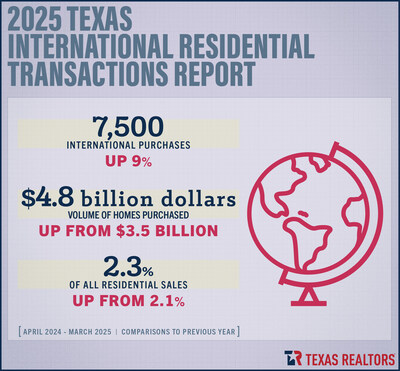
AUSTIN, Texas, Aug. 14, 2025 /PRNewswire/ — The number of residential properties sold in Texas to international buyers increased nearly 9% over the prior year, according to the 2025 Texas International Residential Transactions Report released by Texas Realtors. Approximately 7,500 buyers from other countries purchased Texas residential properties from April 2024 to March 2025, topping $4.8 billion in total dollar volume. That represents a $1.3 billion-dollar increase from the previous reporting period.

Despite the increase in activity, the number of sales falls far short of the high mark of 34,135 Texas home purchases by international buyers in 2017.

Median price is higher for purchases by international buyers
The $420,800 median price of homes purchased by international buyers was up 12% from last year and is $82,300 higher than the median for all Texas homes sold during the same time. International homebuying activity accounted for 2.3% of the total number of residential transactions, a slight increase from 2.1% a year ago.

Mexico remains the top country of origin
Thirty percent of all international buyers of Texas houses came from Mexico, followed by Canada and China (each at 8%), India (7%), and Nigeria (6%).

Texas was the top state in the U.S. for homebuyers from Mexico, accounting for 40% of all purchases, according to the National Association of Realtors 2025 International Transactions in U.S. Residential Real Estate. The next closest state, California, had 17% of all purchases by Mexican buyers.

Texas ranks third among U.S. states
Florida led all states in international activity, with 21% of U.S. residential purchases by international buyers, followed by California (15%), Texas (10%), New York (7%), and Arizona (5%).

Future purchase activity may be affected by new law
Beginning September 1, 2025, Texas law will restrict some property purchases and leases for people and entities from certain countries deemed to be a national security threat (currently China, Iran, North Korea, and Russia). Exceptions to the law include U.S. citizens and lawful permanent residents.

Realtors are professionals who can help all buyers
Texas clearly has much to offer homebuyers from all over the globe,” said Christy Gessler, chairman of Texas Realtors. “A Texas Realtor is the best resource to assist an international client, with extensive market knowledge and guidance to help them with any type of real estate transaction.”

About the Texas International Residential Transactions Report
This study was conducted by the National Association of REALTORS® for Texas REALTORS®. Information about international residential real estate transactions of Texas REALTORS® members pertain to the period April 2024–March 2025. The period is referenced in the report as “2025,” while the prior survey period is referred to as “2024.”

About Texas REALTORS®
With more than 140,000 members, Texas REALTORS® is a professional membership organization that represents all aspects of real estate in Texas. We are the advocates for REALTORS® and private property rights in Texas. Visit texasrealestate.com to learn more. 

About National Association of REALTORS®
The National Association of REALTORS® (NAR) is America’s largest trade association, representing more than 1.5 million members involved in all aspects of the real estate industry. The term REALTOR® is a registered collective membership mark that identifies a real estate professional who is a member of the National Association of REALTORS® and subscribes to its strict Code of Ethics.

CONTACT
David Gibbs
Hahn Agency
david.gibbs@hahn.agency

Cision View original content to download multimedia:https://www.prnewswire.com/news-releases/international-homebuying-activity-in-texas-is-up-302529519.html

SOURCE Texas Realtors

Read the 2025 Wesco Sustainability Report here

By John Engel, Chairman, President and Chief Executive Office, Wesco International.

I am pleased to present Wesco’s 2025 Sustainability Report, which demonstrates our commitment to furthering sustainability, innovation and connection in a rapidly changing world. This report highlights how we continue to build a brighter future for our customers, supplier partners and the communities we serve.

In 2024, we continued to focus on execution while furthering our vision to become the best tech-enabled supply chain solutions company in the world. Our digital transformation is well underway. We’re more than halfway complete on our technology and capabilities build which, once deployed, will help us to do our jobs better, deliver new products and services for our customers and create added value for our supplier partners.

Our progress was driven by strong employee engagement, evidenced by our Wesco Listens survey results which showed improvements in trust and safety, surpassing industry and global benchmarks. These metrics reflect our commitment to operational excellence and our dedication to creating a trusted and safe workplace for all.

Wesco’s global capabilities, leading scale and expanded portfolio of services and solutions uniquely position us to address the world’s critical infrastructure needs, including enhanced power generation, electrical grid modernization, automation, connectivity, security, and supply chain resiliency. I am incredibly proud of our talented Wesco team, whose hard work and dedication drive our success.

This year, we saw momentum in four key areas:

Environmental Stewardship:

We continued to pursue our sustainability goals with progress towards achieving our 2030 carbon reduction target. Our focus on renewable energy exhibits our dedication to reducing our environmental impacts.

Empowering Our People and Communities:

We believe that investing in our employees is crucial for our continued success and growth. In 2024, our employees collectively spent over 172,000 hours in training and development. This commitment to training not only enhances the skills and capabilities of our workforce but also fosters a culture of innovation and inclusiveness. We launched the Wesco Cares Scholarship Program to support the next generation of tradespeople and fortify our commitment to the electrical industry. The $200,000 in scholarships has been awarded to qualified and deserving students pursuing careers in specialized fields within the U.S. electrical industry.

Our Wesco team worked especially hard to help our communities in times of need and I am grateful for their dedication to our customers, supplier partners and one another. In addition to responding to storms and other natural disasters, together we made a positive impact through our Wesco Cares program. Wesco team members volunteered more than 3,000 hours of their time in 2024. We expanded our partnership with Habitat for Humanity, contributing to projects such as Home Equals and construction of sustainable homes in Chiapas, Mexico, along with support of the 2024 Jimmy & Rosalynn Carter Work Project in St. Paul, Minnesota. We joined The Red Cross’s Annual Disaster Giving Program to help them mobilize and respond to emergencies big and small at a moment’s notice.

Ethics and Governance:

Integrity remains at the core of Wesco’s operations. Our robust global compliance program continues to promote the highest ethical standards. We remain steadfast in our commitment to transparency and accountability.

Innovation for a Greener Tomorrow:

We offer a wide range of sustainable products and services that help our customers reach their own sustainability goals. From energy-efficiency and energy-management solutions to renewable energy, we are dedicated to environmental responsibility.

Wesco has developed programs, services and solutions that are designed to be scalable and adaptable, enabling us to meet the evolving needs of the industries we serve. This includes supporting residential, commercial and utility-scale solar projects through supply chain solutions, a broad product portfolio, and expertise that adapts to consumer demands. Innovation remains a cornerstone of our success. We continue to expand our portfolio of sustainable solutions, providing customers with tools to achieve their own environmental goals.

Sustainability is a journey. As we look to 2025 and beyond, I am confident that the dedication of our teams, partners and stakeholders will continue to drive progress. From advancing renewable energy solutions to supporting our employees and communities, we remain steadfast in our vision for a better future for all.

Thank you for being part of this journey.

John Engel
Chairman, President and Chief Executive Officer

To learn more, download the 2025 Wesco Sustainability Report here.

About This Report

Unless otherwise stated, this report covers activities, data and initiatives from our fiscal year 2024.

ESG Disclosure and Framework Alignment

The topics covered in this report include those that we have determined to be material for our business and stakeholders as noted on page 10. Wesco aligns with several ESG frameworks and disclosures in support of our commitment to transparency and our fulfillment
of stakeholder needs and expectations. We leverage the following frameworks and standards to provide robust ESG information disclosure:

  • Global Reporting Initiative (GRI): GRI offers a list of global standards and guidelines around sustainability reporting.
  • Sustainability Accounting Standards Board (SASB): SASB provides a comprehensive set of industry-specific disclosure topics and guidelines.
  • International Financial Reporting Standards (Climate-related disclosures, IFRS S2) which incorporates the now decommissioned Task Force on Climate-Related Financial Disclosures (TCFD): IFRS provides disclosure recommendations on thematic ESG topics such as governance, strategy, risk management, metrics and targets to provide stakeholders with fuller information surrounding climate risks.
  • CDP: Formerly the Carbon Disclosure Project, CDP is
    an international organization that helps companies and cities measure and disclose important environmental impact information through an annual questionnaire and rating system.
  • United Nations Global Compact (UNGC): UNGC is an initiative that aims to help businesses align their strategies and work toward the U.N.’s Sustainable Development Goals.
  • United Nations Sustainable Development Goals (UN SDGs): U.N. SDGs provide a shared set of 17 goals toward peace and prosperity for people and planet goals and create a call to action by all countries in a global partnership

We also regularly engage with our investors, employees, customers, regulators, ratings agencies and others on ESG and business issues. Additional information about Wesco can be found in our public financial filings— including our annual report and proxy filings—as well as on the Security and Exchange Commission’s website at www.sec.gov or on the Investors page of our website at Wesco.com.

Wesco plans to continue to report annually as we monitor, measure and deepen our ESG initiatives and disclosures.

Wesco endorses the United Nations Sustainable Development Goals (SDGs), which are a call to action to end poverty, protect the planet and ensure that all people enjoy peace and prosperity. We have prioritized the following five goals: Good Health and Well Being, Affordable and Clean Energy, Decent Work and Economic Growth, Industry, Innovation and Infrastructure, Responsible Consumption and Production.

More information about our SDG aligned initiatives is included throughout this report.

Assurance

We did not seek third-party assurance for this report; however, we will consider doing so for future reporting. The information and data contained in this report was vetted by internal subject matter experts on the various ESG topics included in this report.

Contact Us

We welcome feedback on our ESG initiatives and reporting. We invite you to contact us directly via email at Sustainability@Wescodist.com.

ST. PETERSBURG, Fla., August 14, 2025 /3BL/ – Duke Energy Florida announced the completion of the Sundance Renewable Energy Center in Madison County. The solar site will generate 74.9 megawatts of clean energy that will be added to the electric grid, generating significant savings for the company’s 2 million customers over its service lifetime.

Our view:

“Solar energy is an important component of Duke Energy Florida’s ‘all of the above’ generation strategy,” said Melissa Seixas, Duke Energy Florida state president. “With sites like the Sundance Renewable Energy Center, we are diversifying our fleet and ensuring we can continue providing reliable, affordable service for our customers for years to come.”

Background:

Duke Energy Florida is establishing four new solar sites by the end of 2026. While the Madison County solar site is the first to be completed, the company has broken ground on sites in Sumter and Hernando counties and plans to begin construction on the fourth site in Jefferson County later this year. All together, these sites are expected to generate nearly 300 megawatts of clean energy, as well as approximately one billion dollars in fuel savings over their service lifetimes.

By the numbers:

  • Duke Energy Florida currently owns, operates and maintains a portfolio of more than 25 solar sites across the state that generate approximately 1,500 megawatts of clean energy.
     
  • Between 2025 and 2027, the company plans to build 12 new solar sites – including Sundance Renewable Energy Center – adding an additional 900 megawatts of clean energy to the electric grid.
     
  • By the end of 2033, Duke Energy Florida projects to have over 6,100 megawatts of utility scale-solar generating capacity online.

Duke Energy Florida

Duke Energy Florida, a subsidiary of Duke Energy, owns 12,300 megawatts of energy capacity, supplying electricity to 2 million residential, commercial and industrial customers across a 13,000-square-mile service area in Florida.

Duke Energy

Duke Energy (NYSE: DUK), a Fortune 150 company headquartered in Charlotte, N.C., is one of America’s largest energy holding companies. The company’s electric utilities serve 8.4 million customers in North Carolina, South Carolina, Florida, Indiana, Ohio and Kentucky, and collectively own 54,800 megawatts of energy capacity. Its natural gas utilities serve 1.7 million customers in North Carolina, South Carolina, Tennessee, Ohio and Kentucky.

Duke Energy is executing an ambitious energy transition, keeping customer reliability and value at the forefront as it builds a smarter energy future. The company is investing in major electric grid upgrades and cleaner generation, including natural gas, nuclear, renewables and energy storage.

More information is available at duke-energy.com and the Duke Energy News Center. Follow Duke Energy on X, LinkedIn, Instagram and Facebook, and visit illumination for stories about the people and innovations powering our energy transition.

Contact: Aly Raschid
24-Hour: 800.559.3853
X: @DE_AlyRaschid

View original content here.

Since inception, Foundation has supported more than 11,000 charities across six continents

IRVING, Texas, Aug. 14, 2025 /PRNewswire/ — The Caterpillar Foundation, the philanthropic arm of Caterpillar Inc. (NYSE: CAT), has reached a historic milestone—donating more than $1 billion globally to improve lives and build stronger, more resilient, and sustainable communities around the world. This achievement reflects more than seven decades of impact.

“This milestone is a powerful reminder of what’s possible when purpose meets passion,” said Asha Varghese, president of the Caterpillar Foundation. “For 73 years, the Foundation has collaborated with organizations around the world to create opportunity, resilience and hope. This moment is more than a milestone, it’s a testament to the dedication with the grantees we support, the passion of Caterpillar employees and retirees and leadership from the Foundation’s board of directors.”

Caterpillar Foundation History
Founded in 1952, the Foundation began with a humble gift to an East Peoria, Illinois, firehouse. Since then, investments have grown to support more than 11,000 community organizations in 110 countries across six continents. Its mission is to build thriving communities by investing in workforce development and the natural and vital infrastructure people rely on.

Over the years, the Foundation’s strategic focus has evolved. Early grants supported helping improve and expand hospitals and workforce training facilities for people with disabilities. Later, the Foundation refined and expanded its grants to technical schools and community colleges to help strengthen their curriculum for students and teachers – a cause the Foundation still champions today. In addition to ensuring individuals are ready to enter the workforce, the Foundation supports programs in STEM education, sustainable natural infrastructure, access to basic services, and disaster preparedness, mitigation and recovery.

As the Foundation celebrates this historic moment, it remains committed to driving lasting impact through strategic partnerships, community investments and amplifying Caterpillar employees’ and retirees’ charitable contributions. With a rich legacy rooted in compassion, innovation and collaboration, the Foundation will continue to empower people and strengthen communities, laying the groundwork for a stronger, more sustainable and more resilient future for generations to come.

Learn more about the Caterpillar Foundation here.

About Caterpillar Foundation
Since its founding in 1952, the Caterpillar Foundation has contributed to helping improve the lives of people around the world. As a company, Caterpillar works alongside its dealers and customers to build the societal infrastructure needed to make the world run. Caterpillar Foundation focuses on the complementary human; natural and basic services infrastructure needed for individuals to thrive and communities to be resilient. Learn more at caterpillar.com/foundation and on LinkedIn.

Cision View original content to download multimedia:https://www.prnewswire.com/news-releases/caterpillar-foundation-surpasses-1-billion-in-global-giving-302530175.html

SOURCE Caterpillar Inc.

MetLife continues to pursue opportunities to reduce resource use and waste by implementing digital communications where possible. In many of our regions and businesses, customers can submit claims, make payments and access documentation and other policy information online. In Bangladesh, we surpassed 1.8 million e-receipts to customers, and in Turkey we’ve developed a fully digital gateway for sales, offering products without the need for hard copy documentation or wet signatures.

We often tie tree-planting initiatives to customer engagement, such as by planting trees for product sales or for customers opting into paperless communications. Our MetLife Legacy Trees™ initiative is our pledge to plant a tree in honor of each loved one for whom MetLife has paid a Group Life Insurance benefit.1 While serving as a living memorial for our insureds, the trees also provide clean air, offer shade cover, and reduce erosion and flooding in communities. MetLife works with the Arbor Day Foundation and its network of local tree planting partners to plant trees for the program.

In the U.S., MetLife Legal Plans offers free attorney document review and consultation to Legal Plans group customers’ employees impacted by natural disasters, whether or not the employees are enrolled in the plan. In 2024, following the California wildfires and hurricanes in the Southeast, MetLife also expanded the availability of employee assistance programs and grief counseling for customers.2

Read more about how we are supporting the environment through our sustainability efforts in MetLife’s 2024 Sustainability Report.
 

1 MetLife Legacy Trees™ is available in the U.S. and Nepal.
2 Programs offered through our provider, TELUS Health.

CHARLOTTE, N.C., AUGUST 14, 2025 /3BL/ – DP World announces that three of its Americas teams have been recognized with Global Kaizen Awards for their outstanding achievements in continuous improvement, raising the bar for operational excellence, customer value, and safety.

The Global Kaizen Awards celebrate DP World teams worldwide that exemplify Kaizen — making small, smart changes that lead to meaningful impact. This year’s winners from the Americas include:

  • Middletown, Pennsylvania, U.S.2024 Global Kaizen Award Winner (Contract Logistics): Greenficiency
  • El Paso, Texas, U.S.2024 Global Kaizen Award Winner (Contract Logistics): Warehouse Optimization
  • Santos, BrazilQ1 2025 Global Kaizen Award Winner (Ports & Terminals): Gate Express for Empty Chassis

Middletown, Pennsylvania – Greenficiency

Category: 2024 Global Kaizen Winner (Contract Logistics)
Focus: Sustainable strategy to reduce plastic/cardboard waste and boost efficiency through innovative technology

The Middletown team tackled underutilization of its Packsize X4 machine and outdated packaging processes, leading to excess waste and lower efficiency. By redesigning workflows, consolidating pick and pack operations, and fully enabling right-size box production, the team delivered:

  • 34% reduction in cycle time
  • 54% increase in units per hour (UPH)
  • 26% improvement in machine utilization
  • 30% increase in volume handled
  • 33% increase in box utilization
  • Elimination of 2.1 tons of plastic waste
  • 74% reduction in cardboard usage

El Paso, Texas – Warehouse Optimization

Category: 2024 Global Kaizen Winner (Contract Logistics)
Focus: Improving put-away and pick performance through 5S and layout optimization

The El Paso II Auto team identified that three key parts caused 88% of relocation-related inefficiencies. Using slotting analysis, lean principles, 5S, and Failure Mode and Effect Analysis (FMEA), they repositioned frequently used materials into a “golden zone” and optimized warehouse layout. The results:

  • 36% increase in bulk capacity
  • 10% improvement in space utilization
  • 19% reduction in cycle time
  • 66% reduction in replenishment time

Santos, Brazil – Gate Express for Empty Chassis

Category: Q1 2025 Global Kaizen Winner (Ports & Terminals)
Focus: Increasing gate productivity through a dedicated empty chassis process

The Santos team streamlined the Gate IN process by creating fast lanes for empty chassis, bypassing the OCR portal, eliminating unnecessary inspections, and deploying handheld devices with targeted staff training. Outcomes included:

  • Transaction times under 1 minute for empty vehicles
  • Transaction times under 2 minutes 30 seconds for trucks with containers
  • Increased monthly truck processing capacity
  • Annual cost savings
  • Enhanced operational safety, resource efficiency, driver satisfaction, and environmental performance

A Culture of Continuous Improvement
These award-winning projects show the power of empowering teams to innovate. From sustainability gains in Middletown, to space and productivity optimization in El Paso, to port process enhancements in Santos — each project demonstrates how Kaizen delivers measurable value to DP World’s customers, people, and our planet.

For more on DP World’s global approach to innovation and operational excellence, visit www.dpworld.com.

Enterprise resource planning (ERP) implementations are among the most transformative and challenging initiatives an organization can undertake. These projects touch nearly every aspect of business operations, from finance and supply chain to human resources and customer service. Yet, despite their scope and complexity, one critical success factor is often overlooked until it’s too late: data.

Clean, well-structured data is not just a nice-to-have, it’s the foundation upon which an ERP project’s success is built. Taking a “data first” approach lays the foundation for this success while also developing long-term analytics value for an organization.

What is a “data first” approach to an ERP project? 

ERP projects are inherently complex with many possible starting points, but regardless of the chosen path, delaying data governance until after go-live is a costly mistake. Rather than treating data as a downstream task, taking a data first approach has organizations prioritizing data readiness and governance from the very beginning of the ERP journey by proactively establishing frameworks, roles and tools needed to ensure clean, consistent and trusted data flows into the new system.

A data first approach begins with establishing a data governance program early in the ERP project timeline. A well-structured data governance program typically rests on three foundational components:

  1. Defining a data governance charter: This charter outlines the guiding principles and desired outcomes of the governance effort. Whether the organization is prioritizing risk mitigation, data quality or improving data accessibility and literacy, the charter serves as a strategic compass for all data-related decisions.
  2. Establishing a governance framework: This involves clearly defining the roles, responsibilities and timing of stakeholder involvement throughout the ERP lifecycle. By mapping out who needs to be involved at each state, organizations can avoid costly rework and ensure that decisions are informed, timely and aligned with broader data objectives.
  3. Developing policies and best practices: Based on the organization’s goals, this step includes setting standards for data security, data quality and master data management – core elements of any ERP project. These policies not only promote consistency, but also elevate the data literacy of ERP stakeholders, many of whom may be experts in their business functions but less familiar with the implications of their decisions on data integrity.

Parallel to these components, success hinges on organizations identifying and engaging key data stakeholders/subject matter experts across each data domain/business unit. These individuals bring essential operational knowledge and should be actively involved in shaping ERP workflows and defining system functionality.

Beyond identifying data owners and stewards, it’s important to establish a strategic advisory group with enterprise-level insight into the organization’s data landscape. This group plays a key role in coordinating across functional areas, resolving cross-domain issues and ensuring that ERP decisions are made with a clear understanding of their downstream implications.

Lastly, when transitioning from a legacy system to a modern ERP platform, one of the most critical tasks is determining which data to migrate. This typically includes essential historical data for analysis, open transactions and core master data such as customer, product, location and employee records.

While most ERP systems offer direct integration capabilities, many organizations still rely on manual, labor intensive processes, like exporting and re-importing data via Excel or CSV templates. Although functional, these traditional methods are prone to human error which can lead to inconsistencies, repeated work and compromised data integrity.

To manage these risks, organizations should utilize modern data management tools such as Microsoft Fabric, Amazon Web Services (AWS) or Snowflake, to automate and streamline data transformation and loading. These platforms enable teams to:

  • Build ingestion pipelines that extract data from legacy systems
  • Define and apply business rules for data cleansing, consolidation and mapping
  • Automate the transformation process and load clean, structured data into the new ERP system

Automating these steps not only reduces the likelihood of errors but also accelerates the migration timeline. While there is some upfront work in configuring these tools, the long-term benefits, such as faster reloads, improved accuracy and reduced work, far outweigh the initial effort. This approach also creates a reusable data model that supports post-go-live analytics. Instead of having to discard the effort invested in manual migration, organizations retain a curated data warehouse that can ingest new ERP data and serve as the foundation for reporting, planning and artificial intelligence (AI) initiatives.

Overall, by taking a data first approach, organizations can avoid the post-implementation scramble to reconcile data inconsistencies or retroactively define data governance policies. Instead, they move forward with a unified strategic direction – one that ensures data integrity, supports analytics readiness and maximizes the value of the ERP investment.

Avoid common ERP challenges with a data first approach 

Taking a data first approach to an ERP implementation directly addresses and resolves many of the most common challenges organizations face during this complex transformation.

  • Misaligned or siloed data ownership: Leads to inconsistent definitions, duplicated efforts and conflicting datasets

Implementing a robust data governance framework helps unify these efforts by clarifying how data is shared, used and impacts multiple areas of the organization. This not only reduces work and inefficiencies, but also ensures that data is accurate, non-redundant and aligned across all functional areas.

  • Low data quality undermining trust in the new system: If users encounter errors or inconsistencies on day one, adoption suffers

A data first approach emphasizes data cleansing, validation and quality standards before migration. Paired with automating data preparation, this ensures users access accurate, reliable data, building trust in the new ERP system and supporting user adoption and change management efforts.

  • Poor visibility into legacy data and mappings: Makes it difficult to trace decisions or support historical reporting

Utilizing cloud-based platforms allows organizations to document and automate data transformation logic. This retains visibility into how legacy data maps to the new ERP system, supporting both operational continuity and future analytics. While ERP systems are not designed to retain legacy data, a well-structured analytics platform can bridge the gap – integrating both old and new data-sources for a unified view.

  • Bottlenecks during migration and testing: Resulting from manual migration processes as teams wait for individual contributors

A data first approach mitigates these delays by automating key steps and making data accessible to all relevant stakeholders. This fosters a more collaborative environment, accelerates testing cycles and reduces dependency on single points of failure.

  • Missed opportunities for analytics post go-live: With valuable transformation logic lost in spreadsheets and ad hoc processes

Rather than needing to start from scratch, a data first approach ensures that the data infrastructure developed during the ERP implementation can be leveraged for ongoing reporting, planning and innovation. This maximizes the return on investment (ROI) and enables data-driven decision-making well beyond go-live.

The benefits of a data first approach are not just complementary to ERP challenges – they are purpose-built to overcome them. This alignment is what makes the approach so effective in driving both immediate implementation success and long-term data value.

Real-world example: Success with a data first approach 

This multi-site mining company was undergoing a major ERP transformation and needed to consolidate six legacy systems into a unified platform. Facing challenges such as fragmented data ownership, inconsistent data quality, limited visibility into historical data and manual migration processes, the company engaged Baker Tilly to deliver a data governance-driven approach.

Utilizing a data first approach, Baker Tilly established a robust data governance framework, defining master data management standards and empowering business stakeholders through data training and stewardship roles. Leveraging Microsoft Fabric, the team automated data ingestion, transformation and validation, enabling iterative data mapping and quality assurance.

This approach not only ensured a smooth ERP rollout with reduced rework and greater trust in ERP system outputs, but also laid the foundation for long-term analytics, reporting and artificial intelligence (AI) initiatives.

How we can help 

Implementing a new ERP system is more than just a technology upgrade, it’s a data transformation. By taking a data first approach and investing in data governance from the outset, organizations can mitigate the risks associated with an ERP project and unlock value faster.

The IFS Cloud platform is designed to be customizable and can integrate successfully with other data migration tools that meet a user’s needs. These robust in-solution tools allow data to be imported from various sources which can help users leverage familiar environments.

Baker Tilly’s digital solutions team can help turn your organizational data into a strategic asset – before, during and after an ERP implementation. Utilize our data first approach to get started turning your organizational data into a competitive advantage. Contact one of our specialists to learn more.