The automotive industry has long built its supply chains around precision: the right components arriving at the right plant, in the right sequence, at exactly the right time.
But as manufacturers contend with shifting demand, trade uncertainty, supplier pressures, and increasingly complex production networks, that model is being tested. Today, efficiency alone is no longer enough. Automotive supply chains also need the flexibility to respond when conditions change.
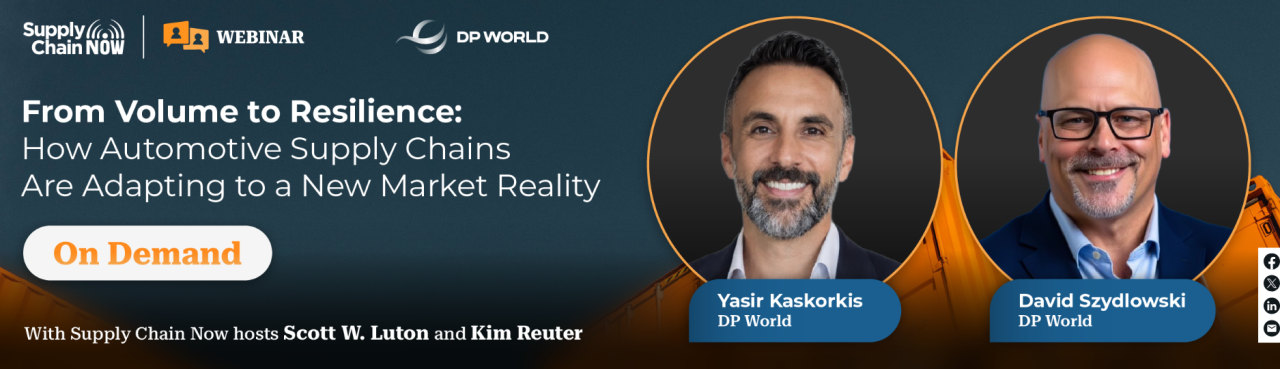
In the recent webinar, “From Volume to Resilience: How Automotive Supply Chains Are Adapting to a New Market Reality,” DP World’s Yasir Kaskorkis, Global Director of EV Batteries, and David Szydlowski, Global Director of Automotive Freight Forwarding, explore how OEMs and suppliers are responding – and why resilience is increasingly becoming a core part of automotive supply chain strategy.
Rethinking the Automotive Supply Chain
For automotive manufacturers, even a relatively small disruption can have consequences far beyond a delayed shipment. When thousands of components must come together on tightly orchestrated production schedules, an interruption upstream can quickly affect plant operations, inventory, costs, and ultimately vehicle availability.
That challenge is becoming even more complex as the industry evolves. The growth of EVs has introduced new considerations around battery logistics and supply chains, while automotive manufacturers continue to navigate global freight networks and cross-border flows connecting suppliers and production facilities.
Drawing on their experience across EV battery supply chains and automotive freight forwarding, Kaskorkis and Szydlowski discuss how companies can build greater flexibility into their operations by connecting logistics, inventory planning and production requirements more closely.
That includes understanding where critical dependencies exist, positioning inventory strategically, and creating options that allow supply chains to respond when circumstances change.
From Efficiency to Optionality
The goal isn’t to abandon efficiency. It’s to build supply chains that can maintain it while becoming better prepared for disruption.
For automotive leaders, that means asking different questions:
- Where could a supplier or transportation constraint affect production?
- Where should inventory be positioned to protect plant uptime?
- How quickly can freight be rerouted when conditions change?
- Do logistics, procurement, and manufacturing teams have the information they need to make those decisions together?
An integrated approach can help connect those decisions across the supply chain – from origin and freight forwarding to warehousing, cross-border transportation, and final delivery. As automotive supply chains adapt to a changing market, the companies best positioned to compete will be those that can combine efficiency with flexibility.
Watch “From Volume to Resilience: How Automotive Supply Chains Are Adapting to a New Market Reality” on demand to hear Yasir Kaskorkis and David Szydlowski share their perspectives on the forces reshaping automotive logistics and how supply chains can prepare for what comes next.