Zum Launches Its First Fully Electric School Bus Yard on the East Coast

Branford Public Schools (CT) to Become the Largest Fully Electric Fleet in the Northeast, Marking Zum’s Continued Electrification National Expansion

REDWOOD CITY, Calif., Feb. 13, 2026 /PRNewswire/ — Today, Zūm, the leader in modern student transportation, announced that it will deploy a fully electric school bus fleet for Branford Public Schools beginning in the 2026–27 school year, making Branford the largest fully electric school district with vehicle-to-grid (V2G) capabilities in the Northeast. All electric buses will be supported by modern charging infrastructure, with built-in bidirectional V2G capabilities.

This announcement represents a significant moment for Branford and the evolution of student transportation nationwide. As the largest school district in the Northeast to fully electrify its school bus fleet, Branford is demonstrating that clean, reliable electric student transportation is not a future ambition, but a current possibility for school districts across the country.

The electric fleet is designed with the future capability to strengthen grid resilience by enabling school bus batteries to return energy to the local grid at scale when not in use. This vehicle-to-grid capacity transforms what has traditionally been an underutilized asset into a strategic energy resource — improving reliability, maximizing the value of district infrastructure, and supporting long-term sustainability.

Zum also provides the students and parents of Branford Public Schools with enhanced safety and reliability, reflected in a 98% on-time arrival rate to school. Through its parent app, families can see exactly where their children are during every ride to and from school — creating peace of mind for families each day.

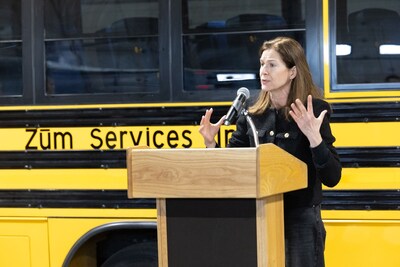
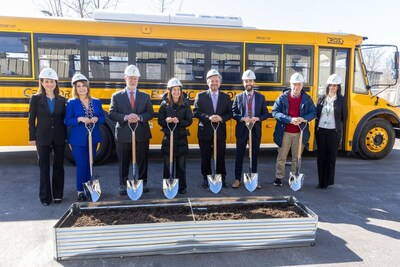
Zum and Branford Public Schools announced the initiative today at Zum’s Branford student transportation yard during an event attended by local and state leaders, including Lieutenant Governor Susan Bysiewicz.

“This marks a major milestone in Zum’s continued national electrification expansion and an exciting moment for student transportation,” said Ritu Narayan, Founder and CEO of Zum. “As we expand our electrification efforts to the East Coast and launch our first fully electric school bus fleet in the region, Branford is helping set a new national standard. With Zum’s technology platform and this state-of-the-art EV fleet, we are reimagining what’s possible — building a modern transportation system rooted in operational excellence and a relentless focus on safety that improves the experience for students, families, and drivers, sets kids up for success in the classroom, strengthens grid reliability and resiliency, and delivers lasting benefits to the entire community.”

“Branford Public Schools, in partnership with Zum, is committed to delivering a first-class transportation system that prioritizes students and families while setting a new standard for safety, reliability, and sustainability,” said Superintendent Christopher Tranberg. “Electric school buses with bidirectional charging capabilities create cleaner transportation today and have the potential to support grid resilience by returning energy from bus batteries back to the grid in the future.”

“Branford is proving that clean, reliable student transportation is possible today,” said Lieutenant Governor Susan Bysiewicz. “By deploying the largest fully electric school bus fleet in the Northeast, we are delivering cleaner air for kids, smarter infrastructure for communities, and a model for the nation.”

In 2024, Branford Public Schools awarded Zum a 10-year student transportation contract with the goal of transitioning the district to a 100% electric school bus fleet within five years. Through its partnership with Zum, Branford Public Schools is now on track to achieve this transition within the first two years of the contract—three years ahead of schedule.

This achievement builds on Zum’s growing national momentum. Today, Zum partners with school districts across 15 states, including Los Angeles, San Francisco, Omaha, Boston and Kansas City, delivering a fully integrated, transparent, and reliable transportation platform at scale. In the 2024–25 school year, Zum made history by deploying the nation’s first fully electric school bus fleet in Oakland Unified School District in California.

To learn more about how Zum is working with thousands of schools to deliver safe, reliable and modern student transportation, please visit Zum’s website.

About Zūm
Zum is a technology-led, data-driven transportation company transforming student transportation—the largest mass transit system in the United States. Today, Zum provides turnkey, modern transportation solutions to more than 4,000 schools across 15 states and is expanding rapidly nationwide. Recognized globally for its innovative approach and operational execution, Zum has raised over $350 million from leading investors including Sequoia Capital, GIC, and SoftBank. Zum has been named to Fast Company’s World’s Most Innovative Companies, CNBC Disruptor 50 and Changemakers, the World Economic Forum, and the Financial Times Fastest Growing Companies. Learn more at www.ridezum.com.

About Branford Public Schools
Located in Branford, Connecticut, Branford Public Schools provides a high-quality, inclusive public education for students from pre-kindergarten through grade 12. The district is committed to academic excellence, student well-being, and equitable learning opportunities that prepare students to think critically, contribute to their communities, and navigate a changing world.

CONTACT:
Jenny Mayfield, Vice President of Communications – press@ridezum.com
Cision View original content to download multimedia:https://www.prnewswire.com/news-releases/zum-launches-its-first-fully-electric-school-bus-yard-on-the-east-coast-302687977.html

SOURCE Zūm

Consider Recycling as You Shop for A New Mattress this Presidents Day Weekend

ALEXANDRIA, Va., Feb. 13, 2026 /PRNewswire/ — Presidents Day is known as one of the highest-volume mattress sales weekends, which means many consumers are likely thinking about how to get rid of an old one. On average, across the United States, approximately 15 -20 million mattresses are no longer wanted each year. However, this does not mean they have to end up in a landfill.

In several states, recycling mattress is easier than you may think. The bedding industry’s Mattress Recycling Council (MRC) administers a program known as Bye Bye Mattress in California, Connecticut, Oregon and Rhode Island. Since launching over a decade ago, MRC has recycled more than 17 million mattresses!

MRC’s Bye Bye Mattress is made possible by a fee that is collected when mattresses and box springs are sold in these states. The fee is used to create a statewide collection network that receives mattresses through a variety of channels – retailers, solid waste providers, local governments, nonprofits, as well as hotels, universities, hospitals and others that discard old mattresses.

Once mattresses arrive at a recycling facility, they are cut open and the materials are separated and prepared for use in other products. Foam and fibers can be used in carpet padding. Innersprings become scrap steel for use in a variety of products. Wooden frames are chipped for use in mulch or biomass fuel.

“When planning what to do with your old mattress, ByeByeMattress.com is a great resource,” said Mike O’Donnell, Chief Operating Officer of the Mattress Recycling Council. “You can learn how we work with mattress retailers in your state, search for your nearest free drop off location or see if your curbside collection provider is participating.”

ByeByeMattress.com also provides a list of mattress recyclers operating in other states across the U.S.

About the Mattress Recycling Council
The Mattress Recycling Council (MRC) is a nonprofit organization created by the International Sleep Product Association and operates recycling programs in four states that have passed mattress recycling laws. MRC recycles over 2 million mattresses each year. For more information, go to www.MattressRecyclingCouncil.org. To learn how to recycle your mattress or to find a collection location or event near you, visit www.ByeByeMattress.

Potential graphic:

B-Roll Videos (without sound)

Photos

Cision View original content to download multimedia:https://www.prnewswire.com/news-releases/consider-recycling-as-you-shop-for-a-new-mattress-this-presidents-day-weekend-302687771.html

SOURCE Mattress Recycling Council

National Donor Day Spotlight: DaVita Patient Care Technician Donates Kidney

DaVita

When Holly’s husband, Heston, was diagnosed with end-stage kidney disease, their lives changed overnight — bringing months of uncertainty. Driven to make a meaningful impact, Holly left her job to become a patient care technician at DaVita, turning her lived experience into guidance and support for others on their kidney journey.

Last year, Holly made the selfless decision to donate her kidney. While she wasn’t a match to donate to Heston, she was able to give through a paired exchange that connects living donors with recipients across a network, expanding access to life-saving transplants and unlocking increased chance for Heston to receive his own.

This #NationalDonorDay, we honor Holly — and all living donors — whose courage and compassion transform lives and bring hope to families everywhere.

About DaVita Inc.

DaVita (NYSE: DVA) is a health care provider focused on transforming care delivery to improve quality of life for patients globally. As a comprehensive kidney care provider, DaVita has been a leader in clinical quality and innovation for more than 25 years. DaVita cares for patients at every stage and setting along their kidney health journey— from slowing the progression of kidney disease to helping support transplantation. This includes ensuring they are supported at home, in dialysis centers, in the hospital and in skilled nursing facilities. As of December 31, 2025, DaVita served approximately 295,000 patients at 3,242 outpatient dialysis centers, of which 2,657 centers were located in the United States and 585 centers were located in 14 other countries worldwide. DaVita has reduced hospitalizations, improved mortality, helped improve health access and worked collaboratively to propel the kidney care community to adopt a higher quality standard of care for all patients, everywhere. To learn more, visit DaVita.com/About.

Posted in UncategorizedTagged

FIBRA Prologis to Host Fourth Quarter 2025 Earnings Conference Call February 24

MEXICO CITY, Feb. 13, 2026 /PRNewswire/ — FIBRA Prologis (BMV: FIBRAPL 14), a leading owner and operator of Class-A logistics real estate in Mexico, will host a webcast and conference call with senior management to discuss fourth quarter results, current market conditions and future outlook on Tuesday, February 24, at 9:00 a.m. Mexico Time.

To access a live broadcast of the call, dial +1 888 596 4144 (toll-free from the United States and Canada), 800 269 4416 (toll-free from Mexico) or +1 646 968 2525 from all other countries or and enter conference code 4603995. A live webcast can be accessed at www.fibraprologis.com in the Investor Relations section February 24.

A telephonic replay will be available February 24 – March 3 at +1 800 770 2030 from the U.S. and Canada or at +1 647 362 9199 from all other countries using conference code 4603995. The replay will be posted in the Investor Relations section of the FIBRA Prologis website.

ABOUT FIBRA PROLOGIS

FIBRA Prologis is a leading owner and operator of Class-A industrial real estate in Mexico. As of September 30, 2025, the company’s portfolio comprised 515 Investment Properties, totaling 87.0 million square feet (8.1 million square meters). This includes 348 logistics and manufacturing facilities across 6 industrial core markets in Mexico, comprising 65.7 million square feet (6.1 million square meters) of Gross Leasing Area (GLA) and 167 buildings with 21.3 million square feet (2.0 million square meters) of non-strategic assets in other markets.

FORWARD-LOOKING STATEMENTS

The statements in this release that are not historical facts are forward-looking statements. These forward-looking statements are based on current expectations, estimates and projections about the industry and markets in which FIBRA Prologis operates, management’s beliefs and assumptions made by management.  Such statements involve uncertainties that could significantly impact FIBRA Prologis financial results. Words such as “expects,” “anticipates,” “intends,” “plans,” “believes,” “seeks,” “estimates,” variations of such words and similar expressions are intended to identify such forward-looking statements, which generally are not historical in nature.  All statements that address operating performance, events or developments that we expect or anticipate will occur in the future — including statements relating to rent and occupancy growth, acquisition activity, development activity, disposition activity, general conditions in the geographic areas where we operate, our debt and financial position, are forward-looking statements. These statements are not guarantees of future performance and involve certain risks, uncertainties and assumptions that are difficult to predict. Although we believe the expectations reflected in any forward-looking statements are based on reasonable assumptions, we can give no assurance that our expectations will be attained and therefore, actual outcomes and results may differ materially from what is expressed or forecasted in such forward-looking statements. Some of the factors that may affect outcomes and results include, but are not limited to: (i) national, international, regional and local economic climates, (ii) changes in financial markets, interest rates and foreign currency exchange rates, (iii) increased or unanticipated competition for our properties, (iv) risks associated with acquisitions, dispositions and development of properties, (v) maintenance of real estate investment trust (“FIBRA”) status and tax structuring, (vi) availability of financing and capital, the levels of debt that we maintain and our credit ratings, (vii) risks related to our investments (viii) environmental uncertainties, including risks of natural disasters, (ix) risks related to the coronavirus pandemic, and (x) those additional factors discussed in reports filed with the “Comisión Nacional Bancaria y de Valores” and  the Mexican Stock Exchange by FIBRA Prologis under the heading “Risk Factors.” FIBRA Prologis undertakes no duty to update any forward-looking statements appearing in this release.

Non-Solicitation – Any securities discussed herein or in the accompanying presentations, if any, have not been registered under the Securities Act of 1933 or the securities laws of any state and may not be offered or sold in the United States absent registration or an applicable exemption from the registration requirements under the Securities Act and any applicable state securities laws. Any such announcement does not constitute an offer to sell or the solicitation of an offer to buy the securities discussed herein or in the presentations, if and as applicable.

(PRNewsfoto/FIBRA Prologis)


Cision View original content to download multimedia:https://www.prnewswire.com/news-releases/fibra-prologis-to-host-fourth-quarter-2025-earnings-conference-call-february-24-302687905.html

SOURCE FIBRA Prologis

How We Build Trust Through Our Work and Culture

Trust isn’t created by software alone. It’s shaped by the values, teams and decisions behind it.

At Gen, responsibility isn’t separate from our work in security and privacy; it’s foundational to it. How we govern our business, support our people and invest in communities directly influences the trust people place in our products. In 2025, that approach was recognized across multiple fronts, reflecting a consistent focus on responsibility, impact and long-term value.

Responsibility is built into how we operate

Gen was named to Newsweek’s ranking of America’s Most Responsible Companies for the third year in a row, a recognition based on performance across more than 30 indicators evaluated by Newsweek and its research partners, spanning environmental impact, social responsibility and governance practices.

This recognition reflects how responsibility is embedded into our operating model, not treated as a parallel initiative, but as part of how decisions are made and progress is measured.

Investing in the people behind the products

Trust is also built from the inside out.

In 2025, Newsweek recognized Gen across eight of its America’s Greatest Workplaces lists, including:

These rankings reflect sustained investment in employee experience, engagement and flexibility, creating an environment where people can do meaningful work and grow over time.

Advancing women in cybersecurity

Building a safer digital future requires broader participation, especially in an industry where representation has historically lagged.

Gen was named one of America’s Greatest Workplaces for Women, recognizing efforts to support advancement and professional development through programs such as:

  • WONDER, Employee Resource Group for women
  • Geniverse, which provides ongoing development opportunities across global teams

These internal efforts are reinforced by external partnerships focused on expanding access to cybersecurity education and careers, including Czechitas, Women4Cyber and the Nasscom Foundation in Europe and India.

Extending impact beyond Gen

Our responsibility work extends beyond our own teams. Our ongoing partnership with the World Association of Girl Guides and Girl Scouts (WAGGGS) on Surf Smart 2.0 was recognized at the Third Sector Awards in the Big Impact category. To date, the program has reached more than 850,000 young women and girls across 100 countries, providing practical digital safety skills and supporting young leaders working to make the internet a safer place.

One standard, everywhere

Across governance, workplace culture and community impact, the throughline is consistency.

The same principle that guides how we build security products also guides how we operate as a company: long-term trust is earned through care, accountability and real-world impact.

To learn more about these initiatives and our broader approach to responsibility, explore our latest Social Impact Report.

Posted in UncategorizedTagged

Hundreds Brave Icy Weather to Attend FHU Spiritual Growth Workshop

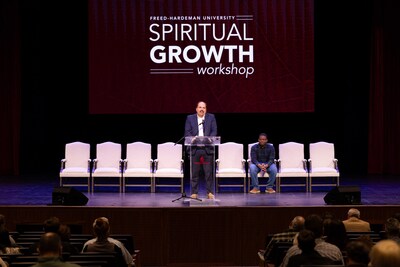
HENDERSON, Tenn., Feb. 13, 2026 /PRNewswire/ — Freed-Hardeman University hosted a successful Spiritual Growth Workshop Feb. 4-6, after icy campus conditions forced the cancellation of the annual Bible Lectureship. Despite remaining weather challenges, approximately 500 visitors received spiritual encouragement from 27 different speakers over the course of the three-day workshop, while more than 870 virtual attendees took advantage of available livestreams.

“While having to cancel the FHU Lectureship because of the ice was disappointing, we were reminded of God’s rich blessings by those who attended and supported the Spiritual Growth Workshop,” said Dr. Doug Burleson, director of the annual lectureship. “We left the workshop encouraged, fulfilled and ready to take what we learned to better serve our friends and neighbors.”

Because of remaining icy conditions, all sessions were held in Dryden Auditorium, and campus shuttles were available to transport visitors to and from the Jones Family Dining Hall. The FHU Associates offered a mini version of their famous FHBrew in Dryden’s hospitality room, serving specialty coffees, teas and pastries to guests, with proceeds benefitting student scholarships.

The Spiritual Growth Workshop was planned as an abbreviated alternative to lectureship which would allow those in close proximity to FHU to learn together. Several attendees, however, still chose to travel greater distances in order to be there in person.

Brenda Hambelton and her husband made the six-hour drive from their home in Gainesville, Missouri, to attend the workshop. “We plan for the lectureship every year. So even though that didn’t happen, I’m so glad we have this,” she shared. “My experience this week has been teary and wonderful. I’ve heard so many things to think about and go back home and implement.”

Hambelton enjoyed attending Friday’s women’s session, led by Kristen Hicks, on the topic of “Leaving Behind Broken Cisterns for the Fountain of Living Water.” She noted that the shorter schedule made it easier for her to choose which sessions to attend. “I love the lectureship but it’s impossible to hear every speaker that you want to hear. The slower pace of the workshop has been nice and allowed me to attend almost every session that I wanted.”

Snow and ice also didn’t keep FHU alumnus John Savage from traveling to Henderson from Louisville, Kentucky, for the workshop. As the president and principal of Academy for Individual Excellence, a pre-K through 12th grade school in Jeffersontown, Kentucky, Savage gathered insight from the session “Impactful Families: Making the Most of Everyday,” led by Ben Coleman, adjunct instructor of Bible at FHU and Family and Education Minister at Bartlett Woods in Bartlett, Tennessee. “I work with kids and families, and I’ve been gathering lessons about the impact of prayer. I’ve been dwelling on it, and I plan to share that when I return,” Savage said.

Following the closing session, “Discipline Yourself for Godliness: The Spiritual Disciplines for Spiritual Growth,” led by Dr. Matt Cook, assistant professor of Bible, Savage left the three-day workshop feeling “full.” “I came here to be fed,” he said. “And this workshop reminded me to not carry all of the baggage we tend to carry, but instead to be sure we keep our relationship with God and to not compare ourselves to each other.”

FHU President David R. Shannon thanked everyone who helped plan and attend the workshop, whether in person or online. Acknowledging the challenging week both lectureship committees faced in pivoting to the new format, he emphasized that FHU was not alone in the effort. “We can see how God has truly used this time. Thank you, God! This has been a good and pleasant time together.”

All plans for the 90th Annual Bible Lectureship, set to study the gospel of Matthew, have been moved to 2027. Although the planning committee initially referred to it as the 91st, they decided the 2027 event will officially be recognized as the 90th anniversary.

The mission of Freed-Hardeman University is to help students develop their God-given talents for His glory by empowering them with an education that integrates Christian faith, scholarship and service. Located in Henderson, Tennessee, FHU offers associate, bachelor’s, master’s, specialist and doctoral degrees. More information is available at fhu.edu.

Cision View original content to download multimedia:https://www.prnewswire.com/news-releases/hundreds-brave-icy-weather-to-attend-fhu-spiritual-growth-workshop-302686813.html

SOURCE Freed-Hardeman University

How Trane Technologies’ Madison Smith Found Community in the Graduate Training Program

For Madison Smith, engineering was always about versatility. She earned her degree in mechanical engineering with a focus on biomedical applications, never imagining she’d find her way to HVAC.

Today, she’s a participant in Trane Technologies’ Graduate Training Program (GTP), preparing to take on her new role in Vancouver, B.C., as a Service Account Manager. “I never would have expected to go into HVAC,” Madison says. “But my internship with Trane Technologies really opened my eyes. I realized that I could combine my technical background with something that helps people.”

VIDEO: How Madison Found Community in the Graduate Training Program

Conquering the learning curve

Like many new grads, Madison quickly realized that stepping into industry came with a steep learning curve. “After four or five years of studying, you get to the field and suddenly realize how much you still don’t know,” she reflects. “Especially in HVAC, which is so specialized. If you don’t have a company that’s willing to invest in your training, it can be really overwhelming.”

That’s what made the GTP so appealing: a five-month immersive program that blends hands-on learning with real-world exposure, designed specifically for early-career professionals in sales, engineering and service. “A lot of companies just throw you in. But here, we’re getting the foundation we need to succeed.”

Theory, practice and people

What sets the Graduate Training Program apart for Madison is how it connects conceptual knowledge to real-world application. “In university, you learn a lot of theory. But this program shows you how it actually applies in the field, in real mechanical rooms, with real customers, solving real problems. That’s been my favorite part.”

It’s also given her the chance to build relationships with customers in diverse industries. “HVAC touches every kind of industry. In service, I get to work with education, healthcare and even industrial clients. It’s diverse and dynamic, and because I’m customer-facing, I’m constantly learning from the people I support.”

Bridging the sustainability gap for customers

Madison sees her role as not just a technician or problem solver, but a knowledge-sharer. “There’s a real gap in technical and sustainability knowledge with many of our customers,” she explains. “I’m excited to be able to empower them with that knowledge. I can walk into their mechanical room and help them identify opportunities to meet their sustainability goals.”

She credits Trane Technologies’ clear mission, to boldly challenge what’s possible for a sustainable world, as a driving force behind her own.

“I didn’t realize how big of a role HVAC plays in reducing community emissions until my internship. Especially in Vancouver, where there’s a push for electrification and a lot of aging infrastructure. I know we can make a huge impact.”

A culture of confidence

Above all, Madison highlights the collaborative spirit of the program. “You can tell a lot of time went into planning this. Everything is so well organized. The instructors are always available, and the other participants are so supportive. We learn by teaching each other, and that culture of community creates a really great learning environment.”

Her advice for other young engineers? Don’t go it alone. “If you’re a people person, I recommend doing sales engineering. And the Graduate Training Program is a really great option. It’s able to train you and ramp you up to a good baseline level of knowledge so you can step into your career more confidently.”

Explore HVAC Account Manager positions at Trane Technologies.

Posted in UncategorizedTagged

Mastercard: Europe’s Future Hinges on Innovators – Here’s How To Unlock Their Potential

Originally published by Mastercard

Europe’s economic future rests on its smallest players. More than 25 million micro and small businesses make up 99% of all EU enterprises and employ nearly half the population. Yet, a persistent gap is holding them back.

A new report from the Mastercard Strive EU programme, “Enabling Innovators, Empowering Micro-businesses: A Path to Europe’s Competitiveness”, reveals a stark reality: while 84% of micro-businesses recognise digitalisation as essential, barriers such as complexity and limited capacity keep them on the sidelines as larger firms surge ahead. Closing this gap is critical for Europe’s competitive, sustainable, and inclusive growth.

The Innovators driving Europe’s digital future

Start-ups, scale-ups, and organisations creating digital solutions for micro-businesses, dubbed the Innovators, are shaping Europe’s transformation. They understand the challenges: tight budgets, no IT teams, competing priorities, and the need for immediate value. The report highlights both the opportunities and obstacles Innovators face, and what’s needed to help them scale.

Four ways to unlock Innovators’ potential

1. Build strong partnerships

Direct sales to micro-businesses are costly and inefficient. Innovators depend on partners – financial institutions, trade associations, larger solution providers – to distribute tools and build trust. Yet, partnership processes remain slow and resource heavy. A more coordinated ecosystem is essential.

2. Provide tailored funding and support

Access to capital is a major hurdle, especially during the scale-up phase. Innovators need simplified public funding, mission-aligned private investment, and non-financial support such as mentorship, expert guidance, and structured market-entry pathways.

3. Simplify regulation

Complex, fragmented rules increase compliance costs and can delay market entry. Regulations on emerging technologies like AI must be proportionate, predictable, and harmonised to encourage innovation rather than stifle it.

4. Close the adoption gap

Micro-businesses want solutions that are affordable, relevant, simple, and quick to integrate. Strengthening collaboration between Innovators and micro-businesses is key to scaling impact.

A call for coordinated action

Europe’s competitiveness depends on empowering micro and small businesses with digital tools, trusted partnerships, and sustainable practices. Innovators are ready to scale – but they cannot do it alone.

Four priorities demand urgent attention:

  • Targeted support for regions and sectors slow to digitalise.
  • Create EU-backed platforms connecting Innovators with mentors, partners, and investors.
  • Streamline funding access through portals and reusable application profiles.
  • Harmonise regulations to reduce compliance burdens.

Through the Mastercard Strive EU programme and expanding initiatives across the region, we’re committed to supporting Innovators who understand micro-businesses best. But this challenge requires collective action – from public and private sectors, policymakers, and entrepreneurs. Together, we can build an innovation ecosystem where every idea with potential can grow, scale, and shape Europe’s future.

Continue reading here

Follow along Mastercard’s journey to connect and power an inclusive, digital economy that benefits everyone, everywhere.

Posted in UncategorizedTagged

SLB Rises in Rank Among Top U.S. Patent Holders

The 2026 Patent 300® list, a key benchmark of technological innovation, has ranked SLB at number 77 among the top patent holders in the U.S. SLB rose 10 spots from its 2025 position — securing 590 new U.S. patent grants over the past year.

Tell me more

The Patent 300® list is an annual compilation of the top 300 organizations leading in U.S. patenting. Published by Harrity Patent Analytics, a trusted authority on patent data analysis, the list’s rankings span a wide range of industries, reflecting a wide variety of entities across different sectors with significant contributions to innovation.

Why it matters

“Our patents reflect the ingenuity, commitment and expertise of our people,” said Demos Pafitis, Chief Technology Officer, SLB. “Each new patent represents our dedication to pushing boundaries and delivering cutting-edge technologies that create tangible value for our customers.”

A culture of innovation

Since the founding of the company a century ago, invention has driven SLB’s ability to meet the evolving needs of its customers and partners. Today, SLB has more than 70 technology centers globally where researchers and engineers collaborate on advanced energy innovations.

In 2025, SLB’s technologies were recognized in the energy sector by the Gulf Energy Information Excellence Awards, the Middle East Oil, Gas and Geosciences Show, the Hart Energy Meritorious Awards, and the Offshore Technology Conference Spotlight on New Technology Awards.

These technologies include: Well Radar™ ranging and interception services, Stream™ high-speed intelligent telemetry, OnWave™ autonomous logging platform, OpenPath Flex™ customizable acid stimulation service, Reveal™ wireline surveillance solutions, DualHelix™ multiformation performance bit, DrillSync™ automated controls platform, AutoProfiler™ automated inline fluid testing, and Electris™ completions.

The takeaway

“Behind every SLB technology is a dedicated team of inventors and intellectual property experts,” said Pafitis. “As a technology company, these are the people who invent the future, and they are showing, by the volume of patent grants, SLB’s leadership in continuously advancing the energy sector, and beyond.”

Learn more about technology and innovation at SLB here.

View original content here.

Posted in UncategorizedTagged

From Good to Great: Transforming Power Utility Safety Programs

By Leigh Phipps

Three Points to Remember

  1. Leidos helps utilities elevate their safety programs by identifying pain points and blind spots, introducing innovative and personalized solutions that are effective and meaningful to employees.
  2. A robust safety culture connects all utility employees around a shared goal of maintaining a workplace free from incidents and injuries, emphasizing accountability, risk avoidance, and daily safety practices.
  3. Leidos conducts evaluations and assessments to align safety goals with organizational culture and customizes training approaches to ensure engagement and sustainability.

When electric utilities truly value safety performance–reflected in everyday decisions on the job–they reduce injuries and protect their workforce. An effective safety approach controls costs and avoids regulatory penalties through fewer investigations, less downtime, and uninterrupted operations. According to OSHA, a strong safety program can reduce workplace injury costs by 20-40% and keeps physical assets hazard-free and operating safely.

Many utilities struggle to keep safety programs fresh and meaningful as routines replace vigilance. Leidos helps transform utility safety programs from good to great. We help utilities identify pain points and blind spots revealed in everyday work, then introduce fresh safety innovations. These solutions are deeply personal and effective because they reflect the real pressures and decisions crews face in the field.

What does safety look like?

Safety management is much more than knowing the regulations and attending training. True risk mitigation depends on people–from leadership to entry-level workers–making daily choices that affect themselves and others. In practice, safety shows up when an employee wears PPE correctly, a colleague adjusts a teammate’s harness before a climb, or a manager mitigates a hazard before it becomes an incident. Safety is a daily, personal practice adopted by every employee on every job, every day. By enhancing safety programs to make them more robust, fresh, and meaningful to employees, utilities can affect real changes in how safety is viewed and implemented by employees. This, in turn, avoids complacency and keeps employees keenly focused on safety, saving them from injury or even fatality.

A culture of safety connects the entire utility around the goal of zero incidents and injuries, with no tolerance for unsafe behavior. A safety-first mindset removes barriers to accountability and gives every employee responsibility for speaking up or stopping work when something doesn’t look right. It reduces complacency, minimizes business interruptions, and protects both people and performance.

“It is extremely rewarding to hear from our utility clients that the safety programs we have elevated and refreshed with our innovative solutions continue to see dramatic results–both in their culture as well as in a reduction in their incidents and injuries.”

Candace Bell, Leidos Safety Manager

How Leidos helps utilities develop a culture of safety

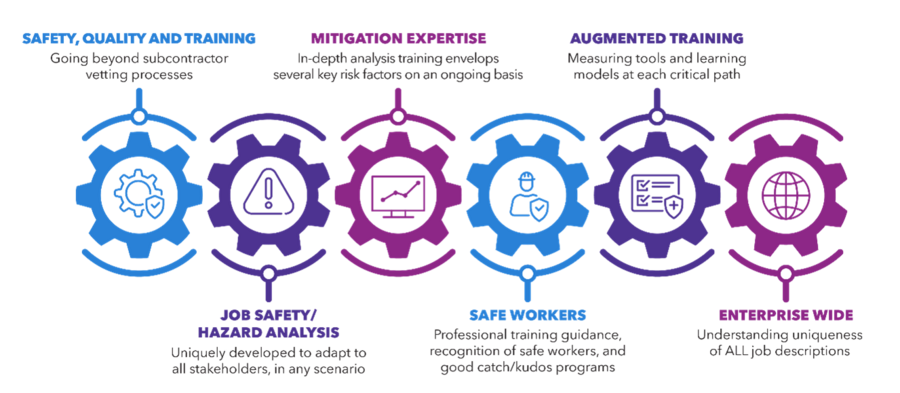
A successful safety program relies on engaging employees through training that inspires a commitment to safety and accountability. Before training begins, we perform tailored evaluations and assessments to learn how we can help utilities make better-informed safety management decisions. Using our deep industry knowledge and insights based on firsthand experience, we focus on ways to align our clients’ organizational culture and attitudes towards safety with their safety goals.

Infographic showing the safety process with Leidos

Our tailored programs help utilities build, sustain and refresh a strong safety culture across their entire enterprise.

We bring fresh solutions to upgrade and improve utility’s safety programs.

“Each utility customer is unique, and their team members have a range of experience, knowledge, and outlooks concerning safety procedures,” said Candace Bell, Leidos safety manager. “We apply granular-level methodology to uncover potential vulnerabilities, using written programs and procedures, people discussions and discovery, and benchmarking.”

Our field safety observer program is one of many examples of innovative solutions that Leidos has successfully implemented with utility clients. This distinctive approach verifies the adoption of new, enhanced, and refreshed safety processes with field operations employees, where it really matters most. This program confronts and mitigates the utility’s invisible risks: fatigue and burnout, being lulled into routine procedures, high pressure environments, and hidden psychological stressors. With continual monitoring, this proven approach provides sustainable and meaningful value.

After the assessments and recommendations are complete, Leidos customizes the training approach to each utility and incorporates a variety of methods to maximize engagement of the entire team, including tabletop exercises, technology-based curriculum, and impactful videos. This process ensures that our solutions are fully inclusive for all participants.  

“The key to a successful safety program hinges on normalizing safety as a mindset and creating a robust culture of safety that utilities can maintain,” Bell said. “The foundation of Leidos’ safety programs is our end-to-end customization, backed by a commitment to program success and sustainability.”

Posted in UncategorizedTagged