April 16, 2026 /3BL/ – Invasive species, introduced accidentally or purposefully outside their original range, can wreak havoc in their new environments, contributing to 60% of global wildlife extinctions and costing $423 billion per year. A new report from World Wildlife Fund (WWF) explores how, when eradication is not possible, developing commercial uses for these pests can help manage their populations and provide environmental and economic benefits to local communities. It presents a first-of-its-kind framework to help businesses and ecologists evaluate the potential benefits and unintended consequences of large-scale harvesting for commercial use.

“The complex part of creating new markets is the chicken-and-egg problem,” said Julia Kurnik, senior director for innovation startups at the Markets Institute at WWF and co-author of the report. “It’s risky to build procurement and processing infrastructure without existing market demand; but companies won’t launch new products until there’s stable supply and processing capabilities. But we’re working on solutions to this problem and already seeing progress.”

Using market forces is a new approach to addressing invasive species, and success will require collaboration from both the conservation and business worlds. To address this challenge, WWF has created a ‘Market Uses for Invasives’ framework. The framework aims to de-risk market-based solutions while centering positive environmental outcomes.

“Creating large-scale markets for invasive species requires planning and rigorous analysis. Our framework helps answer questions that haven’t been fully explored before,” said Emily Moberg, senior director at the Markets Institute and report co-author. “There is a very real risk of unintended consequences with commodifying invasive species; it’s essential we get this right and only use market solutions when they make ecological and business sense.”

To illustrate the framework’s utility, the report applies it to two invasive species causing considerable environmental and economic damage: carp and black locust trees. The analysis examines carp for pet food and black locust for lumber.

There are several companies working to address the bottleneck in processing capacity for invasive carp for the pet food and consumer markets. In 2026, pet food company Chippin launched IGNIZA, a new brand with a large-scale processing facility so other pet food companies can incorporate invasive species into their own products. Other companies, like Two Rivers Fisheries and Impact Fisheries, are developing carp burgers and fish cakes to serve in schools as part of a larger educational campaign about the impacts of invasive species.

“Most pet food in the U.S. comes from byproducts of human food processing. But with demand growing and more consumers seeking human‑grade options, we need new ingredients that don’t add environmental pressure,” said Haley Russell, founder of Chippin and IGNIZA. “Sourcing nutrient‑dense invasive carp for pet food protects native fish, reduces environmental harm, and turns an ecological challenge into part of the solution.”

Going forward, WWF will continue to support and explore the potential of using market forces to address invasive species. This will include revising, refining, and sharing the framework, along with encouraging efforts through business and supply chain support. WWF will also develop additional case studies and share lessons learned, ensuring that all collected wisdom is available long-term.

Read the full report: https://www.worldwildlife.org/publications/from-pest-to-profit-market-use-of-invasive-species/

Media Contact: Lorin Hancock | Lorin.Hancock@wwfus.org

####

Disclosure: WWF Impact, the impact investing arm of WWF-US, supports investment solutions to solve some of the most pressing environmental challenges facing people and the planet. WWF Impact is invested in Chippin. This investment aligns with WWF Impact’s impact investing mandate and internal governance procedures.

####


About World Wildlife Fund

WWF is one of the world’s leading conservation organizations, working for 60 years in nearly 100 countries to help people and nature thrive. With the support of 1.3 million members in the United States and more than 5 million members worldwide, WWF is dedicated to delivering science-based solutions to preserve the diversity and abundance of life on Earth, halt the degradation of the environment, and combat the climate crisis. Visit worldwildlife.org to learn more; follow @WWFNews on X, formerly known as Twitter, to keep up with the latest conservation news; and sign up for our newsletter and news alerts here.
April 16, 2026 /3BL/ – Invasive species, introduced accidentally or purposefully outside their original range, can wreak havoc in their new environments, contributing to 60% of global wildlife extinctions and costing $423 billion per year. A new report from World Wildlife Fund (WWF) explores how, when eradication is not possible, developing commercial uses for these pests can help manage their populations and provide environmental and economic benefits to local communities. It presents a first-of-its-kind framework to help businesses and ecologists evaluate the potential benefits and unintended consequences of large-scale harvesting for commercial use.

“The complex part of creating new markets is the chicken-and-egg problem,” said Julia Kurnik, senior director for innovation startups at the Markets Institute at WWF and co-author of the report. “It’s risky to build procurement and processing infrastructure without existing market demand; but companies won’t launch new products until there’s stable supply and processing capabilities. But we’re working on solutions to this problem and already seeing progress.”

Using market forces is a new approach to addressing invasive species, and success will require collaboration from both the conservation and business worlds. To address this challenge, WWF has created a ‘Market Uses for Invasives’ framework. The framework aims to de-risk market-based solutions while centering positive environmental outcomes.

“Creating large-scale markets for invasive species requires planning and rigorous analysis. Our framework helps answer questions that haven’t been fully explored before,” said Emily Moberg, senior director at the Markets Institute and report co-author. “There is a very real risk of unintended consequences with commodifying invasive species; it’s essential we get this right and only use market solutions when they make ecological and business sense.”

To illustrate the framework’s utility, the report applies it to two invasive species causing considerable environmental and economic damage: carp and black locust trees. The analysis examines carp for pet food and black locust for lumber.

There are several companies working to address the bottleneck in processing capacity for invasive carp for the pet food and consumer markets. In 2026, pet food company Chippin launched IGNIZA, a new brand with a large-scale processing facility so other pet food companies can incorporate invasive species into their own products. Other companies, like Two Rivers Fisheries and Impact Fisheries, are developing carp burgers and fish cakes to serve in schools as part of a larger educational campaign about the impacts of invasive species.

“Most pet food in the U.S. comes from byproducts of human food processing. But with demand growing and more consumers seeking human‑grade options, we need new ingredients that don’t add environmental pressure,” said Haley Russell, founder of Chippin and IGNIZA. “Sourcing nutrient‑dense invasive carp for pet food protects native fish, reduces environmental harm, and turns an ecological challenge into part of the solution.”

Going forward, WWF will continue to support and explore the potential of using market forces to address invasive species. This will include revising, refining, and sharing the framework, along with encouraging efforts through business and supply chain support. WWF will also develop additional case studies and share lessons learned, ensuring that all collected wisdom is available long-term.

Read the full report: https://www.worldwildlife.org/publications/from-pest-to-profit-market-use-of-invasive-species/

Media Contact: Lorin Hancock | Lorin.Hancock@wwfus.org

####

Disclosure: WWF Impact, the impact investing arm of WWF-US, supports investment solutions to solve some of the most pressing environmental challenges facing people and the planet. WWF Impact is invested in Chippin. This investment aligns with WWF Impact’s impact investing mandate and internal governance procedures.

####


About World Wildlife Fund

WWF is one of the world’s leading conservation organizations, working for 60 years in nearly 100 countries to help people and nature thrive. With the support of 1.3 million members in the United States and more than 5 million members worldwide, WWF is dedicated to delivering science-based solutions to preserve the diversity and abundance of life on Earth, halt the degradation of the environment, and combat the climate crisis. Visit worldwildlife.org to learn more; follow @WWFNews on X, formerly known as Twitter, to keep up with the latest conservation news; and sign up for our newsletter and news alerts here.

April 16, 2026 /3BL/ – Invasive species, introduced accidentally or purposefully outside their original range, can wreak havoc in their new environments, contributing to 60% of global wildlife extinctions and costing $423 billion per year. A new report from World Wildlife Fund (WWF) explores how, when eradication is not possible, developing commercial uses for these pests can help manage their populations and provide environmental and economic benefits to local communities. It presents a first-of-its-kind framework to help businesses and ecologists evaluate the potential benefits and unintended consequences of large-scale harvesting for commercial use.

“The complex part of creating new markets is the chicken-and-egg problem,” said Julia Kurnik, senior director for innovation startups at the Markets Institute at WWF and co-author of the report. “It’s risky to build procurement and processing infrastructure without existing market demand; but companies won’t launch new products until there’s stable supply and processing capabilities. But we’re working on solutions to this problem and already seeing progress.”

Using market forces is a new approach to addressing invasive species, and success will require collaboration from both the conservation and business worlds. To address this challenge, WWF has created a ‘Market Uses for Invasives’ framework. The framework aims to de-risk market-based solutions while centering positive environmental outcomes.

“Creating large-scale markets for invasive species requires planning and rigorous analysis. Our framework helps answer questions that haven’t been fully explored before,” said Emily Moberg, senior director at the Markets Institute and report co-author. “There is a very real risk of unintended consequences with commodifying invasive species; it’s essential we get this right and only use market solutions when they make ecological and business sense.”

To illustrate the framework’s utility, the report applies it to two invasive species causing considerable environmental and economic damage: carp and black locust trees. The analysis examines carp for pet food and black locust for lumber.

There are several companies working to address the bottleneck in processing capacity for invasive carp for the pet food and consumer markets. In 2026, pet food company Chippin launched IGNIZA, a new brand with a large-scale processing facility so other pet food companies can incorporate invasive species into their own products. Other companies, like Two Rivers Fisheries and Impact Fisheries, are developing carp burgers and fish cakes to serve in schools as part of a larger educational campaign about the impacts of invasive species.

“Most pet food in the U.S. comes from byproducts of human food processing. But with demand growing and more consumers seeking human‑grade options, we need new ingredients that don’t add environmental pressure,” said Haley Russell, founder of Chippin and IGNIZA. “Sourcing nutrient‑dense invasive carp for pet food protects native fish, reduces environmental harm, and turns an ecological challenge into part of the solution.”

Going forward, WWF will continue to support and explore the potential of using market forces to address invasive species. This will include revising, refining, and sharing the framework, along with encouraging efforts through business and supply chain support. WWF will also develop additional case studies and share lessons learned, ensuring that all collected wisdom is available long-term.

Read the full report: https://www.worldwildlife.org/publications/from-pest-to-profit-market-use-of-invasive-species/

Media Contact: Lorin Hancock | Lorin.Hancock@wwfus.org

####

Disclosure: WWF Impact, the impact investing arm of WWF-US, supports investment solutions to solve some of the most pressing environmental challenges facing people and the planet. WWF Impact is invested in Chippin. This investment aligns with WWF Impact’s impact investing mandate and internal governance procedures.

####


About World Wildlife Fund

WWF is one of the world’s leading conservation organizations, working for 60 years in nearly 100 countries to help people and nature thrive. With the support of 1.3 million members in the United States and more than 5 million members worldwide, WWF is dedicated to delivering science-based solutions to preserve the diversity and abundance of life on Earth, halt the degradation of the environment, and combat the climate crisis. Visit worldwildlife.org to learn more; follow @WWFNews on X, formerly known as Twitter, to keep up with the latest conservation news; and sign up for our newsletter and news alerts here.

Verizon

That trip home to Peru changed her digital habits—now it’s less about screen time limits, and more about using it intentionally to keep language and family close.

Traveling with kids always teaches you something. Traveling back to the place where you grew up, with your child beside you, teaches you even more.

Earlier this year, I took my 5-year-old son, Ford, to Peru. It’s where my roots are, where my family history began, and where many of my earliest memories originated.

Watching him walk the same cobblestone streets, hearing Spanish spoken all around him, was more emotional for me than I expected.

The trip wasn’t just about sightseeing. It was about introducing Ford to his story, his language and his heritage. When we returned home to Miami, I realized the introduction provided by that trip wasn’t enough. The connection needed to continue in our everyday life.

How Peru came home with us

At five, connection is simple but powerful. It comes from hearing familiar voices, seeing familiar faces and feeling included.

Back home, we found small ways to keep Peru part of our routine. Ford uses a Verizon Gizmo Watch 3, which allows him to call or text only the contacts I’ve added. He can send a short voice message in Spanish to family to say good night. Sometimes he calls to share something he learned.

We also use family group chats and video calls so he can practice Spanish, stay engaged with relatives and start building healthy digital habits. As a result, what started as a meaningful trip has become an ongoing relationship with his culture.

Screens fade, people stay: Our family screen time rules

The trip also has me thinking about the kind of digital habits I want Ford to grow up with. These aren’t just rules or screen-time limits, but are the structure we’re using as a family. They’ll change over time, but these five ideas are our starting point:

  • People first. The goal is connection. If a device distracts from the conversation, we put it down.
  • Known contacts only. He can call and message only family and trusted adults we’ve added.
  • Connection on a screen has a time limit. We decide when it’s time to call relatives and when it’s time to unplug.
  • Short and meaningful conversations. A quick voice note in Spanish can have more impact than extended scrolling.
  • Boundaries that grow with him. As he gets older, the tools will change, but the expectations won’t.

We use Verizon Family Plus to help support those rhythms and set clear boundaries for devices beyond his Gizmo watch. The app allows me to manage screen time and set screen time limits, pause internet access when needed and adjust filters as he grows. Not to hover—but to create structure.

At five, structure and screen-time limits matter. They reinforce a simple message: Technology should support real relationships, not replace them.

Turning a trip into something lasting

The trip to Peru helped Ford see where he comes from. Now, we can continue to have an impact through ordinary moments: when he chooses to send a voice note in Spanish, calls a relative in Peru, practices Spanish in a video chat or asks questions about our family history.

Technology, when used thoughtfully, can bridge distance and generations. It can help a child feel connected not only to people, but also to identity. For me, this season of parenting is about raising a child who knows his roots and is using technology to strengthen relationships.

The memories we made in Peru were powerful. The connections we continue to build are what will last.

We got you: You’re there for them with Verizon Family. Verizon’s there for you—including our 3-year price lock*.

*Learn more about our 3-year price lock guarantee.

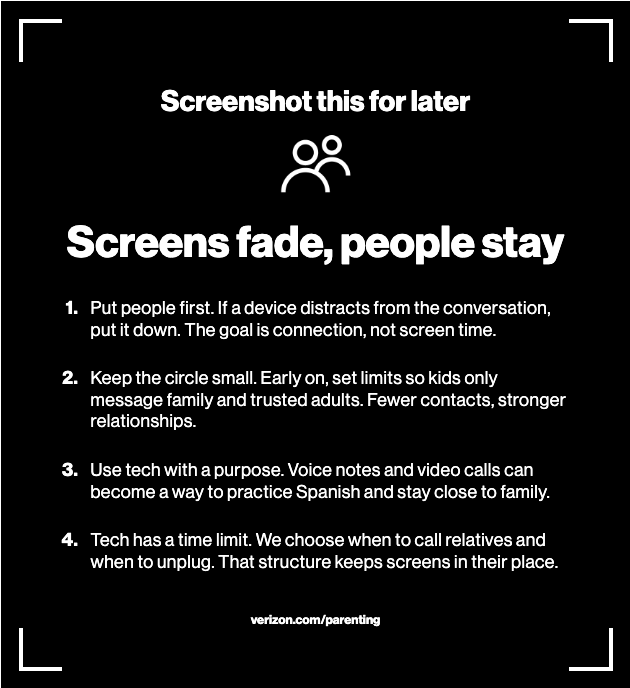
Screenshot this for later  Screens fade, people stay  Put people first. If a device distracts from the conversation, put it down. The goal is connection, not screen time.  Keep the circle small. Early on, set limits so kids only message family and trusted adults. Fewer contacts, stronger relationships.  Use tech with a purpose. Voice notes and video calls can become a way to practice Spanish and stay close to family.  Tech has a time limit. We choose when to call relatives and when to unplug. That structure keeps screens in their place.  verizon.com/parenting

About the author:

Pamela Silva is a journalist, the co-host of Motherish and a mom navigating modern parenting, cultural identity and the evolving ways technology can support families as kids grow.

The author has been compensated by Verizon for this article.

Follow Me:

Verizon

That trip home to Peru changed her digital habits—now it’s less about screen time limits, and more about using it intentionally to keep language and family close.

Traveling with kids always teaches you something. Traveling back to the place where you grew up, with your child beside you, teaches you even more.

Earlier this year, I took my 5-year-old son, Ford, to Peru. It’s where my roots are, where my family history began, and where many of my earliest memories originated.

Watching him walk the same cobblestone streets, hearing Spanish spoken all around him, was more emotional for me than I expected.

The trip wasn’t just about sightseeing. It was about introducing Ford to his story, his language and his heritage. When we returned home to Miami, I realized the introduction provided by that trip wasn’t enough. The connection needed to continue in our everyday life.

How Peru came home with us

At five, connection is simple but powerful. It comes from hearing familiar voices, seeing familiar faces and feeling included.

Back home, we found small ways to keep Peru part of our routine. Ford uses a Verizon Gizmo Watch 3, which allows him to call or text only the contacts I’ve added. He can send a short voice message in Spanish to family to say good night. Sometimes he calls to share something he learned.

We also use family group chats and video calls so he can practice Spanish, stay engaged with relatives and start building healthy digital habits. As a result, what started as a meaningful trip has become an ongoing relationship with his culture.

Screens fade, people stay: Our family screen time rules

The trip also has me thinking about the kind of digital habits I want Ford to grow up with. These aren’t just rules or screen-time limits, but are the structure we’re using as a family. They’ll change over time, but these five ideas are our starting point:

  • People first. The goal is connection. If a device distracts from the conversation, we put it down.
  • Known contacts only. He can call and message only family and trusted adults we’ve added.
  • Connection on a screen has a time limit. We decide when it’s time to call relatives and when it’s time to unplug.
  • Short and meaningful conversations. A quick voice note in Spanish can have more impact than extended scrolling.
  • Boundaries that grow with him. As he gets older, the tools will change, but the expectations won’t.

We use Verizon Family Plus to help support those rhythms and set clear boundaries for devices beyond his Gizmo watch. The app allows me to manage screen time and set screen time limits, pause internet access when needed and adjust filters as he grows. Not to hover—but to create structure.

At five, structure and screen-time limits matter. They reinforce a simple message: Technology should support real relationships, not replace them.

Turning a trip into something lasting

The trip to Peru helped Ford see where he comes from. Now, we can continue to have an impact through ordinary moments: when he chooses to send a voice note in Spanish, calls a relative in Peru, practices Spanish in a video chat or asks questions about our family history.

Technology, when used thoughtfully, can bridge distance and generations. It can help a child feel connected not only to people, but also to identity. For me, this season of parenting is about raising a child who knows his roots and is using technology to strengthen relationships.

The memories we made in Peru were powerful. The connections we continue to build are what will last.

We got you: You’re there for them with Verizon Family. Verizon’s there for you—including our 3-year price lock*.

*Learn more about our 3-year price lock guarantee.

Screenshot this for later  Screens fade, people stay  Put people first. If a device distracts from the conversation, put it down. The goal is connection, not screen time.  Keep the circle small. Early on, set limits so kids only message family and trusted adults. Fewer contacts, stronger relationships.  Use tech with a purpose. Voice notes and video calls can become a way to practice Spanish and stay close to family.  Tech has a time limit. We choose when to call relatives and when to unplug. That structure keeps screens in their place.  verizon.com/parenting

About the author:

Pamela Silva is a journalist, the co-host of Motherish and a mom navigating modern parenting, cultural identity and the evolving ways technology can support families as kids grow.

The author has been compensated by Verizon for this article.

Follow Me:

Verizon

That trip home to Peru changed her digital habits—now it’s less about screen time limits, and more about using it intentionally to keep language and family close.

Traveling with kids always teaches you something. Traveling back to the place where you grew up, with your child beside you, teaches you even more.

Earlier this year, I took my 5-year-old son, Ford, to Peru. It’s where my roots are, where my family history began, and where many of my earliest memories originated.

Watching him walk the same cobblestone streets, hearing Spanish spoken all around him, was more emotional for me than I expected.

The trip wasn’t just about sightseeing. It was about introducing Ford to his story, his language and his heritage. When we returned home to Miami, I realized the introduction provided by that trip wasn’t enough. The connection needed to continue in our everyday life.

How Peru came home with us

At five, connection is simple but powerful. It comes from hearing familiar voices, seeing familiar faces and feeling included.

Back home, we found small ways to keep Peru part of our routine. Ford uses a Verizon Gizmo Watch 3, which allows him to call or text only the contacts I’ve added. He can send a short voice message in Spanish to family to say good night. Sometimes he calls to share something he learned.

We also use family group chats and video calls so he can practice Spanish, stay engaged with relatives and start building healthy digital habits. As a result, what started as a meaningful trip has become an ongoing relationship with his culture.

Screens fade, people stay: Our family screen time rules

The trip also has me thinking about the kind of digital habits I want Ford to grow up with. These aren’t just rules or screen-time limits, but are the structure we’re using as a family. They’ll change over time, but these five ideas are our starting point:

  • People first. The goal is connection. If a device distracts from the conversation, we put it down.
  • Known contacts only. He can call and message only family and trusted adults we’ve added.
  • Connection on a screen has a time limit. We decide when it’s time to call relatives and when it’s time to unplug.
  • Short and meaningful conversations. A quick voice note in Spanish can have more impact than extended scrolling.
  • Boundaries that grow with him. As he gets older, the tools will change, but the expectations won’t.

We use Verizon Family Plus to help support those rhythms and set clear boundaries for devices beyond his Gizmo watch. The app allows me to manage screen time and set screen time limits, pause internet access when needed and adjust filters as he grows. Not to hover—but to create structure.

At five, structure and screen-time limits matter. They reinforce a simple message: Technology should support real relationships, not replace them.

Turning a trip into something lasting

The trip to Peru helped Ford see where he comes from. Now, we can continue to have an impact through ordinary moments: when he chooses to send a voice note in Spanish, calls a relative in Peru, practices Spanish in a video chat or asks questions about our family history.

Technology, when used thoughtfully, can bridge distance and generations. It can help a child feel connected not only to people, but also to identity. For me, this season of parenting is about raising a child who knows his roots and is using technology to strengthen relationships.

The memories we made in Peru were powerful. The connections we continue to build are what will last.

We got you: You’re there for them with Verizon Family. Verizon’s there for you—including our 3-year price lock*.

*Learn more about our 3-year price lock guarantee.

Screenshot this for later  Screens fade, people stay  Put people first. If a device distracts from the conversation, put it down. The goal is connection, not screen time.  Keep the circle small. Early on, set limits so kids only message family and trusted adults. Fewer contacts, stronger relationships.  Use tech with a purpose. Voice notes and video calls can become a way to practice Spanish and stay close to family.  Tech has a time limit. We choose when to call relatives and when to unplug. That structure keeps screens in their place.  verizon.com/parenting

About the author:

Pamela Silva is a journalist, the co-host of Motherish and a mom navigating modern parenting, cultural identity and the evolving ways technology can support families as kids grow.

The author has been compensated by Verizon for this article.

Follow Me:

Verizon

That trip home to Peru changed her digital habits—now it’s less about screen time limits, and more about using it intentionally to keep language and family close.

Traveling with kids always teaches you something. Traveling back to the place where you grew up, with your child beside you, teaches you even more.

Earlier this year, I took my 5-year-old son, Ford, to Peru. It’s where my roots are, where my family history began, and where many of my earliest memories originated.

Watching him walk the same cobblestone streets, hearing Spanish spoken all around him, was more emotional for me than I expected.

The trip wasn’t just about sightseeing. It was about introducing Ford to his story, his language and his heritage. When we returned home to Miami, I realized the introduction provided by that trip wasn’t enough. The connection needed to continue in our everyday life.

How Peru came home with us

At five, connection is simple but powerful. It comes from hearing familiar voices, seeing familiar faces and feeling included.

Back home, we found small ways to keep Peru part of our routine. Ford uses a Verizon Gizmo Watch 3, which allows him to call or text only the contacts I’ve added. He can send a short voice message in Spanish to family to say good night. Sometimes he calls to share something he learned.

We also use family group chats and video calls so he can practice Spanish, stay engaged with relatives and start building healthy digital habits. As a result, what started as a meaningful trip has become an ongoing relationship with his culture.

Screens fade, people stay: Our family screen time rules

The trip also has me thinking about the kind of digital habits I want Ford to grow up with. These aren’t just rules or screen-time limits, but are the structure we’re using as a family. They’ll change over time, but these five ideas are our starting point:

  • People first. The goal is connection. If a device distracts from the conversation, we put it down.
  • Known contacts only. He can call and message only family and trusted adults we’ve added.
  • Connection on a screen has a time limit. We decide when it’s time to call relatives and when it’s time to unplug.
  • Short and meaningful conversations. A quick voice note in Spanish can have more impact than extended scrolling.
  • Boundaries that grow with him. As he gets older, the tools will change, but the expectations won’t.

We use Verizon Family Plus to help support those rhythms and set clear boundaries for devices beyond his Gizmo watch. The app allows me to manage screen time and set screen time limits, pause internet access when needed and adjust filters as he grows. Not to hover—but to create structure.

At five, structure and screen-time limits matter. They reinforce a simple message: Technology should support real relationships, not replace them.

Turning a trip into something lasting

The trip to Peru helped Ford see where he comes from. Now, we can continue to have an impact through ordinary moments: when he chooses to send a voice note in Spanish, calls a relative in Peru, practices Spanish in a video chat or asks questions about our family history.

Technology, when used thoughtfully, can bridge distance and generations. It can help a child feel connected not only to people, but also to identity. For me, this season of parenting is about raising a child who knows his roots and is using technology to strengthen relationships.

The memories we made in Peru were powerful. The connections we continue to build are what will last.

We got you: You’re there for them with Verizon Family. Verizon’s there for you—including our 3-year price lock*.

*Learn more about our 3-year price lock guarantee.

Screenshot this for later  Screens fade, people stay  Put people first. If a device distracts from the conversation, put it down. The goal is connection, not screen time.  Keep the circle small. Early on, set limits so kids only message family and trusted adults. Fewer contacts, stronger relationships.  Use tech with a purpose. Voice notes and video calls can become a way to practice Spanish and stay close to family.  Tech has a time limit. We choose when to call relatives and when to unplug. That structure keeps screens in their place.  verizon.com/parenting

About the author:

Pamela Silva is a journalist, the co-host of Motherish and a mom navigating modern parenting, cultural identity and the evolving ways technology can support families as kids grow.

The author has been compensated by Verizon for this article.

Follow Me:

The Corporate Sustainability Reporting Directive (CSRD) has quickly become one of the most significant developments in sustainability reporting globally. However, recent regulatory updates from the European Union—particularly the Omnibus Simplification Package—have reshaped the landscape.

These changes have created both relief and uncertainty for companies. While the scope of CSRD has narrowed and reporting requirements have been simplified, many organizations are now asking the same questions:

  • Does CSRD still apply to us?
  • If we fall out of scope, should we continue reporting?
  • What standards should we follow moving forward?

During a recent webinar hosted by Inogen Alliance, sustainability experts discussed the new CSRD reality and what companies should focus on in 2026 and beyond. Below are the key takeaways.


Find the full on-demand webinar recording and materials here!


Why CSRD Was Revised

When CSRD was first introduced, it significantly expanded the number of companies required to disclose sustainability information using the European Sustainability Reporting Standards (ESRS).

However, many organizations raised concerns about the complexity and administrative burden associated with implementation. In response, the European Commission introduced the Omnibus Simplification Package, designed to:

  • Reduce regulatory burden on companies
  • Improve EU competitiveness
  • Streamline sustainability reporting frameworks

As a result, the scope of CSRD has been significantly reduced, and reporting requirements have been simplified.


New CSRD Scope: Who Must Report Now?

Under the revised rules, the threshold for companies required to report under CSRD has increased.

Companies must now meet both of the following criteria:

  • €450 million or more in net revenue
  • More than 1,000 employees

This simplified threshold now applies to both listed and non-listed companies.

Reporting Timeline

The implementation timeline also changed:

Company Type First Reporting Year Report Published
Large listed companies already subject to CSRD FY2024 2025
Large non-listed companies (>1000 employees) FY2027 2028
Non-EU companies meeting revenue thresholds FY2028 2029

The Omnibus package also introduced a “stop-the-clock” delay, giving many companies additional time before reporting requirements begin.


Major Changes to the ESRS Reporting Standards

Along with narrowing the scope, regulators also introduced simplified ESRS standards (ESRS Set II).

The goal is to make sustainability reporting more practical and user-friendly.

Key Improvements

The revised standards include:

1. Simplified structure and language
Reporting standards have been rewritten to improve clarity and usability.

2. Fewer data points
Data disclosure requirements were reduced by approximately 60%, primarily by removing overlapping narrative requirements.

3. More flexibility for companies
Companies now have greater flexibility in determining how to disclose sustainability information.

4. Greater focus on decision-useful information
Instead of reporting everything possible, organizations must ensure their reports provide a “fair presentation” of sustainability performance.

This principle—borrowed from financial reporting—means companies must disclose information that is relevant and meaningful for stakeholders and investors.


What Has Not Changed

Despite these simplifications, several core elements of CSRD remain unchanged.

Metrics Are Still Required

Key sustainability metrics remain central to reporting, including:

  • Greenhouse gas emissions (including Scope 3)
  • Energy consumption
  • Water usage
  • Waste generation
  • Workforce metrics

These metrics require robust data collection and management systems, which remain one of the most challenging aspects of implementation.


Double Materiality Remains Critical

The double materiality assessment (DMA) continues to be the foundation of CSRD reporting.

This process requires companies to assess:

  • Impact materiality – how their operations affect the environment and society
  • Financial materiality – how sustainability issues affect financial performance

Organizations must identify their material sustainability topics and disclose relevant data accordingly.

Increasingly, companies are integrating DMA results with enterprise risk management systems, aligning sustainability risks with broader corporate risk frameworks.


Assurance Requirements Still Apply

Companies subject to CSRD must still undergo limited assurance audits of their sustainability reports.

While earlier plans called for transitioning to more rigorous reasonable assurance, that requirement has been removed.

However, organizations should still expect detailed scrutiny of sustainability data and documentation.


What Happens If Your Company Falls Out of Scope?

One of the biggest impacts of the Omnibus package is that many companies previously preparing for CSRD are no longer required to report.

However, this does not mean sustainability reporting will disappear.

Companies may still choose to report voluntarily for several reasons:

  • Customer requirements within supply chains
  • Investor expectations
  • Competitive positioning
  • Access to sustainable finance

For these organizations, a new voluntary framework has emerged.


Voluntary Sustainability Reporting for SMEs

The European Financial Reporting Advisory Group (EFRAG) introduced the Voluntary Sustainability Standard for SMEs (VSME).

This framework is designed for companies that are not subject to CSRD but still need to provide sustainability information, especially within supply chains.

Key Features

The VSME framework includes:

  • Around 100 data points, significantly fewer than ESRS
  • No requirement for a double materiality assessment
  • Simplified ESG metrics and disclosures
  • Optional publication (reports can be shared privately with stakeholders)

The framework also supports companies supplying larger organizations that must report under CSRD.


Why Companies May Continue ESG Reporting Anyway

Even with regulatory relief, most companies are not abandoning sustainability reporting.

Global surveys consistently show that organizations see ESG reporting as valuable for:

  • Risk management
  • Investor relations
  • Access to capital
  • Brand reputation
  • Supply chain transparency

In addition, sustainability reporting regulations continue to expand globally in regions such as:

  • Canada
  • Australia
  • Japan
  • China
  • The United Kingdom
  • The United States

As a result, many companies are continuing to build ESG reporting capabilities regardless of CSRD scope.


Practical Steps for Companies in 2026 for CSRD

Organizations navigating the new CSRD landscape should focus on the following priorities.

1. Determine Your Regulatory Scope

Confirm whether your organization falls within the updated CSRD thresholds or qualifies for voluntary reporting.

2. Strengthen Sustainability Data Systems

Reliable ESG data collection and documentation remain essential—especially for metrics related to emissions, energy, and workforce indicators.

3. Align Sustainability With Risk Management

Integrating sustainability risks into enterprise risk management systems can improve governance and reporting consistency.

4. Consider Voluntary Reporting

Companies outside CSRD scope may still benefit from adopting:

  • VSME standards
  • Simplified ESRS frameworks
  • Other global sustainability reporting standards

5. Prepare for Ongoing Regulatory Evolution

Sustainability reporting frameworks are still evolving. Companies should monitor upcoming developments such as:

  • Finalization of simplified ESRS standards
  • Non-EU reporting standards (NESRS)
  • Additional voluntary reporting frameworks


The Bottom Line

The Omnibus Simplification Package has changed the scope of CSRD—but it has not eliminated the importance of sustainability reporting.

Instead, the EU is moving toward a more focused, flexible approach that emphasizes meaningful sustainability insights over excessive disclosure.

For companies operating globally, the message remains clear:

Sustainability transparency is becoming a business expectation, not just a regulatory requirement.

Organizations that invest now in strong ESG data systems, governance processes, and reporting frameworks will be best positioned to navigate the evolving sustainability landscape.


If you would like support understanding how CSRD changes affect your organization—or how to implement voluntary ESG reporting frameworks—Inogen Alliance experts across our global network are ready to help.


Inogen Alliance is a global network made up of over 70 of independent local businesses and over 6,000 consultants around the world who can help make your project a success. Our Associates collaborate closely to serve multinational corporations, government agencies, and nonprofit organizations, and we share knowledge and industry experience to provide the highest quality service to our clients. If you want to learn more about how you can work with Inogen Alliance, you can explore our Associates or Contact Us. Watch for more News & Blog updates, listen to our podcast and follow us on LinkedIn.

The Corporate Sustainability Reporting Directive (CSRD) has quickly become one of the most significant developments in sustainability reporting globally. However, recent regulatory updates from the European Union—particularly the Omnibus Simplification Package—have reshaped the landscape.

These changes have created both relief and uncertainty for companies. While the scope of CSRD has narrowed and reporting requirements have been simplified, many organizations are now asking the same questions:

  • Does CSRD still apply to us?
  • If we fall out of scope, should we continue reporting?
  • What standards should we follow moving forward?

During a recent webinar hosted by Inogen Alliance, sustainability experts discussed the new CSRD reality and what companies should focus on in 2026 and beyond. Below are the key takeaways.


Find the full on-demand webinar recording and materials here!


Why CSRD Was Revised

When CSRD was first introduced, it significantly expanded the number of companies required to disclose sustainability information using the European Sustainability Reporting Standards (ESRS).

However, many organizations raised concerns about the complexity and administrative burden associated with implementation. In response, the European Commission introduced the Omnibus Simplification Package, designed to:

  • Reduce regulatory burden on companies
  • Improve EU competitiveness
  • Streamline sustainability reporting frameworks

As a result, the scope of CSRD has been significantly reduced, and reporting requirements have been simplified.


New CSRD Scope: Who Must Report Now?

Under the revised rules, the threshold for companies required to report under CSRD has increased.

Companies must now meet both of the following criteria:

  • €450 million or more in net revenue
  • More than 1,000 employees

This simplified threshold now applies to both listed and non-listed companies.

Reporting Timeline

The implementation timeline also changed:

Company Type First Reporting Year Report Published
Large listed companies already subject to CSRD FY2024 2025
Large non-listed companies (>1000 employees) FY2027 2028
Non-EU companies meeting revenue thresholds FY2028 2029

The Omnibus package also introduced a “stop-the-clock” delay, giving many companies additional time before reporting requirements begin.


Major Changes to the ESRS Reporting Standards

Along with narrowing the scope, regulators also introduced simplified ESRS standards (ESRS Set II).

The goal is to make sustainability reporting more practical and user-friendly.

Key Improvements

The revised standards include:

1. Simplified structure and language
Reporting standards have been rewritten to improve clarity and usability.

2. Fewer data points
Data disclosure requirements were reduced by approximately 60%, primarily by removing overlapping narrative requirements.

3. More flexibility for companies
Companies now have greater flexibility in determining how to disclose sustainability information.

4. Greater focus on decision-useful information
Instead of reporting everything possible, organizations must ensure their reports provide a “fair presentation” of sustainability performance.

This principle—borrowed from financial reporting—means companies must disclose information that is relevant and meaningful for stakeholders and investors.


What Has Not Changed

Despite these simplifications, several core elements of CSRD remain unchanged.

Metrics Are Still Required

Key sustainability metrics remain central to reporting, including:

  • Greenhouse gas emissions (including Scope 3)
  • Energy consumption
  • Water usage
  • Waste generation
  • Workforce metrics

These metrics require robust data collection and management systems, which remain one of the most challenging aspects of implementation.


Double Materiality Remains Critical

The double materiality assessment (DMA) continues to be the foundation of CSRD reporting.

This process requires companies to assess:

  • Impact materiality – how their operations affect the environment and society
  • Financial materiality – how sustainability issues affect financial performance

Organizations must identify their material sustainability topics and disclose relevant data accordingly.

Increasingly, companies are integrating DMA results with enterprise risk management systems, aligning sustainability risks with broader corporate risk frameworks.


Assurance Requirements Still Apply

Companies subject to CSRD must still undergo limited assurance audits of their sustainability reports.

While earlier plans called for transitioning to more rigorous reasonable assurance, that requirement has been removed.

However, organizations should still expect detailed scrutiny of sustainability data and documentation.


What Happens If Your Company Falls Out of Scope?

One of the biggest impacts of the Omnibus package is that many companies previously preparing for CSRD are no longer required to report.

However, this does not mean sustainability reporting will disappear.

Companies may still choose to report voluntarily for several reasons:

  • Customer requirements within supply chains
  • Investor expectations
  • Competitive positioning
  • Access to sustainable finance

For these organizations, a new voluntary framework has emerged.


Voluntary Sustainability Reporting for SMEs

The European Financial Reporting Advisory Group (EFRAG) introduced the Voluntary Sustainability Standard for SMEs (VSME).

This framework is designed for companies that are not subject to CSRD but still need to provide sustainability information, especially within supply chains.

Key Features

The VSME framework includes:

  • Around 100 data points, significantly fewer than ESRS
  • No requirement for a double materiality assessment
  • Simplified ESG metrics and disclosures
  • Optional publication (reports can be shared privately with stakeholders)

The framework also supports companies supplying larger organizations that must report under CSRD.


Why Companies May Continue ESG Reporting Anyway

Even with regulatory relief, most companies are not abandoning sustainability reporting.

Global surveys consistently show that organizations see ESG reporting as valuable for:

  • Risk management
  • Investor relations
  • Access to capital
  • Brand reputation
  • Supply chain transparency

In addition, sustainability reporting regulations continue to expand globally in regions such as:

  • Canada
  • Australia
  • Japan
  • China
  • The United Kingdom
  • The United States

As a result, many companies are continuing to build ESG reporting capabilities regardless of CSRD scope.


Practical Steps for Companies in 2026 for CSRD

Organizations navigating the new CSRD landscape should focus on the following priorities.

1. Determine Your Regulatory Scope

Confirm whether your organization falls within the updated CSRD thresholds or qualifies for voluntary reporting.

2. Strengthen Sustainability Data Systems

Reliable ESG data collection and documentation remain essential—especially for metrics related to emissions, energy, and workforce indicators.

3. Align Sustainability With Risk Management

Integrating sustainability risks into enterprise risk management systems can improve governance and reporting consistency.

4. Consider Voluntary Reporting

Companies outside CSRD scope may still benefit from adopting:

  • VSME standards
  • Simplified ESRS frameworks
  • Other global sustainability reporting standards

5. Prepare for Ongoing Regulatory Evolution

Sustainability reporting frameworks are still evolving. Companies should monitor upcoming developments such as:

  • Finalization of simplified ESRS standards
  • Non-EU reporting standards (NESRS)
  • Additional voluntary reporting frameworks


The Bottom Line

The Omnibus Simplification Package has changed the scope of CSRD—but it has not eliminated the importance of sustainability reporting.

Instead, the EU is moving toward a more focused, flexible approach that emphasizes meaningful sustainability insights over excessive disclosure.

For companies operating globally, the message remains clear:

Sustainability transparency is becoming a business expectation, not just a regulatory requirement.

Organizations that invest now in strong ESG data systems, governance processes, and reporting frameworks will be best positioned to navigate the evolving sustainability landscape.


If you would like support understanding how CSRD changes affect your organization—or how to implement voluntary ESG reporting frameworks—Inogen Alliance experts across our global network are ready to help.


Inogen Alliance is a global network made up of over 70 of independent local businesses and over 6,000 consultants around the world who can help make your project a success. Our Associates collaborate closely to serve multinational corporations, government agencies, and nonprofit organizations, and we share knowledge and industry experience to provide the highest quality service to our clients. If you want to learn more about how you can work with Inogen Alliance, you can explore our Associates or Contact Us. Watch for more News & Blog updates, listen to our podcast and follow us on LinkedIn.

The Corporate Sustainability Reporting Directive (CSRD) has quickly become one of the most significant developments in sustainability reporting globally. However, recent regulatory updates from the European Union—particularly the Omnibus Simplification Package—have reshaped the landscape.

These changes have created both relief and uncertainty for companies. While the scope of CSRD has narrowed and reporting requirements have been simplified, many organizations are now asking the same questions:

  • Does CSRD still apply to us?
  • If we fall out of scope, should we continue reporting?
  • What standards should we follow moving forward?

During a recent webinar hosted by Inogen Alliance, sustainability experts discussed the new CSRD reality and what companies should focus on in 2026 and beyond. Below are the key takeaways.


Find the full on-demand webinar recording and materials here!


Why CSRD Was Revised

When CSRD was first introduced, it significantly expanded the number of companies required to disclose sustainability information using the European Sustainability Reporting Standards (ESRS).

However, many organizations raised concerns about the complexity and administrative burden associated with implementation. In response, the European Commission introduced the Omnibus Simplification Package, designed to:

  • Reduce regulatory burden on companies
  • Improve EU competitiveness
  • Streamline sustainability reporting frameworks

As a result, the scope of CSRD has been significantly reduced, and reporting requirements have been simplified.


New CSRD Scope: Who Must Report Now?

Under the revised rules, the threshold for companies required to report under CSRD has increased.

Companies must now meet both of the following criteria:

  • €450 million or more in net revenue
  • More than 1,000 employees

This simplified threshold now applies to both listed and non-listed companies.

Reporting Timeline

The implementation timeline also changed:

Company Type First Reporting Year Report Published
Large listed companies already subject to CSRD FY2024 2025
Large non-listed companies (>1000 employees) FY2027 2028
Non-EU companies meeting revenue thresholds FY2028 2029

The Omnibus package also introduced a “stop-the-clock” delay, giving many companies additional time before reporting requirements begin.


Major Changes to the ESRS Reporting Standards

Along with narrowing the scope, regulators also introduced simplified ESRS standards (ESRS Set II).

The goal is to make sustainability reporting more practical and user-friendly.

Key Improvements

The revised standards include:

1. Simplified structure and language
Reporting standards have been rewritten to improve clarity and usability.

2. Fewer data points
Data disclosure requirements were reduced by approximately 60%, primarily by removing overlapping narrative requirements.

3. More flexibility for companies
Companies now have greater flexibility in determining how to disclose sustainability information.

4. Greater focus on decision-useful information
Instead of reporting everything possible, organizations must ensure their reports provide a “fair presentation” of sustainability performance.

This principle—borrowed from financial reporting—means companies must disclose information that is relevant and meaningful for stakeholders and investors.


What Has Not Changed

Despite these simplifications, several core elements of CSRD remain unchanged.

Metrics Are Still Required

Key sustainability metrics remain central to reporting, including:

  • Greenhouse gas emissions (including Scope 3)
  • Energy consumption
  • Water usage
  • Waste generation
  • Workforce metrics

These metrics require robust data collection and management systems, which remain one of the most challenging aspects of implementation.


Double Materiality Remains Critical

The double materiality assessment (DMA) continues to be the foundation of CSRD reporting.

This process requires companies to assess:

  • Impact materiality – how their operations affect the environment and society
  • Financial materiality – how sustainability issues affect financial performance

Organizations must identify their material sustainability topics and disclose relevant data accordingly.

Increasingly, companies are integrating DMA results with enterprise risk management systems, aligning sustainability risks with broader corporate risk frameworks.


Assurance Requirements Still Apply

Companies subject to CSRD must still undergo limited assurance audits of their sustainability reports.

While earlier plans called for transitioning to more rigorous reasonable assurance, that requirement has been removed.

However, organizations should still expect detailed scrutiny of sustainability data and documentation.


What Happens If Your Company Falls Out of Scope?

One of the biggest impacts of the Omnibus package is that many companies previously preparing for CSRD are no longer required to report.

However, this does not mean sustainability reporting will disappear.

Companies may still choose to report voluntarily for several reasons:

  • Customer requirements within supply chains
  • Investor expectations
  • Competitive positioning
  • Access to sustainable finance

For these organizations, a new voluntary framework has emerged.


Voluntary Sustainability Reporting for SMEs

The European Financial Reporting Advisory Group (EFRAG) introduced the Voluntary Sustainability Standard for SMEs (VSME).

This framework is designed for companies that are not subject to CSRD but still need to provide sustainability information, especially within supply chains.

Key Features

The VSME framework includes:

  • Around 100 data points, significantly fewer than ESRS
  • No requirement for a double materiality assessment
  • Simplified ESG metrics and disclosures
  • Optional publication (reports can be shared privately with stakeholders)

The framework also supports companies supplying larger organizations that must report under CSRD.


Why Companies May Continue ESG Reporting Anyway

Even with regulatory relief, most companies are not abandoning sustainability reporting.

Global surveys consistently show that organizations see ESG reporting as valuable for:

  • Risk management
  • Investor relations
  • Access to capital
  • Brand reputation
  • Supply chain transparency

In addition, sustainability reporting regulations continue to expand globally in regions such as:

  • Canada
  • Australia
  • Japan
  • China
  • The United Kingdom
  • The United States

As a result, many companies are continuing to build ESG reporting capabilities regardless of CSRD scope.


Practical Steps for Companies in 2026 for CSRD

Organizations navigating the new CSRD landscape should focus on the following priorities.

1. Determine Your Regulatory Scope

Confirm whether your organization falls within the updated CSRD thresholds or qualifies for voluntary reporting.

2. Strengthen Sustainability Data Systems

Reliable ESG data collection and documentation remain essential—especially for metrics related to emissions, energy, and workforce indicators.

3. Align Sustainability With Risk Management

Integrating sustainability risks into enterprise risk management systems can improve governance and reporting consistency.

4. Consider Voluntary Reporting

Companies outside CSRD scope may still benefit from adopting:

  • VSME standards
  • Simplified ESRS frameworks
  • Other global sustainability reporting standards

5. Prepare for Ongoing Regulatory Evolution

Sustainability reporting frameworks are still evolving. Companies should monitor upcoming developments such as:

  • Finalization of simplified ESRS standards
  • Non-EU reporting standards (NESRS)
  • Additional voluntary reporting frameworks


The Bottom Line

The Omnibus Simplification Package has changed the scope of CSRD—but it has not eliminated the importance of sustainability reporting.

Instead, the EU is moving toward a more focused, flexible approach that emphasizes meaningful sustainability insights over excessive disclosure.

For companies operating globally, the message remains clear:

Sustainability transparency is becoming a business expectation, not just a regulatory requirement.

Organizations that invest now in strong ESG data systems, governance processes, and reporting frameworks will be best positioned to navigate the evolving sustainability landscape.


If you would like support understanding how CSRD changes affect your organization—or how to implement voluntary ESG reporting frameworks—Inogen Alliance experts across our global network are ready to help.


Inogen Alliance is a global network made up of over 70 of independent local businesses and over 6,000 consultants around the world who can help make your project a success. Our Associates collaborate closely to serve multinational corporations, government agencies, and nonprofit organizations, and we share knowledge and industry experience to provide the highest quality service to our clients. If you want to learn more about how you can work with Inogen Alliance, you can explore our Associates or Contact Us. Watch for more News & Blog updates, listen to our podcast and follow us on LinkedIn.