Courts, Congress, and Statehouses: Where Sustainability Is Quietly Winning

The loudest sustainability headlines these days tend to focus on what’s being rolled back at the federal level. But a closer look at what happened in the past few weeks tells a different story — one where carbon management secured bipartisan funding in Congress, a federal court drew a constitutional line against anti-ESG overreach, and state legislatures continued building new frameworks for corporate environmental accountability. The action may be quieter, but it is reshaping the sustainability landscape in ways that matter.

Start with the federal budget. When Congress passed the FY 2026 spending package last month, many in the climate sector expected the worst. In our Top Stories this issue, Carbon Herald reports that instead of cuts, the final appropriations preserved core funding for direct air capture hubs, carbon capture R&D, and the Carbon Dioxide Removal Purchase Pilot Prize — which received $45 million across at least four pathways.

Perhaps most notably, the package included language from the PROVE IT Act, directing the DOE’s National Energy Technology Laboratory to study U.S. manufacturing’s carbon intensity relative to global peers — a move that positions American industry to respond credibly as the EU’s Carbon Border Adjustment Mechanism takes hold. Carbon management, it turns out, is increasingly being justified in economic competitiveness terms, not just environmental ones.

Meanwhile, in a Texas courtroom, ESG News reports that a federal judge permanently struck down Senate Bill 13 — one of the most aggressive anti-ESG laws in the country. The 2021 law had blacklisted more than 300 companies and triggered billions in state pension divestments from firms deemed to be “boycotting” fossil fuels. Judge Alan Albright, a Trump appointee, ruled SB 13 unconstitutionally vague and overbroad, finding that it violated First and Fourteenth Amendment protections by penalizing companies for climate-related speech, advocacy, and association. With similar laws already blocked in Missouri and Oklahoma, the ruling sends a clear signal: states cannot weaponize economic policy to punish sustainability-minded investors without running into constitutional guardrails.

On the regulatory front, sustainability governance continues to build momentum at the state level. G&A Institute has released a new Resource Paper examining the rapid expansion across the U.S. of Extended Producer Responsibility (EPR) laws for packaging. Seven states have now enacted EPR legislation, with approximately 14 more actively considering similar measures. These laws are fundamentally shifting who pays for packaging waste management — from municipalities and taxpayers to the producers themselves — and are creating new compliance, reporting, and financial obligations that companies selling packaged products need to get ahead of now.

Taken together, these developments reinforce a theme G&A has been tracking throughout 2026: the sustainability agenda in the U.S. is not stalled, rather it is decentralizing. Companies waiting for a single federal signal before acting may find themselves behind the curve. The G&A team is available to help your company stay ahead of rapidly changing reporting requirements. Reach out to us at info@ga-institute.com.

This is just the introduction of G&A’s Sustainability Highlights newsletter this week. Click here to view the full issue

Posted in UncategorizedTagged

Whole Foods Market Foundation 2025 Impact


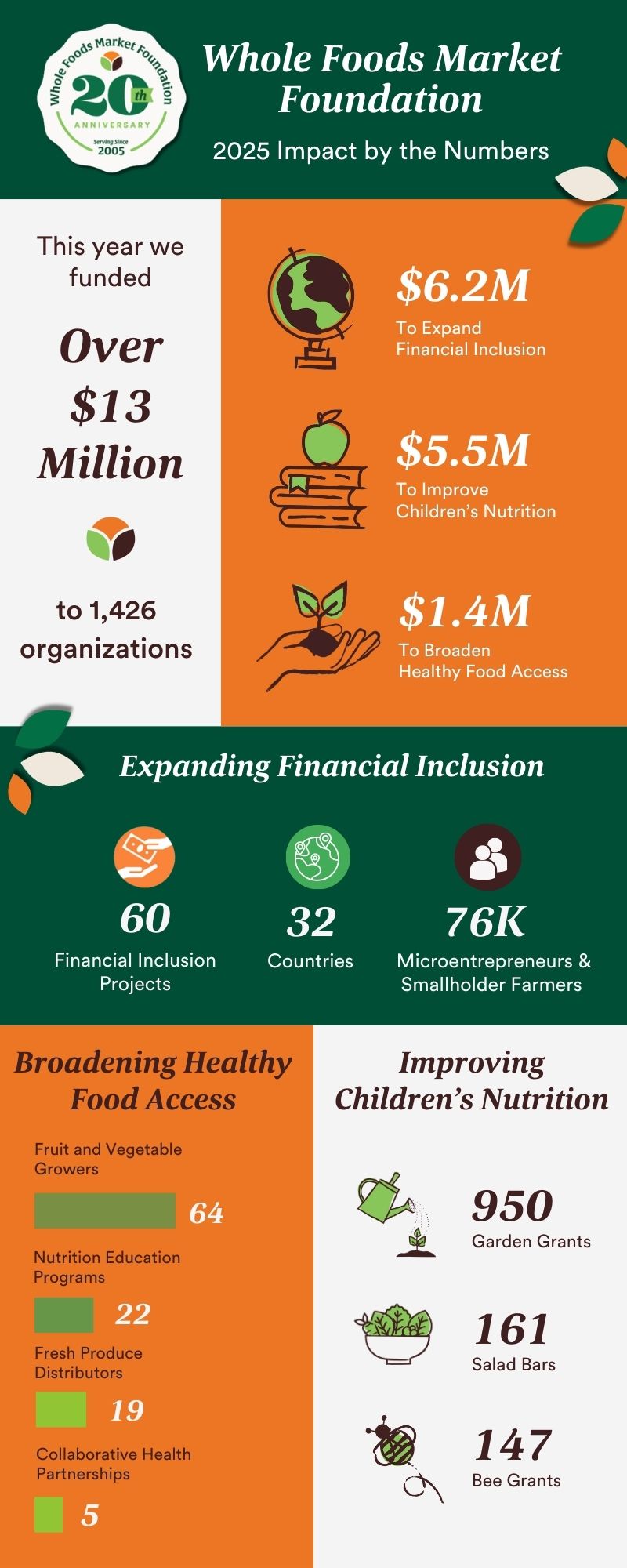
Whole Foods Market Foundation 2025 Impact by the Numbers


AUSTIN, Texas, February 12, 2026 /3BL/ – “At Whole Foods Market Foundation, we know that collective impact requires partnerships and collaboration. Our community partners bring deep local knowledge and innovative solutions. Whole Foods Market Team Members contribute their passion and generosity. Like-minded brands amplify our reach. Together, we’re building pathways to health and prosperity that help our local and global communities thrive. This is the power of collective action in service of a shared mission: to nourish people by advancing food security, improving nutrition, and strengthening resilient food systems.

2025 has been a year of growth and learning. Both personally as a first year Executive Director and as a team in our second year as a unified foundation, I’m energized by how our integrated approach is creating new possibilities for greater impact. Integrating our three focus areas has allowed us to think more holistically about the challenges people face around food access, nutrition and financial inclusion, and the interconnected solutions that can address them.

This past year, we also marked a significant milestone: our 20th Anniversary! Over the last two decades, we’ve supported over a million smallholder farmers and microentrepreneurs with economic opportunities, assisted hundreds of community organizations expand healthy fresh food access, and helped transform millions of children’s relationship with food to improve nutrition. We’ve witnessed the power of our unified approach to create deeper, more meaningful, lasting change through strategic partnerships. This was a wonderful opportunity to celebrate our collective impact with valued supporters, reflect on our community-led approach, and envision the next 20 years.

As we move forward, community remains at the heart of our work. The team is energized by the opportunities ahead to collaborate with our stakeholders. Together, we are creating pathways for innovative approaches that help smallholder farmers prosper, advance children’s nutrition, and foster thriving community health. I am deeply proud of our team and honored to lead such a remarkable group of passionate, intelligent, caring, and driven changemakers.”

– Daniel Zoltani

Whole Foods Market Foundation Executive Director

2025 Impact

This year, Whole Foods Market Foundation invested over $13 million in 34 countries around the world, supporting 1,426 organizations and schools to help advance healthy food access, nutrition and economic opportunities.

Broadening Healthy Food Access

  • 64 Fruit & Vegetable Growers
  • 22 Nutrition Education Programs
  • 19 Fresh Produce Distributors
  • 5 Collaborative Health Partnerships

Improving Children’s Nutrition

  • 950 Garden Grants
  • 161 Salad Bars
  • 147 Bee Grants

Expanding Financial Inclusion

  • 76,216 Microentrepreneurs and Smallholder Farmers
  • 60 Financial Inclusion Projects
  • 32 Countries

Learn More

2025 Spotlight Stories

Acceso – Empowering Women Farmers in Post-Conflict Colombia

In rural Colombia’s post-conflict areas, women smallholder farmers possess agricultural knowledge and entrepreneurial drive but often lack access to commercial markets and startup capital needed to build sustainable businesses.

Through Whole Foods Market Foundation’s support, Acceso Colombia’s Community Training Farm (CTF) program is bridging this gap. The program trains female heads of household and unemployed youth in agronomy, agri-business and sales, connecting them with commercial buyers.

Meet Smallholder Farmers


Chef Ann Salad Bars- Transforming School Food in Cleveland

Every day in Cleveland, Ohio, 100% of the district’s 36,298 students walk into school cafeterias eligible for free or reduced lunch. The Cleveland Metropolitan School District saw an opportunity to transform how these students experience healthy food at school.

Through Chef Ann Foundation’s Salad Bars to Schools program, the district received 46 salad bars last year. Staff expanded their culinary skills through training in food safety, knife skills, and produce preparation. The district now operates 16 hydroponic growing towers producing fresh lettuce, peppers, cucumbers, tomatoes, and herbs for school salad bars. They’ve partnered with local farms, bringing farmers who reflect the student population into cafeterias as role models.

See Scratch Cooking in Action


Restorative Farms- Growing a Better Dallas

In South Dallas, where fresh produce is often out of reach, Freddie, a Whole Foods Market Team Member, has championed Restorative Farms through five consecutive years of Community First Grant funding. Since 2021, Freddie’s advocacy has helped secure over $45,000, enabling the organization to expand their urban farming initiatives. Most recently, Freddie’s support is helping launch a new vermiculture project at Lawnview Station, a DART hub in South Dallas. With Freddie’s support, Restorative Farms is empowering individuals while building a healthier, more resilient community.

See how Restorative Farms is Growing a Better Dallas


Donor Impact that Goes Further

Whole Foods Market Foundation is deeply grateful to all donors—individuals, customers, Team Members, corporate, and supplier donors—whose generosity makes its work possible. Their contribution translates directly into community impact because Whole Foods Market covers 100% of its operational costs. Every dollar donated reaches the organizations and communities working on the front lines of food access, nutrition education and economic empowerment. Each contribution strengthens the work of partners building healthier, more resilient communities.

Whole Foods Market Foundation can expand its impact thanks to the generous support of donors, including the following 2025 top donors:

  • Amazon Fresh
  • Blackhawk Network
  • MaryRuth’s Organics
  • The Matt O’Hayer Foundation
  • Nature’s Path Organic Foods
  • Newman’s Own Foundation
  • Ocean’s Halo
  • Shoes For Crews

Meet Foundation Donors

####

ABOUT WHOLE FOODS MARKET FOUNDATION

Whole Foods Market Foundation is on a mission to nourish people by advancing food security, improving nutrition and strengthening resilient food systems. The registered 501(c)(3) non-profit organization, based in Austin, Texas, focuses on broadening healthy food access, improving children’s nutrition, and expanding financial inclusion. For more information on the Foundation’s work, visit wholefoodsmarketfoundation.org. For ongoing news and updates, follow Whole Foods Market Foundation on Facebook, Instagram, or LinkedIn.

Posted in UncategorizedTagged

Whole Foods Market Foundation 2025 Impact


Whole Foods Market Foundation 2025 Impact by the Numbers


AUSTIN, Texas, February 12, 2026 /3BL/ – “At Whole Foods Market Foundation, we know that collective impact requires partnerships and collaboration. Our community partners bring deep local knowledge and innovative solutions. Whole Foods Market Team Members contribute their passion and generosity. Like-minded brands amplify our reach. Together, we’re building pathways to health and prosperity that help our local and global communities thrive. This is the power of collective action in service of a shared mission: to nourish people by advancing food security, improving nutrition, and strengthening resilient food systems.

2025 has been a year of growth and learning. Both personally as a first year Executive Director and as a team in our second year as a unified foundation, I’m energized by how our integrated approach is creating new possibilities for greater impact. Integrating our three focus areas has allowed us to think more holistically about the challenges people face around food access, nutrition and financial inclusion, and the interconnected solutions that can address them.

This past year, we also marked a significant milestone: our 20th Anniversary! Over the last two decades, we’ve supported over a million smallholder farmers and microentrepreneurs with economic opportunities, assisted hundreds of community organizations expand healthy fresh food access, and helped transform millions of children’s relationship with food to improve nutrition. We’ve witnessed the power of our unified approach to create deeper, more meaningful, lasting change through strategic partnerships. This was a wonderful opportunity to celebrate our collective impact with valued supporters, reflect on our community-led approach, and envision the next 20 years.

As we move forward, community remains at the heart of our work. The team is energized by the opportunities ahead to collaborate with our stakeholders. Together, we are creating pathways for innovative approaches that help smallholder farmers prosper, advance children’s nutrition, and foster thriving community health. I am deeply proud of our team and honored to lead such a remarkable group of passionate, intelligent, caring, and driven changemakers.”

– Daniel Zoltani

Whole Foods Market Foundation Executive Director

2025 Impact

This year, Whole Foods Market Foundation invested over $13 million in 34 countries around the world, supporting 1,426 organizations and schools to help advance healthy food access, nutrition and economic opportunities.

Broadening Healthy Food Access

  • 64 Fruit & Vegetable Growers
  • 22 Nutrition Education Programs
  • 19 Fresh Produce Distributors
  • 5 Collaborative Health Partnerships

Improving Children’s Nutrition

  • 950 Garden Grants
  • 161 Salad Bars
  • 147 Bee Grants

Expanding Financial Inclusion

  • 76,216 Microentrepreneurs and Smallholder Farmers
  • 60 Financial Inclusion Projects
  • 32 Countries

Learn More

2025 Spotlight Stories

Acceso – Empowering Women Farmers in Post-Conflict Colombia

In rural Colombia’s post-conflict areas, women smallholder farmers possess agricultural knowledge and entrepreneurial drive but often lack access to commercial markets and startup capital needed to build sustainable businesses.

Through Whole Foods Market Foundation’s support, Acceso Colombia’s Community Training Farm (CTF) program is bridging this gap. The program trains female heads of household and unemployed youth in agronomy, agri-business and sales, connecting them with commercial buyers.

Meet Smallholder Farmers


Chef Ann Salad Bars- Transforming School Food in Cleveland

Every day in Cleveland, Ohio, 100% of the district’s 36,298 students walk into school cafeterias eligible for free or reduced lunch. The Cleveland Metropolitan School District saw an opportunity to transform how these students experience healthy food at school.

Through Chef Ann Foundation’s Salad Bars to Schools program, the district received 46 salad bars last year. Staff expanded their culinary skills through training in food safety, knife skills, and produce preparation. The district now operates 16 hydroponic growing towers producing fresh lettuce, peppers, cucumbers, tomatoes, and herbs for school salad bars. They’ve partnered with local farms, bringing farmers who reflect the student population into cafeterias as role models.

See Scratch Cooking in Action


Restorative Farms- Growing a Better Dallas

In South Dallas, where fresh produce is often out of reach, Freddie, a Whole Foods Market Team Member, has championed Restorative Farms through five consecutive years of Community First Grant funding. Since 2021, Freddie’s advocacy has helped secure over $45,000, enabling the organization to expand their urban farming initiatives. Most recently, Freddie’s support is helping launch a new vermiculture project at Lawnview Station, a DART hub in South Dallas. With Freddie’s support, Restorative Farms is empowering individuals while building a healthier, more resilient community.

See how Restorative Farms is Growing a Better Dallas


Donor Impact that Goes Further

Whole Foods Market Foundation is deeply grateful to all donors—individuals, customers, Team Members, corporate, and supplier donors—whose generosity makes its work possible. Their contribution translates directly into community impact because Whole Foods Market covers 100% of its operational costs. Every dollar donated reaches the organizations and communities working on the front lines of food access, nutrition education and economic empowerment. Each contribution strengthens the work of partners building healthier, more resilient communities.

Whole Foods Market Foundation can expand its impact thanks to the generous support of donors, including the following 2025 top donors:

  • Amazon Fresh
  • Blackhawk Network
  • MaryRuth’s Organics
  • The Matt O’Hayer Foundation
  • Nature’s Path Organic Foods
  • Newman’s Own Foundation
  • Ocean’s Halo
  • Shoes For Crews

Meet Foundation Donors

####

ABOUT WHOLE FOODS MARKET FOUNDATION

Whole Foods Market Foundation is on a mission to nourish people by advancing food security, improving nutrition and strengthening resilient food systems. The registered 501(c)(3) non-profit organization, based in Austin, Texas, focuses on broadening healthy food access, improving children’s nutrition, and expanding financial inclusion. For more information on the Foundation’s work, visit wholefoodsmarketfoundation.org. For ongoing news and updates, follow Whole Foods Market Foundation on Facebook, Instagram, or LinkedIn.

Posted in UncategorizedTagged

AEG Engages Compton High School Students Through Career Pathway Panel and Tour of Andre “Dr. Dre” Young Performing Arts Center

As part of its ongoing commitment to expanding access and career exposure for young people, AEG hosted an interactive student career panel at Compton High School with a tour of Andre “Dr. Dre” Young Performing Arts Center in Compton, CA on Wednesday, February 11, 2026.

The event offered students an inside look at the wide range of professions that drive the live events and entertainment industry. Through panel discussions, Q&A sessions, and direct conversations with AEG employees, students gained firsthand insight into career paths spanning event operations, community relations, creative services, broadcast production, talent buying, and partnership development.

AEG leaders from across the company’s divisions shared their personal journeys, discussed the skills needed to succeed, and provided practical guidance on navigating opportunities in the entertainment sector.

AEG panelists included:

  • Tamala Lewis, Senior Director, Community Affairs — Dignity Health Sports Park & LA Galaxy
  • Nakya Carter, Event Specialist — AEG Global Partnerships
  • Chavante “Tae” Flakes, Talent Buyer — AEG Goldenvoice (Festivals/Concerts)
  • Juan A. Mc David, Broadcast Services — Crypto.com Arena
  • Jose Rubio, Graphic Designer — LA Galaxy Creative Services
  • Kyle Robinson, General Manager, The Novo

“Creating access for young people—especially in the communities we serve—is core to our mission,” said Tamala Lewis, Senior Director of Community Affairs at Dignity Health Sports Park & LA Galaxy. “When students can meet professionals who look like them, who grew up in similar neighborhoods, and who have built meaningful careers in sports and entertainment, it opens doors they may never have realized were possible.”

Lewis noted that programs like this encourage confidence, curiosity, and early career exploration among students. “Exposure is powerful. Even one conversation can spark a passion or make a student feel seen,” she added. “We’re proud to partner with Compton High School to help the next generation discover their potential.”

Posted in UncategorizedTagged

Bristol Myers Squibb to be Inaugural Partner for Life Science Cares National Campaign to Advance Health Equity and Fight Food Insecurity

PRINCETON, N.J., February 12, 2026 /3BL/ – Bristol Myers Squibb (NYSE: BMY) today announced that it will be an inaugural partner to Life Science Cares in support of its national campaign to fight food insecurity. Led by Life Science Cares, the Food is Health: Nourishing Communities, Advancing Health initiative, aims to invest $30 million and mobilize 30,000 volunteer hours by 2030 to deliver measurable, lasting impact for communities nationwide.

The initiative is grounded in growing evidence that access to nutritious food is foundational to disease prevention, treatment adherence, and long-term health outcomes. Research shows that food insecurity is associated with higher rates of chronic disease, increased hospitalizations, and poorer health outcomes — underscoring that nutrition is not separate from healthcare, but essential to it.

As an inaugural partner, Bristol Myers Squibb will commit $5 million, underscoring its leadership in advancing health equity and reducing barriers to care. 

“We believe in the transformative power of our medicines to help patients live longer, healthier lives. Through our purpose and responsibility as a global company, we also recognize the need to treat the whole patient, both through innovative medicines and by addressing broader factors that impact a person’s health, like food insecurity,” said Wendy Short Bartie, Executive Vice President of Corporate Affairs, Bristol Myers Squibb. “We work tirelessly to ensure patients can access the treatments they need while breaking down inequities and barriers to care to improve outcomes. Advancing health equity requires bold action and shared responsibility, and we’re proud to partner with Life Science Cares and lead in driving systemic change for healthier communities.”

More than 40 million Americans struggle with food insecurity every year — including 1 in 5 children. Hunger doesn’t exist in isolation: it drives poor health, limits educational success, and makes it harder for families to break cycles of poverty.

“Bristol Myers Squibb is showing the kind of leadership our industry needs—rooted in compassion, responsibility, and a belief that strong communities are the foundation for better health,” said Rob Perez, Founder of Life Science Cares. “This commitment goes beyond a single moment on a global stage. By recognizing the impact of food security on health, BMS is making a long-term investment in people, in communities, and in measurable health outcomes. We hope others across the life sciences industry will join BMS in stepping up, leaning in, and investing in the communities that make our work possible. Together, we can create lasting systemic impact.”

This collaboration with Life Science Cares reflects Bristol Myers Squibb’s belief that advancing both science and society go hand in hand, ensuring lasting benefits for local communities and addressing critical societal challenges. Through this collaboration, Bristol Myers Squibb and Life Science Cares are striving to make a meaningful impact in addressing food insecurity in a scalable, measurable way that advances health equity and improves health outcomes nationwide.

About Bristol Myers Squibb: Transforming Patients’ Lives Through Science

At Bristol Myers Squibb, our mission is to discover, develop and deliver innovative medicines that help patients prevail over serious diseases. We are pursuing bold science to define what’s possible for the future of medicine and the patients we serve. For more information, visit us at BMS.com and follow us on LinkedIn, X, YouTube, Facebook and Instagram

About Life Science Cares

Life Science Cares leverages the power of the life science industry to solve one of our most intractable social issues—poverty. Harnessing the financial, human, and social capital across the life science industry, we focus on ensuring local communities have access to basic needs, access to education, or access to economic opportunity. Learn more at www.lifesciencecares.org.
 

###

For more information, contact: 

Media Relations: 
media@bms.com

Posted in UncategorizedTagged

Nudge the Ones You Love To Get Checked

By Dan Amos, chairman and CEO, Aflac Incorporated

Dan Amos, CEO Aflac.

Originally published on Aflac Newsroom

Whether or not you celebrate Valentine’s Day, I hope you take this opportunity to give the gift that matters most: time.

As I wrote in a recent article published on Time.com, cancer has touched my own family more than once, and those losses remain a constant reminder: We don’t control how much time we get, but we do control how we use it. One appointment — one hour — can profoundly change the course of a life.

With 35 years of experience as a CEO, I’ve learned that our most precious resource is not capital, talent or technology — it’s time. It’s finite, irreplaceable and unequally distributed. And, ironically, it’s the very thing many of us feel we lack when trying to prioritize our health. In fact, nearly half of respondents to the 2025 Aflac Wellness Matters Survey said the same thing, that time was the biggest obstacle to staying on schedule with cancer screenings. Busy workdays, packed calendars, family responsibilities and long wait times all compete with something as essential as a routine check that could help save a life.

Valentine’s Day offers us a moment to rewrite that pattern. In addition to (or instead of) flowers or chocolates, consider giving the people you love a different kind of gift: encouragement and assistance that allows them to prioritize their health. Remind a spouse to schedule their mammogram. Urge a parent to book that long-postponed colonoscopy. Offer to watch a friend’s kids so they can finally go to that appointment.

This February, let’s expand our idea of love, and let’s make it actionable. The greatest Valentine we can give is more time with the people who matter most. Encourage them — and yourself — to get checked for cancer. It may be the most meaningful gift you ever give.

This content is for informational purposes only and is not a solicitation for insurance. Aflac’s family of insurers includes American Family Life Assurance Company of Columbus and/or American Family Life Assurance Company of New York.

Aflac | Aflac NY | WWHQ | 1932 Wynnton Road | Columbus, GA 31999

Z2600083 
Exp 2/27            

Posted in UncategorizedTagged

Nudge the Ones You Love To Get Checked

By Dan Amos, chairman and CEO, Aflac Incorporated

Dan Amos, CEO Aflac.

Originally published on Aflac Newsroom

Whether or not you celebrate Valentine’s Day, I hope you take this opportunity to give the gift that matters most: time.

As I wrote in a recent article published on Time.com, cancer has touched my own family more than once, and those losses remain a constant reminder: We don’t control how much time we get, but we do control how we use it. One appointment — one hour — can profoundly change the course of a life.

With 35 years of experience as a CEO, I’ve learned that our most precious resource is not capital, talent or technology — it’s time. It’s finite, irreplaceable and unequally distributed. And, ironically, it’s the very thing many of us feel we lack when trying to prioritize our health. In fact, nearly half of respondents to the 2025 Aflac Wellness Matters Survey said the same thing, that time was the biggest obstacle to staying on schedule with cancer screenings. Busy workdays, packed calendars, family responsibilities and long wait times all compete with something as essential as a routine check that could help save a life.

Valentine’s Day offers us a moment to rewrite that pattern. In addition to (or instead of) flowers or chocolates, consider giving the people you love a different kind of gift: encouragement and assistance that allows them to prioritize their health. Remind a spouse to schedule their mammogram. Urge a parent to book that long-postponed colonoscopy. Offer to watch a friend’s kids so they can finally go to that appointment.

This February, let’s expand our idea of love, and let’s make it actionable. The greatest Valentine we can give is more time with the people who matter most. Encourage them — and yourself — to get checked for cancer. It may be the most meaningful gift you ever give.

This content is for informational purposes only and is not a solicitation for insurance. Aflac’s family of insurers includes American Family Life Assurance Company of Columbus and/or American Family Life Assurance Company of New York.

Aflac | Aflac NY | WWHQ | 1932 Wynnton Road | Columbus, GA 31999

Z2600083 
Exp 2/27            

Posted in UncategorizedTagged

Nudge the Ones You Love To Get Checked

By Dan Amos, chairman and CEO, Aflac Incorporated

Dan Amos, CEO Aflac.

Originally published on Aflac Newsroom

Whether or not you celebrate Valentine’s Day, I hope you take this opportunity to give the gift that matters most: time.

As I wrote in a recent article published on Time.com, cancer has touched my own family more than once, and those losses remain a constant reminder: We don’t control how much time we get, but we do control how we use it. One appointment — one hour — can profoundly change the course of a life.

With 35 years of experience as a CEO, I’ve learned that our most precious resource is not capital, talent or technology — it’s time. It’s finite, irreplaceable and unequally distributed. And, ironically, it’s the very thing many of us feel we lack when trying to prioritize our health. In fact, nearly half of respondents to the 2025 Aflac Wellness Matters Survey said the same thing, that time was the biggest obstacle to staying on schedule with cancer screenings. Busy workdays, packed calendars, family responsibilities and long wait times all compete with something as essential as a routine check that could help save a life.

Valentine’s Day offers us a moment to rewrite that pattern. In addition to (or instead of) flowers or chocolates, consider giving the people you love a different kind of gift: encouragement and assistance that allows them to prioritize their health. Remind a spouse to schedule their mammogram. Urge a parent to book that long-postponed colonoscopy. Offer to watch a friend’s kids so they can finally go to that appointment.

This February, let’s expand our idea of love, and let’s make it actionable. The greatest Valentine we can give is more time with the people who matter most. Encourage them — and yourself — to get checked for cancer. It may be the most meaningful gift you ever give.

This content is for informational purposes only and is not a solicitation for insurance. Aflac’s family of insurers includes American Family Life Assurance Company of Columbus and/or American Family Life Assurance Company of New York.

Aflac | Aflac NY | WWHQ | 1932 Wynnton Road | Columbus, GA 31999

Z2600083 
Exp 2/27            

Posted in UncategorizedTagged

Scam Policy in Action

Kim Allman, Head of Corporate Responsibility & Public Policy | Impact Blog

Scams have become one of the most pervasive threats in today’s digital world. They are no longer isolated attempts of deception, but organized, fast-moving, personal and increasingly powered by AI. The result is a growing wave of financial and emotional harm that cuts across age, income, and geography.

Gen released a policy paper outlining clear recommendations for how US policymakers can help turn the tide against scam networks targeting Americans. From improved data protection to increased coordination with law enforcement, the recommendations reflect Gen’s long-standing commitment to protecting consumers online. 

Policymakers are paying attention

In January, the US Senate’s Special Committee on Aging held a hearing focused on international scams targeting older Americans. This group remains one of the most vulnerable to financial fraud, often losing life savings to carefully constructed schemes that exploit trust and emotional connections. At Gen, protecting older adults has always been a focus, and we continue our commitment as increased attention and resources are improving understanding and responses to these targeted scams.

The committee’s focus on elder fraud reinforces the urgency behind Gen’s recommendations. National awareness campaigns, stronger enforcement tools, and improved coordination across agencies are critical steps to address the scale of these scams and protect our most vulnerable. As threats continue to evolve, policy solutions must keep pace.

How Gen is leading the way

Gen leaders have joined a number of recent engagements in Washington to advance understanding of scams and promote policy solutions, including participation in the Global Anti-Scam Alliance’s North American Anti‑Scam Summit in December. Here, Gen leaders joined cybersecurity experts from across the industry to share insights on systemic approaches to scam prevention and the growing risks of AI-enabled fraud.

Gen is also collaborating with members of Congress through the bipartisan Stop Scams Caucus to reinforce why a coordinated federal response is essential. These discussion scenter on how policy and industry can work together to reduce risk and protect people at scale, and our efforts are helping to shape a smarter, more unified approach to the crisis.

Read our takeaways from these conversations here.

Policy solutions to match the threat

Gen threat data shows that scams now make up a majority of the harmful content and attacks blocked by our products each day. These include phishing schemes, impersonation campaigns, fraudulent investment scams, and AI‑assisted social engineering that uses stolen personal information to deceive victims in highly convincing ways.

Traditional approaches to cybercrime are not sufficient on their own. Criminal networks now operate across borders, using sophisticated tools that exploit gaps in information sharing and law enforcement capabilities. Gen’s policy proposals are designed to address these gaps with practical approaches, including:

  • Expanded public awareness campaigns to inform the public about common scam techniques and how to avoid them.
  • Enhanced collaboration between technology companies and federal law enforcement to accelerate investigations into transnational fraud networks.
  • Support for stronger consumer protection standards that help reduce the harm caused by identity theft and financial fraud.

Each of these recommendations is rooted in what we see every day: real threats, real victims, and clear opportunities to strengthen digital safety for all.

A path forward

Scam prevention requires coordinated action from all parts of society. Technology companies can innovate new defenses, educators can help people recognize risks, and policymakers can adopt frameworks that align incentives and strengthen protections at the national level.

As the conversation in Washington evolves, Gen will continue working with federal leaders, consumer advocates, and industry partners to promote practical, effective policy solutions. Our focus will remain on helping ensure that protections keep pace with threats and that Americans can navigate the digital world with confidence.

Posted in UncategorizedTagged

Scam Policy in Action

Kim Allman, Head of Corporate Responsibility & Public Policy | Impact Blog

Scams have become one of the most pervasive threats in today’s digital world. They are no longer isolated attempts of deception, but organized, fast-moving, personal and increasingly powered by AI. The result is a growing wave of financial and emotional harm that cuts across age, income, and geography.

Gen released a policy paper outlining clear recommendations for how US policymakers can help turn the tide against scam networks targeting Americans. From improved data protection to increased coordination with law enforcement, the recommendations reflect Gen’s long-standing commitment to protecting consumers online. 

Policymakers are paying attention

In January, the US Senate’s Special Committee on Aging held a hearing focused on international scams targeting older Americans. This group remains one of the most vulnerable to financial fraud, often losing life savings to carefully constructed schemes that exploit trust and emotional connections. At Gen, protecting older adults has always been a focus, and we continue our commitment as increased attention and resources are improving understanding and responses to these targeted scams.

The committee’s focus on elder fraud reinforces the urgency behind Gen’s recommendations. National awareness campaigns, stronger enforcement tools, and improved coordination across agencies are critical steps to address the scale of these scams and protect our most vulnerable. As threats continue to evolve, policy solutions must keep pace.

How Gen is leading the way

Gen leaders have joined a number of recent engagements in Washington to advance understanding of scams and promote policy solutions, including participation in the Global Anti-Scam Alliance’s North American Anti‑Scam Summit in December. Here, Gen leaders joined cybersecurity experts from across the industry to share insights on systemic approaches to scam prevention and the growing risks of AI-enabled fraud.

Gen is also collaborating with members of Congress through the bipartisan Stop Scams Caucus to reinforce why a coordinated federal response is essential. These discussion scenter on how policy and industry can work together to reduce risk and protect people at scale, and our efforts are helping to shape a smarter, more unified approach to the crisis.

Read our takeaways from these conversations here.

Policy solutions to match the threat

Gen threat data shows that scams now make up a majority of the harmful content and attacks blocked by our products each day. These include phishing schemes, impersonation campaigns, fraudulent investment scams, and AI‑assisted social engineering that uses stolen personal information to deceive victims in highly convincing ways.

Traditional approaches to cybercrime are not sufficient on their own. Criminal networks now operate across borders, using sophisticated tools that exploit gaps in information sharing and law enforcement capabilities. Gen’s policy proposals are designed to address these gaps with practical approaches, including:

  • Expanded public awareness campaigns to inform the public about common scam techniques and how to avoid them.
  • Enhanced collaboration between technology companies and federal law enforcement to accelerate investigations into transnational fraud networks.
  • Support for stronger consumer protection standards that help reduce the harm caused by identity theft and financial fraud.

Each of these recommendations is rooted in what we see every day: real threats, real victims, and clear opportunities to strengthen digital safety for all.

A path forward

Scam prevention requires coordinated action from all parts of society. Technology companies can innovate new defenses, educators can help people recognize risks, and policymakers can adopt frameworks that align incentives and strengthen protections at the national level.

As the conversation in Washington evolves, Gen will continue working with federal leaders, consumer advocates, and industry partners to promote practical, effective policy solutions. Our focus will remain on helping ensure that protections keep pace with threats and that Americans can navigate the digital world with confidence.

Posted in UncategorizedTagged