St. Louis Children’s Hospital launches “I Am Proof” fundraising campaign to transform the future of children’s health

The historic campaign, which highlights patient journeys and underscores the powerful impact donors can make, has privately raised $335 million toward its $400 million goal

ST. LOUIS, Jan. 28, 2026 /PRNewswire/ — St. Louis Children’s Hospital announced the public phase of its “I Am Proof” campaign, a $400 million fundraising effort designed to expand access to world-class pediatric care, accelerate groundbreaking pediatric research at WashU Medicine, and enhance the patient and family experience for the more than 270,000 children a year who seek care at St. Louis Children’s.

The campaign—which highlights patient care journeys and underscores the powerful impact donors can make—has privately raised more than $335 million toward its $400 million goal. The early success of the campaign reflects its strong philanthropic leadership and provides extraordinary momentum for public support.

“Supporting pediatric research is one of the most meaningful investments we can make,” said James S. McDonnell, honorary chair of the “I Am Proof” campaign. “Through the Children’s Discovery Institute, St. Louis Children’s Hospital, its Foundation, and WashU Medicine collaborate to make discoveries that lead to better treatments and cures for children with cancer and other life-threatening illnesses. I’m honored to help lead a campaign that will advance this critical work and continue to strengthen St. Louis as a center for pediatric innovation.”

The “I Am Proof” fundraising campaign focuses on three priorities that reflect St. Louis Children’s leadership as Missouri’s No. 1 children’s hospital:

  • Advancing Scientific Discovery: Through investments in WashU Medicine pediatric research and innovation, anchored by the Children’s Discovery Institute (CDI), donors support a campaign that will enable St. Louis Children’s and WashU Medicine to establish disease-specific centers of excellence. These centers will accelerate discoveries that lead to treatments and cures for children.
  • Expanding Access to Care: St. Louis Children’s and WashU Medicine are committed to reaching children where they live, learn, and play—extending revolutionary pediatric health care beyond the hospital walls. Campaign donations will support community-based programs like Healthy Kids Express, mobile health care units that deliver essential care directly to children who might not otherwise receive it.
  • Enhancing the Patient and Family Experience: Campaign contributions will enable St. Louis Children’s to support spaces and services that bring comfort and relief during challenging times. This support includes St. Louis Children’s Center for Families, open 24/7, which provides a welcoming place for parents to rest, do laundry, enjoy snacks, and find comfort while their child receives care.

The campaign priorities are outlined in greater detail on the “I Am Proof” website, which shares stories of patients, families, care teams, physicians, and donors who are helping bring this vision to life. In addition, the campaign will be featured regionally on colorful billboards and highlighted through local radio, television, and online promotions. To learn more or to make a gift, visit StLouisChildrens.org/IAmProof or contact Tanya Waskiewicz at 314.286.0971.

Early commitment and funding have built the necessary momentum for the public campaign

Leadership commitments from James S. McDonnell III, members of the Taylor and Kindle families, along with Enterprise Mobility, Dana Brown Charitable Trust, Emerson, Nestlé Purina PetCare Company, the Hauck Charitable Foundation, Robert and Signa Hermann Jr., Richard G. Engelsmann, and several anonymous donors are propelling the “I Am Proof” campaign forward.

Early funding from these gifts supports transformational initiatives across all three campaign pillars:

  • Scientific Discovery: Establishing disease-specific pediatric research centers of excellence as part of the Children’s Discovery Institute, including the Center for Brain Development and Neurological Disorders; Center for Gene and Cell-Based Therapies; Center for Pediatric Immunology; Center for Pediatric Pulmonary Disease and Asthma; Center for Rare, Undiagnosed and Genetic Diseases; Hermann Center for Child and Family Development; and McDonnell Pediatric Cancer Research Center.
  • Access to Care: Expanding outreach programs like Healthy Kids Express and advancing the development of the mental wellness campus to expand behavioral health services and increase access to care across the region.
  • Patient and Family Experience: Enhancing programs and spaces that support families during their care journeys, including pet therapy, the new Child Life Zone, and the Center for Families.

“My family and I have a deep love and passion for our hometown, and we believe in giving back to help make this community as strong as possible,” said Chrissy Taylor, CEO of Enterprise Mobility and campaign co-chair. “Unfortunately, too many children in our region still face barriers to receiving the care they need. Programs like Healthy Kids Express are powerful examples of how this campaign will bring critical services directly to kids who might not receive them otherwise. Together, we can make sure every child has access to outstanding care, right here at home.”

For nearly 150 years, St. Louis Children’s, in collaboration with WashU Medicine pediatric physician specialists, has provided exceptional care to children and families from every state and more than 80 countries. WashU Medicine pediatric specialists are the physicians who treat patients at St. Louis Children’s. Physicians and researchers at WashU Medicine advance discovery and lead innovative clinical trials, giving children and families more answers and treatment options for the most common to the most complex conditions. As the hospital continues to expand its programs and facilities to meet growing regional needs, the “I Am Proof” campaign provides the resources to strengthen its legacy of excellence.

“St. Louis Children’s has a storied history of serving children and families with heart, innovation, and excellence,” said John Stupp Jr., campaign co-chair. “This campaign both honors that legacy and secures the future—fueling discoveries, advancing cures, and ensuring generations of children continue to receive world-class care and support.”

In 2025, U.S. News & World Report again recognized St. Louis Children’s as one of America’s Best Children’s Hospitals, ranking St. Louis Children’s as No. 1 in Missouri, No. 1 in St. Louis, and No. 3 in the Midwest region.

About St. Louis Children’s Hospital
St. Louis Children’s Hospital is part of BJC Health, one of the largest nonprofit health care organizations in the United States and has provided exceptional care for children from all 50 states and 80 countries around the world for more than 140 years. With its academic partner, WashU Medicine, St. Louis Children’s is consistently ranked among the nation’s best pediatric hospitals by U.S. News & World Report and earns national distinction for comprehensive services that include heart, cancer, neurology, and orthopedics. St. Louis Children’s is among an elite group of pediatric hospitals worldwide that have achieved a fifth consecutive, four-year Magnet Distinction® designation by the American Nurses Credentialing Center. St. Louis Children’s is also one of the few pediatric hospitals in the Midwest nationally recognized by the American College of Surgeons as a Level 1 Pediatric Trauma Center, which is the highest classification of trauma care.

CONTACT:
Patrick Barry, BYRNE PR
314-540-3865    
patrick@byrnepr.net

Rachel Yann, BJC HealthCare
618-334-1787
Rachel.yann@bjc.org

Cision View original content to download multimedia:https://www.prnewswire.com/news-releases/st-louis-childrens-hospital-launches-i-am-proof-fundraising-campaign-to-transform-the-future-of-childrens-health-302672901.html

SOURCE St. Louis Children’s Hospital

One Family’s Dream Now Feeds a Community With Local Farming

Originally published on January 7, 2026 on LinkedIn

From one family’s dream to fields that now feed a community.

Ambrosio Organic Farms is a California family-owned business rooted in resilience, hard work, and local pride. Founded in Gilroy, CA, Maria Romero Ambrosio and her family have grown their farm from a handful of crops into a thriving operation supplying fresh, seasonal produce to their community.

Through FreshPoint’s Local Farmer Insurance Program, it helps remove barriers that small, local farmers often face, making it possible for partners like Maria to grow their business, create local jobs, and strengthen regional food systems. It’s one of the ways Sysco companies support local farmers today so they can keep growing for generations to come.

Support Local FreshPoint, Inc.

About Sysco

Sysco is the global leader in selling, marketing and distributing food products to restaurants, healthcare and educational facilities, lodging establishments and other customers who prepare meals away from home. Its family of products also includes equipment and supplies for the foodservice and hospitality industries. With more than 76,000 colleagues, the company operates 340 distribution facilities worldwide and serves approximately 730,000 customer locations. For fiscal year 2024 that ended June 29, 2024, the company generated sales of more than $78 billion. Information about our Sustainability program, including Sysco’s 2023 Sustainability Report and 2023 Diversity, Equity & Inclusion Report, can be found at www.sysco.com.

 For more information, visit www.sysco.com or connect with Sysco on Facebook at www.facebook.com/SyscoFoods. For important news and information regarding Sysco, visit the Investor Relations section of the company’s Internet home page at investors.sysco.com, which Sysco plans to use as a primary channel for publishing key information to its investors, some of which may contain material and previously non-public information. In addition, investors should continue to review our news releases and filings with the SEC. It is possible that the information we disclose through any of these channels of distribution could be deemed to be material information.

View original content here.

Posted in UncategorizedTagged

Global Dedicated Outdoor Air Systems (DOAS) Market Projected to Reach USD 12.4 Billion by 2035

NEWARK, Del., Jan. 28, 2026 /PRNewswire/ — The global commercial building landscape is undergoing a “respiratory” revolution. According to a comprehensive new market report, the Global Dedicated Outdoor Air System (DOAS) Market is valued at USD 5.2 billion in 2025 and is projected to skyrocket to USD 12.4 billion by 2035.

This steady 9.0% CAGR reflects a fundamental shift in how we design indoor environments. In a post-pandemic world, “good enough” ventilation is no longer acceptable. Facility managers are pivotting toward DOAS—technology that decouples the heating and cooling of a building from its ventilation—ensuring 100% fresh air delivery without the massive energy penalty of traditional HVAC systems.

“Driven by a 9.0% CAGR, Dedicated Outdoor Air Systems (DOAS) are Moving from Niche Efficiency Tools to Essential Infrastructure for Post-Pandemic Building Safety and Net-Zero Goals.”

Decoupling the Load: The Science of Efficiency

Traditional HVAC systems often struggle to manage humidity while cooling a space. DOAS solves this by handling the “latent load” (moisture) and “sensible load” (temperature) separately. This allows for precise humidity control, which is mission-critical for hospitals, data centers, and schools.

Key Market Takeaways (2025-2035):

  • Dominant Capacity: Mid-sized systems (20-40 Tons) lead the market with a 40.0% share, offering the perfect balance for office buildings and educational facilities.
  • The Retrofit Boom: Retrofit applications account for 56.0% of the market, as aging commercial stock is modernized to meet new IAQ (Indoor Air Quality) codes.
  • Energy Savings: Advanced DOAS configurations are proven to reduce total HVAC energy consumption by 30-40%, a critical metric for buildings aiming for LEED or Net-Zero certifications.

Quick Stats: Market Outlook at a Glance

Metric

2025 Value

2035 Forecast

CAGR

Market Valuation

USD 5.2 Billion

USD 12.4 Billion

9.0 %

Leading Segment

20-40 Tons

40% Share

Top Vertical

Commercial

62% Share

Fastest Growth

South Korea

11.5% CAGR

The Growth Equation: Why DOAS? Why Now?

The market expansion is fueled by three primary drivers:

  1. IAQ Regulation Tightening: Codes like ASHRAE 62.1 are becoming more stringent, mandating higher fresh-air intake to protect occupant health.
  2. Sustainability Mandates: With real estate owners facing “carbon taxes” in some jurisdictions, the energy recovery capabilities of DOAS (often exceeding 80% effectiveness) are financial lifesavers.
  3. Humidity Management: Precise dehumidification is now a requirement for infection control in healthcare and preventing mold in high-occupancy schools.

Regional Powerhouses: The Rise of East Asia

While North America and Europe remain established leaders due to strict building codes, East Asia is the new frontier for growth.

  • South Korea (11.5% CAGR): The global growth leader, driven by “Smart City” initiatives in Seoul and Busan. High-rise density necessitates the compact, vertical DOAS configurations that South Korean developers favor.
  • India (10.8% CAGR): Fueled by a massive boom in Tier-1 city technology parks and data centers requiring precise moisture control.
  • United States (9.2% CAGR): The “Stability Leader,” where growth is anchored in a massive wave of school and hospital retrofits funded by post-pandemic infrastructure grants.

Strategic Opportunity Pathways

The report identifies several key “Pathways” for stakeholders to capture value:

  • Pathway A: Mid-Capacity Leadership: Companies focusing on the 20-40 ton range are expected to tap into a revenue pool of USD 630-820 million by optimizing modular scalability.
  • Pathway E: Energy Recovery Excellence: As net-zero targets loom, systems with 80%+ energy recovery effectiveness will command premium pricing, targeting a USD 360-470 million revenue segment.
  • Pathway G: Smart Integration: The future of DOAS lies in cloud connectivity and predictive maintenance, allowing building owners to monitor IAQ in real-time via smartphone apps.

The Competitive Landscape

The market is dominated by global engineering titans, including Daikin Applied, Johnson Controls, Carrier, and Trane Technologies. These players are moving beyond simple “air moving” to offering “environmental intelligence.” Competition is moderate but intensifying as specialty manufacturers like Greenheck and Munters innovate in high-efficiency energy wheels and desiccant dehumidification.

“The DOAS market is no longer just about moving air; it’s about managing the ‘Health Score’ of a building,” says an industry analyst. “In 2035, a building without a dedicated outdoor air system will be as obsolete as a building without high-speed internet.”

About the Report

This 900-word executive briefing is based on the “Dedicated Outdoor Air System (DOAS) Market Forecast and Outlook (2025-2035)” report. It provides a granular analysis of capacity segments, implementation types (Retrofit vs. New Construction), and vertical applications across 40+ countries.

Access Request for Dedicated Outdoor Air System (DOAS) Market Report: https://www.futuremarketinsights.com/reports/brochure/rep-gb-18974 

Related Reports:

About Future Market Insights (FMI)

Future Market Insights (FMI) is a leading provider of market intelligence and consulting services, serving clients in over 150 countries. Headquartered in Delaware, USA, with a global delivery center in India and offices in the UK and UAE, FMI delivers actionable insights to businesses across industries including automotive, technology, consumer products, manufacturing, energy, and chemicals.

An ESOMAR-certified research organization, FMI provides custom and syndicated market reports and consulting services, supporting both Fortune 1,000 companies and SMEs. Its team of 300+ experienced analysts ensures credible, data-driven insights to help clients navigate global markets and identify growth opportunities.

For Press & Corporate Inquiries
Rahul Singh
AVP – Marketing and Growth Strategy
Future Market Insights, Inc.
+91 8600020075
For Sales – sales@futuremarketinsights.com
For Media – Rahul.singh@futuremarketinsights.com
For web – https://www.futuremarketinsights.com/

Logo: https://mma.prnewswire.com/media/1197648/3531122/FMI_Logo.jpg

Cision View original content to download multimedia:https://www.prnewswire.com/news-releases/global-dedicated-outdoor-air-systems-doas-market-projected-to-reach-usd-12-4-billion-by-2035–302672796.html

SOURCE Future Market Insights

5 CDP Reporting Tips To Prepare for the 2026 Cycle

Key Takeaways:

  • CDP expands disclosure scope in 2026, adding ocean-related topics and refining climate, water, and forest requirements.
  • Scoring places greater emphasis on clarity, consistency, and transition planning, particularly for climate disclosures.
  • 2025 results provide a critical baseline for identifying gaps and prioritizing improvements ahead of the 2026 cycle.
  • Early preparation is essential, with updated CDP guidance expected in late April and rising expectations for assured data.
  • CDP increasingly supports regulatory readiness, aligning with ISSB, CSRD, TCFD, and TNFD requirements.
  • High-quality, validated data and scenario analysis are now foundational, not optional, for strong CDP performance.

CDP, formerly known as the Carbon Disclosure Project, is a cornerstone of corporate sustainability reporting. With nearly 25,000 organizations disclosing in 2025, nearly two-thirds of the global market are sharing progress on their environmental impacts such as climate change, water security, forests, and biodiversity. Using major frameworks, such as the International Sustainability Standards Board (ISSB), Global Reporting Initiative (GRI), Task Force on Climate-Related Financial Disclosures (TCFD), and Taskforce on Nature-related Financial Disclosures (TNFD), CDP is also helping organizations prepare for new and developing environment, social, and governance (ESG)-related regulatory disclosures around the world.

CDP Changes in 2026

For the 2026 reporting cycle, CDP is introducing updates to clarify reporting expectations, expand environmental topics, and better align disclosures with emerging global frameworks. The updates below summarize the most important changes for reporters.

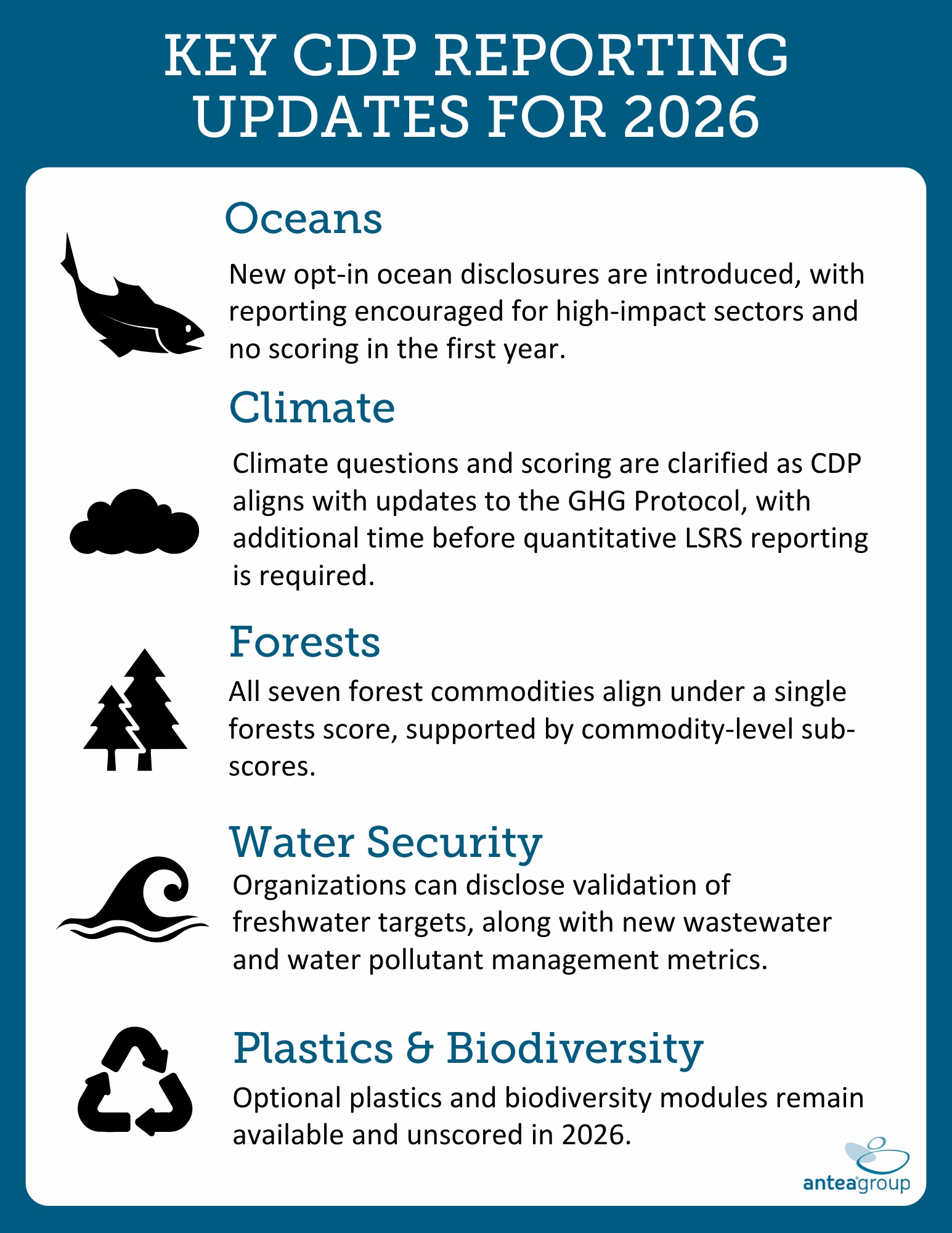
Introduction of ocean-related issues into CDP’s existing framework and modules. While all organizations responding to the full corporate questionnaire will have the ability to opt in, CDP strongly encourages high-impact sectors, such as fishing and aquaculture, shipping, and offshore energy, to disclose ocean-related information. Ocean content in the 2026 questionnaire will not be scored, in line with CDP’s precedent of allowing organizations time to evaluate and prepare for disclosure.

For climate change, CDP is closely monitoring the Greenhouse Gases (GHG) Protocols for updates to their suite of standards and guidance materials, and will adjust questions as necessary. In response to the timeline of the GHG Protocol Land Sector and Removals Standard (LSRS), CDP does not expect organizations to report quantitative data in alignment yet, but will instead provide time for organizations to collect data and align in future cycles. CDP’s scoring for climate-related matters will be streamlined and clarified.

Organizations disclosing to the Forests questionnaire will see all seven commodities align, providing a more comprehensive, single score for forests. Commodity sub-scores will be provided to disclosers and data users.

Water security will now allow organizations to disclose validation of their freshwater targets. There will be specific questions regarding the level of wastewater treatment, as well as questions about how water pollutant management is measured for success.

As in past years, plastics and biodiversity modules will be made available for organizations to opt-in but remain unscored.

With the 2025 CDP behind us, now is the time to reflect on the Corporate Questionnaire and evaluate areas for improvement for the 2026 season. Whether you have reported for the past 25 years or are just starting your CDP journey, these actionable tips to help you prepare for the upcoming 2026 cycle.

Preparing for the 2026 Climate Change Disclosure

As climate disclosures continue to evolve, preparing for the 2026 cycle requires organizations to strengthen data, assess climate risks, and define transition pathways. The five steps below break this into practical, actionable actions.

1. Start Early

CDP has shared their commitment to enhancing the reporting experience, including providing clearer guidance materials, as it seeks to strengthen the link between data and action. The 2026 materials are scheduled to be released in late April. With the 2025 scores released, organizations can leverage the existing 2025 disclosure materials, including the Scoring Methodologies, to re-evaluate their most recent submissions. This approach can help reporters assess improvement opportunities and develop a strategy for 2026 and beyond.

Our Advice: Organizations should think of CDP as a strategic exercise, preparing their organization for compliance with current and developing ESG-related disclosures around the world.

2. Strategize Data Collection & Validation

Many global regulations, including California, Canada, United Kingdom, and the European Union, are mandating that greenhouse gas (GHG) inventories be disclosed and undergo assurance. As you prepare for CDP, think strategically about your data collection process. CDP is a great tool to help organizations gather information and understand the level of effort required from a voluntary perspective—before it becomes mandatory. The same can be said about water, forest, and biodiversity data, if applicable.

Our Advice: Begin by mapping where your emissions and environmental data lives across the organization and who owns it. While many organizations can readily calculate Scope 1 and 2 emissions, Scope 3 often presents the greatest challenge due to data gaps, supplier engagement, and methodological complexity. Use the GHG Protocols to define boundaries and prioritize material Scope 3 categories, focusing first on those most relevant to your business.

For water, forest, and biodiversity data, engage procurement and site teams early to support consistent data collection, particularly where monitoring is limited or information is needed from tier-one suppliers and beyond.

3. Conduct a Climate Risk Assessment and Scenario Analysis

Conduct a climate risk assessment and scenario analysis to help evaluate how current and potential future climate-related events could affect your business. By understanding these climate-related physical and transition risks, organizations can also uncover new opportunities as they build a more resilient organization. Scenario analysis is also an expectation for the European Union (EU) Corporate Sustainability Reporting Directive (CSRD) and the International Financial Reporting Standards Sustainability Disclosure Standard S2, and is helpful for completing a TCFD report.

Our Advice: Undergoing complete scenario analyses and establishing business continuity plans enables organizations to mitigate risks associated with droughts, wildfires, floods, and beyond. It also future-proofs organizations by planning for long-term resiliency.

4. Set Environmental Targets

Setting meaningful targets—especially those aligned with Science Based Targets initiative (SBTi) for climate, the United Nation’s Sustainable Development Goal 6 for access to safe water, sanitation, and hygiene, or the —can lead to cost savings through more resource-efficient programs and strengthen brand reputation, in addition to meeting any applicable regulatory requirements or contractual obligations. Setting goals is also a requirement for achieving high marks across all three themes of CDP.

Our Advice: Leverage the right framework(s) to inform your goals, as both a best practice and starting point. While SBTi provides an excellent framework for many organizations, it may not be right for every organization or industry. Be sure to also evaluate what contractual obligations you may be facing and if you have any regulatory requirements that may also influence your target-setting process.

5. Establish a Climate Transition Plan

It is not enough to simply have a goal; organizations need to have a clear, actionable plan to help them achieve these aspirations. Whether it is through the purchase of renewable energy, installation of more efficient equipment, or innovations that are yet to be seen, these actions can require significant financial investments. CDP rewards organizations that disclose climate transition plans and increase their use of renewable energies.

Our Advice: Plan a clear pathway to actively reduce your carbon footprint. It sends a strong signal to your stakeholders that you are committed to achieving the goal, unlocking potential access to finances, enhancing your brand reputation, and fostering innovation. Transition plans also represent an essential scoring criteria and are an important component of regulations such as the EU’s CSRD.

Need help? Antea Group USA is proud to be an Accredited Solutions Provider with CDP, providing responding organizations with full-service support disclosing to CDP.

Visit our website to learn more about our Sustainability Services that can help you prepare your GHG emissions inventory, set targets, conduct climate scenario analysis, and more.

Posted in UncategorizedTagged

Why Minerals Matter in Today’s Roofing Systems

Every roof is exposed to many different stresses with different impacts. The ability of roofing materials to withstand the effects of sunlight, temperature swings, and wind and rain depends not only on design and installation but on the minerals built into the system. In modern roofing construction materials, fillers and aggregates play a central role in durability, stability and long-term performance.

Minerals such as silica sand quietly support many of the roofing products used today, improving resistance to ultraviolet radiation, adding weight for wind performance and supporting adhesion during manufacturing and installation. Understanding how these materials function helps explain why consistency and quality control are so critical in building materials and roofing applications.

Minerals: The Hidden Strength in Modern Shingles

Asphalt shingles remain the most widely used roofing material in North America, covering about 80 percent of residential roofs, according to the Asphalt Roofing Manufacturers Association (ARMA). Their popularity reflects a balance of affordability and durability, supported by mineral components that drive performance. Each asphalt shingle consists of a fiberglass mat coated with asphalt and surfaced with mineral granules. These granules, commonly made from high-quality silica sand, are embedded into the asphalt during manufacturing and serve several essential functions.

  • UV Protection
    Mineral granules shield asphalt from direct ultraviolet exposure. Without this protective layer, UV radiation would accelerate asphalt oxidation, leading to brittleness and cracking. Opaque, coated mineral granules absorb and reflect UV light, significantly slowing weathering and extending shingle service life.
     
  • Durability and Weather Resistance
    The hardness of silica-based granules improves resistance to hail, wind-driven debris and surface abrasion. Granules also contribute to fire resistance by forming a noncombustible outer layer. Quartz, one of the hardest naturally occurring minerals, provides the structural integrity needed to withstand these conditions without degrading over time.
     
  • Weight and Wind Performance
    Mineral content adds significant weight to each shingle, improving resistance to wind uplift and movement. Mineral granules can account for more than one-third of an asphalt shingle’s total weight, a critical factor in helping shingles remain securely in place during high-wind events. Added mass supports stability, impact resistance and long-term roof integrity.
     
  • Adhesion and Handling
    Granules must bond securely to the asphalt coating to perform their protective role. Uniform particle size and clean surfaces help ensure consistent adhesion during production. Fine mineral sands are also applied to the back of shingles to prevent them from sticking together in packaging, improving handling and installation efficiency. Inside the asphalt coating itself, mineral fillers contribute to internal strength and cohesion, supporting both manufacturing consistency and field performance.

Beyond Shingles: Minerals Across Roofing Systems

In addition to asphalt shingles, minerals support performance across a wide range of roofing construction materials.

  • Ceramic and clay tiles rely on silica sand to maintain shape and strength during firing. Silica’s thermal stability helps tiles resist cracking and deformation at high temperatures.
  • Built-up roofing systems use sand or gravel as a protective top layer, shielding underlying bitumen from UV exposure while adding mass and durability. In some formulations, finely ground silica improves reflectivity and surface performance.
  • Roofing sealants and mastics incorporate mineral fillers to control viscosity, enhance adhesion, and improve cured strength, ensuring reliable sealing under environmental stress.

Across all these applications, the quality and consistency of the mineral inputs directly affect performance, appearance and service life.

Consistency in Roofing Materials

Because mineral performance depends on purity and particle size, roofing manufacturers require materials that meet tight specifications. Variations in grading, moisture or chemistry can lead to surface defects, adhesion issues or inconsistent appearance.

Covia supplies roofing-grade silica materials processed under rigorous quality control programs to ensure predictable performance batch after batch. High-purity quartz minimizes unwanted chemical interactions while controlled sizing supports uniform coverage and adhesion in roofing applications.

Covia’s products enhance durability and reduce failures, which directly supports sustainability by extending service life and minimizing waste.

Sustainability Through Smarter Materials

Sustainability in roofing materials also depends on how efficiently materials are manufactured and how safely they are handled throughout production. High-quality mineral fillers support sustainability by enabling tighter process control and minimizing material waste.

Worker safety is a critical part of responsible manufacturing. GRANUSIL® DST®, Covia’s dust-suppressed silica sand, is designed to significantly reduce airborne dust during handling and processing. By minimizing respirable silica exposure, GRANUSIL DST supports safer manufacturing environments while maintaining the performance characteristics required for roofing applications.

Consistent, high-purity minerals also help manufacturers avoid formulation variability that can lead to rejected batches or premature material failure. By supplying reliable materials that support durability and predictable performance, Covia helps extend service life and reduce waste across the roofing product lifecycle.

Covia’s Mineral Solutions for Roofing Applications

Covia supports modern roofing systems with mineral products engineered for performance, consistency and safety:

  • GRANUSIL High Performance Industrial Silica: High-purity silica sand used in roofing granules and backsurfacing applications, delivering UV resistance, durability and consistent appearance.
  • GRANUSIL DST: Dust-suppressed GRANUSIL that enhances worker safety and operational efficiency during shingle manufacturing.
  • IMSIL® Microcrystalline Silica: Finely ground silica used as a functional filler to improve UV resistance, thermal stability and formulation control in select roofing materials.

Each product is backed by Covia’s nationwide supply network and quality-assurance programs, helping roofing manufacturers maintain consistent output and meet demanding specifications.

A Trusted Partner Behind Roofing Performance

Minerals play a critical role in the performance of modern roofing materials and a wide range of building products. By enhancing UV resistance, adding weight and stability and supporting adhesion and durability, silica-based fillers and aggregates help roofing systems stand up to long-term environmental exposure.

Covia delivers these minerals with the consistency, quality control and safety focus roofing manufacturers rely on. Backed by technical expertise, responsive collaboration and a dependable supply network, products like GRANUSIL, IMSIL, and GRANUSIL DST support reliable production and durable roofing systems for residential and commercial buildings across North America.

Click here to read this article on CoviaCorp.com 

Contact us to learn more.

Posted in UncategorizedTagged

Leidos Helps Utilities and Developers Tackle AI Data Centers' Power Demands

Three Points to Remember 

  1. AI data centers are straining the power grid, and major system upgrades are needed to handle their significant and variable energy demands.
  2. Leidos helps utilities and data center developers integrate energy systems using the existing grid combined with on-site power generation and energy storage.
  3. Leidos is developing AI-powered tools for grid planning and power system optimization.

The nation’s power grid needs modernization to meet rapidly growing energy demands from an AI-powered society. As more hyperscale data centers come online to serve AI computing needs, these massive installations could consume as much as 12% of all U.S. electricity within a few years, according to the Dept. of Energy’s Berkeley Lab.

AI data centers will further stress the aging infrastructure that carries, distributes and delivers electricity, which is already under strain from factors like electrification-driven load growth and weather-related heating and cooling demands.

“The power grid is an amazing thing but has been very slow, big and complicated to build, and we don’t have enough people and time to get where we need to be,” said Josh Wepman, VP and CTO of energy, infrastructure and automation at Leidos. “We need a radically more effective way of designing and scaling the future power grid.”

The power industry is grappling with a shortfall of engineers. Through AI-powered solutions, Leidos supports utilities and system owners across the country by automating much of the daily and labor-intensive tasks of power engineering design. The master planning work to create a higher-capacity grid, Wepman said, is also well-suited for intelligent automation and human-AI collaboration. 

Grid operators could benefit from AI modeling and simulation that helps optimize infrastructure as the power dynamics of entire regions change with new data centers. AI-powered tools can help planners for large-scale energy development projects reach design and engineering decisions much more quickly and adapt as AI strategies evolve.  

“Getting AI data centers online has become an arms race. It’s a matter of importance both commercially and for national security.”

Josh Wepman
Leidos VP and CTO of energy, infrastructure and automation

AI data centers intensify the paradigm shift in power planning

Load growth from data centers is putting significant pressure on transmission and substation infrastructure.

Substations act as large electrical transformers, receiving electricity from long-distance transmission lines and stepping down the voltage for local lines that deliver the power. Because of their enormous and continuous power demands, hyperscale data centers require mega-sized substations, and many developers are working with utilities to build ones located on site. 

“There are very few 1-gigawatt-plus substations in the power grid,” Wepman noted. One gigawatt, equaling 1,000 megawatts, is approximately half the power generated by the Hoover Dam.

“Getting AI data centers online has become an international arms race,” he added. “It’s a matter of importance both commercially and for national security, and developers are in a ludicrous-speed hurry.” 

Market analysts put the volume of U.S. hyperscale data centers at above 600, and the typical installation requires 100 to 150 megawatts of peak power. But their number and size are expected to rise quickly with the proliferation of AI computing.

Match game: bridging capacity and load differences

At these installations, the power-dense, high-intensity hardware for performing AI computations and the advanced cooling systems for managing heat require immense around-the-clock power.

Data center developers are making sure that installations have the power capacity to run nonstop by adding on-site energy production and storage atop the utility-provided baseload power. These co-generation schemes have as much to do with having contingency power in case of outages as supplementing the grid supply during peak periods.

More and more, Leidos provides power systems engineering support for co-generation at data centers. The company works with project partners to plan and integrate on-site power solutions, which are typically natural-gas-fired powerplants and lithium-ion battery energy storage systems.

“Hyperscalers are attempting to develop data centers faster than traditional utility project cycles,” said Chris Houle, VP of power delivery solutions in Leidos’ Commercial and International Sector. While developers work with utilities on long-term upgrades, “they have to decide how to make up for the energy they need in the short term,” he said.

In some cases, that deficit can be significant. And with AI data centers, the swings in computational demand, and therefore energy needs, can be massive. 

AI workloads, particularly those for training or running deep learning models, can quickly change by hundreds of megawatts due to GPU processing demands. Together with usage volumes that can also vary greatly, this presents new challenges in power system operations. 

“Data centers change how we think about power systems. These are mega-projects that the U.S. hasn’t done in a long time.”

Chris Houle
Leidos VP of power delivery solutions

Managing much larger and more frequent load fluctuations has also become an important aspect of Leidos’ power engineering work. Leidos is developing solutions to handle energy densities that are orders of magnitude greater than those of typical commercial office buildings. 

Akin to a car’s suspension going over a road full of potholes and bumps, Leidos engineers integrate advanced load management to keep the power supply stable during wider-ranging load variances, using battery energy storage systems and other devices to absorb and release energy to compensate.

“The load ramps and reductions are anticipated to be faster and more frequent than traditional large loads served by the grid,” Houle noted. “These data centers change how we think about power systems. Even a 10% demand swing at a gigawatt data center is 100 megawatts of load change.”

Micro to macro support for power industry partners

By working in tandem with the utility supply, the “behind-the-meter” generation and storage at data centers form, in effect, private microgrids powerful enough to sustain small cities.

“These are the largest microgrids the industry has ever had to build,” Wepman said. “The developers’ value proposition to their customers is to keep the ginormous power farms going and serving the need. No developer wants a $5 billion data center that keeps tripping offline.”

“These are mega-projects that the U.S. hasn’t done in a long time,” Houle added. He noted that on some projects, Leidos is “working from tip to tail” with utilities, developers and construction companies on master planning, owner’s engineering and site execution. 

Both he and Wepman noted that the company has introduced generative AI-powered tools to projects and is working on more advanced AI to help partners optimize power distribution and plan transmission systems faster and more effectively. 

They hinted that the AI being developed and trained will accelerate analytical capabilities and problem-solving of complex and capital-intensive power projects. The technologies will strengthen Leidos’s collaboration with industry partners in grid planning and development. 

“The grid will undergo its biggest transformation since the time it was built, and AI technologies are letting humans rise to the challenge,” Wepman noted. 

“It’s a challenge that’s moving fast,” Houle remarked. 

MORE ON LEIDOS’ POWER DELIVERY SOLUTIONS

Posted in UncategorizedTagged

Wk Kellogg Co Partners With Mayors Alliance and No Kid Hungry To Fight Childhood Hunger

BATTLE CREEK, Mich., January 28, 2026 /3BL/ – WK Kellogg Co is proud to announce its new partnership with the Mayors Alliance to End Childhood Hunger, a nonpartisan coalition working in collaboration with Share Our Strength’s No Kid Hungry campaign. The Mayors Alliance to End Childhood Hunger brings together more than 500 mayors from across all 50 states and Washington, D.C., representing a coalition of leaders united in the fight against childhood hunger.

The strategic alliance builds on WK Kellogg Co’s longtime support of No Kid Hungry and underscores the company’s commitment to efforts that increase access to nutritious food for every child. It also aligns with the company’s sustainable business strategy, Feeding Happiness — which aims to make eating well easy, help kids be their best and better our communities.

“WK Kellogg Co has a longstanding commitment to ensuring all kids have the healthy food they need to thrive,” said Stacy Flathau, Chief Corporate Affairs Officer at WK Kellogg Co. “We are honored to support the Mayors Alliance and No Kid Hungry in their mission to empower local leaders, elevate community-driven solutions and create lasting change toward this important cause.”

This partnership will help strengthen the Mayors Alliance’s efforts to expand its membership and amplify the voices of mayors and communities leading innovative efforts to end hunger.

“With the support of WK Kellogg Co, the Mayors Alliance is empowering city leaders to move from intention to action in the fight against childhood hunger,” said Aaron Goldstein, Senior Manager, Local Government Relations at No Kid Hungry. “We know that mayors are on the frontlines of innovation, and this partnership ensures they have the resources, relationships and momentum to end hunger in their communities.”

WK Kellogg Co has a strong connection with the communities represented in the Mayors Alliance, including Lancaster, Pa. and Memphis, Tenn. – two key plant locations for WK Kellogg Co – as well as the company’s hometown of Battle Creek, Mich.

“WK Kellogg Co has long been a vital part of the Battle Creek community, and we’re proud to see their impact reaching far beyond our city,” said Mark Behnke, Mayor of Battle Creek. “The Mayors Alliance to End Childhood Hunger plays a critical role in helping communities like ours work toward a future where no child goes without the food they need to succeed. Supporting kids and families in this way is a shared responsibility, and we’re committed to tackling this together.”

This collaboration reinforces the power of public-private partnerships in addressing childhood hunger, one of the most pressing issues facing America’s youth.

###

ABOUT WK KELLOGG CO 

At WK Kellogg Co, we bring our best to everyone, every day through our trusted foods and brands. Our journey began in 1894, when our founder W.K. Kellogg reimagined the future of food with the creation of Corn Flakes, changing breakfast forever. Our iconic brand portfolio includes Kellogg’s Frosted Flakes®, Rice Krispies®, Froot Loops®, Kashi®, Special K®, Kellogg’s Raisin Bran®, and Bear Naked®. With a presence in the majority of households across North America, our brands play a key role in enhancing the lives of millions of consumers every day, promoting a strong sense of physical, emotional and societal wellbeing. Our beloved brand characters, including Tony the Tiger® and Toucan Sam®, represent our deep connections with the consumers and communities we serve. Through our sustainable business strategy – Feeding HappinessTM – we aim to build healthier and happier futures for families, kids and communities. We are making a positive impact, while creating foods that bring joy and nourishment to consumers. For more information about WK Kellogg Co and Feeding Happiness, visit www.wkkellogg.com.

ABOUT NO KID HUNGRY

No child should go hungry in America. But millions of kids in the United States live with hunger. No Kid Hungry is working to end childhood hunger by helping launch and improve programs that give all kids the healthy food they need to thrive. This is a problem we know how to solve. No Kid Hungry is a campaign of Share Our Strength, an organization committed to ending hunger and poverty.

Posted in UncategorizedTagged

Guiding Stars: Beverage State of Affairs

Originally published on Guiding Stars Health & Nutrition News

by Allison Stowell

Maybe you’re just two weeks into your Dry January. Or possibly you’re already part of the growing sober curious movement, which saw a 44% increase in 2025. Americans are becoming more aware of the health impacts of alcohol consumption and looking toward non-alcoholic options. We’re not simply drinking less alcohol, we’re seeking beneficial beverages that do more than just hydrate. It’s a growing trend that’s changing the beverage industry.

It’s also affecting consumer health, and to address this impact, Guiding Stars evaluates beverages using a dedicated beverage algorithm. Star ratings in the beverage aisle help consumers embrace drinks lower in natural and added sugar, saturated fat, salt, and artificial colors. At a time when the beverage category includes everything from alternative sodas to functional sips infused with probiotics, adaptogens, and more, this is welcome guidance.

Adaptogen Drinks 

Adaptogens are plant-based ingredients that help your body achieve better balance. They’ve become very popular for reducing stress, creating calm, and managing cortisol levels. And market research shows that they’re likely to become available in more products. Adaptogen-infused beverages, along with other popular options that combine amino acids and herbs that behave like adaptogens, are increasingly popular. When adaptogens are consumed in safe amounts, they’re non-toxic. However, if you’re taking daily medication or under medical care for a chronic condition, talk to your doctor before adding them to your regular routine.

Modern Sodas

Gone are the days when soda was either clear or dark, regular or diet. Today’s soda category includes options that offer probiotics, adaptogens, and more. Given the benefits and popularity of modern sodas, it’s easy to view them all with a health halo. But it’s important not to overlook the drawbacks. For example, in many cases these products will be low-sugar, but not sugar-free, a potential pitfall for diabetics. That said, they’re a welcome alternative to traditional soda. And most are sold in varying can sizes to assist with portion control. Lean on the Guiding Stars beverage algorithm to help you find options higher in vitamins, minerals, and live active cultures, and lower in sugar and other attributes to limit (like artificial colors).

Probiotic & Prebiotic Beverages

You’ve probably noticed that probiotic and prebiotic beverages are increasingly taking over the beverage aisle. Probiotic beverages offer live active cultures, which add more beneficial bacteria to your gut microbiome. Look for probiotic-rich fermented drinks like kombucha, along with many other sparkling options. Include Guiding Stars-earning drinks with prebiotic fiber too. Prebiotic options like Olipop and Poppi, for example, “feed” probiotic bacteria in the gut microbiome, allowing it to flourish. Together, prebiotics and probiotics improve gut health, which means fewer digestive issues and improved immunity.

Mocktails & Non-Alcoholic Beer

The most popular alternatives to alcoholic beverages, particularly in social settings, are mocktails and non-alcoholic beer. Sales of ready-to-drink mocktails are surging as more people look for convenient ways to avoid alcohol. Before making these your “go-to” alternative, however, consider attributes like added sugar, which you’ll find in many popular brands. And as with anything, balance is key. Whenever possible, make your own mocktails with less sugar and fewer calories. Try this Cucumber Lemon Kombucha Mocktail or Tropical Ginger Punch.

About Guiding Stars

Guiding Stars is an objective, evidence-based, nutrition guidance program that evaluates foods and beverages to make nutritious choices simple. Products that meet transparent nutrition criteria earn a 1, 2, or 3 star rating for good, better, and best nutrition. Guiding Stars can be found in more than 2,000 grocery stores and through the Guiding Stars Food Finder app.

Image by Freepik

Posted in UncategorizedTagged

Ontario designates Hydro One to build the Greenstone Transmission Line

To be developed in partnership with First Nations, this priority investment is a foundational link to expand the electricity system in the province’s far north

TORONTO, Jan. 28, 2026 /PRNewswire/ – Today, the Honourable Stephen Lecce, Minister of Energy and Mines directed the Ontario Energy Board to designate Hydro One Networks Inc. (Hydro One) to develop and construct a new priority transmission line in the Greenstone region. Once complete, the Greenstone Transmission Line will provide additional capacity to the area and improve reliability for northern communities. The line is also expected to drive economic development and support Indigenous community growth.

The proposed project is a single-circuit 230-kilovolt (kV) transmission line, designed to support a future second circuit and will be connected to the existing 230-kV infrastructure (the East-West Tie) near Nipigon Bay. The line will extend to Longlac Transformer Station where a new 230-kV station will connect to the existing 115-kV circuit and continue to or near Aroland First Nation, terminating at a new 230-kV switching station with associated station facilities. The line is expected to be in-service in 2032.

Through Hydro One’s industry-leading First Nation 50-50 Equity Partnership Model, proximate First Nations will have the opportunity to invest in a 50 per cent equity stake in the transmission line component of the project. Together, Hydro One and the proximate First Nations will collaborate on the planning, development and construction of the transmission line.

Quotes

“The designation of this line is the result of three years of collaboration between First Nations, Hydro One and Ontario. We are grateful to have been selected as a partner of choice by the First Nations who advocated for the line, and look forward to developing this project together,” said David Lebeter, President and CEO, Hydro One. “This line is foundational to building a secure and reliable electricity system in the north—one that supports every community in the region. In the process of building it, we’re also strengthening local economic prosperity by partnering with First Nations and sourcing goods and services from Canadian, Ontario and Indigenous suppliers.”

“Last year, our government took action to bolster our self-reliance by reducing the permitting timelines by 50 per cent to build mines faster, along with a new processing fund to end the ripping and shipping of our resources abroad,” said the Hon. Stephen Lecce, Minister of Energy and Mines. “We are putting Canada first by accelerating a plan to create 20,000 jobs. With President Trump’s economic assault on our country, Ontario is officially giving the greenlight to build the Greenstone Transmission Line, delivering the energy backbone and infrastructure to unlock the Ring of Fire’s vast mineral potential. Ontario has what the world needs as a reliable and stable democratic partner, and that is why we are unlocking one of the largest undeveloped, high-grade deposits of critical minerals on earth.”

“The Ontario Government’s designation of the Greenstone Transmission Line marks a historic and transformative milestone for our region. This project will not only enable First Nations to secure meaningful equity ownership in major Canadian infrastructure, but it will also deliver reliable power to the seven communities that have long faced chronic service disruptions with extended outages,” said Chief Allan Odawa Jr., Red Rock Indian Band. “We extend our appreciation to our First Nation partners for their continued leadership and collaboration throughout this process. We also acknowledge Hydro One for their outstanding commitment and hard work in advancing this project. Finally, I would like to thank everyone from Red Rock Indian Band that worked on this project and took a concept and made it a reality.”

“We are very proud to work with our fellow communities to develop the Greenstone Transmission Line,” said Chief Sonny Gagnon, Aroland First Nation. “Our community and the communities we are working with have been plagued by unreliable and inadequate energy resources for our region limiting growth and opportunities. This will create more reliable energy for our membership and eventually to the communities to the north.”

“The Greenstone Transmission Line will bring much-needed infrastructure improvements to the region. As my community continues to develop, we will benefit from improved electricity reliability and increased capacity to support future growth and economic opportunities,” said Chief Yvette Metansinine, Animbiigoo Zaagi’igan Anishinaabek. “Our partnership with Hydro One will be a meaningful step towards economic reconciliation — helping us create generational wealth while building the electrical infrastructure our community and local economy need to thrive.”

“This new transmission line will provide us with the necessary power to continue building our community but also provide the capacity to enable critical mining and energy projects to further develop the Greenstone region,” said Chief Paul Gladu, Bingwi Neyaashi Anishinaabek. “We are thrilled to be working jointly in partnership with our neighbouring First Nations on the development of this critical transmission project.”

“Biinjitiwaabik Zaaging Anishinabek/Rocky Bay First Nation proudly announces an inspiring milestone we have achieved as we officially announce a partnership between Hydro One and six other First Nations in our area,” said Chief Gladys Thompson, Biinjitiwaabik Zaaging Anishinabek. “This collaboration stands as a testament to the power of unity, respect and shared vision. By working together, we can ensure access to reliable energy, create meaningful employment opportunities and support local infrastructure initiatives that foster prosperity for all. Our initiatives will prioritize training, skills development and capacity-building, ensuring that community members participate fully in these exciting new endeavours. This partnership is a real step towards reconciliation. By recognizing and respecting the rights and voices of First Nations communities, we are demonstrating that progress is best achieved when we walk the path together. We are grateful for the trust extended to us and look forward to deepening relationships, understanding and collaboration in the years ahead.”

“Opportunities like investment and oversight in the Greenstone Transmission Line honour the spirit and intent of the Treaty Relationship. It’s heartening to see our communities start to become equal partners,” said Chief Sheri Taylor, Ginoogaming First Nation. “First Nations are looking toward a bright future of more frequent collaboration in our many shared interests. In order for us to exercise our sovereignty, we must have own-source funding for independence. Economic development opportunities are integral to our community’s development, and equity investments are a path forward to resolving our challenges today. There’s still a lot of work to do. This is just one project, and just a start – there’s more to come. We’re willing to do our share of the work.”

“Long Lake #58 First Nation is pleased to be part of building the foundation for greater economic prosperity for our community and the region,” said Chief Judy Desmoulin, Long Lake #58 First Nation. “By partnering in the development of this transmission line and securing ownership in the asset, we are strengthening our role as stewards of the land while creating meaningful opportunities for our people. This project reflects our commitment to self–determination, long–term economic growth, and collaborative relationships that respect our rights, our vision and our future generations.”

Hydro One Limited (TSX: H)
Hydro One Limited, through its wholly-owned subsidiaries, is Ontario’s largest electricity transmission and distribution provider with 1.5 million valued customers, $36.7 billion in assets as at December 31, 2024, and annual revenues in 2024 of $8.5 billion.

Our team of 10,100 skilled and dedicated employees proudly build and maintain a safe and reliable electricity system which is essential to supporting strong and successful communities. In 2024, Hydro One invested $3.1 billion in its transmission and distribution networks, and supported the economy through buying $2.9 billion of goods and services.

We are committed to the communities where we live and work through community investment, sustainability and diversity initiatives.  

Hydro One Limited’s common shares are listed on the TSX and certain of Hydro One Inc.’s medium term notes are listed on the NYSE. Additional information can be accessed at www.hydroone.comwww.sedarplus.com or www.sec.gov.

For More Information

For more information about everything Hydro One, please visit www.hydroone.com where you can find additional information including links to securities filings, historical financial reports, and information about the Company’s governance practices, corporate social responsibility, customer solutions, and further information about its business.

Forward-looking statements and information:
This press release may contain “forward-looking information” within the meaning of applicable Canadian securities laws and “forward-looking statements” within the meaning of applicable U.S. securities laws (collectively, “forward-looking information”). Statements containing forward-looking information are made pursuant to the “safe harbour” provisions of applicable Canadian and U.S. securities laws. Words such as “expect”, “anticipate”, “intend”, “attempt”, “may”, “plan”, “will”, “can”, “believe”, “seek”, “estimate”, and variations of such words and similar expressions are intended to identify such forward-looking information. These statements are not guarantees of future performance or actions and involve assumptions and risks and uncertainties that are difficult to predict. Therefore, actual outcomes and results may differ materially from what is expressed, implied or forecasted in such forward-looking information. Some of the factors that could cause actual results or outcomes to differ materially from the results expressed, implied or forecasted by such forward-looking information, including some of the assumptions used in making such statements, are discussed more fully in Hydro One’s filings with the securities regulatory authorities in Canada, which are available on SEDAR+ at www.sedarplus.com. Hydro One does not intend, and it disclaims any obligation, to update any forward-looking information, except as required by law.

Our website is www.HydroOne.com. Follow us on facebook.com/HydroOneOfficial, twitter.com/HydroOne and instagram.com/HydroOneOfficial.

Cision View original content to download multimedia:https://www.prnewswire.com/news-releases/ontario-designates-hydro-one-to-build-the-greenstone-transmission-line-302672743.html

SOURCE Hydro One Limited

New Report Finds Apparel Decarbonization Progress Off-Track

AMSTERDAM and HONG KONG and OAKLAND, Calif., January 28, 2026 /3BL/ – Cascale today released the State of the Industry 2026: Decarbonization Progress in the Apparel, Footwear & Textiles Industry report, finding the sector is not decarbonizing at the pace or scale required to meet global climate targets. The report analyzes verified 2023 and 2024 energy data from the Higg Facility Environmental Module (Higg FEM), with a focus on Tier 1 finished product manufacturing and Tier 2 material manufacturing. Using Cascale’s new Effective Energy Carbon Intensity (EECI) metric, the analysis assesses how effectively the industry is decarbonizing energy use, which remains the dominant source of Scope 1 and 2 emissions.

“This report makes clear that there are no shortcuts to decarbonization,” said Jeremy Lardeau, Senior Vice President, Higg Index at Cascale. “Real progress depends on true value chain collaboration, not sourcing shifts by the brands. The level of investment required to achieve the deep decarbonization measures at facility level means brands will have to step up in a meaningful way. The climate agenda must be seen as an imperative to change the legacy sourcing dynamics of this industry.”

Key Findings

  • Overall decarbonization progress remains slow. Verified facility data shows only marginal improvement in EECI performance over time, far below what is required to meet climate targets.
  • Coal use remains a critical barrier to progress. Coal accounts for 31 percent of total industry energy consumption, remaining unchanged year-over-year. In Tier 2, coal represents the largest fuel source, accounting for 40 percent of the global energy mix.
  • Renewable energy adoption remains limited and flat. Renewables account for only two percent of total industry energy consumption, unchanged between 2023 and 2024, despite more facilities reporting some renewable energy use.
  • Emissions are highly concentrated. A relatively small number of large, energy-intensive facilities drive a disproportionate share of emissions, indicating that targeted interventions could accelerate progress more effectively than uniform approaches. Cascale encourages brands and suppliers to engage with the Manufacturer Climate Action Program (MCAP), providing manufacturers with a structured pathway to measure emissions, set science-aligned targets (SATs), and implement reductions.

The findings align with broader global assessments, including recent analysis from the United Nations Environment Programme, which underscores that current policies remain insufficient to limit warming to 1.5°C.

Cascale’s report cautions against relocating production based on country averages and emphasizes long-term, collaborative engagement with manufacturers, particularly in Tier 2; to achieve this, supply chain engagement is essential. On March 4 , Cascale will host a member-only webinar that includes a deep dive into the report and a discussion on how EECI can be used by organizations to analyze their supply chains; Cascale members can register here.

Cascale will publish this State of the Industry report annually to track progress and support collective action. The organization will continue expanding access to data and analytics for members and advancing programs such as the Manufacturer Climate Action Program to support science-aligned targets and measurable emissions reductions.

ABOUT CASCALE

Cascale is the global nonprofit alliance empowering collaboration to drive equitable and restorative business practices in the consumer goods industry. Formerly known as the Sustainable Apparel Coalition, Cascale owns and develops the Higg Index, which is exclusively available on Worldly, the most comprehensive sustainability data and insights platform. Cascale unites over 300 retailers, brands, manufacturers, governments, academics, and NGO/nonprofit affiliates around the globe through one singular vision: To catalyze impact at scale and give back more than we take to the planet and its people.

LinkedIn | Instagram | Facebook | YouTube

Posted in UncategorizedTagged